Art Mart

20190106_120410

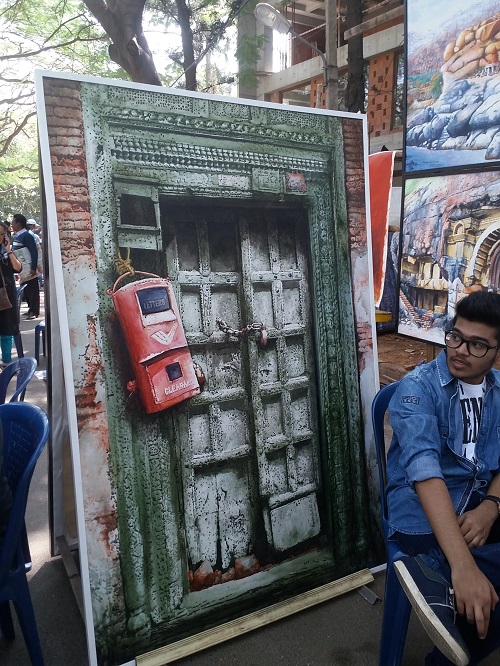
A dramatic 6’x4’ acrylic on canvas by Mahadeva Shetty

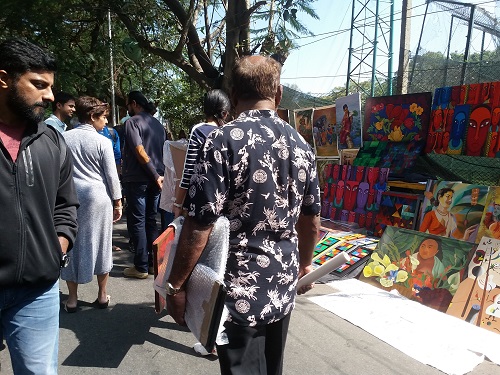
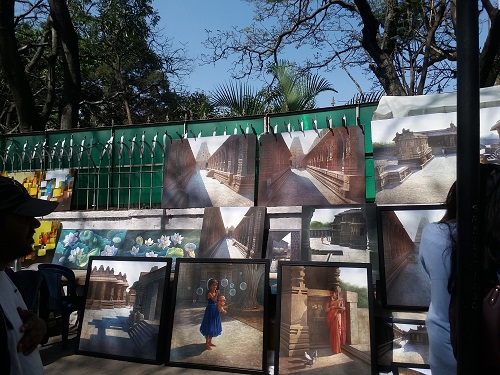
The first Sunday of January is marked down in every Bangalorean’s calendar as Chitra Santhe Day, the day when the busy Kumara Krupa Road is taken over by artists exhibiting and selling their works.

20190106_111151The Sunday just gone by was the 16th edition of the Chitra Santhe. About 1500 artists from 16 states of India were there, and 400,000 people visited!

As a regular visitor to the Santhe, it is something I look forward to. More than the art even, the festive atmosphere, people taking the time to look at paintings and talk about them, mothers and fathers discussing art with their children….

20190106_113620

Grateful to the organizers and the city for this opportunity. And since it is about art, less words and some pics this time!

–Meena

Dear Sir,

In school, one of the standard writing exercises in our language classes was to write a letter to the editor of a newspaper. We were encouraged to think about issues—from local to global—and express our considered opinion on the same in the letter. It was also an exercise in the proper form of address, the clear enunciation of views, and discipline of expressing what we had to say in limited words.

It was not only the writing, but also the reading of letters to editors in newspapers that was an integral part of the morning newspaper reading ritual. Over the years, it was comforting to know that the right hand column on the middle page of my newspaper would carry the day’s letters. Over time, one became familiar with some of the ‘regular’ writers, and were amused, appalled, or in silent agreement with the views expressed.

In recent times this part of the daily newspaper has been disappearing in many papers. In the age of social media, people express their views instantly, in the required number of characters. The almost knee-jerk reaction to happenings invokes an equally instant avalanche of responses. And, then, a new day begins with a fresh news-storm as it were.

Long before all this, it was a tradition of newspapers around the world to carry their readers’ opinions, thoughts, questions, and outrage on the news of the day.  What is it that motivates people to write these letters? Letter writers do not receive material compensation for their efforts, but do enjoy rewards such as publicity, or satisfaction from directly or indirectly influencing public discourse. And most newspapers still honour and respect this sharing from their readers by giving them the space to be seen and heard.

Newspapers like the New York Times and the Washington Post receive thousands of letters to the editor  every year. Letter writers respond to news articles and opinions, and often take the newspaper to task for how it operates.  At the end of the year the Washington Post puts up on its website a selection of the novel, thoughtful and funny insights that readers submitted that year, sorted by the date they appeared in print and subject matter.

Other newspapers are also encouraging of the art of writing to newspapers. As the  associate editor of an Irish newspaper puts it, “In a world where social commentary is now almost free of any kind of professional oversight — or curating, to use today’s vernacular — the letters columns of mature, honest newspapers are, as they ever were, a reliable weather vane of how a society feels on certain issues. They are a kind of a social pulse giving an insight into the health–in the broadest terms–of the nation. They are direct, from-the-heart commentary.”

The power of “Dear Sir”…is evident in the case of the letter to the Times from a seven-year old girl from the Isle of Man. It read ‘Sir, Yours faithfully, Caroline Sophia Kerenhappuch Parkes.’ The brief epistle was intended to inform readers of her unusual name Kerenhappuch which had been mentioned in a letter the previous week on the subject of uncommon 19th century names.

I for one do look forward to seeing the column back in all newspapers.

–Mamata


Reach for the Rani Muthu!

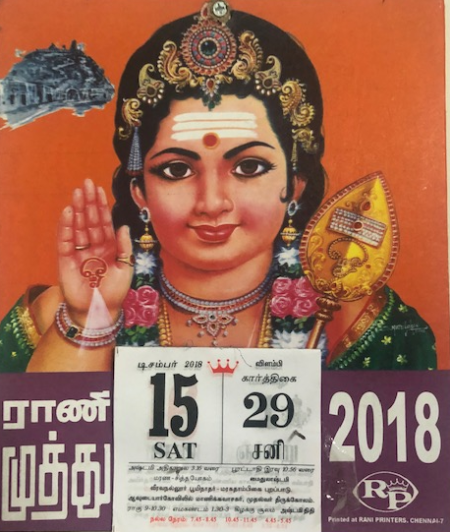
I am sure ‘Rani Muthu’ means nothing to anyone except Tamilians. But to them, it means a lot! Rani Muthu is a daily tear-away calendar, without which no Mami can operate!

blog picIt is amazing how much information a page of approx. 2.5 inches square can pack. Not only does it give the ‘English month, date’ and day, but equally boldly, the Tamil day, date and month. This is just the start. Other information includes:

  • Rahu kalam: This is the period of Rahu— a certain period of time every day that is considered inauspicious for any new venture.(Of course, self-respecting Tams don’t need to consult an almanac for this, they know it offhand. For the next tier of not-so-well informed, there are mnemonics like Mother SaFather Wearing ThTurban Suddenly. Too complex to explain to the uninitiated, but a breeze for the savvy ones)


  • Yama gandam: Yamagandam means death time. Only death ceremonies are performed during Yamagandam. Any activity commenced during this time invites the ‘death’ of the work or energies relating to that work. So activities during Yamagandam leads to a failure or destruction of the end-result.

But it is not all gloom and doom. The page will also give you:

  • Nalla nayram: Good time to start anything.
  • Festivals falling on the date (local, regional, national, pan-religious included).
  • Phases of the moon
  • Whether the day is auspicious for house-warmings, and other sundry celebrations.

Last but not the least. Quirky little illustrations enliven the pages. You have to look closely to figure them out, but it is worth it.

The size and the colour illustration on the main card board have remained unchanged for as long as I can remember (and that is pretty long!). A very benevolent pic of the God-child Subramanian is a pleasant sight to look at first thing in the morning.

Sadly, I could find no reference to the history of the Rani Muthu. And, as journalists say, e-mail to the concerned did not get any response till time of publication. A senior uncle says it goes back at least to the ‘50s.

Rani Muthu is a Tamil household essential. Many regions and states in India have their own calendar-almanacs, which are as basic to a home as a threshold.

What would life be without Rani Muthu!

–Meena

Scrambling to buy a Rani Muthu by Jan 1 was one of my year-end tasks. Alas, with the passing of my mother, this is one more ritual that I will no longer undertake.

Chronicling the Years

Many years ago, I visited a Native American Museum. There I saw a long scroll, with a series of pictures. Though they were all done in the same style, and at first glance looked like one piece, but upon looking closely, they seemed to be several pieces, done at different times and by different hands.

We were told that these scrolls were living history books. Some of the tribes used this technique to document their life and times. The tribe/community would sit together at the end of each year, and collectively decide on what was the most significant event that had taken place that year. The event could be anything—from an epidemic, to a victory over another tribe, to a bear attack on one of the members.  And they would then add it on to the scroll. And so it went on, from year to year, generation to generation.

What a beautiful and democratic way to record history.  Collective decision making. Having to prioritize the ONE important thing. And then recording it in pictures, as a continuum with the previous years! What a chronicle!

We thought we too should put on record what was the important event in our life in the year gone by. For the MM, surely it was the blog!

What did it do for us?

  • Got us back into writing regularly
  • Brought us the discipline of putting out three pieces a week
  • Gave us a platform to muse, to share, to vent and to celebrate.
  • It was an opportunity to learn, research, reflect, and travel down memory lane.
  • Helped us look at things around us differently…exploring and discovering much to write about.
  • Forced us to learn new skills—even getting on to WordPress was major step forward for the tech-shy MMs!
  • Made us more conscious of the power of pictures, above and beyond the power of words.
  • And the greatest gift, brought us new ‘virtual friends’, our readers!

So thank you from the Millennial Matriarchs, to each one of you—the regular readers, the occasional readers, the one-time readers, and the readers-to-be!

We wish you a Happy, Healthy, Enriching and Satisfying 2019!

–MM

Time Passages

“It was late in December…
I felt the beat of my mind go
Drifting into time passages
Years go falling in the fading light
Time passages
The years run too short and the days too fast…”

Remembering, this morning, the words from Al Stewart, one of my favourite singers in the nineteen eighties, and wondering where the years have flown… As most of us will be doing this week, looking back, and perhaps wishing we had had more of that elusive TIME…here is something to pause and ponder over.

“Without time nothing is possible. Everything requires time. Time is the only permanent and absolute ruler in the universe. But she is a scrupulously fair ruler. She treats every living person exactly alike each day. Time is one great leveller. Everyone has the same amount of time to spend every day.

The next time you feel you haven’t the time to do what you really want to do it may be worthwhile for you to remember that you have as much time as anyone else—twenty-four hours a day. How you spend the twenty-four hours is up to you.” (William J. Reilly)

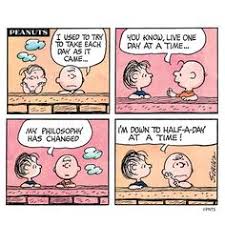
Before we turn the page, and greet a new year with renewed resolutions, remember…

peanuts time.jpg
source: Google

Busy is a decision…you don’t have to find the time to do things—you make the time to do things.

–Mamata


Cleaning up the Abode of Gods

Lessons on Sustainable Tourism: Sudha Priscilla, continues..

Yuksom currently serves as the gateway to many of India’s most beautiful and difficult treks. Recognised as the ancient capital of Sikkim, the town is of historical importance as the first Chogyal (king) of Sikkim was crowned here in 1642 AD.

IMG_20181101_154529On our drive to Yuksom from the airport, I noticed a garbage bag provided in the taxi. This gave us our first insight into their environmentally conscious mind-set. Despite the invasion of visitors, Yuksom has retained an abundance of green spaces and public spaces are all remarkably clean. Every street is equipped with a well-placed litter bin.

Through my travel, I tried to find out more, and here is some of what I learnt. Truly inspiring

In order to thwart degradation of the fragile ecosystem caused by increased tourism, the community formed the Khanchendzonga Conservation Committee in the ‘90s. KCC played an instrumental role in banning the use of firewood previously used for cooking, heating and camp-fires. They also run a garbage management centre that segregates garbage collected on the trekking trails and recycles it.

IMG_20181102_122801The local gram panchayat has also formed an informal association of shopkeepers known as the ‘Bazaar Association’. One of the activities they undertake is sending a family member each week to collect trash from the streets of Yuksom.

During the off-season, members of the Yuksom Tourism Development Committee comprising of stakeholders from the tourism industry, trudge back along various trek routes to collect trash that may have been left behind by travellers. Most of the collected waste is then recycled, thereby reducing pollution.

Additionally, most reputable tour agencies offer clients portable pop-up toilet tents that act as pit latrines. The tent and toilet seat is pitched on a flat surface and placed over a shallow pit with a hump of mud outside. The pit is then used by the client who in turn covers it with mud ensuring that the waste seeps into the ground.  This prevents trekkers from defecating near water bodies.

The town is truly at the helm of the movement promoting sustainable tourism.

ABODE OF GODS

A Christmas Guest Longread from a friend and colleague, Sudha Priscilla . This should get you planning your 2019 Autumn break now!

When G and I met in 2014, we quickly bonded over our passion for the Himalayas. He had just completed the Leh-Ladakh bikers’ circuit on his KTM Duke 390, and I had backpacked across Nepal with a close friend.

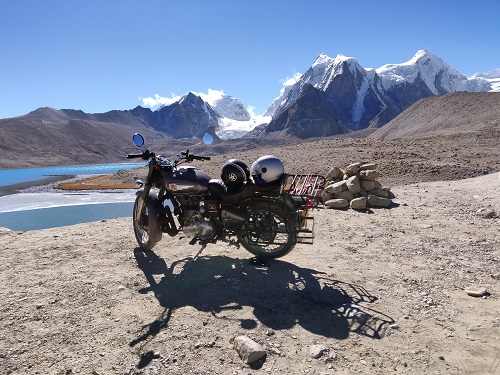
Fast forward to 2018 and we’re now married, having shared many adventures along the way. Most recently we formulated an ambitious plan that included trekking and camping for 8 days in West Sikkim and then exploring East and North Sikkim on an Enfield.

Putting plan into action, we got in touch with Mingma Sherpa, proprietor of ‘Mountain Tours, Treks & Travels’. His family has a rich legacy in the field of mountaineering. His grandfather, Namgyal Sherpa was part of the first successful Everest expedition in 1953 alongside Edmund Hillary and Tenzing Norgay. He was the expedition companion of the then expedition leader, Sir John Hunt. The dynamic duo played a critical role in opening the route towards the summit of Everest.

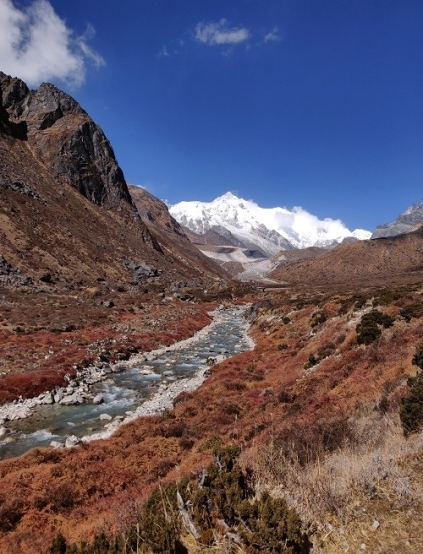
Faced with many options, we zeroed in on the ‘Goechala’ trek. The steep trail allows one to view Mt. Kanchenjunga from up close. Having finalised the itinerary with Mingma, we were left with three months to prepare ourselves mentally and physically for the trek.

We got our first glimpse of the mighty Himalayan range as the flight prepared to land in Bagdogra. At the airport, we met Manzil, a young lad who drove us to Yuksom which serves as the gateway to many of India’s most beautiful and difficult treks.
IMG_20181107_121145

The next day, we met Mingma who was busy planning the return journey, for a client who suffered from Altitude Sickness The client in question was an experienced trekker who has even summited Mt. Kilimanjaro. Unfortunately, he was struck by AMS halfway through the Goechala trek, and had to be carried down the mountain by his team on a stretcher. The oxygen tanks that his team members carried made a huge difference to his life. Once in Yuksom he was rushed to a nearby hospital where his health improved.

This episode left me worried. On observing this, Mingma handed me a strip of ‘Diamox’ tablets, which is commonly used by mountaineers and trekkers a few days before their steep ascent in order to prevent AMS. He also went through the gear we brought along and offered me a down jacket, which was insulated with soft, warm feathers.

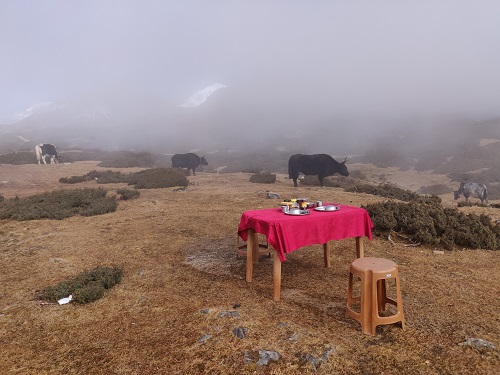
Early next morning, we were introduced to our experienced guide. He was accompanied by a very capable team which included a cook, cook’s helper, porter, Yak herder and 4 beautiful Dzos.  Dzos are a hybrid between yak and domestic cattle, possessing the desirable characteristics of each animal. Our heavier backpacks were mounted on the Dzos along with food supplies and the required logistics. This included a two person A-shape sleeping tent, toilet tent, dining tent, kitchen tent, dining table and sleeping bags.

Before we set off, Mingma presented us with beautiful silk scarves to wish us good luck. We were filled with excitement as we exited Yuksom and entered Kanchenjunga National Park.

Day 1- The first day of the trek was long and arduous. We had to reach Tshoka  13 kms away and perched at approx. 3050 metres. The trail was picturesque but steep. Lunch consisted of a boiled egg, potato slices, juice and chocolate, aimed towards restoring depleted strength. Enroute we met a couple of dejected trekkers who were headed back to Yuksom. They were exasperated at not being able to get a clear view of Mt. Kanchenjunga due to inclement weather.
IMG_20181106_081638

An hour before arriving at Tshoka, Ashok signalled us to remain quiet. We heard what sounded like a bark coming from inside the jungle. ‘Barking Deer’, said a gleaming Ashok. Though tired, this incident propelled us along.

By the time we reached Tshoka, it was around 8 pm. The rest of our team members who reached a few hours earlier, greeted us with a heart-warming dinner consisting of vegetable soup, rice, dal, sabzi, rayosag fry (local type of spinach), papad, ginger tea and a banana.

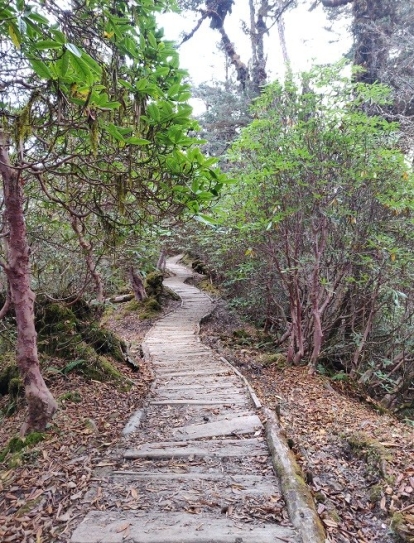
Day 2- We headed out to Phedang (Approx. 3550 metres), only 5 hours away. The trail was laid with pine wood logs, and meandered through Rhododendron forests. During April and May, the trail is apparently set ablaze by colourful Rhododendron blooms. G spent most of the day spotting birds such as the Himalayan Magpie and the Himalayan Eagle through his binoculars.

At the campsite, we were greeted by our team who offered us hot orange juice and pakoda. The treat was laid out neatly on a dining table surrounded by the glorious views of the Himalayas and the Rhododendron forest.

On Day 3-After a hearty breakfast that included muesli, ginger tea, steamed banana and toast with peanut butter, we left for our upward march towards Dzongri. Perched at approx. 4300 metres, it is surrounded by the mighty peaks of the Himalayan range. The landscape changed dramatically from forest trails to open mountain meadows rich in juniper shrubs. The plant is mostly used as incense in Buddhist monasteries, in order to purify the air of any negativities ahead of a puja or arrival of an important guest. We reached our campsite by noon.

Since we were not surrounded by trees, our tents lay exposed to winds that seemed to strengthen as time went by. G and I took a walk around, but we didn’t get too far since oxygen levels were much lower at this point and every step felt tedious. Lunch that day included boiled apples.

The night sky was lit by a million stars, but we were unable to fully enjoy it as temperatures plummeted.

Day 4- It was just about 4:00 am when Ashok woke us. After snacking on ginger tea, biscuits and popcorn, we set off for Dzongri Top. Popcorn also known as ‘Natural Diamox’, is said to increase one’s oxygen capacity. It was a constant snack throughout our trek.

We braved the heavy winds to reach Dzongri top at around 5:30 am, just as the amber sun rays hit the top of Mt. Kanchenjunga and its surrounding peaks such as Mt. Pandim and Mt. Kabru Dome. The magnificent view injected our tired souls with much needed energy. As the winds picked up, we headed down to the valley for yet another breakfast and then headed out to Thangsing.

Situated at 3,930 mtrs, Thangsing is a beautiful valley that can be reached via a short climb to a ridge followed by a rapid steep descent through yet another Rhododendron forest. The highlight of the day was the apple pie that our remarkable cook, Purna, served us for dinner.

Day 5- We took a gentle 3 hour walk to Lamuney (Approx. 4,200 metres) alongside the Prekchu River. The trail goes past stunted rhododendron bushes, azaleas and a Buddhist prayer wall. According to legend, years ago, a trekker of foreign descent was passing through when he ran into a lady. He repeatedly asked her the name of the place, when she answered ‘Lamuney’ meaning ‘Female Monk’. Not knowing English, the monk thought he was asking her name.
IMG_20181109_153517.jpg

This campsite was by far my favourite. It had the best views of Mt. Pandim, Mt. Kanchenjunga, and Mt. Tenchenkhang.

Day 6- The ever conscientious Ashok woke us at 2:45 am. We quickly got ready and met our team members who fed us biscuits, popcorn and loads of ginger tea. Armed with head torches and flashlights, we headed out in the dark to Goechala (Approx. 4,950 mtrs). Temperatures had dipped to -15 degrees, but the down jacket coupled with a shawl made of yak wool kept me warm. We trudged upward along the moraine path by the side of Samiti Lake to view the East face of Mt. Kanchenjunga. Towering at 8586 metres, the sunrays hit Mt. Kanchenjunga peak first, and slowly spread across the peaks of Kobru, Tenchenkhang, Pandim, Jupono and Rathong. We munched on popcorn and drank hot chai as this scene played out before us.

Ashok explained to us that as a gesture of respect for the religious sensitivities of the local people who regard the mountain as a deity, the Indian govt. banned expeditions to Kanchenjunga and seven others sacred peaks surrounding it.

Trekkers were earlier allowed to proceed to a second viewpoint, which now remains closed due to sightings of the elusive snow leopard. After basking in the sun for an hour, we headed back to Lamuney for breakfast. On our way down, Ashok pointed out towards the upward ridge, where we could see the silhouette of a Bharal, commonly known as the Himalayan Blue Sheep.

After yet another hearty breakfast, we headed down to Kockchurung campsite (Approx. 3700 metres). We slept at the trekker’s hut that night instead of pitching our tents by the riverside. Purna managed to make us pizza for dinner, which he aptly christened ‘Mountain Pizza’.

Day 7- We headed back to Tshoka, our final campsite. We enjoyed going at a slower pace choosing to spend more time with our team members. Lucky for us, we also stumbled upon a flock of ‘Blood Pheasants’ (the state bird of Sikkim), scurrying through the tree lines.

As it was our final night together, the team surprised us with a steamed cake that said ‘Thank you Visit Again’. This gesture reflected how we were cared for by our team. They were patient, kind, humble, witty and understanding of us throughout the trek.

Day 8- The following day we were escorted back to Yuksom, by a young guide named ‘Buddhist’, as Ashok had to accompany a couple from Canada back to Goechala. His introductory line was ‘My name is Buddhist but I’m a Hindu’. He was a jovial lad, who hoped to visit Goa someday.

The day ended with G and me rushing into the hotel and competing to hit the bathroom first. Our first shower in many days!

The next day we headed to Gangtok and met with Tsewang, owner of ‘Biker’s Hub’. He advised us to rent the Enfield 500 cc for the second leg of our journey.

Over the next few days, we rode to many touristy places such as the high altitude lake of Gurodongmar (Approx. 5180 metres) and zero point situated close to the Indo-China border.

The highlight of our ride was visiting Nathang valley. Located at approx. 4100 metres, the valley is located along the old Silk Route. The Silk Route in Sikkim is an offshoot of an ancient trade route which originated in Lhasa, Tibet and ended in the sea ports of Bengal. Interestingly, horses and tea were the most treasured items traded in this part of the route and not silk.

What was supposed to be a 3 hour ride from Gangtok, ended up being 8 hours due to snowfall and ice covered roads. I spent half of the time walking since it was impossible for G to manoeuvre the slithering roads with a pillion. We stopped midway in a guesthouse for a hot cup of chai and Maggi noodles. The friendly owner, led us to the bukhari in her house so we could warm ourselves. The bukhari seen in many homes here, is a traditional wood burning stoves that act as a radiator and a cooker.

We also passed a lot of army camps along the way, as the route ran along the border of China. At one point, I was even offered a lift by an Army officer in a jeep. He obviously took pity on the scrawny figure who was waddling through the snow just moments earlier. I would like to mention that the army officers we met in Sikkim were extremely helpful. Apart from helping us tweak our bike when we had trouble with the headlights, we saw a couple of bikers take shelter in an army camp as one of them unexpectedly suffered from AMS.

We finally reached Nathang valley around dusk and took shelter at a local homestay, where we were treated to a hot plate of rice and chicken curry. Rest of the night, we chatted away with the owner on the history of Nathang and my hopes of collecting a yak bell on this trip.

The next morning, the owner promptly greeted me with an antique yak bell that was just lying around as scrap in his home. I was beyond thrilled!

We then returned to Gangtok via Dzuluk, which has approximately 32 sharp hairpin bends. This was the perfect end to our adventurous tour.
IMG_20181113_102248

Merry Christmas to all our Readers!
Nōmenclātūra

As an “arts” student with two “science type” sisters I was always somewhat awed by the way they used to reel off the scientific names of plants, animals, and later in medicine. The names sounded like tongue twisters and I was most impressed at how they managed to remember these.

In a later avatar as environmental educator, I myself had to explore and discover the until-then mysterious realm of taxonomy and nomenclature. Over time I found that I was myself as easily saying Azadirachta indica and Phyllanthus emblica instead of neem and amla!

As an explorer of words I found it equally, if not more, fascinating to find out just how and why the flora and fauna got their scientific names. It appears that the first person to name, describe, and put an example of the species into a museum gets to name it. The name only gets changed if scientists learn something about the species evolutionary history to make them change the name.

How does this work? The International Commission on Zoological Nomenclature (ICZN) founded in 1895, provides the standard framework, and regulates a uniform system of zoological nomenclature ensuring that every animal has a unique and universally accepted scientific name. As long as it is within the guidelines of the International Code of Zoological Nomenclature and with no offensive wording, we can even have insects and butterflies named after our favourite teacher or parent! There are similar commissions for other areas like Botany and Entomology.

Since the scientist who discovers a species gets the right to name it, some scientists try to follow the traditional practice of incorporating an organism’s characteristics into its name, others give up and try something else. Scientists may be serious people, engaged in the pursuit of objective truth. But when it comes to naming species, they often let their hair down. There are species named for body parts and bodily functions, for celebrities, painters and writers, for cartoon characters and favourite sports. There are the literal as in Egretta egrettoides (literally, “egret that looks like an egret.”) There are creatures from Aa to Zyzzyx. There are the palindromic names Ababa and Xela alex.

Here are some really fun ones!

Aha ha: An Australian wasp named by entomologist Arnold Menke The story goes, Menke was in a debate with another research group over the validity of the species, and when he finally provided the definitive evidence, he exclaimed, “Aha ha!”

Ba humbugi: When scientists discovered this snail on the remote Pacific island, they opted to name him after the crankiest man in literature, Ebeneezer Scrooge whose trademark sneer was “Bah humbug”.

Ittibitium: Bittium is well-known genus of small sea snails and mollusks that are found all across the globe. So what name did scientists choose when they discovered a genus of mollusks even tinier than these? Ittibitium!

Ekrixinatosaurus calvo named “explosion-born lizard”because its bones were discovered during construction-related blasting.

 Kamera lens: Although its discovery goes back to 1773, little was known about this  single celled organism until 1991 when scientists must have thought, “Hey, we should use a camera lens to see this species better.”

It’s not scientists who have all the fun! Sometimes the naming rights for a new species are auctioned for a cause. Most recently the naming rights for a newly-discovered 10 cm amphibian were auctioned to raise money for the Rainforest Trust. The slippery little creature, found in the rainforests of Panama is blind, and likes to bury its head in the ground. Aidan Bell, co-founder of EnviroBuild, a sustainable building company, paid $25,000 for the right to name the creature after no other than President Donald Trump!

And what was his choice? Dermophis donaldtrumpi!

“Burrowing [his] head underground helps Trump when avoiding scientific consensus on anthropomorphic climate change […] Dermophis donaldtrumpi is particularly susceptible to the impacts of climate change and is therefore in danger of becoming extinct as a  direct result of its namesake’s climate policies.”

The scientists who made the discovery have agreed to use the name Dermophis donaldtrumpi when they officially publish the discovery in scientific literature.

–Mamata


Navigating a Book

It has probably happened to all of us at some time. We read a book, and we love it. We urge our friends to read it, but when they do, they react to it in a very different way—find it unreadable even. I had always attributed this to different tastes. And then, sometimes a book by an author that I know and like just does not hold my attention, and I don’t quite ‘get into it’ as it were. I attribute this to my ‘mood’ or state of mind.

Interestingly, I recently came across a piece by the famous German author Herman Hesse that helps to explain why this happens. In an essay titled On Reading Books written in 1920, Hesse describes what could be called the ‘taxonomy’ of readers. He argues that just as people have different temperaments and attitudes towards anything in the world, these also affect our personality as readers. He outlines three key types of reader personalities, which can coexist within a single reader over the course of a lifetime.

The first type he calls the naive reader—“one who assumes that a book is there simply and solely to be read faithfully and attentively and who experiences a book merely as content.” Such a reader consumes a book as he consumes a loaf of bread, or sleeps because there is a bed.

The second type of reader is one “who is endowed with childlike wonderment, who sees past the superficialities of content to plumb the depths of the writer’s creative impulse. This reader treasures neither the substance nor the form of a book as its single most important value. He knows, in the way children know, that every object can have ten or a hundred meanings for the mind. For such a mind the bread becomes a mountain to bore tunnels into, and the bed a cave, a garden, a snow field.” This kind of reader may be described as an imaginative investigator.

Next comes the final type of reader, who is really a non-reader but rather a dreamer and interpreter: “He is so completely an individual, so very much himself, that he confronts his reading matter with complete freedom. He wishes neither to educate nor to entertain himself, he uses a book exactly like any other object in the world, for him it is simply a point of departure and a stimulus. Essentially it makes no difference to him what he reads. He does not need a philosopher in order to learn from him, to adopt his teaching, or to attack or criticize him. He does not read a poet to accept his interpretation of the world; he interprets it for himself. He is, if you like, completely a child. He plays with everything — and from one point of view there is nothing more fruitful and rewarding than to play with everything. If this reader finds a beautiful sentence in a book, a truth, a word of wisdom, he begins by experimentally turning it upside down.”

“This reader is able, or rather each one of us is able, at the hour in which he is at this stage, to read whatever he likes, a novel or grammar, a railroad timetable, a galley proof from the printer. At the hour when our imagination and our ability to associate are at their height, we really no longer read what is printed on the paper but swim in a stream of impulses and inspirations that reach us from what we are reading. They may come out of the text, they may simply emerge from the type face. An advertisement in a newspaper can become a revelation; the most exhilarating, the most affirmative thoughts can spring from a completely irrelevant word if one turns it about, playing with its letters as with a jigsaw puzzle. In this stage one can …play with the words, letters, and sounds, and thereby take a tour through the hundred kingdoms of knowledge, memory, and thought”.

Before we begin to analyse where we fit into this taxonomy, Hesse reminds us that “no one of us need belong permanently to any one of these types. Each mode of reading is necessary for a full life, but it is insufficient in and of itself.”

He goes on to urge “For just once in your life remain for an hour, a day at the third stage, the stage of not-reading-any-more. You will thereafter (it’s so easy to slip back) be that much better a reader, that much better a listener and interpreter of everything written.”

–Mamata

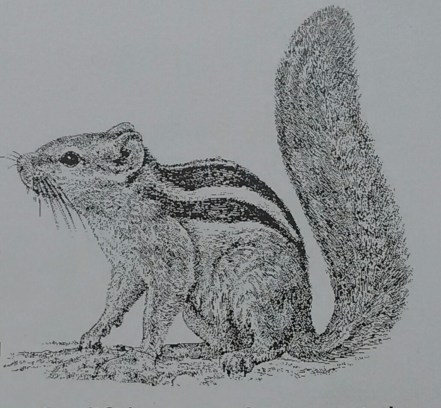
Take the Time to Look at the Squirrels

I had the good fortune to work for two decades at Centre for Environment Education, Ahmedabad. Apart from the work and the work environment, the campus itself was a boon. 14 acres of both ‘groomed’ and ‘wild’ spaces. A variety of trees, undergrowth, lawns, water-body and the attendant birds, snakes, small mammals, rodents, butterflies, etc. etc.
IMG_20181217_114832We were an earnest and idealistic bunch. We had the benefit of mentoring by some of the wisest of people. One of them was Dr.PR Pisharoty, Father of Indian Meteorology and Remote Sensing. On one of his visits in the early days, he listened to all of us presenting our work and holding forth. With a gentle twinkle in his eyes, he told us: ‘You are all doing wonderful work. But I hope you don’t forget to take time off to look at the squirrels.’

We took that lesson to heart. Being immersed in nature at the workplace is a luxury few have today. But I think, looking back, that this made a difference to our work, our interactions and us as people and an organization. Being ‘distracted’ by a bird call in the middle of a meeting and the whole group rushing to look through the window or refer to ‘the Book’ (Salim Ali of course), broke up many a tension. Waiting for a monitor lizard to amble across the path as one rushed from one dept. to another was a good way to get a sense of ‘Nothing is that urgent. They have survived without rushing for millennia’. When ideas dried up, gazing out of the window at the squirrels chasing each other usually did the trick and the brain got unclogged. Feeding the fish at lunch brought people from unconnected work spaces together.

Did the campus make us more creative? More strongly bonded as teams? More lateral-thinking? More empathetic as people? I like to think so!

Business case for green campuses made! After all, today nothing can get approved without a business case! And by green campus, I don’t mean manicured lawns and potted plants. But a bit of wildness and a bit of wildlife!

–Meena

Illustration credit: CEE