The Postman Does Not Knock Even Once

When is it that you last saw letters slipped under your door by the postman? For that matter, can you recall where your nearest postbox is?

The Indian postal system has a hoary history. The official website of India Post informs us that: ‘For more than 150 years, the Department of Posts (DoP) has been the backbone of the country’s communication and has played a crucial role in the country’s social economic development. It touches the lives of Indian citizens in many ways: delivering mails, accepting deposits under Small Savings Schemes, providing life insurance cover under Postal Life Insurance (PLI) and Rural Postal Life Insurance (RPLI) and providing retail services like bill collection, sale of forms, etc. The DoP also acts as an agent for Government of India in discharging other services for citizens such as Mahatma Gandhi National Rural Employment Guarantee Scheme (MGNREGS) wage disbursement and old age pension payments. With more than 1,55,000 post offices, the DoP has the most widely distributed postal network in the world.’

True, every word. Except alas, it needs a high school grammar exercise to be truthful: ‘Transform the verbs in present continuous to the past tense’. So the truth will read: ‘For more than 150 years, the Department of Posts (DoP) was the backbone of the country’s communication and played a crucial role in the country’s social economic development. It touched the lives of Indian citizens in many ways.

The post office has sadly lost its relevance completely–at least in the urban context. One can understand the supplantion of some of the functions: Telegrams are not relevant now that we have emails and whatsapp and phones for instantly reaching out; the phone at the post office which was used in the pre-privatization era has obviously given way to mobile phones in every pocket; money orders which we looked forward to so eagerly in our hostel days have been efficiently replaced by money transfer apps galore.  But we are still sending documents, packages, invitations etc. physically from one point to another. But we never think of using the postal system do we? By default, we use the private courier.

Private couriers came in with the promise of overnight delivery. At most, if it was the other end of the country, it was 48 hours. And that did work, for the first few years. And they do come over and pick up and drop off things. The Postman will definitely not come home if you have a package, even for a charge. And so we all started shifting to couriers.

But today, for all the fancy tracking and tracing systems, except for a few premier and highly expensive couriers, they take a good 3-4 days. And whatever the level of service, they charge a huge multiple of the value of stamps I think I would have stuck on a good old letter or package.

I am sure the Postal Department has a huge workforce. We see occasional announcements as to additional functions they will take on. But in day to day life, one seldom sees this happening.

A sad example of the public sector’s presence and importance diminishing in a key vital sector. I don’t care if Govt. of India sells all its PSUs—it probably should. But are there not some core citizen services where its presence needs to be maintained? Should these not be the focus of modernization, revitalization and re-imagination? Are we, as a country not the losers if India Post is not able to live up to its Vision and Mission quoted below?

Vision​​​

India Post’s products and services will be the customer’s first choice.​

Mission​

  • To sustain its position as the largest postal network in the world touching the lives of every citizen in the country.
  • To provide mail parcel, money transfer, banking, insurance and retail services with speed and reliability.
  • To provide services to the customers on value-for-money basis.
  • To ensure that the employees are proud to be its main strength and serve its customers with a human touch.​
  • To continue to deliver social security services and to enable last mile connectivity as a Government of India platform

–Meena

Winter Is Coming….

Unlike the Starks, I don’t need to worry about endless nights and freezing cold; or White Walkers and scary creatures breaking through the Wall.

But I do have to worry about keeping my skin moisturized.

I am bewildered when I go into a shop these days, with the multiplicity of choices. When we were young, there was a default setting. It was cold cream—in fact, Ponds Cold Cream. It was used on face, on arms, legs or any other exposed parts of the body. For particularly recalcitrant dryness, there was Vaseline, also used on chapped lips. There was the weekly ‘oil bath’ in Tam households wherein til oil was mercilessness massaged into the skin till it saturated every pore, and then washed away with shikai powder or besan.

We were simple and naïve. We didn’t even know there were other types of creams and lotions and potions. There was one dream product though, that our hearts yearned for. But seldom did we get our hands on it. I am not sure why—was it very expensive? Or was it that it was a ‘frivolous’ beauty cream and not a ‘useful’ moisturizing cream? (I saw a recent article mentioning  Afghan Snow as a fairness cream, but I don’t have any memory of it being billed in those days as such). Whatever the reasons middle-class mothers of those days had, I do remember the longing of my young heart for Afghan Snow.

I am not sure if it is still available, but I do remember the light, sparkly, ethereal look of the cream. It came in a blue glass bottle and had a lovely gentle smell. It was the most exotic thing that we knew in terms of cosmetics.

Recently, trying to figure out a bit more about this, I unearthed the fascinating Atmanirbhar story behind this product.

Ebrahim Sultanali Patanwala, originally from Rajasthan, made his way to Mumbai in the early 20th century. He found work with a perfumer and quickly picked up the techniques of blending perfumes. Soon he branched out and set up as an entrepreneur. His first product was a hair oil called ’Otto Duniya’ which met with quite some success, enabling him to set up his own lab and offices.

Messrs. E.S.Patanwala was established in 1909. The company sold oils and perfumes—both those they made, and imported ones. He developed quite a clientele among the Britishers as well as Indian royalty. This did not content him and he took himself off to Europe to learn more. He knew little English, but his earnestness and desire to learn opened doors for him. He connected with Leon Givaudan of Switzerland, at that time the world’s biggest manufacturer of aromatic chemicals. With the training and mentorship he got in Europe, he developed the formula for what was to become one of India’s most popular cosmetics—a cream.

He came back to India and set up a factory in Byculla to make the cream itself, but imported the glass bottles from Germany and the labels from Japan. Around that time, King Zahir of Afghanistan was visiting India and wanted to meet some Indian entrepreneurs. Patanwala was one of them, and he presented the King a hamper of his products included the new, as-yet-unnamed cream. The King is supposed to have opened the bottle, been charmed by the look and perfume, and made the remark that it reminded him of the Snow of Afghanistan. The enterprising Patanwala immediately asked if he could name the cream as Afghan Snow, and the King agreed, and product was launched in 1919 (making it more than 100 years old!)

The product was extremely popular, but ran into some rough weather during the Swadeshi Movement. Because the bottle and labels looked (and were) imported, people thought it was an imported product and listed it as one of the items to be boycotted. Patanwala sent a letter to Mahatma Gandhi, telling him that the product was wholly indigenous and manufactured in Byculla. Mahatma Gandhi then wrote in his newspaper about Afghan Snow, saying that it was a mistake to boycott it, and that he was appreciative that such a good product was being made in India, and that he personally endorsed it.  

I yearn even more for the product now that I know the story! What I would not give for a dark blue glass bottle full of beautifully-perfumed, light frothy shiny white snow, promising to transport me into a fairy tale!

Even more, I yearn for biographies of these amazing people who broke so many barriers, who did so many pioneering things, and who made products whose name still evokes so many memories a hundred years down the road! How they succeeded and why they did or did not sustain.

–Meena

A-Rated History

I am living in 40 BC. Or the 13th, or 15th, or the 18th century. Really depends on which series I am watching at the moment. And my favourite ones are all set way, way back.

And boy, am I learning! Whether it is the Roman Empire, or the Mongols, or the Medicis, or South America, here is the most interesting way to get a feel of the time, the place, the world-changing events. Fully of course realizing that as per reviews (and my own shaky knowledge of history), these series range in accuracy from about 80% (Boilvar), to about 30% (Marco Polo). But I suppose it is up to me to read more authentic scholarly accounts and get my facts straight. I have started on Marco Polo: The Travels. But that, I suppose is not really very factual either. Marco Polo and his co-author have reports on the most fantastical things, whose authenticity is very much in doubt. But nevertheless the television series got me eager to read it.

The point I am coming around to is that this may be the best way to get young people interested in history. Just as David Attenborough and Jacques Cousteau used television and film to bring nature into the house, and thus awaken a whole generation to interest in the environment, here is an opportunity to do the same with history.

And there are several, several such popular serials which can lend themselves to this. My question is: why are they made such that the 13 and 14-year olds who I really feel would be inspired by them, cannot watch them? I understand the Romans had their orgies, the Mongols their harems, and all of them their bloody wars and brutality. But is there no way to bring them into the family room to be family watching? Surely, there can be a way to avoid so much frontal nudity, explicit sex and the level of gore that is shown. Creative film-making is about that!

This is not a plea for censorship. It is to only reiterate that more than soap-value, these topics have educational value. And as an educator, it saddens me when the opportunity is missed. Billions of dollars and so much creative talent spent. But no teacher dealing with these topics in classroom can prescribe these as required watching. Because of the nudity, sex, strong language, drug use and violence, they are not rated for this age group.

If producers feel that their core audience is not this age group, and only putting in a lot of this will bring in the audience and generate revenues, maybe expurgated student-friendly versions available in the daytime?

There MUST be a way around. Surely technology can find a fix!

–Meena

Gandhi the Vegetarian

In September 1888 a young Gujarati man named Mohandas Karamchand Gandhi set sail for England where he would pursue studies in law. Before he left he made a vow to his mother that while he was abroad he would not touch wine, women and meat. Easier said than done!

The challenge began as soon as he boarded the ship–managing to find something to eat, which both his religious belief and palate could support. A fellow passenger, an Englishman, assured him that it was so cold in England that one could not possibly survive without eating meat. The young man managed to subsist on what he could, until he reached England. It did not get any easier when he tried a couple of different lodgings. The English landladies were kind, but at a loss about what to feed their boarder. He ate oatmeal for breakfast, but barely subsisted on bland spinach, a few slices of bread and jam for lunch and dinner. The young man was almost always hungry, but was adamant to keep his vow.

As time passed, he began to find his feet in his new environs. He began to walk around the neighbourhood. He also began to look for vegetarian restaurants; walking sometimes ten or twelve miles in his search. Then one day, as he described in his autobiography: During these wanderings I once hit on a vegetarian restaurant in Farringdon Street. The sight of it filled me with the same joy that a child feels on getting a thing after his own heart. Before I entered I noticed books for sale exhibited under a glass window near the door. I saw among them Salt’s ‘A Plea for Vegetarianism’. This I purchased for a shilling and went straight to the dining room. This was my first hearty meal since my arrival in England. God had come to my aid.

Henry Salt’s book opened up a new perspective for Gandhi, and it whetted his appetite for dietetic studies. As he recalled over 40 years later when he shared the dais with Henry Salt at a meeting organised by the London Vegetarian Society on 20 November 1931: I received the invitation to be present at this meeting, I need not tell you how pleased I was because it revived old memories and recollections of pleasant friendships formed with vegetarians. I feel especially honoured to find on my right, Mr. Henry Salt. It was Mr. Salt’s book ‘ A Plea for Vegetarianism’, which showed me why apart from a hereditary habit, and apart from my adherence to a vow administered to me by my mother, it was right to be a vegetarian.

Till then Gandhi was a vegetarian by religion and tradition, but from the moment he read Salt he became ‘a vegetarian by choice’ and the spread of vegetarianism became his mission. He read whatever he could find on the subject. He found that there was a Vegetarian Society in London; he subscribed to its weekly journal, and then began to attend its meetings. In his new zeal, he even formed a branch of the Society in the locality where he then lived. Through the meetings he made friends with like-minded people. One of these friends was a man named Josiah Oldfield who was an active member of the London Vegetarian Society and editor of its journal. Sometime later, the two friends also shared accommodation, and dietetic experiments. In September 1890 Gandhi was elected to the Executive Committee of the Vegetarian Society as Secretary.

Badge of the Vegetarian Society as designed by Gandhi

Interestingly the start of Gandhi’s life-long prolific writing was a series of six essays that he wrote for the Society’s journal The Vegetarian. These were published from February to June 1891 under the heading Indian Vegetarians. In one of the essays Gandhi explained how Asian vegetarianism differed from its European counterpart. Unlike the English, the Indians do not take each dish separately, but they mix many things together. …Each dish is elaborately prepared. In fact, they don’t believe in plain boiled vegetables, but must have them flavoured with plenty of condiments, e.g., pepper, salt, cloves, turmeric, mustard seed, and various other things for which it would be difficult to find English names unless they be those used in medicine.’ He explained how the Indian diet was richer and more varied, except in one respect—the fruit, yes, the all-important fruit, is sadly conspicuous by its absence in the above-mentioned specimen dishes.

Gandhi’s essays took apart some common myths and misconceptions. They also  helped him to articulate his early thoughts on what was to remain a life-long passion and preoccupation. His experiments in dietetics continued during his time in South Africa, and throughout out his life in India. As he experimented, Gandhi also continued to write about diet and health. In 1906 while in South Africa, he wrote some articles under the heading Guide to Health. He further consolidated and expanded his ideas while he was confined to the Aga Khan Palace in Poona in 1942. These were published under the title Key to Health. This booklet concisely but comprehensively covers a wide spectrum of topics related to all aspects of health.

Today, across the world there is a proliferation of gyan on healthy foods and lifestyle. Movements like veganism are trending; as are the paeans to fruit, nuts and seeds; eliminating refined sugar and salt, and adopting non-dairy milks such as almond and soya milk. Whole grains and raw food, and even fasting are being promoted as the newly-discovered pillars of healthy life.  

1 October is celebrated as World Vegetarian Day, and 2 October marks the birth anniversary of Mohandas Karamchand Gandhi. An appropriate time to remind ourselves that well over a hundred years ago, MKG had already “been there, done that.”

–Mamata

Teacher Teacher   

My father-in-law will be 96 years old this month. He trained as an artist, but spent his career teaching machine drawing in a government polytechnic. He has now been retired for more years than he taught a subject that he was not passionate about. But what he was passionate about was reaching out to his students, not driven by any great philosophy or mission, but his innately sociable and open personality.  Even today, he gets phone calls from his old (literally—some are 75 years and over!) students, just for them to say that they remember him fondly. Till a couple of years ago he clearly remembered names and attributes of so many of his students. It is that life force which continues to energize him even today.

The word Teacher itself is loaded with so much meaning. After all teachers were the key players in the long drama of one’s school (and college) life, with distinct characters, roles and parts. As a part of the student audience, and at times, minor characters in the crowd scenes, we spent a great deal of time and emotion on ‘adoring’, ‘hating’, ‘fearing’, ‘hero worshipping’,  ‘imitating’, or ‘buttering up’ our teachers.

Teachers were a necessary evil that dominated every ‘period’ of our school days.­­­­­­­­­­­ It is when we were older (and perhaps a wee bit wiser) that we could look back with nostalgia and remember those teachers. This was also when we realized the lasting impressions and influences that different teachers had left on us. Not all of these were related to the subject they taught. More often, it was how they taught, or what they said and did, or even what they wore, and how they behaved. We could now see these as individuals with distinct personalities and persuasions. For some of us, the older we get, the more sentimental we get. And Teachers Day, celebrated in India on 5 September, revives many such memories.

In the good old school days, the run up to T-Day was exciting. This was the day that the tables were turned, as it were. It was the one day when students turned into teachers! This was how Teachers Day was celebrated in many schools.

This year for the first time perhaps in memory, the Covid wave has meant that educational institutions across the world are closed. In just a few months, our age-old understanding of educational spaces, classroom transactions, and players has been turned on its head. The e-learning revolution is sweeping across the globe.

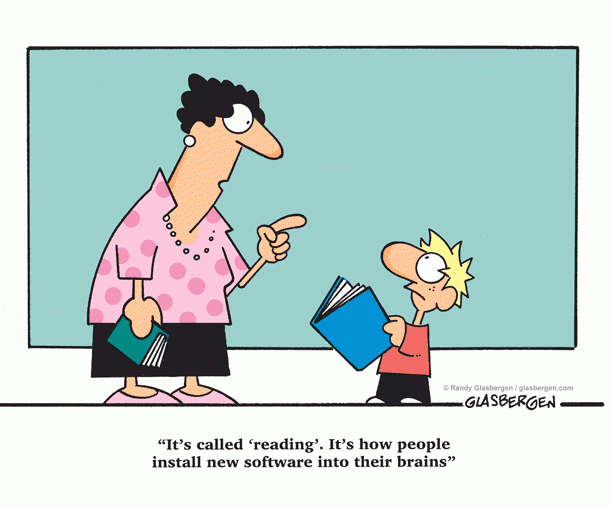
Children of all ages (starting from nursery and kindergarten) passively face a small screen which reflects other small faces and a bigger face. It is in this virtual classroom that lessons are communicated (rather than taught). The day is divided into sterile time slots, rather than a time table in which the best parts were the time-outs for rowdy recesses and roistering assemblies. The Teacher is just a talking head who pops up at a designated time. As the young eyes and ears strain to keep alert and awake, the other senses lie dormant. Missing are the smells from the tiffin boxes, the touch of the dog-eared books and scarred desks, the jostling camaraderie of classmates, the fights and the making-up, the shared secrets, and playful antics…and with it the range of emotions that mark the gamut of relationships among the students, and between the teacher and the taught.itscalledreading (1).gif

I must confess that I have no current and direct experience of e-learning, as a teacher, learner, or parent. But as Teacher’s Day approaches, I cannot help wondering and worrying about this new model of teachers and teaching. Yes, we have no alternative at this moment when safety and health is the priority. True that technology has enabled a safer and more widespread route to reaching out. Agreed that there are examples of inspiring innovations and models. But what will a child of the Age of Corona and Era of E-learning remember of her classroom, her classmates and above all, her teacher? What stories will he share with his children? Who will she remember with a smile or a grimace on another Teacher’s Day?

One looks back with appreciation to the brilliant teachers, but with gratitude to those who touched our human feelings. The curriculum is so much necessary raw material, but warmth is the vital element for the growing plant and for the soul of the child.   Carl Jung

–Mamata


Friendship Matters

In thepooh friends.png next few days the hype will build up. There will be a marketing blitz reminding us that Friendship Day nears, and that the best way to be friends is by buying and gifting for each other, and that the proof of friendship is the number of cards and presents that one gets.



Indeed the idea of this day has commercial origins. As far back as 1919 Hallmark cards in the United States came up with the idea of celebrating the first Sunday of August every year as Friendship Day. It was intended to be a day for people to celebrate their friendship by sending each other cards and thereby boost the sales. Even today many countries celebrated this day in August.

However 30 July marks what is called International Friendship Day. Interestingly both the origin and the intent of this Day have a non-commercial history.

It began over sixty years ago in Paraguay. Dr Ramon Artemio Bracho was a surgeon who had worked as a doctor in rural areas for many years before he became a military doctor for his national government. Dr Ramon strongly believed that friendship is central in overcoming people’s cultural, political and religious differences. As he recalled, the seed was sown one evening when he was invited by a worker’s union to a meeting to celebrate trees. The doctor was inspired. In his words, “I began to remember what had happened the night before and I told myself how interesting it is, the gesture of the man of having created the day of the tree.  In that same instant it came to my mind that friendship is something so important and does not have its day, so it seemed to me an extraordinary idea.” The very next evening, on 20 July 1958, over dinner with close friends in Puerto Pinasco, a town on the Paraguay river, he proposed the idea of a campaign designed to promote the value of friendship in order to foster a more peaceful society. Thus was born the Cruzada Mundial de la Amistad (World Friendship Crusade).Today the World Friendship Crusade is a Foundation that promotes friendship and fellowship among all human beings, regardless of race, colour or religion.

For many years the World Friendship Crusade lobbied the United Nations to recognize and declare an international day to mark the sentiments of the Foundation.

On 5 August 1997, Mrs. Nane Annan, wife of then United Nations Secretary-General Kofi Annan, designated the much loved children’s book character Winnie the Pooh as “Ambassador of Friendship”. This was to encourage young people to learn what they could do to forge ties of friendship and understanding among different cultures to bring about peace and harmony around the world. The books by A A Milne featuring Pooh the little bear and his band of close friends are a beautiful celebration of the simple joys of companionship, loyalty and friendship.

It was on 27 July 2011 that the 65th Session of the United Nations General Assembly declared 30 July as the International Day of Friendship. The United Nations invites all Member States to observe this day in accordance with the culture and customs of their local, national and regional communities, including through education and public awareness-raising activities.

It is a reminder that we are often so caught up in seeing the “otherness” in people that we cannot look beneath, to recognise the “sameness”. A great deal of how we interpret another person’s behaviour and intentions is merely a manifestation of the picture our minds have constructed about them. We assume that we can be only friends with those who are like us, and those that are not, are the “other”. But otherness can also be the most beautiful ground for connection, for it is through the blending of the sameness and the otherness that the rich tapestry of friendship is woven. Openness in thought and deed is the glue of true friendship, not just between individuals but equally cultures, communities and countries.

Today more than ever before, in a topsy-turvy world, we need to remind ourselves of the original intent of Friendship Day as Dr Ramon described it: “I think it is a special day and that it helped or helps people to remember friends in a special way, to be able to cultivate and value more this beautiful feeling that one has towards others.”

While we may not be able to physically meet our friends, while we cannot celebrate with parties and shopping sprees, what enables us to carry on in our respective mental and physical spaces is the comfort of friends and friendship. What better time to be grateful for the gift of friendship that sustains us, and to celebrate the bonds that make our life so much richer?

A friend is one of the nicest things that you can have and one of the best things you can be. Winnie the Pooh

–Mamata


Much in Little

It is almost six months since the world as we knew it, changed. For many, this period of lockdown has also been one of unlocking some simple joys of life and living.

IMG_20200626_093148.jpg

A reprieve from the frenetic activities of modern life has given Nature a new lease of life. And humans, from behind their glass windows, are discovering the wonders of the world that we share with millions of other living beings. People are noticing plants, birds and insects in their immediate surroundings; they are hearing bird song and rain symphonies which had been drowned out by incessant urban cacophony and pollution. Locked inside, humans are rediscovering nature.

Humans are also rediscovering that it is possible, even satisfying, to live with what one has; that life can go on without 24/7 doings and happenings, extravagant shopping sprees, dining out, and other self-indulgences. That the quality of life is not dependent entirely on the quantum of material resources.

But this is not the first time in history. Almost 200 years ago Henry David Thoreau took a break from the often numbing routine of daily life which was driven by the need to earn a living. As he put it “the mass of men lead lives of quiet desperation.” He wondered, “Was it possible to lead a different kind of life?”

Thoreau spent two years, two months and two days living by himself in a basic wooden cabin that he built himself, on the shore of Walden Pond, near Concord, Massachusetts in America. He wanted to answer for himself the question “how simple can a life be and still be a good one?”, and to illustrate his belief of “much in little.”

As he wrote, “I went to the woods because I wished to live deliberately, to front only the essential facts of life, and see if I could not learn what it had to teach, and not, when I came to die, discover that I had not lived. I did not wish to live what was not life, living is so dear; nor did I wish to practice resignation, unless it was quite necessary.”

Even while at Walden Pond, Thoreau did not live a life of seclusion. He had visitors, and walked to the nearby village often. His experiment was more to prove that one does not have to go far in any physical sense to “get away from it all.”

During this period in 1845-46, he observed, enjoyed and recorded his observations of the natural world around him. These were to be published as Walden, one of his best known works. It also earned him the moniker Father of Environmentalism.

Thoreau was however much more than a nature writer. He wore many hats–social reformer, naturalist, philosopher, transcendentalist, scientist, and conscientious objector.

Born on July 12, 1817 in New England, USA in a middle class family, he graduated from Harvard following which he spent some years teaching in school, and also working in his father’s pencil factory. The young Thoreau was greatly influenced by Ralph Waldo Emerson who became his close friend and mentor. He began to publish essays that reflected his deeply-felt political views which were considered radical in those times. He was an outspoken abolitionist and was arrested (and jailed for one day) for resisting to pay poll tax to a government that supported slavery. This experience led him to write one of his best-known and most influential essays titled Civil Disobedience. He made a strong case for acting on one’s individual conscience and not blindly following laws and government policy. “The only obligation which I have a right to assume is to do at any time what I think right,” he wrote.

Thoreau’s non-violent approach to social and political resistance greatly influenced Mahatma Gandhi who adopted many of his thoughts while developing his concept of Satyagraha.

Following his Walden experiment Thoreau wrote extensively, although a lot of his writing was published and became well-known only after he died. He continued his daily afternoon walks in the Concord woods and kept a journal of his nature observations and ideas. He travelled and lectured, living on a modest income, till he died of tuberculosis in 1862, at the age of 45.

Thoreau, a man of simple tastes and high thinking, was indeed an original thinker of his times. The lesson he taught himself and that he tried to teach others, was summed up in the word “simplify”. That meant simplify the outer circumstances of your life, simplify your needs and your ambitions; learn to delight in simple pleasures which the world of nature affords. It meant also scorn public opinion, refuse to accept the common definition of success, refuse to be moved by the judgement of others. And unlike most who advocate such attitudes, he put them into practice.

A few years ago on a trip to the United States I had the opportunity to retrace Thoreau’s footsteps on a walk around Walden Pond, and see the modest shack where he penned his notes on nature. At that time I knew him mainly as an evocative nature writer. Today I find that his philosophy of life and living is more relevant than perhaps ever before. And Walden is so much more than a nature lover’s diary—it is an inspiring guide to changing the way we view ourselves and the life we want to live, especially in these times when we are feeling lost, and the times that will follow.

Our life is frittered away by detail. Simplify, simplify. Henry David Thoreau

–Mamata

A Requiem for Lost Libraries

Right through the last three months of lockdown the one ‘unlocking’ that I was looking forward to, was that of my local British library. The once-a-month visit to the library was an outing that I enjoyed, with its comfortable ritual of collecting the books to return; the short trip to reach the library; the leisurely browsing of shelves to select the next batch to issue, and the spending of some quiet time among fellow readers perusing the newspapers and magazines.

A couple of weeks ago I got a mail that this library was shutting down it physical space and transactions, and turning completely digital. Among the many changes that the world is seeing, and will see, in the age of Corona, this was one of the most upsetting changes for me.

As I have often shared in these columns (lately A Browser Laments) libraries and bookshops have sustained the bibliophile in me all through my life. These have been integral parts of my learning and becoming, and much more than a collection of books. As E B White, described much more eloquently than I can:

library shelves.jpg

“A library is many things. It’s a place to go, to get in out of the rain. It’s a place to go if you want to sit and think. But particularly it is a place where books live, and where you can get in touch with other people, and other thoughts, through books… A library is a good place to go when you feel bewildered or undecided, for there, in a book, you may have your questions answered. Books are good company, in sad times and happy times, for books are people — people who have managed to stay alive by hiding between the covers of a book.”

A library is not only a sanctuary, it is also an invitation to explorations that lead to serendipitous discoveries of new authors and titles. It is a place where the solid physicality of books creates the intellectual space to freely roam across historical ages, geographical boundaries, and labels of colour, language and identity.

The library has been the mainstay, the beacon, the support, and the sustenance for readers through history. Yet today, libraries themselves are in danger of becoming history. We are told that the library is being reinvented in the face of budget cuts, new technology, and changing needs. The age of internet has brought unimagined sources of information and knowledge at our fingertips. There is an increasing transformation to digital libraries.  To ‘browse’ has taken on an entirely new connotation.  The voyage of discovery is now marked by keywords–we reach for what we know to reach for. More than anything else this has transformed the library experience which was marked by a special sense of community into an individual and isolated exercise.

I mourn for these losses, as I apprehensively search for replacements.

–Mamata

LEGISLATING GENDER QUOTAS

In our work with communities, the term SP is common. It stands for Sarpanch Pati—the husband who is the de facto Sarpanch, though his wife is the elected representative in the woman-reserved constituency. A few weeks ago, there was a news item about some state government prohibiting SPs from taking decisions!

Women not able to act in spite of legislative provisions—if we think it is a rural phenomenon, it would be a mistake.

Gender quota challenges play out in corporate India too—only differently.

The New Companies Act 2013 mandated that all listed companies and large public companies should have at least one woman on their Boards.  I decided to take a look at the representation of women in Boards in large companies in India to get a feel of this.

A quick examination of the top 30 BSE companies threw up these interesting facts:

  • Yes, all of them have complied with the law and had at least one woman directors.
  • But taking into account the total number of directors in these 30 companies, less than 15% of them are women.
  • Only one of the 30 companies had a woman in the Chair.
  • There was no company which have women as a majority on the Board or even half the directors as women. Most companies have between 11 and 20 percent women directors.
  • Every company has four mandatory committees (sub-committees of the Board). In the 30 companies studied, there are therefore, 120 mandatory committees. Of these, women were represented in less than half.  Only 15 Committees were chaired by women
  • ‘3’ is a magic number as far as women representation on Boards goes. Many researchers have averred that this is the minimum threshold which ensures that women directors are able to bring into play their strengths and contribute meaningfully to board processes, and hence corporate governance and management. It is found to be the minimum required number for women board members to make a difference and bring into play their value-addition. Only 10 percent of the companies studied had three or more women on the board.
  • A very small proportion of directors are internal women directors, especially those holding the position of Executive Director.

185909EC-97D6-40FF-B8C1-89710FC3916C

Large companies in India are seen to be fully compliant with the law, and none of them has missed out on appointing one woman director to the Board. Some have gone beyond, and have appointed two. But very few have facilitated the condition which would really make women representation effective—viz, having three women on the board. Hence it seems that much more has to be done in terms of making the participation of women directors effective. Apart from absolute numbers, it would seem that proportion of women on the boards could also do with enhancement.

The serious under-representation of women in the position of Board Chairs is a matter of concern.

Equally the fact that very few women directors are internal. Such internal representation of women in top management positions is a strong signal for the women employees of the possibilities of career progression.


Also, the representation of women on mandatory committees, and their leadership of these is another area that corporates may need to focus efforts. Board Committees are where a significant amount of detailed work happens, and Committees have the scope to delve deep into the important issues facing the corporation, and setting the tone for governance. Poor representation and low leadership of mandatory Board Committees by women is hence another missed opportunity.

While it seems that we comply in name, it does not seem that we are really interested in complying with the spirit of the legislations or the underlying inequities which they are trying to correct.

–Meena

Online Nature?

As the global pandemic continues to keep children indoors in many parts of the world, there is a continuing barrage of information on how to keep them ‘meaningfully engaged’. And heading the list is online activities–the one-size-fits-all solution. It started with online classes and assignments to help complete the academic year and requirements. This grew to include online ‘activities’ with students following virtual instructions to make and do things. And then, on to stories being told through a face and voice on a one-way screen.  And now, invitations to discover Nature online.

This in itself seems to be a contradiction in terms. EspeciallIMG_20200611_093510y for an environmental educator whose work and mantra for over three decades had been ‘connecting children with nature’. Environmental education as we believed was learning in the environment, learning through the environment, and for the environment. More than anything else, this was true for nature education. Based on this conviction we worked with passion and imagination to create hands-on teaching-learning experiences–from stepping outside the classroom to observe a single tree, to a camping experience of immersion in natural surroundings. These were experiences that engaged not just the head, but all the five senses—seeing, hearing, smelling, tasting and feeling—and thence the heart. We believed that it was the heart and not the head which would create a new generation of sensitive, informed and able champions of the environment.

As Rachel Carson beautifully put it, “For a child…, it is not half so important to know as to feel. If facts are the seeds that later produce knowledge and wisdom, then the emotions and impressions of the senses are the fertile soil in which the seeds must grow”.

But this was a Sisyphean task. Even while people like us were advocating the ‘take children outdoors’ experience, children everywhere were beginning to stay indoors more and more, due to a variety of reasons. The seriousness of the situation was highlighted in a book titled Last Child in the Woods: Saving Our Children From Nature-Deficit Disorder. Published in 2005, the author Richard Louv expressed his apprehension at the growing phenomenon of alienation from Nature, and coined the term Nature-Deficit Disorder.

NDD was then an unwanted side-effect of the electronic age and a plugged-in-culture. Today, this is threatening to be a major fallout of an unfamiliar and unprecedented global pandemic. As our children remain cloistered in what we hope is a safe environment, our lives are slowly been taken over by technology.

Much can be taught and learnt online. But Nature? Will the most beautiful pictures and inspiring speakers be able to match the intangibles of a personal experience? Will a set of neatly-framed images on a flat screen be able to create an experience that engages all the senses? Will it have any room for the magic of “feeling”? Will it create the child-nature connection that is a fundamental element of a children’s cognitive development, as well as its psychological and physical health.

What will be the psychological, physical and cognitive costs of this technology-supported human alienation from nature, particularly for children in their vulnerable developing years?

When some day in the not too distant future we emerge from our sanitised cocoons, blinking our eyes in the sunshine, let us remember again that real and not virtual Nature is the best teacher.

“It is a wholesome and necessary thing for us to turn again to the earth in the contemplation of her beauties to know of wonder and humility.” Rachel Carson

–Mamata