
Travel PANIC…..

I regret planning a holiday before I leave. And once I am ‘there’ I don’t want to think of home!

So here is a list of things I panic about:

  1. Packing: Have I enough clothes? Have I too many clothes? Have I the right clothes? How do I fit in the walking shoes and the formal shoes and the chappals? Is it going to rain? Do I need an umbrella? Is it going to be cold? Do I have enough woollies? Do I really need them? What medicines should I take? Did I pack my chargers? Am I going to read two books or three? Are the books too heavy?EB301699-D567-4B7B-A138-124C3458A90C
  2. Money: Do I have enough? Do I need all these credit cards? Have I got them safe yet handy? Am I going to lose my money? Are my cards going to get pinched? What is the exchange rate? Shall I change money at the airport or the city? What if I don’t change at the airport and don’t find an exchange easily? Am I going to get gypped?
  3. Documents: Did I put in all the papers I need? Do I have all the hotel contacts, the visa documents, the whatever, the whatever? Have I got copies of all of them? What if I lose them?
  4. Connectivity: Will my phone work? Are the charges going to kill me? Will I be able to regularly access email?

And of course..

  1. Work: Did I forget to do something important? Is what I sent the Boss OK, or is he/she going to want some changes? If so, how will it get done? Is there going to be a crisis just in this one week? Are the skies going to fall?
  2. Home: What about thieves and burglars and break-ins? Do all those wicked people know I am away? Are they watching for a chance? Are they planning for a break-in?

And the most predominant one in my life currently…

  1. Older people: Is my mother going to be OK when I am away? Even if she doesn’t fall ill, is she going to panic herself sick because I am away? What if the doctor doesn’t respond promptly? Does she have all her medicines? Does she have all contact numbers??

But the learning for life, which I have to remind myself about before every trip…..

Crises do break out, but they get managed somehow.

Wallets do get whacked, but there is not much one can do.

We do over-pack and under-pack, but never learn to do better next time.

And we do live to travel another day.

So no point worrying, just go!

–Meena

Yes, you got it right. Just got back from a holiday!
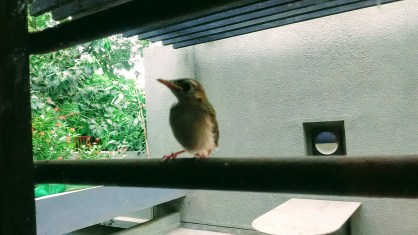
Inside Outside

Through the glass, curiously

IMG_20180805_120336063.jpg

Little bird looking in

What do you see?

Strange giants pacing within.

Trapped in a cage of steel, stone and wood

In an existence that your kind has not understood.

Harried human looking out

What do I see?

A fledgeling just sprouting wings

To soar wide and free with a song to sing

Of the air and light, the trees and the sky.

Grow strong little one, spread your wings and fly

And I will wait for you to sometime come by.

–Mamata

Crotchety Me!

Knitting. Not my area of natural comfort. The only time I did knit was when I was forced to, back in school. And were those booties and bonnets and ponchos disastrous! My needlework teacher ‘frogged’ them regularly (to fully understand the term, continue reading!).

Then why do a piece on knitting-related terms?

Because a dear friend just gifted me a beautiful crocheted shawl. I have been looking at it all week and appreciating the beauty of the piece, the patience that has gone in, and the centuries of tradition behind it. So here is to my friend Mahashwetha and knitters and crotcheters across the world who bring beauty and warmth (pun intended) to our lives.

CB8E4CC3-FB0E-4E77-8EBB-D9EBB791C477

Since the gift is crocheted, not knitted, we will begin with ‘crotchety’ terms.

Crochet: ‘Crotchet’ is from a very old French word for ‘small hook,’ and the verb means ‘sewing with a hooked needle’. ‘Crotchet’ has been in use in this sense since the 15th century.

Crotchety: By late 16th century, ‘crotchet’ was also being used to mean ‘an odd whim or peculiar notion.’ The logic of this seems to be that strange ideas or unusual behavior are mental ‘twists’! A person with odd ideas and habits came to be described as ‘full of crotchets’ or simply ‘crotchety,’ a term which first appeared around 1847. “Crotchety” is now also used in place of “grouchy”.

Knitting commemorates people!

Cardigan: Knitted jackets or sweaters open down the front have been around for several centuries, but the term cardigan came into use in 1862. The cardigan was named after the seventh earl of Cardigan (a county in Wales) who sported such jackets during the Crimean War.

Raglan: The word raglan also came into use during the Crimean War. It is named after Cardigan’s commanding officer, the first Baron Raglan. During the war, Raglan wore a loose-fitting overcoat with sleeves that extended all the way to the neckline instead of stopping at the shoulder. Originally raglan referred to the overcoat; it now can also refer to the style of sleeve.
And animals too!
Frog: What happens when a knitting project doesn’t go well? Well, a knitter frogs it. Frog is knitting slang for “ripping out” knitting: taking the piece off the needles, and unraveling it quickly. It’s not unique to knitting: crocheters frog their work, and needleworkers also frog stitches that aren’t right.

As well as places…

English knitting: Also called right-handed knitting, this is the method of knitting in which the working yarn in is held in the right hand.

Continental knitting: This is a method of knitting in which the working yarn is held in the left hand.

Knitting terms confuse…

Ravel: The verb ravel can mean “to knit together.” It can also mean “to unspool, unknit, or unravel.” Ravel is a contronym (or Janus word), a word with meanings that contradict each other.
End note

If you thought only music had its own notation, turns out knitting does too! Just to start you off….

BO: bind off (cast off)

CC: contrasting color

cn: cable needle

CO: cast on

dec:: decrease

dpn(s): double-pointed needle(s)

inc: increase

kfb: knit into the front and back of the stitch (an increase)

knitwise: as if to knit

And so on…
–Meena
References:

http://en.wiktionary.org/wiki/crotchety
http://en.wiktionary.org/wiki/crotchet#E…
https://www.dummies.com/crafts/knitting/designs-patterns/terms-and-abbreviations-used-in-knitting-patterns/
• Terms and abbreviations used in Knitting Patterns. Kristi Porter.

Otherness and Sameness

When we were in school one of the most assigned topics for essay was Unity in Diversity. We prepared hard for this by finding out many examples from India to demonstrate this. We were proud of living in a country where people of such diversity could co-exist, and celebrated this diversity. We also sang with fervour a school song in Hindi that proclaimed that all people of Hind were one, even though there were many colours and features, attires and languages. Hind desh ke nivasi, sabhi jan ek hai, Rang, roop, vesh-bhasha chahe anek hai.

 My heart breaks today, day after day, to read about a country and a world where it is this very diversity that is broken into identity fragments that divide rather than unite; a world that is increasingly emphasising the ‘otherness’ to create chasms, rather than the ‘sameness’ that builds bridges.

This sentiment is beautifully expressed by Maria Popova:

“Where Walt Whitman once invited us to celebrate the glorious multitudes we each contain and to welcome the wonder that comes from discovering one another’s multitudes afresh, we now cling to our identity-fragments, using them as badges and badgering artillery in confronting the templated identity-fragments of others.”

And then, this past month there was a ray of hope in the World Cup with the multi-ethnic compositions of many of the teams, and much was written about how the not-so-long ago ‘outsiders’ had become integral parts of National teams. This was best demonstrated by the multicultural French team that lifted the Cup…where the Otherness was transcended by the Sameness.

“You gave me blue and I gave you yellow

Together we are simple green. You gave me

What you did not have, and I gave you

What I had to give—together, we made

Something greater than the difference.” (Alberto Rios)

Yes it can happen, and yes there is hope, even in these strange and uncertain times, as Barack Obama said in his centennial memorial lecture to Nelson Mandela, and reminding us of his words: “No one is born hating another person because of the color of his skin, or his background, or his religion. People must learn to hate, and if they can learn to hate, they can be taught to love, for love comes more naturally to the human heart.”

–Mamata


Well Spun!

Ponduru, a village in Srikakulam, Andhra Pradesh, arguably produces the best khadi in India. Well, at least Gandhiji thought so. He was highly impressed with the fineness of the khadi produced here and preferred it to other khadis. The best dressed (khadi-mode) contemporary politicians even today get their saris, dhotis and shirt material from here.

Ponduru khadi is hand-carded, hand spun and hand woven—truly khadi in letter and spirit.

What makes it special? Well, more than one factor, it seems. For one, the raw material itself is of a special quality—it is made from special varieties of hill cotton and red cotton which are grown in Vizianagaram and Srikakulam districts. For another, Ponduru khadi is very smooth, especially the higher count variety. This is because the jawbone of the Valunga fish found in Srikalkulam is used to comb the cotton  fibers to separate them from the seeds, and the process lends a soft sheen  to the cotton.

21637405-76C9-4CD8-B597-D2A608CB60E3

There was a time when every home in this village had a loom. But like in most of India, the number of khadi workers in Ponduru is falling. The low remuneration is of course a major reason. Those involved in the sector do not want their children to follow them—they would much rather they got a ‘professional’ degree and got a ‘secure’ job.

Fortunately, there are some efforts to improve the situation, including dedicated NGOs working in the sector. Chitrika is one such which has been working closely with the Ponduru khadi sector for over a decade now. They are helping the workers organize themselves into Producer Cooperatives, find newer markets, and improve their capacities. New and innovative designs are being brought in. All this is enhancing the incomes of the weavers, almost doubling them in the last decade.

But without a pull from the market, no government subsidies or NGO efforts are going to lead to sustainable results. An eminent Gandhian once mentioned that if every Indian bought one khadi garment a year, the sector would thrive and all our khadi workers would be able to earn decent incomes.

A small thing to ask! And this is in our hands.

So this piece today is a call to action. We are about a month away from Independence Day. Go out and buy some khadi! It is a practical and easy ‘good deed’ for 15 August!

Buy khadi, and specially buy Ponduru khadi, best of all khadis!

–Meena


Up My Wall

Of course house lizards must climb my walls in summer. They must eat up the nameless insects and the mosquitoes and the what-nots. I don’t love them, though I respect their role. And the translucent babies are amazingly cute.

Moths must rest on the walls of my room occasionally. Grey, brown, black, white, small, big. Love all of them. Also spiders.

I have found a slug or two climb the outside-wall. Don’t mind too much, though they do leave a yucky trail.

But the one that really stunned me was a tree frog up my bedroom wall, next to a portrait of my mother! The wall of my first floor room, on the side with no window. How did it even get up there? Climb a tree, jump through the open window, hop across the whole room and then climb the opposite wall? Wow!

D1CEBD2F-E21B-44E8-8827-E80D13734C2D

Ten minutes of full-on excitement. Lots of jumping around ( frog, Raghu and me, with the frog winning on agility and grace— hands down, or is it feet down??); screeching (mainly me, not at all the frog);  some sleight of hand with newspapers and a bucket. And we managed to get the frog out safely.

Oh, how boring  life would be without things that climb my walls!

5A9AB48F-7A43-461C-A334-E8B3DC79EE2D

78BE1532-E3D7-4514-93E7-39C5BC5FC5F6

—Meena


Talk Time

All through school and college, one of the best parts was the ‘night-spend’ (before it was called ‘sleep-over’!) at a friend’s place. The high point of this was staying awake till very late, sometimes even till dawn, simply nattering the hours away. Though well past our school and college days, for myself and my friends, this continues to be so, even today!

We never seemed to run out of conversation. Conversation was comfort, it was catharsis, it was heart-to-heart and tête-à-tête, and more. Conversation was face-to-face communication.

It was not just with friends–face-to-face communication was a way of life. Families caught up with doings and happenings/news over daily meals, and at family get-togethers; colleagues exchanged views over a cup of tea; housewives met at the corner for a chinwag to exchange neighbourhood gossip, and senior citizens bemoaned the state of the world as they took their constitutional in the park. We communicated daily with the shopkeepers, the domestic help, the essential service providers like the milkman, the presswalla, the newspaper supplier, and the auto drivers.

Today we are told that the world is “connected” like never before. We are in constant communication, as it were…Through the press of a button we can order our groceries and daily requirements; we can book tickets for movies or order in food; we can upload pictures of our latest travels; we can stream live the family wedding from the exotic destination; we can open our hearts to the BFF through Twitter and Instagram…and we can even text our children in their bedroom to say that dinner is ready!

The world is “connected” 24/7. Time saving, effort saving, technological marvels we say.  But somewhere in all this, have we not lost something precious? Something that is a basic human need–Face-to-face communication, an ancient and abiding human gift? Are we losing a vital connection?

“When you speak a word to a listener, the speaking is an act. …Listening is not a reaction, it is a connection. …And it is a mutual act: the listener’s listening enables the speaker’s speaking. It is a shared event, intersubjective: the listener and speaker entrain with each other.  …When you can and do entrain, you are synchronising with the people you’re talking with, physically getting in time and tune with them. No wonder speech is so strong a bond, so powerful in forming community.” (Ursula K. Le Guin in a piece titled Telling Is Listening.)

Perhaps the next time, before we sign up for “Unlimited Talk Time” offers, let us see if we can make real Time for Talk.

–Mamata

Justifications Believers Could Give

In the old days, it seems from all reports,

That Gods of all faiths performed many, many miracles


THEY would save believers from the jaws of death

THEY would heal lepers and give sight to the blind

THEY would grant riches and victory to the righteous

And take the time to wipe the tears of widows and orphans


But it seems THEY are slipping up badly these days

I can see no miracles around me

In fact, THEY are performing ‘Below Expectation’ (a term from my appraisal process!)

Even in their core function

Which is to reward the good and punish the bad


Well, when you think about it

I can find some excuses for THEM

How do you expect THEM to cope

With the kind of rise in population

The world has seen from the good old days?

So many billions of souls

Calling out to them for

Miracles big and small


Agreed THEY are Gods

But even THEY, surely

Must be stressed and over-worked

Poverty, hunger, AIDS

Terrorist attacks, the War on Terror

Nuclear proliferation

Stock market booms and busts

Dictators and trolls

Floods, droughts, tsunamis

Child trafficking, porn sites

Violence against women


In between sorting out all this

Do you seriously expect THEM

To make the time

For a personal miracle for you?


Get real!


–Meena


Things That Got Our Teachers’ Goats

A few weeks ago, I wrote about something that had our teachers and school management paranoid—so called ‘contraband books’. We had a well-stocked school library, but obviously we had an urge to read something beyond—like comics and M&Bs! Which our teachers and the nuns were determined to stop us from doing. One of the things that used to happen irregularly regularly were surprise checks. Suddenly about four teachers would walk into the classroom, and order us to open our desks and bags, and would riffle through them. Anyone caught with any book other than textbooks or school library books was sent off to the Principal, and had the book confiscated.

I marvel at those days of innocence, considering that as far as I know, no one was ever caught with anything more wicked than an Archie comic. Or yes, a Barbara Cartland. While Georgette Heyers were completely kosher and in fact, in the school library lists, and even M&Bs were tolerated (which meant we were not too nervous if a teacher heard us mention them), for some reason BCs really got the teachers paranoid.

They were also paranoid about what our hair was fastened with. It had to be black ribbons. Rubber bands, even black ones, got them. What to talk of ‘love in Tokyos’!

And socks. They had to be plain white, and NO DESIGN! The faintest sprays of flowers or creepers, even white on white, would get them on a trip.

Skirts had to be just above the knee. Anything shorter and there would be consequences. The girls with more oomph and guts found their way around this. They used to roll up the waist band of the skirt two or even three times, so that the skirts were at a daring mid-thigh. And roll them down, oh so innocently, when any strict teacher happened by.

All this was at Carmel Convent Delhi. But I am sure that readers of my generation would all relate to this.

I thank my teachers for the discipline they dinned into us. For the values they made a part of our lives. For the seriousness with which they taught us. For how earnestly they took their mission of making something of us.

–Meena

Starry, Starry Village

Last week, I was in interior Andhra Pradesh. We were felicitating high-performing Std. 10 students from government schools of villages in our project area.

All was routine, till they announced one of the winners as Keerthi Chawla. I wasn’t sure I had heard right. It was too North-Indian a name for a village in AP. So I asked again what the child’s name was, and she reiterated that it was Keerthi Chawla. And she was speaking Telugu. I asked her if she belonged to those parts or her family had moved there. She told me she was very much from Dosari village. And also told me her full name, which was Vangapudi Keerthi Chawla.

I couldn’t wait for the function to finish to catch hold of my colleagues to ask what this was about. They told me that the trend in Dosari village was to name children after film stars. That is not an unusual trend—we all know that many a Rajesh or Dilip or Aishwarya were named about the eponymous stars. What was unusual of course was the adoption of the name—lock, stock and surname!

We thought we should get a little more into it. A very quick count in the primary school and Bala Badi in the village threw up 81 children who were named after stars: from Trishas to Tamannas to Anushas (these ladies don’t use surnames, I think). From among those who do use surnames, we found apart from Keerthi Chawla, also a Vidya Balan. Among the boys there were Nageswar Raos, Ram Charans and Prabhas.

(I have met many a Jhansi, Jhansi Rani and Jhansi Lakshmi from AP/Telangana. Not sure why these names are so popular here.)

I thought mine was my Keerthi Chawla was the most exciting find. But I was deflated when my colleague told me that in her previous job, where they used to provide education support for children from Tamilnadu slums, they had one child called David Beckham (Muthu David Beckham).

With what dreams do parents name their children?

How we look up to the stars!

Do they know?

–Meena