Have We Lost the Apostrophe?

When something needs a protection society, you can be sure it is well on its way to extinction. And so is the case with the apostrophe. But ironically, the Apostrophe Protection Society (APS) in Britain has declared itself dead and buried while the apostrophe it created itself to protect is still breathing—though barely.

The Society was founded in 2001 with “the specific aim of preserving the correct use of this currently much abused punctuation mark”. The Society’s founder Mr. John Richards, who has fought valiantly for two decades in the service of the apostrophe, is closing it down for two reasons. First is that he is cutting down on his commitments—given that he is 96, that is perfectly understandable. But surely, there may be, somewhere in the world, some younger champion of the post-office comma? (In some parts of India, the apostrophe is referred to as the post-office comma). The other is disillusionment with the state of punctuation—he feels that less and less people and organizations care about the proper use of the apostrophe.

What a tragedy! The apostrophe is an essential part of punctuation. Though misused, the mind boggles when one thinks of the confusion we would face without it. The Society laid down three key tenets in this regard: (1) use apostrophes to denote missing letters; (2) use them to indicate possession—except in the case of possessive adjectives like ‘its’. They also had a strict rule about when not to use them—never use them to indicate plurals.

At any rate, the announcement of the closing down of the APS has elicited so much interest that the website has not been able to take the traffic over the last few days, and is temporarily replaced with a message that the full site will be back soon. And the reassuring thing is that the site is not being closed down and will remain open for reference. (http://www.apostrophe.org.uk/)

RIP APS. But let us hope RIP Apostrophe is still some time away!

See also our older  post ‘Emma Watson’s ‘Eats Shoots and Leaves’ Moment’ https://wordpress.com/post/millennialmatriarchs.com/21

–Meena

Jeeves at Hand

IMG_20190117_130529I hate when shops ask me to leave behind my handbag at the counter and give me a token in return. Apart from the general feeling of insecurity in being parted from my bag, there is the very real problem of juggling phone and purse as I shop. I certainly, however, will not be amenable to using ‘wallet parking’, though the service should be offered generously, as it is in a restaurant close to my office.

I quite sympathize with the confusion over valet and wallet. After all, since the 16th century, the word ‘valet’ has traditionally been pronounced as rhyming with pallet, though an alternative pronunciation, rhyming with chalet, as in French, is now more commonly used. The Oxford English Dictionary lists both pronunciations as valid.

Who is a valet? Well, the origin of the word is French. A valet or varlet is a male servant who serves as personal attendant to his employer and is responsible for the clothes and personal belongings of an employer, as well as making minor arrangements for his comfort. Taking guests’ horses or carriages to the stables were additional responsibilities. In English, the use of the term valet as “personal man-servant” is recorded since 1567. Famous fictional valets include of course Jeeves, familiar to readers of Wodehouse, and Alfred Pennyworth, valet to Bruce Wayne (Batman).

One supposes that the term for parking attendant must have evolved from the duty of the valet to ‘park’ horses in the stable.

Valet parking, as a professional service originated in the US, with Herb Citrin called the Father of Valet Parking. His father used to park cars in the ‘30s, and Herb joined him in this when he was about 16 years old. In 1946, he started a company, predictably enough, called Valet Parking Service, and professionalized the service including introducing the now-ubiquitous smart valet uniforms. Starting from restaurants, he went on to provide the service to office buildings, department stores, airports, and events like the Oscars and Emmys.

The service has evolved from being something availed by the affluent, to being available in even modest establishments. It is big business, with US estimating that in that country alone, there are 2,00,000 people employed to provide parking services.

Valet parking is still evolving.  From just parking cars, now valet services are being provided for other vehicles like bikes and boats. Bicycle parking especially is gaining traction, with the increasing use of bicycles and bicycle services in cities across the world.

A welcome development indeed.

But still. Wallet Parking? No thank you!

–Meena

Photo credit: Sudha Priscilla

Close Encounters with Al-Seshan: Tribute to the Man Who made Elections Free and Fair

TN-seshan-_16e58b8495a_largeWe who worked at the Centre for Environment Education (CEE) were lucky. The list of luminaries with whom we had the opportunity to interact was beyond belief.

Mr. TN Seshan was one of them. During his stint as Secretary, Ministry of Environment and Forests, he was on our Governing Board, as CEE was a Centre of Excellence under the Ministry. Apart from that, since CEE was part of Nehru Foundation for Development founded by Dr. Vikram Sarabhai (whom Mr. Seshan counted as a guru), he took interest in the institution beyond his term also.

When he was on the Board, he made it a point to visit CEE whenever he was in Ahmedabad. And review the programs. He could pick holes in any presentation in a matter of minutes, if not seconds, and ask the most unanswerable questions. And his questions were certainly not put gently! While it was traumatic, when we dried our tears and reflected back on the experience, what he pointed out were indeed basic shortcomings in the program design or implementation.

All of us at CEE used to get all primed in the weeks preceding The Visit. We tried to ensure that everything was in order, but sure enough his perfectionist eye would catch just that smallest detail that we had overlooked. And someone had better have had a convincing answer for that! As Mamata remembers: “My personal Encounter with Mr Seshan was when I had to present some parts of a compilation of what was, in future, to become a publication titled ‘Essential Learnings in Environmental Education’. As someone who was still very new and untutored in the subject, this was an absolute trial by fire. Mr Seshan ruthlessly ripped apart every sentence, and reduced me to tears in front of the entire gathering of CEE! In the many years that followed, the Day that Mr Seshan Made Mamata Cry, became one of the memorable milestones in the institutional, and my personal history! As I grew older, and perhaps a little bit wiser, and Mr Seshan became a national icon, every time he was in the news, I remembered with greatest respect how he ingrained in me the importance of working towards ‘excellence’ in whatever one did”.

During his tenure as Secretary Environment, he gave CEE the task of doing a review of the state of Environment Education in the country. And a ridiculous deadline. In those unimaginable days before internet and Google and emails, we set about physically gathering reports, syllabi, textbooks from each state and UT. Almost 30 people worked day and night for about 20 days trying to make sense of the mounds of material. And then the day of the first presentation was upon us! Our director, Kartikeya Sarabhai and a small team of us were to take the 8 a.m. flight to Delhi. We were in the office till 4.30 a.m. putting the report together. While we went home for a quick shower, a team continued work printing and photocopying the report. We and the reports just made it onto the flight!

The meeting was set for 11 or 11.30 in the morning. It was a large Board room where about a dozen officials and our team were gathered. We had about 3-4 copies of the report. We put one at the head of the table where Mr. Seshan would sit. And waited, with butterflies in our tummies. He walked in almost on time; gave us barely a look of acknowledgement, picked up the report and rifled through it. For exactly about 7 minutes. And then tore us and the report to shreds! He started with the shortcomings in the framework that we had created for the analysis, the data gaps, the facets we had not even tried to look at, etc. etc. The meeting lasted about 15 minutes. He spoke in a flow for the latter 8 minutes, tossed the report back on the table, and told his office to fix another date for the next presentation the following week.

It was a learning like no other! We had worked on the report for days, but he was able to get a better perspective in 7 minutes!

The story had a fairly happy ending in that we completely re-thought our approach, and worked on the report over the next month, with interim presentations. The report became a baseline for our work on Environmental Education, and definitely impacted subsequent policy directions.

I had the chance to interact with Mr. Seshan on many occasions, including teaching him how to use the new Apple Computers, a big novelty at that time! He would often call us home for meetings early in the mornings, and his gracious wife would give us wonderful coffee. After the official work, over the coffee, he was not averse to chatting about this and that, including Mamata Kulkarni and Shilpa Shetty!

It is indeed a privilege to have seen Mr. Seshan in action, and worked with him in a small way. When media referred to him as Al-Seshan, he would joke that Bulldog might be more appropriate than Alsatian! Well, from my memory of him, his bark and his bite were both scary. But they did set India’s democracy on a solid footing!

–Meena

 

Tribute to India’s Birdman: Dr. Salim Ali

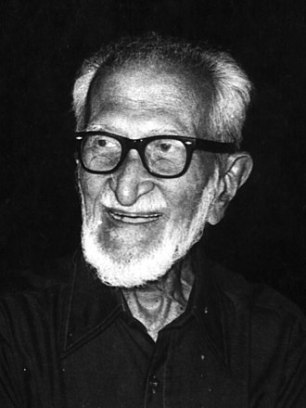
330px-Salim_ali_mnsSalim Ali’s birthday falls on 12 Nov. He was born in 1896 and passed away in 1987. He may be credited with single-handedly bringing ornithology to India. And this interest in ornithology, as it spread, led to interest in wildlife and biodiversity; in environmental issues; in conservation; and in sustainable development.
He inspired generations in India and created a culture of systematic and scientific study of wildlife. If his ‘Book of Indian Birds’ is the easy guide which every bird watcher starts with, the landmark ten volume Handbook of the Birds of India and Pakistan which he wrote with Dillon Ripley is the authoritative guide. Dr. Salim Ali was respected across the world, and decorated with the Padma Bhushan and Padma Vibhushan.

On this his birth anniversary, here are excerpts from an interview of Dr. Salim Ali (when he was 85+ years of age!), with Dr. HSA Yahya of Aligarh Muslim University, and taken from http://wgbis.ces.iisc.ernet.in/ envis/doc97html/biosalim24.html. My only contribution is to have picked out two sections that I found of particular interest.

MONEY MATTERS NOT A JOT

‘Then I told Prater ” look we have so many places in India and we know nothing about birds.”  Hyderabad for instance, was a complete blank on the ornithological map. So I said ” if you write to the British Residents who are really interested in these kinds of things we can probably get some financial support. I do not want any pay. I only want my expenses paid and I will be quite happy to go, study and collect birds.”So the Society got in touch with the Hyderabad Government which had largely British heads of Departments. They were very glad. But it is really quite laughable, the amount we asked for and which we got and in which I was able to complete the survey. I think for the whole of the Hyderabad State survey for six months we got about 6000 Rupees (NOTE: THIS WAS WAY BEFORE INDEPENDENCE!).  Yes, six thousand which included the food of the skinner, our own food, cost of travelling and everything (laughter)! We were able to do it with a lot of trouble, many of our camp shifts had to be done by bullock carts because there were no roads in the places where we were camping. After Hyderabad I did Kerala which was then two states, Cochin and Travancore. Then one after the other Central India, Gwalior, Indore, Bhopal. So all these were done under the same system: asking for small amounts and doing it. I could do it because I had the time, I mean, I was just doing it and nothing else and I did not have any ambition to try again for some bigger job somewhere and so on. Not because bigger jobs were not there and perhaps I would have not got them, but they were not in the line in which I was interested.’

ON THE IMPORTANCE OF A LIKE-MINDED PARTNER IN FOLLOWING A PASSION

‘I tried all kinds of jobs for a long time. Finally, I said that, well, I have all these trainings and I have my chief interest in birds so why should I not do this on my own. My wife had a little money and I had a little investment and so on. Then we worked out and found that we had just enough if we left Bombay, which was very expensive and went to live in some quieter place which would give more facilities for bird study, we will be far happier. My great fortune was that my wife who had had all her education in England and been used to quite a different sort of life to what she would have in the kind of work I wished to do. She insisted that I should take up only the work that I was interested to do. She said ” now we have enough to live quietly, we would go to some small place, I will be quite happy.” She was keen on poetry and Urdu and various kinds of reading and so on. Then she got very interested in birds too, and in outdoor life and in things she had never had any experience in England of.’

From: TRANSCRIPT OF AN INTERVIEW WITH SALIM ALI by Dr H S A Yahya Reader, Centre for wildlife & ornithology, Aligarh Muslim University, Aligarh.

–Meena

PS: ‘The Fall of a Sparrow’ his autobiography,  is a must-read.

0 to 51 in 10: The Panna Tiger Story

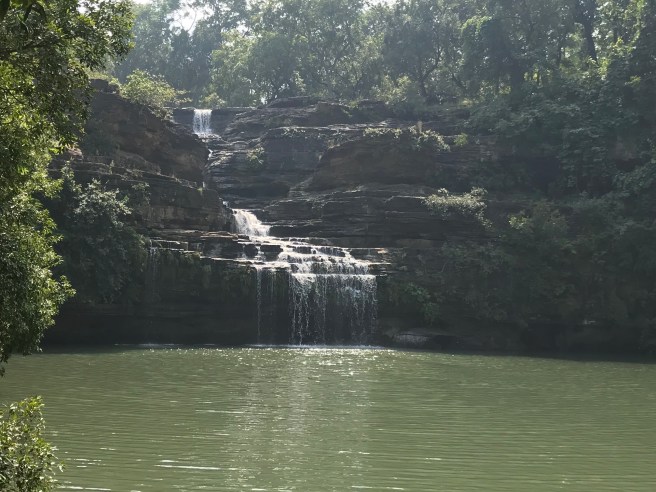
The verdant forests of Panna, Madhya Pradesh. We were able to visit two weeks ago. And were lucky enough to see a tigress and her cub. What a majestic sight! The tigress was pretty big and healthy, the cub frisky and curious. The mother was contemptuous of the humans in their vehicles going into contortions to catch a look, to take a pic, to exclaim to each other. She moved when she felt like, sat down and relaxed when she felt like. Not looking in the direction of the vehicles even once, though she knew we were there. She was the queen of her territory and saw no reason to acknowledge us.

It was a wonderful feeling. To see the healthy tigress and her confidence in her security. The active cub, about 5 months old. The number and variety of herbivores. And the thick forests and healthy, lush greenery.

falls

It would be good to have seen this in any of our protected areas. But especially gratifying when we go into the story of Panna. Panna was declared a National Park in 1981, and subsequently a Tiger Reserve in 1994. The tiger population in Panna was down to zero in Feb 2009, thanks to poaching. It was a sad time indeed for India’s conservation efforts.

Things started to change with the posting of Mr. Sreenivasa Murthy, who took over as Chief Conservator of Forests and Field Director, Panna Tiger Reserve. They speak of the tough measures he took in securing the Park, coming down hard on all incursions, trespass, illegal activities and poachers. Even as he protected the area and worked on the morale of the Forest Staff, he built on the already initiated plan for re-introduction of tigers into the Park. Starting with one tigress in 2009, six of the species were introduced from different parts of the country. And it was not an easy task. As the Panna website tells it, one of the re-introduced males strayed out of the protected area into unsafe terrain, and 70 Park staff led by the Field Director followed it on elephants for 50 days, securing it from gunshots, poisoning and electrocution, till at last they were able to tranquilize it and bring it back into the safe area. All the hard work paid off and the re-introduction worked, with the first litter of cubs born in Panna in 2010. The results are obvious today, with the Park now home to 51 tigers. Several cubs have been born this year too.

Nothing is achieved by one man alone. But equally, individuals make all the difference. And in the case of Panna, this individual was Mr. Murthy. He has been posted out of the Park, but even today, drivers and guides speak his name in hushed tones, in tones of awe. And when respect and admiration penetrate to all levels, it is surely the greatest homage to the real difference someone made.


bear

So a huge THANK YOU Mr. Murthy and all our Forest Dept. staff who work in extremely difficult situations to ensure that our biodiversity and natural heritage are safe. The thick forests of Panna, the variety of animals and birds we saw, of whom of course the tigress and cub were at the peak, the flourishing trees and plants—all of these stand testimony to your efforts.

–Meena

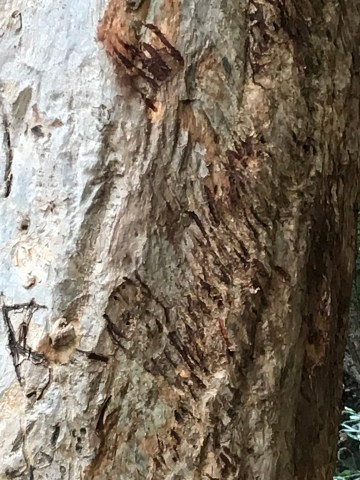
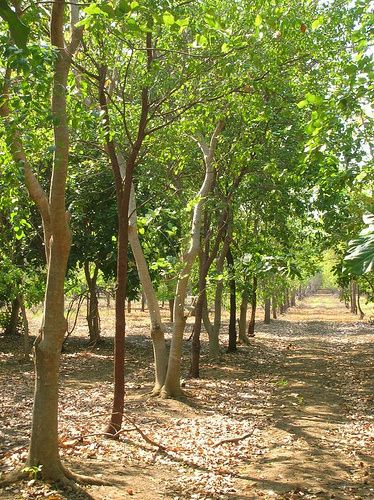
(There are many trees like the pic, with nail marks made by bears climbing them to get at honeycombs.)


PS: We did not get any pics of the tigers—we were too busy looking at them. And anyway, they were far away and our phone-cams were not up to the task.

But a few other pics from the Park and Pandava Falls nearby. Photo credits: Prof Samir Barua.

Carved in Stone, Carved in Our Memories

Khajuraho. Memories of history textbooks. Also of sniggers and side glances among us as school girls.

When our friends and we decided to visit, it was on a whim. We wanted to see the monuments which are counted among the best in terms of the flowering of Indian art, architecture and creative expression. But we half-feared we would see badly maintained ruins.

What an amazing surprise! We were awe-struck with the boldness of imagination and design of the 25 out of 85 temple structures still standing. We marvelled at how, more than a 1000 years ago, buildings of such complexity and technical perfection could have been built. Even in terms of just moving material and creating such huge structures—how did they manage it? Truly a civilization at the height of its cultural powers.

We were equally impressed with how well the structures have been restored and how well they are being maintained. No ugly and inappropriate renovation. No vandalism. No graffiti. No unpleasant solicitation by guides or vendors. No garbage. No muck.

The cluster of temples (85 at the peak), were built between about 950 and 1050 AD, by kings of the Chandela dynasty. And the eclectic collection of Gods to whom they were dedicated is interesting—Shiva, Vishnu and even Jain temples (Devi temples being conspicuous by their absence).  The erotic nature of the carvings in Khajuraho is much talked about, but it constitutes only 10 per cent of the total. And done in a completely matter of fact way, juxtaposed with everyday scenes of life and times.

varahaWhat I found most fascinating was the Varaha temple. A temple dedicated to the 3rd avatar of Vishnu–Varaha or Boar. I don’t recall any other temple devoted to this avatar. The sculpture is a humungous sandstone monolith—2.6 metres long and 1.7 metres tall.  It boggles the mind how they got the stone up there and carved it. Because carve they did—every inch of the boar’s body is covered with numerous figures. Between the nose and mouth is a carving of Goddess Saraswathi, with the Veena in her hands—a tribute to knowledge. In the Varaha avatar, the demon Hiranyaksha kidnapped Goddess Earth and hid her under the cosmic ocean. Varaha battled the demon for a 1000 years and brought back the Goddess. Well, the Varaha statue has battled the elements for over a 1000 years, and stands testimony even today, to the skill of its creators. It looks fresh, exudes power, and is almost shiny metallic looking.
14F60E49-C3F9-4317-9D1F-FD07ED2A5575

telescope


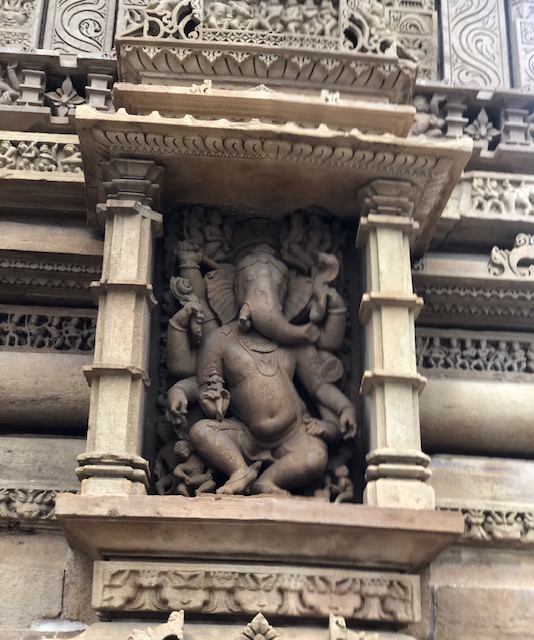
Other sculptures that stand out are a dancing Ganesha. You can see his paunch swaying as he dances! An elephant with a sense of humour, who looks with a twinkle in his eyes, at an amorous couple.

And most interesting of all, a man who is ‘upskirting’ a voluptuous beauty with the help of a device that looks like a telescope. But the telescope was invented only in about 1608!! So what could this device be?


While Khajuraho was an amazing experience, getting there was not! There is an airport, but flights seem seasonal, and only connect to Delhi, Agra and Varanasi. There is a station there, but only serviced by a few trains. We got there by road from Jabalpur. A distance of about 250 kms which took about 6 hours, thanks to 30 kms of potholed roads, and 20 kms of no road at all!

So while I bow to those who conceived and created Khajuraho, and bow to those who have restored and are maintaining it, I definitely do have a bone to pick with those who are doing their best to make getting there such a pain. A real disservice to anyone who wants to see India’s heritage in its glory, a disservice to the world in making access to a World Heritage site so difficult.

–Meena

Mole of Memories, Table of Nostalgia

I saw in a dream a table where all elements fell into place as required. Awakening, I immediately wrote it down on a piece of paper, only in one place did a correction later seem necessary. Mendeleev

An appropriate year and time of year to remind myself of my all-but-forgotten Chemistry roots! It takes quite an effort to remind myself of the time four decades ago, when I was a student of Chemistry at Delhi University.

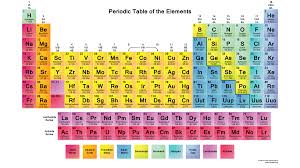
But reading about the declaration by the UN, of 2019 as peridic table.jpgYear of the Periodic Table of Chemical Elements, did bring back some memories.
Why is 2019 so marked? Well, because 1869 is considered as the year of the discovery of the Periodic system by Dmitri Mendeleev, the Russian physicist, and it commemorates 150 years of the Periodic Table.

The Periodic Table, if you can recall your school chemistry, is a table of the chemical elements arranged in the order of their atomic numbers, so that elements with similar atomic structure (and hence similar chemical properties) appear in vertical columns.

Chemistry is usually looked upon as a swot or ‘rattu’ subject. The introduction to the Periodic Table is the first time students get to understand the pattern and logic of chemistry. From being a random assortment of letters, elements and their properties being to make sense. It becomes possible to predict the types of chemical reactions that a particular element is likely to participate in. Without memorizing facts and figures about an element, students can, from looking at the position of an element in the table, understand about the reactivity of an element, whether it is likely to conduct electricity, whether it is hard or soft, and many other characteristics.

And hence a whole world opens up!

And coming to the Day. Oct 23 is Mole Day. Not MOLE as in the four-legged creature. But the MOLE that chemistry students struggle to understand. The definition of this mole, as the base unit of a substance having 6.02 x 10²³ particles is really confusing to begin with. Exploring another definition– mass of a substance that contains 6.023 x 10²³ particles of the substance—does not really help either. As a Masters’ student of Chemistry, I was expected to help younger kids in my colony with the subject. And how I struggled to explain this concept! (I shall not venture into such an attempt now, but I think those struggles helped me understand it better).

But at least Mole Day and Year of Periodic Table have reminded me of some claims I may make to be scientifically literate!

Happy double Chemistry Whammy!

–Meena

Technology And the Sweet Smell of Success

c51a218268e55a64559428ab06f2eff5Last week, at a Rotary event, I heard Kavita Misra speak. She  is a woman-farmer-entrepreneur from the backward district of Raichur, Karnataka. A diploma and PG in Computer Applications, she was married into a traditional family. Though offered a lucrative job in an IT major 20 years ago, she did not take up the offer as her family was not happy to have her take a job. Her husband threw her the challenge to stay in the village and do something. He gave her an acre of land—which was rocky, barren and water-less. Because that was all that was available there. From there to becoming the millionaire famer-entrepreneur she is today was a long and hard journey.

The most important lesson to me was the role her technical education and training have played in her success. Her actively seeking new and better methods of farming, and quick adoption of innovations has been at the heart of her achievements.  And it brought to me that if we want a paradigm shift in the way farmers do agriculture, they need to be more comfortable with technology, in sync with scientific developments and more technically savvy.

To give an example, Kavita is one of the most successful sandalwood growers in the country, and has sandalwood nurseries which sell sandalwood saplings all over India. Sandalwood is one of the very high value trees, and farmers who cultivate it can earn in crores. The tree fetches about Rs. 1 crore per tonne. A 15-year old tree yields about 15 kg of heartwood (though waiting 20-25 years gives more yields), and one acre can support about 300 trees.

One of the biggest challenges in sandalwood cultivation is theft. Given the high value of the wood, thieves and smugglers are constantly looking for ways to get into plantations and make away with trees. Farmers usually deploy guards and guard dogs, apart from physical and electrical fences.

Recently, Institute of Wood Science and Technology (IWST), has developed a microchip which can be inserted into the growing sandalwood trees, and linked to a smart phone. And you can monitor your tree from anywhere in the world! Alerts go to the farmer as well as the nearest police station if any movement of the wood is detected.

This has been developed, field tested and improved over two years by IWST and Hitachi India Pvt. Ltd. There were many problems to overcome..from the battery size which was too big for the tree trunks to bear, to need for increasing battery life, to the sensitivity of the chip to wear and tear and exposure to the elements.

Even though it is expensive, progressive farmers like Kavita have been able to see the potential and have quickly come forward to adopt the technology and popularize it among others. It is this mind-set and appreciation of the benefits of technology which will be game-changers in agriculture.

–Meena

A Gandhi for Every Poet

Among the thousands of events to mark Gandhiji’s 150th anniversary, the one I was privileged to attend was indeed special. A evening of ‘Gandhi music’ by the renowned Shubha Mudgal, at the Bangalore International  Center.

What made it special was that it was not the usual ‘Ashram bhajans’.  It was a bit disorienting to not have the performance begin with ‘Vaishnava Jan’ or ‘Raghupati Raghav’ or even ‘Ekla chalo’. But one was soon in the flow…not only of Shubhaji’s voice, but also the unknown…at least to me…songs.

This was a collection of poems on Gandhi and about his leadership of the freedom movement which the artist had researched, curated and set to music. Nothing else could have brought home more powerfully how wide and deep the Mahatma’ s influence was. There were pieces written by literary figures. A Bhojpuri folk song which talked about the charkha. A Holi song from Uttaranchal urging people to get immersed in Gandhi’s colours. A poem by someone who had lived in Gandhi’s ashram for 30 years and had written 500 poems reflecting on his experiences. A contemporary poem written a few years ago by an educational administrator from the Delhi government.

But the one that left a special mark was a song by a courtesan. In a characteristically out of the box move, Gandhiji had apparently addressed a ‘Tawaif Sabha’ in Benaras to urge them to do their bit for the freedom movement. His request was they should include  at least one protest song in their performances. In response, one well-known artist, Vidyadharibai, wrote and presumably performed a very powerful song castigating the British.

And the evening was limited to Hindi songs. It is mind-boggling to think what wealth of poetry there must be in all our languages! How did Gandhiji touch so many people, so many different kinds of people, people in so many places? How did he relate to all of them and all of them to him? Businessmen, farmers, rich, poor, professionals, weavers…..How did he inspire them and change them all?

The memory persists down generations. But the change?

—Meena

Environmental Scolder-in-Chief

E_SDG goals_icons-individual-rgb-13“You have stolen my dreams and my childhood with your empty words. And yet I’m one of the lucky ones. People are suffering. People are dying. Entire ecosystems are collapsing. We are in the beginning of a mass extinction, and all you can talk about is money and fairy tales of eternal economic growth. How dare you!’ said Greta Thunberg to world leaders at the UN.

And that is a scolding they will not forget in a long time!

Greta, the girl, who in her teens is shaking up the world! Deeply concerned about the climate crisis, and even more concerned that world leaders were not taking it seriously, a few years ago, Greta took off from school to protest outside Sweden’s Parliament, calling for action on climate. She tried to get some of her school mates to join her, but no one was interested. So she took time off from school every Friday, and sat alone outside Parliament for three weeks, holding signs which said ‘School Strike for the Climate’, and handing out pamphlets. Her strikes found their way to social media and started attracting worldwide attention.

As time went on, inspired by her, more school children joined in, and organized protests in their own communities. This developed into the School Climate Strike movement, or ‘Fridays for the Future’. And there have been strikes involving tens of thousands of school children in major cities of the world.

So strong were these voices of the youth that Greta was invited to address the United Nations Climate Change Conference in 2018. Her advocacy is forcing governments to acknowledge that they need to do more for the future generations by taking climate action.

Greta is not just about advocacy and telling other people what to do. She challenged her family to adopt more a more environment friendly life style and reduce their carbon footprint. And she succeeded! Her family is vegan now, and her mother has even given up her career as an international opera singer—which involved a lot of air travel– in order to reduce her carbon footprint!

Greta herself made the headlines once again when in August 2019, she sailed across the Atlantic Ocean from Plymouth, UK to New York, US in a 60ft racing yacht equipped with solar panels and underwater turbines to participate in some key meetings. The 15-day voyage demonstrated that it was possible to reduce emissions and do a carbon neutral transatlantic crossing serving. Greta attended the UN Climate Action Summit in New York City and COP 25 (Conference of Parties) Climate Change Conference in Santiago, Chile.

Greta has told the world what young people expect. Will world leaders and adults like us be able to step and do what it takes?

–Meena