Srinivasa Ramanujan: A Book and A Movie

April 26th marked the 101st death anniversary of one of 20th century’s greatest mathematicians, Srinivasa Ramanujan. By coincidence, I was finishing ‘The Indian Clerk’ by David Leavitt at just about this time. And then went on to watch ‘The Man Who Knew Infinity’.

When it comes to the book, even with its various digressions, the mystic mathematical genius of Ramanujan comes through. The trials and tribulations of lower-middle class lad from the deep South of India, steeped in religious tradition, totally unprepared for the England of the 1910s, are heart-rending. The mathematical genius is an uncomfortable social being–moody, vulnerable, lonely, awkward, under-confident. Never mind food for the heart and soul in terms of companionship and friendship, he does not have enough food to keep in good health. First his strict vegetarian regime and various taboos make it imperative to cook for himself. But more seriously, as the First World War breaks out, he does not even get basic rations, vegetables and fruits. This, coupled with the cold, had lasting impacts on his health, which not only led to serious bouts of illness and hospital stays, but his tragically untimely death at the age of 32.

Away from anything familiar, longing for his wife, and with only a few Indian friends, how lonely life must have been!

But whatever the body, the heart and the soul missed, the mind just went on! And in Prof Hardy who was instrumental in bringing him to Cambridge, England, he had an intellectual companion, albeit they did not always agree on ‘ways and means’. Ramanujan’s refusal to provide systematic proof for his intuitive mathematical assertions led to many an argument. His insistence that his mathematical claims and insights were written on his tongue by the Goddess Namagiri irritated and baffled Hardy.

Ramanujan’s legacy was in the form of 37 published papers, as well as three notebooks and a ‘lost’ notebook (discovered only in 1976) with approximately 4,000 mathematical claims, most without proofs. Almost all of these have now been proved, in the century and more after his death. They continue to inspire modern-day mathematics and expand its boundaries.
I got a sense of all this from the book.

Coming to the movie, starring Dev Patel as Ramanujan, I found it sadly unsatisfying. To begin with, I could not reconcile the tall, debonair and poised Patel with my image of the short, stout, badly dressed and awkward Ramanujan. However good the actor, there have to be some physical similarities. It cannot be that the first Indian at hand is cast in a movie with an Indian protagonist. Ben Kingsley’s looks were as important as his acting, in bringing the Mahatma to life.

And then, small trivial details about life and mores in Tamilnadu of a century ago. Just a little fact-checking could have made it so much better.

Though both are for a general audience and cannot by definition get into too much math, of course a book can deal a little better with math than a movie can. So there is that too.

Both play up the ‘saas-bahu’ drama between Ramanujan’s mother and wife to the hilt, the movie a little more sympathetic to the MIL than the book.

All in all, worth it for anyone to spend some time on. It will surely awaken a sense of wonder about the unimaginable achievements of a short life—not only blazing paths that no Indian had trod, but impacting the course of mathematics for times to come. And give a sense of genius which is beyond rational explanation.

‘Man Who Knew Infinity’ by Robert Kanigal, is a more serious, and hence somewhat heavier read. There is also a movie titled ‘Ramanujan’, which I have yet to see.

–Meena

Rhymes for the Times

In times such as we are passing through, poetry is catharsis; it is a way to share emotions and feelings; it represents the triumph of creativity even in difficult situations; it brings a ray of hope and humour, albeit often black.

And so naturally, there have been thousands of poems on COVID all over print media and social media. In fact, the Washington Post focused its annual kids’ poetry writing competition on Corona this year, with “Poetry of the Pandemic” as the theme of their 2021 poetry contest.

Corona Poetry has taken such proportions that there are several appeals against more of the genre.

So this piece will now stop talking about Corona and move on to trivia about other well-known nursery rhymes.

A widely-held belief—though some scholars disagree—is that ‘Ring-A-Ring of Roses’ has its origins in another pandemic, the Great Plague. The ‘roses’ are the red rashes which are a symptom of the disease; the ‘posies’ are the herbs that were carried as a protection against the infection; and the ‘Atishoo, atishoo’ (which at least in my childhood version became ‘husha-busha’!) represents the final sneezing before falling down dead.

But moving on to some poems with non-pandemic associations:

The rhyme ‘There was a little girl, who had a little curl’ is believed to have been written by the famous American poet Henry Wadsworth Longfellow for his daughter Edith, on a day she was throwing tantrums about having her hair curled. Well, I suppose that is the difference between poets and others—most parents’ reaction to a tantrum is a raised pitch rather than a rhyming verse!

‘Humpty Dumpty’ is very ancient and there are variants all over Europe. This is obviously a riddle whose answer is ‘egg’, but seems to have lost that connotation, especially as most illustrations of the poem clearly show an egg, not leaving any suspense.

‘Tinker, tailor, soldier, spy’ is played with counters, and is supposed to indicate what the child will become when it grows up.

The historical event of the Norse King Olaf destroying the London Bridge in the 11th century probably gave rise to the popular ditty ‘London Bridge is falling down’.

Children across the world wistfully recite ‘Rain, rain go away’ when downpourings stop their games. The poem’s origins go back to ancient Greece, and it is supposed to be a charm to keep rain away.

‘Little Miss Muffet’ was probably written  Dr. Thomas Muffet, an entomologist of the 16th century, who was fascinated by spiders for his daughter Patience. ‘Incy winsy spider’ or ‘Itsy bitsy spider’ the other popular spider-verse was first published around 1910, thought it may be older. It is a ‘finger song’ and children mimic the actions of a spider climbing up and down.

A popular poem about an insect is ‘Ladybird, ladybird fly away home’. It is to be recited when a ladybird lands on your hand or arm, as harming these creatures is supposed to bring bad luck.

 ‘This little pig went to market’ is a toe game played with toddlers while counting off their toes.

While the origins of many nursery rhymes is speculative, the author of ‘Twinkle, twinkle little star’ is known definitively to be Jane Taylor, who published this in 1806. She and her sister Ann were popular nursery-rhyme writers.

And to end, a story about a poem which is not very popular today.

Three wise of Gotham

Went to sea in a bowl.

If the bowl had been stronger

My story would have been longer.

It does not rhyme particularly well, and sounds pretty abrupt. But the origin-story is very interesting. Apparently, in England during the reign of King John (about 800 years back), when the King passed through any road, that road became a public road. Now the King on one of his journeys planned to pass through the village of Gotham. The citizens of that village did not want their village road to become a thoroughfare. So they came up with a strategy. They all decided to start acting completely silly when the King’s advance party came around. So some went in pursuit of a cuckoo, and spread the word that they were doing it to capture it and hence have perpetual summer. Others tried to drown an eel in a pond. The King’s guards were convinced that the villagers were all mad, and advised the King to change his route, which he did. So the ‘mad men’ were actually wise, and saved their village.

If only we could strategize, cooperate and subvert the more unreasonable of the plans of our rulers like this!

–Meena

High-tech Barriers to Heritage

In between the first COVID wave and the second ongoing one, we were tempted to get a little adventurous. We scouted around for sites which we could visit on day-trips.

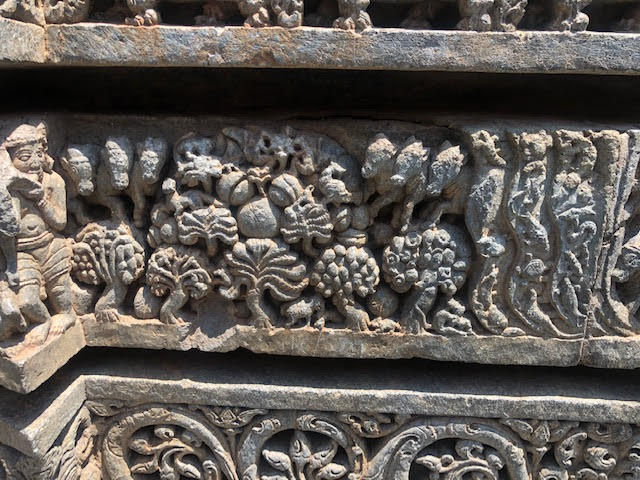
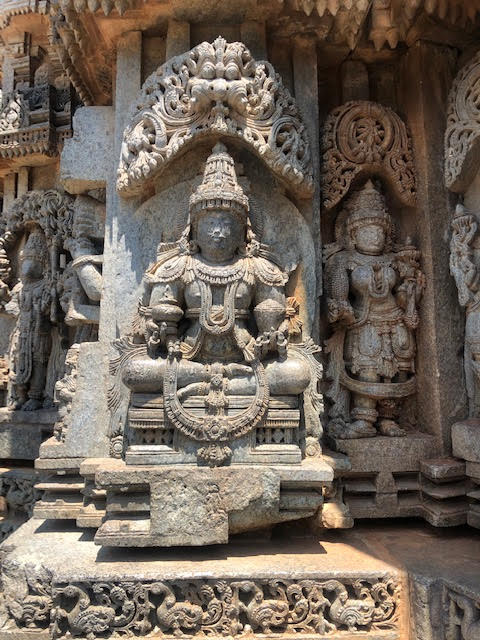
It is in this process that we got to know about a beautiful Hoysala-style temple situated in Somanathapura, which lies about 130 kms from Bangalore. This is the Chennakeshava Temple built by the Hoysala commander, Somanatha, in 1268 A.D.

And we made our way there with some friends.

It is an astounding structure, made completely of sandstone, with the most intricate carvings, built at the peak of Hoysala architectural excellence.

Chennakeśava means ‘handsome Keshava’, and the temple is dedicated to three forms of Vishu—Keshava, Janardhana and Venugopala. The main temple is on a star-shaped platform with three garbagrahas, each dedicated to one on the three forms. Besides this, there are 64 corridor shrines, set in magnificent pillared corridors. The main temple is surrounded by a pradakshina patha, all along which are carvings from the Ramayana, Mahabharata, Bhagavata Purana etc., which unfold as one undertakes the pradakshina.  The ceilings are decorated with intricate sculptures depicting different stages of the unfolding of a lotus. The massive stone pillars supporting the inner shrine were turned in ancient animal-drawn lathes.

The temple took several decades to build, but was in worship for only 60-70 years before it was sacked by invaders. Since the statues and the structure were defaced and broken, worship could no longer take place there, as per tradition.

It is a wonder that such an old and disused structure still stands in such good shape today—it is nearly 700+ years after it stopped being an active temple. It is in the hands of the Archaeological Survey of India (ASI), and one must appreciate their efforts to have the site in such good shape, standing in such well-maintained grounds. Even the toilets are fairly functional and clean.

But….

And it is a big BUT.

It is plagued by some problems which many of our heritage sites suffer from. For instance, we did not see a single signage anywhere on the roads telling the passers-by of the existence of such an amazing monument close by. Or to direct those who were looking for it.

Within 25 kms of the structure—leave alone on or near the premises—there is not a decent restaurant or even a picnic ground for those who had their own food.

But for the first time we came across a tech-challenge in such a place!

When we reached the gates of the monument and looked around for a ticket window, there was none. Instead there were a few flex posters, informing us of the rates (Rs 20 for online tickets), and a barcode to scan and pay. There were about six groups of tourists, all desperately trying to scan but no one was successful. After about five minutes, the helpful security guard came up to us and told us that it was not working. He suggested we should try to log into the ASI site, pay online and get our tickets. We all tried dutifully. But the signal was at best patchy and the site slow. My friend could get in. The names of each one of the group had to be entered. And the Aadhar or PAN of the person doing the booking. When she tried to pay, it got into a loop which there was no coming out of. We looked around, and many other people were in the same soup. We asked the Guard if he could not just take the money and give us tickets, but he told us that was not allowed. By this time, one person from another group was successful in getting his ticket from the ASI site. So using typical Indian jugaad, we begged him not to exit, but to do our ticketing online, and that we would pay him the Rs. 20/head in cash. He obligingly did this for some of us.

The whole process took us about 20 minutes and was pretty stressful.

And then we went in to visit the monument. Which fortunately was amazing enough to make it all worth while.

But it left us wondering what the point was. Does anyone who wants to visit a heritage site HAVE to have a smartphone? In a country where literacy, let alone digital literacy, is not to be taken for granted, should lack of these prevent a person from such basic access (never mind that it is a barrier even to COVID vaccination!). Is there an inherent age-discrimination–many older people are uncomfortable with all these scan-and-pay modes.  If the wifi does not work at a site, are people to go back the 150 kms they came to visit the monument? And why is the name of every visitor needed for buying entry tickets? Why is Aadhar or PAN information needed? Where does this information go, and what becomes of it?

If the purpose of technology is to make life easier for citizens, then this is surely not the way! The system is good in that it provides a nudge for digital payment (if you scan and pay it is Rs. 20, and if you could buy a physical ticket it is Rs. 25 per ticket). Nudges are good for bringing about behavior change. But taking away options is discriminatory and against basic rights. As is seeking information which is not relevant to anything!

Why does something like a visit to our own heritage sites have to become a battleground about rights?

–Meena

Silver-tongued Orator of the British Empire

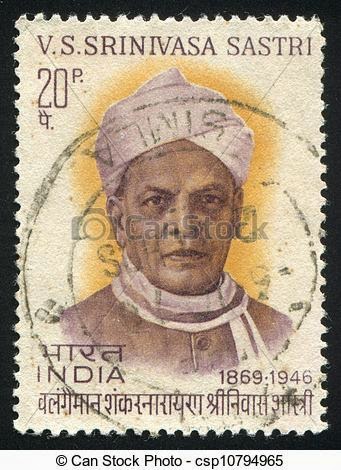
As a student, he corrected passages in JC Nesfield’s “English Grammar” (the standard grammar textbooks used in India in those days). He was often consulted over spellings and pronunciations by the English. His mastery over the English language was recognized by King George V, Churchill, Lady Lytton and Lord Balfour. Many rated him among the five best English-language orators of the century. He is the man of whom the Master of Balliol declared, ‘I never knew that the English Language was so beautiful till I heard Sastri speak it.’ He is the man who found 27 mistakes when Gandhiji sent him the first copy of his newspaper “Harijan” for review. He is the man to listen to whom the British Prime Minister Lloyd George postponed a cabinet meeting.  He is the man conferred with the title of ‘Silver-tongued Orator of the British Empire’.

This was Srinivasa Sastri, born to a poor priest in 1869 in the small village of Valangaiman in Tamilnadu. He was a brilliant student who did his education in Kumbakonam. He graduated in Sanskrit and English, and went on to become a teacher, and later the Principal of the Hindu High School, Triplicane, Madras.  Though he went on to be many things—freedom fighter, politician, diplomat, administrator—he probably remained at heart an educator.

His foray into public life began from academic roots—he founded the Madras Teachers’ Guild when he was Headmaster of the Triplicane School. He was also a pioneer of the co-operative movement in the country, and started India’s first co-operative society, the Triplicane Urban Co-operative Society (TUCS) in 1904.

He is said to have been so influenced by a pamphlet written by Gopala Krishna Gokhale that he gave up his job and joined the Servants of India Society, going on to become its President. He joined the Indian National Congress in 1908, and was nominated to the Madras Legislative Council in 1913. He was later also a member of the Privy Council.

He was a part of delegation which visited England in 1919, a delegate to the Imperial Conference and the Second session of the League of Nations in 1921. He played a key role in getting the Government of South Africa to drop legislation which would have led to the segregation of Indians there. In 1927 he was appointed India’s first Agent to South Africa.

Gandhiji and Sastri were lifelong friends, and respected each other deeply. The Mahatma always referred to him as ‘Anna’ , never letting him forget that he was 10 days older! However, Sastri’s views and stands were often controversial. He was seen as too accommodative of British actions. He opposed the Non-cooperation Movement on the grounds that it was subversive of the law and would set a wrong precedent. This and other similar stances brought him in conflict with Nehru and others in the Congress, and he resigned from the Party in 1922, and subsequently founded the Indian Liberal Party.

Late in life, he returned to his first love, academia, serving as Vice Chancellor of the Annamalai University, Chidambaram. He was a legendary teacher. Far ahead of his time, he believed that students were ‘comrades engaged in a common task and whom one should meet with a smiling face not only in the school room but on playfields ..’. He persuaded Mahadeva Iyengar, then Head of the Tamil Research Department of Annamalai, to translate Kalidasan’s epic poem Abhignana Sakuntalam in Tamil. His lectures at the Annamalai University packed the halls, with faculty competing with students for seats.

He headed a Committee set up in 1940 to frame a set of general principles for coining words for scientific and technical terms in vernacular languages. The report of this Committee was controversial, since it recommended the continuation of Sanskrit loan-words in Tamil technical language and this was violently opposed by Tamil adherents.

It was his tenure in Annamalai University that has special meaning for me. At this time, my grandfather Shri Anantavaidhyanathan was Head of the Dept. of Chemistry there, and the Right Honorable Srinivasa Sastri became a family friend, and mentor to my father A. Nagaratnam who was a student there.

Our family dictionary was a Cambridge Dictionary gifted by him to my father with the inscription ‘To Nagaratnam, with a grandfather’s blessings’, and signed. Alas, when my mother closed up her house, the dictionary (still in decent shape, if in two pieces, disappeared).

What a loss of a family heirloom! But still, I like to think that the pages my grubby childhood hands touched, had been touched by the legendary Silver-tongued Orator!

–Meena

He passed away on 17 April 1946. This week marks his death anniversary.

Get that Goat!

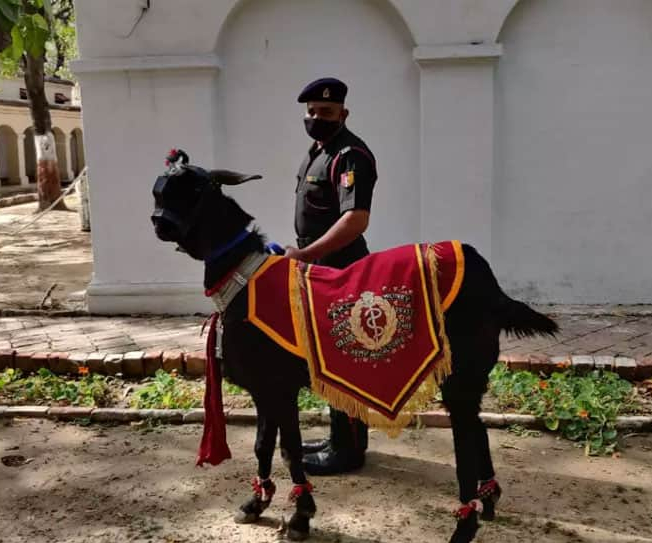
Last week, newspapers reported that when the Army Medical Corp Centre at Lucknow marked its Foundation Day, the marching band was led by Munna Havaldar. Mr. Munna is not a man but a goat, serving as a non-commissioned officer in the Regiment. And he is not the first! There has been a Munna Havildar in the regiment since 1951, the title handed down without break from one handsome Marwari goat to the next!

This is in keeping with the tradition of animal mascots that many army regiments, not only in India, but across the world have. Probably a tradition popularized by the British. Today, the British Army has nine animal mascots, from goats to ponies.

The Spanish Legion has its own goat mascot, ‘Odin’. The Bengal Tigress ‘Quintas Durga’, is the mascot for the 5th Battalion Royal Australian Regiment. ‘Chesty XV’ an English Bulldog is a mascot to the US Marine Corps.  The Sri Lankan Light Infantry mascot is an elephant. This is a tradition since 1961, and they are all named after the most famous elephant in Sri Lanken history, ‘Kandula’. ‘Brigadier Sir Nils Olav’ is a King Penguin who is the mascot of the Kings Guard of Norway. Toronto Zoo is home to the Canadian Army’s mascot, ‘Juno’, a female polar bear. ‘Bill the Goat’ is the mascot  of the United States Naval Academy.

Armies have both official and unofficial mascots or pets. Official mascots have a rank, and are maintained at the expense of the State. As with human soldiers, they too can even be promoted and demoted!

For some reason, goats are very popular mascots. In fact, they may be among the first-ever army animal mascots. The Royal Welsh Fusiliers have adopted goats as mascots since the 1770s, starting from the American War of Independence, during the famous Battle of Bunker Hill in 1775, when a wild goat entered the battlefield and led the Royal Fusiliers from the field.

Of course, goats are not very well-behaved or tractable. Lance Corporal William ‘Billy’ Windsor, mascot of 1st Battalion The Royal Welsh, earned a demotion in 2006 when he deviated from the parade he was leading in front of the Queen and tried to head-butt the drummers marching ahead of him.

Which reminds me of another goat which was a mascot not of a Unit in the Army, but of a road in Vastrapur, Ahmedabad. This strip of road (extremely narrow, bumpy and non-straight), lined with shops, parked vehicles, thelas and carts, temples and milling humanity, was a vital one connecting IIM, PRL, ISRO Colony etc. to the ‘other side’.

And it was ruled by a huge goat. He lay down in the middle of the road when he felt like, and all traffic had to flow around him. If he decided to take a walk and charge any pedestrian, they just had to make their way to safer ground. He was fed and pampered by all the shop keepers and denizens of the street. He had his pick of the choicest vegetables and fruits from the carts. If he felt like some sweets, he just had to make his way to one or the other sweet shop in the market. On festival days, he was festooned with garlands and daubed with paint. He was given to smoking, and the paan gallawallahs used to light beedies and put them in his mouth for him to puff at.

Sadly, the goat which gave the road so much character passed away of old age some years ago. Not being an Army Regimental Mascot, he was not replaced.

But thankfully, the road has been widened and smoothed!

–Meena

Multi-faceted Nation Builder: Remembering Kamaladevi Chattopadhyay

She persuaded Gandhiji to give a call for women to participate in the Salt Satyagraha.

She campaigned with Jawaharlal Nehru.

She argued with Sardar Patel, and convinced him.

She worked with the Kanchi Shankaracharya to defeat temple bureaucracies.

She complained against Indira Gandhi (and paid the price!).

She toured with her theatre company and mesmerized audiences.

She acted in the first Kannada silent movie.

She was the first woman to run for a legislative assembly seat in India

She pioneered thinking on legislation with regard to women in the workforce, and the safety of children.

She led international thinking on women’s Right to Health, and for the first time, brought to attention the economic value of women’s work in the house.

She revived Indian crafts and ensured their survival.

She founded institutions that are part of our national fabric even today.

Kamaladevi Chattopadhyay whose birth anniversary we mark this week on 3 April, was a woman of her times and before her time. She accomplished in one lifetime what many will not dare to attempt in three!

Born in Mangalore in 1903, her parents were immersed in the nationalistic cause and were a major influence on her. Freedom fighters and thinkers like Mahadeva Ranade, Ramabai Ranade, Gopalakrishna Gokhale, Annie Besant were family friends and set the course of her life. While her father died early, her mother pushed, supported and moulded her into a redoubtable force.

She was married at 14 and widowed two years later. After this, she married Harindranath Chattopadhyay. After several years, they were divorced.

There were three distinct phases to her life’s work for the nation:

Her contribution to the Freedom Struggle: She heard of Gandhiji’s Non-cooperation movement in 1923 when she was in England, and promptly returned to India to join it. She joined the Seva Dal, was a founding member of the All India Women’s Conference, and helped organize the Salt Satyagraha movement in Bombay.

Her work with Refugees: Seeing the plight of the people coming in from Pakistan after the Partition, she became active in their cause. Convinced that self-help and cooperatives were the way forward, she set up the Indian Cooperative Union to work on resettlement and rehabilitation of refugees, and built the township of Faridabad on these lines, rehabilitating over 50,000 refugees from the North West Frontier, building not only homes but their livelihoods through training them in new skills.

Her work with Artists and Craftspeople: Passionately committed to arts and crafts in every form, she recognized how fundamental they were to India’s way of life and the livelihoods of crores of people. She understood that the mechanization route that India was taking would impact these negatively, to a point where they might disappear, and she took on the mission to revive, revitalize and conserve these crafts and livelihoods.

Among the institutions she played an active part in setting up were the Sangeet Natak Academy, Central Cottage Industries Emporia, the Crafts Council, All India Handicrafts Board, National School of Drama, and the India International Centre.

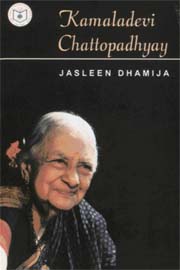
Kamaladevi was a prolific writer too, and her works, including her autobiography Inner Recesses, Outer Spaces: Memoirs may be the best way to learn more about her. A great starting point however is the lovingly written biography by Jasleen Dhamija’s Kamaladevi Chattopadyay. Brought out by the National Book Trust, it is a publication of less than 200 pages, which amazes you with how much can be packed into such a little book. And currently costing Rs. 100!

–Meena

Coffee, Bournvita, or Horlicks?

…asked my mother hospitably, when our friends Kiran and Jagdeep dropped in of an evening.

I could see the surprise on their faces. While in South India, it is perfectly normal to offer drinks like Bournvita, Horlicks or Ovaltine to guests, it is definitely unusual in the North. Nevertheless, they opted for Horlicks and enjoyed the beverage…they had not partaken of it for decades! In fact, so taken were they with the idea that they went out and bought a bottle for regular use at home!

These beverages were part and parcel of our growing-up years. So great was the belief in the abilities of these drinks to aid our growth, health and well-being that bottles of Horlicks and at least one of the other malted, cacao-flavoured drink were permanent fixtures in the larder. And partaken not just by the children, old and sick, but everyone in between as a change from coffee or tea. And of course, offered to guests in some parts of the country!

What are these drinks which are (were?) such an integral part of our lives?

Actually, India is as integral to Horlicks, as Horlicks is to India. We are the largest market for the drink in the world! The origins of the drink go back almost 150 years to 1873 when James Horlick, a pharmacist, along with his brother William, founded a company called J & W Horlicks in Chicago to manufacture a patented malted milk drink. Originally it was positioned as an infant and invalid food; then added old people and travelers in its target; and in the early 20th century was sold as a meal replacement drink. As far as the India story is concerned, it was brought back to India by our soldiers who were part of the British Indian Army returning from Europe after fighting in the First World War. People in the Punjab, Bengal and Madras presidencies quickly took to it, and it was a status symbol in the 1940s and ‘50s. While there was only one type of Horlicks for many decades, today we have not only a plethora of flavours—from elaichi to kesar baadam, we also have age and gender segmented products!

One distinctive characteristic of Horlicks was that it just would not dissolve! What a lot of stirring it took! The strategy was to spoon the powder into the glass, pour in a little super-hot water, and stir and stir. One interrupted the stirring with small breaks of trying to mash the lumps with the back of the spoon against the side of the glass. Only after about five minutes of all this would the glass be filled up with hot milk and/or water. And even with all this effort, there would be lumps left at the bottom when one finished!

This was not such a problem with the other popular drinks.

Compared to Horlicks, Bournvita is much more recent, having been developed in the late 1920s, and entering the Indian market only in 1948. This malted chocolate drink mix was invented by Cadbury and got its name from Bournville, the model village developed by the Cadbury factory. The original recipe included full-cream milk, fresh eggs, malt and chocolate  and was positioned as a health drink.

Ovaltine was developed in Switzerland, where it is known by its original name Ovomaltine (from ovum, Latin for “egg”, and malt).  It came to the UK in 1909, where a misspelling of the name on the trademark registration application led to the name being shortened to Ovaltine. And the name stuck in English-speaking markets. Originally advertised as consisting solely of “malt, milk, eggs, flavoured with cocoa”, it has changed the contents and formulation over the years. In India and the UK, it no longer contains eggs.

Complan, unlike the others, is made entirely of milk protein, and was developed in the UK in 1942, during the Second World War, as an easy-to-carry nutritious drink-mix for soldiers during battle where they take only very limited dry ration. It was launched in India in 1964.

Another lesser-known drink was Ragimalt, of which I can find no trace today. The violent orange drink was lapped by pre-teens but was way too sweet for anyone else.

Many of these drink mixes have stopped being sold in many countries—for instance, Bournvita was discontinued in the UK in 2008. With changing fads and tastes, with changing understanding of nutrition, with newer allergies which seem to prevent our children from eating and drinking what was basic a few decades ago, with trends like veganism, one wonders how long these drink-mixes will be around.

Maybe time to go out and buy a few bottles before it is too late?

–Meena

The Postman Does Not Knock Even Once

When is it that you last saw letters slipped under your door by the postman? For that matter, can you recall where your nearest postbox is?

The Indian postal system has a hoary history. The official website of India Post informs us that: ‘For more than 150 years, the Department of Posts (DoP) has been the backbone of the country’s communication and has played a crucial role in the country’s social economic development. It touches the lives of Indian citizens in many ways: delivering mails, accepting deposits under Small Savings Schemes, providing life insurance cover under Postal Life Insurance (PLI) and Rural Postal Life Insurance (RPLI) and providing retail services like bill collection, sale of forms, etc. The DoP also acts as an agent for Government of India in discharging other services for citizens such as Mahatma Gandhi National Rural Employment Guarantee Scheme (MGNREGS) wage disbursement and old age pension payments. With more than 1,55,000 post offices, the DoP has the most widely distributed postal network in the world.’

True, every word. Except alas, it needs a high school grammar exercise to be truthful: ‘Transform the verbs in present continuous to the past tense’. So the truth will read: ‘For more than 150 years, the Department of Posts (DoP) was the backbone of the country’s communication and played a crucial role in the country’s social economic development. It touched the lives of Indian citizens in many ways.

The post office has sadly lost its relevance completely–at least in the urban context. One can understand the supplantion of some of the functions: Telegrams are not relevant now that we have emails and whatsapp and phones for instantly reaching out; the phone at the post office which was used in the pre-privatization era has obviously given way to mobile phones in every pocket; money orders which we looked forward to so eagerly in our hostel days have been efficiently replaced by money transfer apps galore.  But we are still sending documents, packages, invitations etc. physically from one point to another. But we never think of using the postal system do we? By default, we use the private courier.

Private couriers came in with the promise of overnight delivery. At most, if it was the other end of the country, it was 48 hours. And that did work, for the first few years. And they do come over and pick up and drop off things. The Postman will definitely not come home if you have a package, even for a charge. And so we all started shifting to couriers.

But today, for all the fancy tracking and tracing systems, except for a few premier and highly expensive couriers, they take a good 3-4 days. And whatever the level of service, they charge a huge multiple of the value of stamps I think I would have stuck on a good old letter or package.

I am sure the Postal Department has a huge workforce. We see occasional announcements as to additional functions they will take on. But in day to day life, one seldom sees this happening.

A sad example of the public sector’s presence and importance diminishing in a key vital sector. I don’t care if Govt. of India sells all its PSUs—it probably should. But are there not some core citizen services where its presence needs to be maintained? Should these not be the focus of modernization, revitalization and re-imagination? Are we, as a country not the losers if India Post is not able to live up to its Vision and Mission quoted below?

Vision​​​

India Post’s products and services will be the customer’s first choice.​

Mission​

  • To sustain its position as the largest postal network in the world touching the lives of every citizen in the country.
  • To provide mail parcel, money transfer, banking, insurance and retail services with speed and reliability.
  • To provide services to the customers on value-for-money basis.
  • To ensure that the employees are proud to be its main strength and serve its customers with a human touch.​
  • To continue to deliver social security services and to enable last mile connectivity as a Government of India platform

–Meena

A Wise Lady from the 12th Century Guides Education Even Today

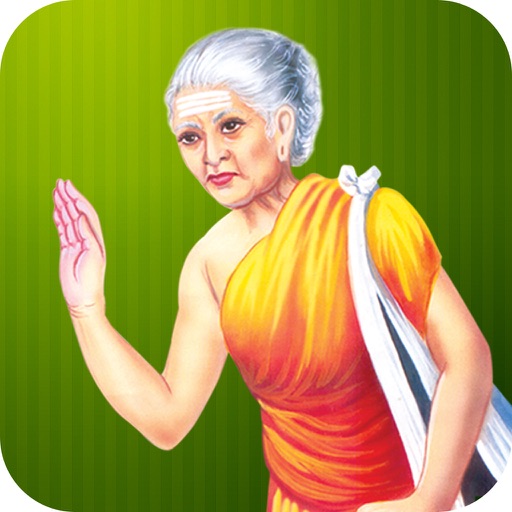
The Aathichudi is the alphabet primer with which every child in Tamilnadu takes its first step in education. It begins with: ‘A is for ‘Aram chaiya virumbu’. The phrase means ‘Intend to do good’. And this is the first thing that a child is taught. There cannot be a better way to start the journey of life.

And so the Aathichudi goes through the A to Z of Tamil, 108 lines in all, with short moral and practical aphorisms. It spans a wide variety of exhortations from ‘Control your anger’, to ‘Never stop learning’ to ‘Care for your parents’ to ‘Do not forget charity’ to ‘Do not allow suffering’.

If we think the ‘quote a day’ approach is new, let’s think again. The Aathichudi is a pithy moral-science textbook cum self-help book which was penned by the legendary Avvaiyar in the 12th century.  

Actually, there was not just one poetess called Avvaiyar  (meaning ‘Wise and respected lady’). There were at least three—the first was way back in the Sangam period (BC); the second probably in the 10th century; and the third, the author of the alphabet primer (among many, many other works) lived in the 12th century.

All of them were wise. They talked with kings and walked with common people. They effortlessly defied convention–they did not marry, they traveled alone across the length and breadth of several kingdoms, they advised kings. wrote poetry, and shared their wisdom. They shunned worldly wealth and power. They not only provided a moral compass to people of the time, but most of what they wrote is timeless.

How influential and independent these women were in their times—they were writing, advising, travelling, teaching, judging the literary works of others, acting as negotiators between kings to stop wars. Their works don’t just endure to this day; they are living documents which every adult, youth and child in the state can quote.

A few gems from Konrai Venthan, another of her works:

Oadhalin nandre vethiyarkku ozhukkam:  For priests, morality is more important than chanting.

Kutdram paarkkil suttram illai: Finding fault results in loss of relationships.

Kaip porul thannil meip porul kalvi: Education is the real wealth, more than the one in your hands.

Neraa noonbu seer aagaathu: A job not done well is not a job to be proud of.

Valavan aayinum alavu arinthu azhiththu unn: Even the super-rich should spend within limits.

Apart from being known to every school child through the Alphabet Primer, in Tamilnadu, the mass memory of Avvaiyar is, predictably enough, based on a film–one starring KT Sundarambal which was released in 1953. There are many, many stories and myths about the Avvaiyaars—from verbally jousting with Subramania (son of Lord Shiva), to being transformed from an attractive young girl to an old lady in an instant. This last was a result of praying to Ganesha, since Avvaiyar wanted to avoid getting into a marriage and family responsibilities, so that she could focus on her scholarly pursuits. There are besides, several statues across the State, including an imposing one at Marina (though how we know how she looked is not clear to me!). There are many college and educational institutions named after her.

For a long time now, people of Tamilnadu have been remembering her through the Avvai Vizha, an annual festival celebrated around mid-March, which is a gathering of scholars of Tamil and other subjects. This has, in recent times been taken over by the State Government. Besides this, the TN Govt. has instituted the Avvaiyar Award, to be given to ‘one eminent woman who has rendered excellent service in any one field such as Social Reform, Women Development, Communal harmony, Service for Language, Service in various disciplines in Art, Science, Culture, Press, Administration, etc., on the International Women’s Day which is being celebrated on March 8th every year’.

Avvaiyar even has a crater on Venus named after her—Feature 512!

But probably if she is looking down on us, what will please her most is that her work is still being used to lay the basics of literacy and education for children! And though she does not seem to make any explicit references to women empowerment nor set herself up as a role model, she will surely be happy that she is an inspiration for women through the centuries!

On the occasion of International Women’s Day…

–Meena

‘millennialmatriarchs’ was launched on 8 March, 2018. So this piece marks our third anniversary. Our heartfelt thanks to all those who have supported and encouraged us, and most of all, our kind readers!
Mamata and Meena

Thinking About Science

A few days ago, on Feb 28, we marked National Science Day. This commemorates the discovery of the Raman Effect.

As we think about the state of Science in India, there are two historical documents I would like to quote as my contribution to this day, to remind ourselves of the vision of the early national leaders, as well as the scientific leaders of yore.

The first is India’s earliest policy statement on the subject, tilted “Scientific Policy Resolution’, brought out by the Govt. of India in March 1958:

‘1. The key to national prosperity, apart from the spirit of the people, lies, in the modern age, in the effective combination of three factors, technology, raw materials and capital, of which the first is perhaps the most important, since the creation and adoption of new scientific techniques can, in fact, make up for a deficiency in natural resources, and reduce the demands on capital. But technology can only grow out of the study of science and its applications.

2. The dominating feature of the contemporary world is the intense cultivation of science on a large scale, and its application to meet a country’s requirements.

3. It is only through the scientific approach and method and the use of scientific knowledge that reasonable material and cultural amenities and services can be provided for every member of the community, and it is out of a recognition of this possibility that the idea of a welfare state has grown.

4. The wealth and prosperity of a nation depend on the effective utilisation of its human and material resources through industrialisation. The use of human material for industrialization demands its education in science and training in technical skills.

5. Science and technology can make up for deficiencies in raw materials by providing substitutes, or, indeed, by providing skills which can be exported in return for raw materials. In industrialising a country, heavy price has to be paid in importing science and technology in the form of plant and machinery, highly paid personnel and technical consultants. An early and large scale development of science and technology in the country could therefore greatly reduce the drain on capital during the early and critical stages of industrialisation.

6.  It is an inherent obligation of a great country like India, with its traditions of scholarship and original thinking and its great cultural heritage, to participate fully in the march of science, which is probably mankind’s greatest enterprise today.

The Government of India have accordingly decided that the aims of their scientific policy will be

1. to foster, promote, and sustain, by all appropriate means, the cultivation of science, and scientific research in all its aspects – pure, applied, and educational;

2. to ensure an adequate supply, within the country, of research scientists of the highest quality, and to recognize their work as an important component of the strength of the nation;

3. to encourage, and initiate, with all possible speed, programmes for the training of scientific and technical personnel, on a scale adequate to fulfil the country’s needs in science and education, agriculture and industry, and defence;

4. to ensure that the creative talent of men and women is encouraged and finds full scope in scientific activity;

5. to encourage individual initiative for the acquisition and dissemination of knowledge, and for the discovery of new knowledge, in an atmosphere of academic freedom ;

6. and, in general, to secure for the people of the country all the benefits that can accrue from the acquisition and application of scientific knowledge.

The Government of India have decided to pursue and accomplish these aims by offering good conditions of service to scientists and according them an honoured position, by associating scientists with the formulation of policies, and by taking such other measures as may be deemed.’

The second quote is from an important document called ‘A Statement on Scientific Temper’, put out by the Nehru Centre, Mumbai, in 1980, which lays down what scientific temper is:

ATTRIBUTES OF SCIENTIFIC TEMPER

Spread of scientific temper in society is much more than the spread of science or technology. Scientific temper is neither a collection of knowledge or facts, although it promotes such knowledge; nor is it rationalism although it promotes rational thinking. It is something more. It is an attitude of mind which calls for a particular outlook and pattern of behaviour. It is of universal applicability and has to permeate through our society as the dominant value system powerfully influencing the way we think and approach our problems—political, social, economic, cultural and educational. 

Scientific temper involves the acceptance, amongst others, of the following premises:

  1. that the method of science provides a viable method of acquiring knowledge;
  2. that human problems can be understood and solved in terms of knowledge gained through the application of the method of science;
  3. that the fullest use of the method of science in everyday life and in every aspect of human endeavour—from ethics to politics and economics—is essential for ensuring human survival and progress; and
  4. that one should accept knowledge gained through the application of the method of science as the closest approximation to truth at that time, and question what is incompatible with such knowledge; and that one should from time to time re-examine the basic foundations of contemporary knowledge.’

There is no need to re-articulate anything. The path is clear. What needs to be done is to ask ourselves, why we are not there!

We can judge for ourselves whether the Science Policy articulated close to 65 years ago has achieved what it set out to. And agonize how to put the focus back on ‘scientific temper’ which is relegated to the archives as a quaint and old-fashioned term.

Definitely needed more today than ever before!

–Meena