Golden morning sunlight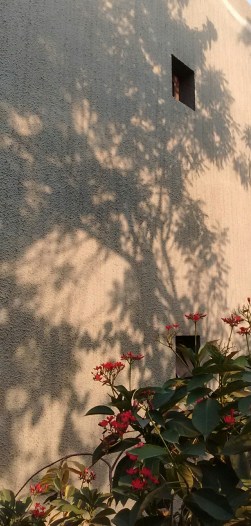
Dapples the grey wall
With dancing shadows.
Evening shadows grow longer.
–Mamata
Musings on Life and Times: Views, Reviews, Previews, Interviews..and Advice
Golden morning sunlight
Dapples the grey wall
With dancing shadows.
Evening shadows grow longer.
–Mamata
Last week a friend from France was visiting, and we had bhindi vegetable for lunch. The conversation turned to what this vegetable was called, and how it was eaten, in different parts of the world– from crisply fried Lady’s Fingers, to Okra soup. This not particularly fancy nor exotic vegetable boasts of a long list of synonyms including gombo, gumbo, quingombo, okro, ochro, bamia, bamie, quiabo!
Fruits and vegetables are such an integral part of our daily diet, but most of us are not aware of their intriguing histories. Many vegetable names simply refer to their shape, colour and taste. In the case of Drumstick, this makes sense, but to imagine bhindi as Lady’s Fingers does take a leap of imagination!
The names of many vegetables and fruits in English have their origins in languages like Latin, Spanish, and French; and sometimes the original meanings lie hidden in their names.
Eggplant was given its name by Europeans in the middle of the eighteenth century because the variety they knew had fruits that were of a whitish or yellowish colour, and the shape and size of goose eggs. The purple variety that we are most familiar with, and call baingan or brinjal may have been derived from the Sanskrit vatimgana. This word travelled through Persian to the Arabic name al-badinjan, and further filtered through Portuguese and Catalan to become aubergine in Britain and Europe.
Cabbage gets its name from Middle French caboche which means ‘head’. It was derived as a diminutive from Latin caput which means head as it resembled the head of a person.
Orange, the fruit on the other hand, was not named for its colour, but the other way round. The word is believed to have its origins from the Sanskrit naranga; which explains why, in several Indian languages, it is called narangi.
Pineapple seems to be a simple joining of two English words–pine and apple. But surprisingly this word was originally used for what we call pine cone; although it is inexplicable why an inedible, hard piece of a tree should be called a pine ‘apple’. To confuse things further, melon is the Greek word for apple!
In a similar vein, Gooseberry has nothing to do with geese. It was originally gorseberry, derived from the ‘gorst’ which meant rough. This berry was so called because it grew on a rough and thorny shrub.
Raspberry comes from the German verb raspen which means to rub together or rub as with a file. The marks on the berry were thought to resemble file markings.
Strawberry is a corruption of ‘strayberry’ which was so named because of the way the runners from this plant stray all over the place!
Currants were so called because they first came from Corinth. Cherries got their name from the city of Cerasus. The term grape is the English equivalent of the Italian grappo, and the Dutch and the French grappe, all meaning bunch. Raisin is a French word that comes from the Latin racenus, a dried grape.
Kiwi however takes the cake! It is so called not because it originated in New Zealand—the home of the Kiwi bird. It is the Chinese missionaries who brought the fruit to this country, and they called them Chinese gooseberries because they were from China and similar in flavour to gooseberries. It wasn’t until the 1960s, when New Zealand began exporting the fruit, that people started calling it Kiwi fruit.

And then there is the tomato. In culinary terms we consider it a vegetable; but this is actually a fruit in terms of its botanical characteristics—it is edible, contains a seed, is at least somewhat sweet, and grows on a plant.
16 October is celebrated every year as World Food Day. This marks the date of the founding of the Food and Agriculture Organisation (FAO) of the United Nations. Let each day be one of thanksgiving and celebration of the food we eat, by whatever name we may call it. After all, a mango by any other name will taste just as delicious!
–Mamata
World Post Day is celebrated on 9 October each year. This is the d ate on which the Universal Postal Union was established in 1874, in Bern, Switzerland. It was declared as World Post Day at the UPU Congress held in Tokyo in 1969. In just 50 years technology has hugely changed our modes of written communication. Soon there will be an entire generation that has never handled pen, paper, envelopes and stamps, and will never know what the age of physical post was all about. I do feel sorry for them!
Here is my small way of celebrating World Post Day!
An Ode to Letters
The last time I wrote a letter? Why, just today!
I need it like therapy, at least once a day.
I do not twitter nor tweet, tho’ the world finds it so neat!
Instagram and Snapchat…What’s that?
I like my words to be spelt as they must, and sentences that don’t rust.
Alas, now I too must type my words and SEND an e-mail.
Oh for the days when they were penned, and were snail mail!
I so miss the prelude, the preparation and the process…
Choosing the paper and filling the pen (with an ink called Quink!)
Trying to capture the words as they tumbled and tangled and dangled,
Protestations and lamentations, explanations and vexations.
Reports to parents, and advice to sisters, news to share and opinions to air.
Musings with friends–from mundane to surreal,
Sweet nothings to that someone special!
Drafting and crafting late into the night,
Stashing the sheets in the envelope, before first light.
To the post office the following day, to weigh and decide
The stamps to be bought, and pasted on the top right side.
Then drop into the big red box with swish and a wish,
And the delicious anticipation of the letter in return… a month, a week, a fortnight,
Counting the days, awaiting the post, what a splendid way to spend days and nights!
I cannot think of anything better, than the sheer joy of penning a letter!
For the dinosaurs who lived through the age of pen and paper, and those who may only read about it in history books!
–Mamata
It is the face that launched a thousand (and more) emoticons. It is the ubiquitous SMILEY! Probably one of the most recognizable icons across the world, this simple graphic had humble beginnings, and an interesting history.
The original version was created in 1963 by an American graphic artist and ad man Harvey Ross Ball. He was commissioned by an insurance company that had recently been merged with another, and was facing low employee morale. His brief was to create a visual icon to accompany a morale-boosting ‘friendship campaign’ that the company was planning to launch.

Harvey Ball picked up a black pen and a yellow piece of paper and started with just a grinning mouth on a perfect circle. Then he realised that this could be easily inverted to send a “frowney” message, and he added the small oval eyes. The left eye was deliberately created slightly smaller than the right, and the right side of the mouth thicker, larger and slightly off centre, in order to humanize the drawing through its imperfection. Thus emerged the world’s first Smiley Face! The design took Harvey ten minutes, and he was paid $45 for it.
The company first produced this design on a hundred buttons with a 7/8 inch radius, for its employees. But soon their clients also started requesting these, and the company ordered thousands of buttons. Soon the face started appearing on posters and signs also. It is not known to what extent it boosted morale, but the round yellow graphic made up only of two dots and a lopsided line was an instant hit!
Neither Harvey Ball nor the company had thought of taking a trademark or copyright on the design. With its unanticipated popularity, it was only a matter of time before the immense commercial potential of this was exploited. In the early 1970s, two brothers Bernard and Murray Spain added the tagline ‘Have a happy day’ (later changed to ‘Have a nice day’) and copyrighted the logo/slogan combination in 1971. The Spain brothers sold an estimated 50 million Smiley Face buttons, as well as an avalanche of other Smiley merchandise including coffee mugs, T-shirts, posters and, you name it… Beginning in 1996, Walmart tried to claim ownership of the design which they started using in their stores and TV ads. The disputed case dragged on for 10 years before they lost their claim to the Smiley Face.
Over the years as Harvey Ball saw how his simple idea for sharing a smile had changed. He observed that “Smiley has become so commercialized that its original message of spreading good will and good cheer has all but disappeared. I needed to do something to change that.” In 1999, he announced the formation of the Harvey Ball World Smile Foundation, a charitable trust that supports various children’s causes. Its slogan is “Do an act of kindness – help one person smile!”
Harvey Ball died in 2001 at the age of 79. He never regretted the fact that he did not make a penny more than $45 from the million-dollar industry that his Smiley spawned. He was satisfied that the smiling face, “has gone around the world. It’s reached everybody. Its message is as good as you can get.” Proud to be its creator, he often said, “I made the world smile.”
To spread his message, the first Friday in October is celebrated as World Smile Day. A reminder that a smile can make a difference!
–Mamata
It is Gandhi week, and newspapers are full of articles and pieces a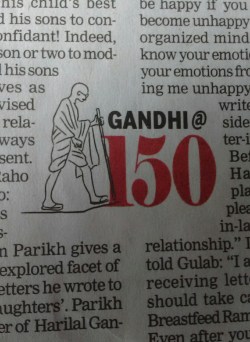 bout Gandhi, his thoughts and deeds. This year it is with renewed vigour as it marks the 150th anniversary of Gandhi’s birth. Being the prolific writer that he was, and the wide spectrum of subjects and areas on which he expressed his thoughts, every writer today can find some words of wisdom from Gandhi with respect to whatever they may choose to contribute for the ‘Gandhi special’ editions.
Gandhi himself was no exception to the pressure of meeting a newspaper deadline. Sometime in the second half on 1917 he wrote: I promised the Editor a contribution for the Diwali number of Hindustan. I find that I have no time to make good the promise, but thinking that I must write something, I place before the readers my views on newspapers. Under pressure of circumstances, I had to work in a newspaper office in South Africa and this gave me an opportunity to think on the subject. I have put in practice all the ideas that I venture to advance here.
Continuing, he went on to express his views on the business and ethics of newspapers of the day.
Newspapers are meant primarily to educate the people. They make the latter familiar with contemporary history. This is a work of no mean responsibility. It is a fact however, that the readers cannot always trust newspapers. Often the facts are found to be quite the opposite of what has been reported. If newspapers realised that it was their duty to educate the people, they could not but wait to check a report before publishing it. It is true that often they have to work under difficult conditions. They have to sift the true from the false in but a short time, and can only guess at the truth. Even then I am of the opinion that it is better not to publish a report at all if it has not been found possible to verify it.
How interesting that the same debate about Fake news, and news used to provoke and promote dissension and distrust, continues to rage even today, albeit now, in the context not only of the print media, but all other media also.
Equally thought provoking and relevant are his concerns about the potentially dangerous role that newspapers can play.
It is often observed that newspapers publish any matter that they have, just to fill in space. This practice is almost universal. The reason is that most newspapers have their eye on profits. There is no doubt that newspapers have done great service. …But to my mind they have done no less harm. …many are full of prejudices, create or increase ill will among people. At times they produce bitterness and strife between different families and communities. …On the whole, it would seem that the existence of newspapers promotes good and evil in equal measure.
He continues with his canny observations on how revenue from advertising tends to override other journalistic responsibilities. And this was over a hundred years ago!
It is now an established practice with newspapers to depend for revenues mainly on advertisements, rather than on subscriptions. The result has been deplorable. The very newspaper which writes against the drink-evil publishes advertisements in praise of drink. Medical advertisements are the largest source of revenue, though today they have done and are doing, incalculable harm to people. I have been an eye witness to the harm done by them. Many people are lured into buying harmful medicines. …No matter at what cost or effort we must put an end to this undesirable practice or, at least, reform. It is the duty of every newspaper to exercise some restraint in the matter of advertisements.
Ironically my newspaper today has ten full-glossy pages creating aspirations of ”dream” lifestyles, and wooing consumers with advertisements of state-of-the art luxurious residences, gadgets, and holidays; and profligate indulgences in food, drink, clothes, cosmetics and more. The other ten pages has the kind of news that Gandhi had been so concerned about (violence, intolerance, discrimination and disparity), along with a sprinkling of pieces about the Gandhian tenets of simplicity, honesty and truthfulness, and introspection! Contradiction, or comfortable and convenient co-existence? Something to think about indeed!
Written by Gandhi sometime before 14 November 1917 (originally in Gujarati) Source: Collected Works of Mahatma Gandhi, Vol.14. https://www.gandhiheritageportal.org
–Mamata
The beginning of autumn

decided by
the red dragonfly
Shirao
The September morning sky is dotted these days with dragonflies. It is an uplifting sight—to see them gliding gracefully, flitting, swirling and swooping like dancers against the canvas of blue sky and white clouds. I remember several Japanese Haiku that celebrate the dragonfly.
Dragonflies play an important part in Japanese life and culture. They are associated with autumn as well as spring, and are seen as harbingers of life and prosperity, birth, and renewal, happiness and strength. Japanese art, literature, textiles, and design, as well as literature (especially haiku poetry) reflect this close association and respect. The red dragonfly is considered to be sacred. One of the popular traditional pastimes of Japanese children has been catching dragonflies.
The dragonfly is one of the oldest of the insect species, which has inhabited our planet for almost 300 million years. It is natural that these insects have become an integral part of folklore in many cultures which have developed their own beliefs associated with the form and life cycle of insect.
In China, people associate the dragonfly with prosperity, harmony and as a good luck charm. Amongst Native Americans, it is a sign of happiness, speed and purity.
In many parts of the world the dragonfly also symbolises adaptation, transformation and renewal. In Native American culture it was seen as a sign of resurrection after a hard struggle. This is probably associated with the metamorphosis that the insect undergoes in its life-cycle, from a drab larval stage in which it spends most of its life before it emerges as a graceful and colourful adult. Once it emerges, it has a very short time to live its adult life, but it seems as if it flies freely with no regrets. The Dragonfly’s scurrying flight across water represents an act of going beyond what’s on the surface and looking into the deeper implications and aspects of life. Thus it symbolises the virtue of living in the moment and living life to the fullest, while at the same time looking deeper.
Across cultures, the dragonfly has been associated with magical qualities and mysticism. This may be associated with the fact that they exhibit the phenomenon of iridescence, which means that the body of the dragonfly can reflect and refract white light to create beautiful colours that change depending on the angle of light or the angle from which you look at them. Thus they also symbolize illusion–making others see you the way you want them to see!
Dragonflies are respected by fishing communities. In some places it is believed that plenty of dragonflies over a particular spot meant there were plenty of fish around. If a dragonfly hovered near the fisherman, he took it as a good luck sign.
I had not realised what a deep and rich association the dragonfly has in so many cultures. However I have not found much about this association in Indian culture. We do tend to somewhat overlook, let alone write poems about, these flying insects as they neither catch our eye as butterflies do, nor intrude into our daily life as flies and mosquitoes do.
But I did come across something that makes immediate sense for me. Seeing swarms of dragonflies means that rain is on the way; and as our monsoon still lingers this year, maybe they will bring more rain! And, more practically, that dragonflies are very useful in helping combat the mosquito and other pests that constitute their prey. I definitely consider having them around my house as a symbol of health and good luck!
See this dragonfly….
His face is
practically
nothing else but eyes.
Chisoku
–Mamata
September 16 was proclaimed as the International Day for the Preservation of the Ozone Layer by the United Nations General Assembly. It was on this day in 1987 that the Montreal Protocol to control production and consumption of Ozone Depleting Substances was signed by various countries at Montreal, Canada. Since then this day is used as an opportunity to bring to public attention the importance of the Ozone layer and the threats to it caused by human activities.
The theme for this year’s World Ozone Day is ‘32 Years and Healing’. This celebrates one of the few success stories in the gloom and doom of news about the environment. The healing is the outcome of three decades of international cooperation to protect the ozone layer and the climate.
On reading about this I felt a sense of satisfaction at having contributed in a teeny-tiny way to the healing effort. It was in 1997 that the Centre for Environment Education got engaged in a variety of projects to raise awareness about the issue to a wide range of audiences—from school children to policy makers. As part of this we developed educational material that could communicate the somewhat complex science in a simple way, as well as motivate people to take action to prevent what was then an ominously growing hole in the ozone layer.
Today both the science and the understanding has advanced greatly, but it is still useful to remember some ozone basics.
OOOzone: When it is alone, it is called an oxygen atom. When two oxygen at oms get together, it is called oxygen molecule or just oxygen. When three oxygen atoms get together, it is called an ozone molecule!
Where is Ozone? A thin invisible layer of ozone gas is found in the upper atmosphere 15-60 km above the earth. This is called the ozone layer.
How much Ozone? There are only one to ten units of ozone in every million units of gas or particles in the upper atmosphere. Instruments measure ozone in parts per million (ppm).
What does the ozone layer do for us? In the upper atmosphere, the ozone layer acts as a natural shield. It protects the earth and its inhabitants by absorbing the harmful part of the ultraviolet radiation from the sun. Too much ultraviolet radiation is dangerous for all living creatures—humans, animals and plants.
What kind of danger? In humans it may increase the rate of skin cancers, eye problems and cataracts; and also weaken the immune system. It can reduce crop yields as plants will have reduced leaf size and germination time. It could kill phytoplankton—the base of the food chain in water and disturb the entire aquatic food chain. It can also damage paints and fabrics, as well as plastic.
How is the ozone layer damaged? By the use of Ozone Depleting Substances (ODS) which include chemicals called CFCs and Halons, which are released through human activities, and which float into the upper atmosphere.
In the last thirty years since the awareness about the danger from these substances was recognised, there has been a consistent effort at national and global levels to phase out the ODS, through policies, international agreements, and R&D in industry to find better substitutes. The Montreal Protocol has led to the phase-out of 99 per cent of ozone-depleting chemicals in refrigerators, air-conditioners and many other products.
However there are still products in the market that could potentially be threats. As consumers we can all play a role in protecting the layer that protects us, through the choices we make. Here are some tips on what we can avoid. Avoid aerosols whether for pesticides or perfumes. Avoid Styrofoam glasses and plates; use reusable steel and glass vessels. Avoid foam mattresses and pillows, use traditional cotton or coir products. We must also remain vigilant to tackle any illegal sources of ozone-depleting substances as they arise
While we can celebrate success this year, this day is also a reminder that we must keep up the momentum to ensure healthy people and a healthy planet.
–Mamata
Remember the loveable character of Mary Poppins who could fix messes in homes and families? Don’t we all sometimes wish that Mary Poppins would fly into our lives and set things straight? Someone who could discipline us to set ourselves in order? Believe it or not there is a real new-age Mary Poppins, and her name is Marie Kondo!
Who is this new Marie and what does she do? Marie Kondo is a Japanese “tidying expert!” She helps people to clear up the clutter in their homes, and guides them towards creating spaces of order and serenity.
Marie was born in Japan in a culture which celebrates beauty in simplicity. Marie grew up with the ingenious origami art of folding, artistic ikebana, beautifully orchestrated tea ceremonies, and the art of creating minimalistic but serene surroundings, as well as an inborn gift for creating order out of chaos. She added to this, a canny entrepreneurial spirit when she started her “tidying consultant” business as a 19-year old university student in Tokyo. Realising the immense need and scope of “tidiness consulting” in an age when people lives were ‘cluttered’ in every which way, she went on to write a best-selling book “The Life-Changing Magic of Tidying Up.”
Where Mary Poppins created magic with the wave of her umbrella and a catchy tune on her lips, Marie Kondo starts her process of transformation in a more oriental style by making her clients calmly meditate on how their space is special to them, and to give thanks for this. She then proceeds to gently but firmly get them to review all their possessions, and let go whatever does not “spark joy” in them, after thanking these for their service! She then advises on how to rearrange and reorganise the remaining belongings by category, following the KonMari Method.
Today Marie is a global expert with her own Netflix’s hit show “Tidying Up With Marie Kondo, and founder of KonMari Media Inc.
I admire this young woman who has found herself a natty niche, and is smart enough to make a successful enterprise out of it. But I cannot but help thinking of the generations of homemakers who have kept beautifully organised and managed homes with limited resources, but much hard work, care and creativity. For them it was a way of life, into which they were oriented by mothers and mothers-in-law. Today when we have much more of everything, except time and patience, voila, Marie Kondo is at your service!
–Mamata
September 5–Teacher’s Day in India is marked by awards, articles, and essays remembering and honouring those who instruct and inspire. Across the world, and across generations, there have been many who have left behind their legacy on the young minds and lives. Films and books have tried to capture some of this in their own small way.
A film that I saw recently was a new addition to this list of ‘must watch and must read’. Freedom Writers tells the story of an idealistic young teacher confronted with the challenge of teaching ‘unteachable, at-risk’ students, and her non-conformist attempts at making meaningful connections.
The movie is based on the real experiences of Erin Gruwell that she documented in a book titled The Freedom Writers Diary: How a Teacher and 150 Teens Used Writing to Change Themselves and the World Around Them. The book was published in 1999.
Erin was a 23-year-old white American when she stepped into her classroom of a motley group of African American and Latino teenagers coming from a world of broken homes, violence, and every form of social, cultural and economic discrimination. Instead of giving up, and simply labelling her charges as ‘unteachable’, Erin realised that these young people were deprived of exposure, attention and respect. One way to open up their vision and world was to introduce them to writings that shared similar histories of discrimination, beginning with The Diary of Anne Frank, and Zlata’s Diary: A Child’s Life in Sarajevo, and including a visit to the Holocaust Museum of Tolerance in Los Angeles. Despite initial resistance, the students began to see the parallels between these books and events in history, and their own lives; they realised that they were not alone in their struggles. Erin then moved on to encouraging every student to keep a journal in which they recorded their thoughts and feelings about their past, present and future.
The students were so inspired by Anne Frank’s story that they organised a “Read-a-thon for Tolerance” and collected funds to invite Miep Gies, the Dutch woman who sheltered Anne Frank’s family, to visit them in California during the 1994/1995 school year. Miep declared that Erin Gruwell’s students were “the real heroes”. As a testament to Erin’s dauntless efforts, all 150 Freedom Writers graduated from high school and many went on to attend college—a hitherto unachieved triumph.
The book The Freedom Writers Diary is a compilation of the journals kept by these students. Its title The Freedom Writers is a tribute to the name of the 1960s US civil rights group called Freedom Riders. Erin’s book was a huge success. She went on to set up The Freedom Writers Foundation, which functions to promote Erin’s successful teaching methods.
The film brought to mind another path-breaking movie To Sir, With Love. Released in 1967, this is also based on an autobiographical novel by E.R. Braithwaite which recounts his experiences as a teacher in London. In this case, it was the challenge of a teacher of colour teaching a class of white, economically and socially-deprived teenagers in a working-class area of London. Facing similar challenges of teaching a set curriculum to semi-literate and disinterested, hostile students, Braithwaite took on the challenge by switching to unconventional teaching methods including visits to museums, and allowing students to discuss what was meaningful to them, in the class. Like Erin, he broke through the barriers, and succeeded where others had thrown up their hands in despair.
Inspiring films both. Also a reminder that, in any time and place, a single individual can make a big difference. A tribute to every teacher, who in his or her own way, touches countless minds and hearts, and changes lives.
–Mamata
Imagine that you are cruising along a highway; enjoying the smooth flow and passage of time and miles. On the other hand, imagine you are in a city, driving at the required speed, eagerly crossing the green lights, slowing at the amber, and every now and then, stopping at the red light. There is a sense in both the experiences; in both cases, a different kind of pace is set.
The act of writing could perhaps be compared to this. Every writer sets their own pace and rhythm of how the words flow. For some the long uninterrupted cruise is the mode of choice; others prefer the ordered structure of breaking the flow, sometimes with a pause and sometimes with a longer halt—from green to amber to red. It is the punctuation marks that represent these traffic lights.
Many writers have expressed their thoughts on these—essential parts of t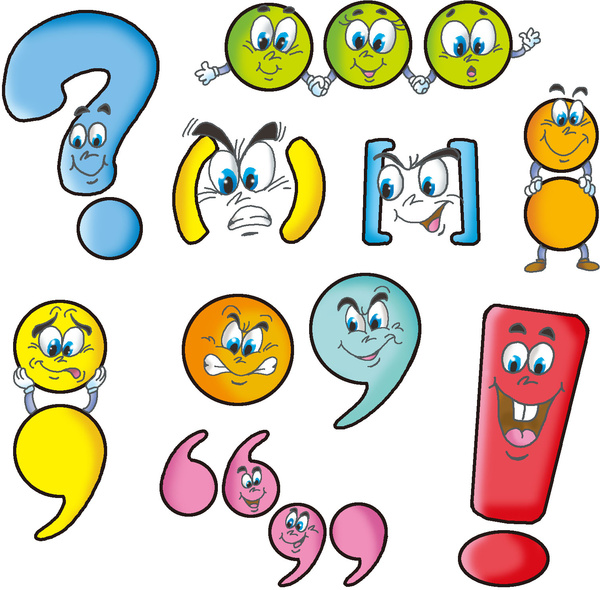 he tools of their trade. Some have celebrated punctuation as the friendly spirits whose bodiless presence nourishes the body of language”, while another believes that each writer has a lifetime quota of them, to be used judiciously. I myself have always enjoyed the mental exercise of fixing the appropriate place for the appropriate mark, and am always attracted by how authors perceive and practice the use of punctuation marks.
I recently read a delightful articulation of this in an article which had excerpts from an essay titled Notes on Punctuation by Lewis Thomas. Thomas was an American physician, poet, etymologist, essayist, administrator, educator, researcher and teacher. Amidst his serious research and writing, Thomas applied equal affectionate attention to the traffic signals, giving each one a distinct character and identity.
Sharing some in his own words.
, The commas are the most useful and usable of all the stops. It is highly important to put them in place as you go along. If you try to come back after doing a paragraph and stick them in the various spots that tempt you you will discover that they tend to swarm like minnows into all sorts of crevices whose existence you hadn’t realized and before you know it the whole long sentence becomes immobilized and lashed up squirming in commas. Better to use them sparingly, and with affection, precisely when the need for each one arises, nicely, by itself.
; I have grown fond of semicolons in recent years. The semicolon tells you that there is still some question about the preceding full sentence; something needs to be added; it reminds you sometimes of the Greek usage. It is almost always a greater pleasure to come across a semicolon than a period. The period tells you that that is that; if you didn’t get all the meaning you wanted or expected, anyway you got all the writer intended to parcel out and now you have to move along. But with a semicolon there you get a pleasant little feeling of expectancy; there is more to come; read on; it will get clearer.
: Colons are a lot less attractive, for several reasons: firstly, they give you the feeling of being rather ordered around, or at least having your nose pointed in a direction you might not be inclined to take if left to yourself, and, secondly, you suspect you’re in for one of those sentences that will be labeling the points to be made: firstly, secondly and so forth, with the implication that you haven’t sense enough to keep track of a sequence of notions without having them numbered.
!!! Exclamation points are the most irritating of all. Look! they say, look at what I just said! How amazing is my thought! It is like being forced to watch someone else’s small child jumping up and down crazily in the center of the living room shouting to attract attention. If a sentence really has something of importance to say, something quite remarkable, it doesn’t need a mark to point it out. And if it is really, after all, a banal sentence needing more zing, the exclamation point simply emphasizes its banality!
As for me, I do so love the comma, and simply cannot resist the !!!
–Mamata
 Millennial Matriarchs