
Two news items last week took me to my cache of ‘saved for a rainy (read lockdown) day’ books.
The first was that the tagline for this year’s World Health Day is ‘Support Nurses and Midwives’. April 7 is celebrated as World Health Day as it marks the anniversary of the World Health Organization which was founded in 1948.
The second news was that on April 3 Britain’s first emergency field hospital exclusively for coronavirus patients was inaugurated in the East End or docklands of London. More remarkable, that a large exhibition space, usually used for large events such concerts and conferences, was transformed into this 4000 bed hospital in just nine days. The hospital is fittingly called NHS Nightingale Hospital. Similar Nightingale hospitals are planned to be set up in different cities of UK, as emergency sites to treat coronavirus patients.
Calling these facilities Nightingale hospitals, is an apt and timely reminder of Florence Nightingale, who almost 200 years ago changed the face of nursing from a mostly untrained profession to a highly skilled and well-respected medical profession with very important responsibilities.
These stories took me to the book titled Called the Midwife by Jennifer Worth. The book is the memoir of the years that Jenny, this young nurse an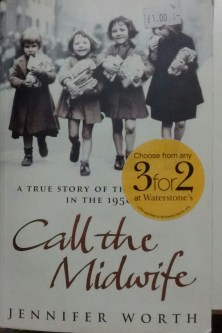 d midwife spent in the poor slums of the East End of London. 23 years old and newly qualified she lived and trained as a midwife with a dedicated group of nuns St Raymond Nonnatus.
Though set in the 1950s, the conditions of the area, and the people who lived in these docklands were appalling in terms of health, hygiene and sanitation. The book recounts anecdotes that paint vignettes of the people, and the experiences as a midwife, delivering babies at home amidst challenging and often overwhelming circumstances. But where the narration could have been dark and depressing, Jenny’s description of her patients and their families brings out the touching humanity, and tough spirit that rises above the squalor. Whether it is the pen portraits of the nuns, each with a unique personality; the fellow trainees; and the soon-to-be or new mothers (from the first baby of a 14 year-old girl, to the 25th baby of a 45 year-old woman!), the book captures the power and spirit of the vocation. Rushing on their bicycles through the freezing smoggy streets with their simple delivery bags to attend a calling the middle of the night (almost 100 deliveries a month), to the daily routine of morning and evening home visits for pre and post-delivery check-ups, one cannot help but applaud the total dedication and role of the midwives.
Interestingly in India generations of children had been born at home under the hand of the local midwife or dai. Around the time when Jennifer Worth was a midwife in England, hospital deliveries started becoming more common in India. In the last fifty years, with advances in the world of medicine, and advancing technology, the traditional art and craft of midwifery was replaced with the science of sonography and Csections. Interestingly, in the last ten years or so, there seems to be a return to the traditional ways of childbirth. While at the one end of the spectrum, there are boutique clinics offering 5-star deliveries, other young women are opting to ’call the midwife’. And there is a new generation of Jennys who are undergoing the rigorous training of midwifery to qualify and practice as midwives.
It is fitting indeed that WHO has designated 2020 as the Year of the Nurse and Midwife, in honour of the 200th birth anniversary of Florence Nightingale who fought, against all odds, in the frontlines of the Crimean war. And once again, more than ever before, it is time to salute these brave and tireless soldiers who are at the frontline of the Corona war. Hail, to all these Nightingales! 
–Mamata
 cutta, but Bangalore was also Sir Raman’s ‘karma bhoomi’, in that he worked at the Indian Institute of Science from 1933 till his retirement in 1948, after which he founded the Raman Research Institute in the city, and continued working there till his death in 1970.
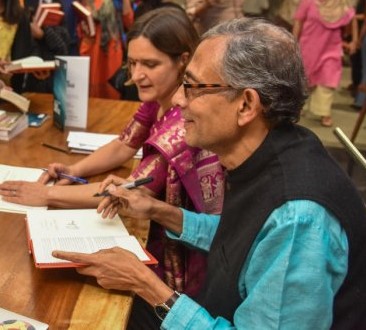 January 4 was also the day when Profs Abhijit Banerji and Esther Duflo were in conversation with Manish Sabarwal at the Bangalore International Center, and demystified RCTs, or Randomized Control Trials, the body of work which got them their newly minted Nobels. RCTs are an experimental method to do research on developmental issues like education and poverty, to find what can really be effective to solve the problems, and hence can help policy making.
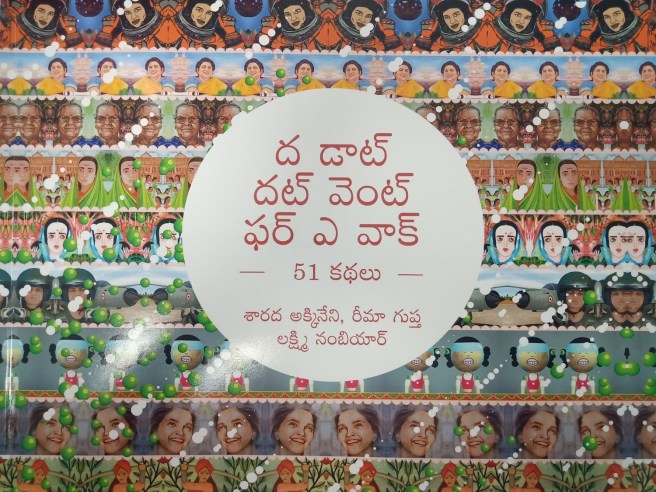 Everything starts with a dot. On a mid-summer day, I got a call from Reema Gupta, who is the co-lead of the Women’s Leadership and Excellence Initiative at Indian School of Business, asking if I could translate the book she had co-authored along with her two friends. The book “The Dot that Went for a Walk” was written in English by Reema and her two friends Sarada Akkineni and Lakshmi Nambiar who have made it a mission to create social change and empower young girls through inspirational stories. Inspired by the quote of artist Paul Klee “A line is a Dot that went for a walk”, the book was titled “The dot that went for a walk”. They wanted the book to be available in regional languages including Telugu.
 We who worked at the Centre for Environment Education (CEE) were lucky. The list of luminaries with whom we had the opportunity to interact was beyond belief.
 this past weekend. The venue itself was unique—the Art District in Alembic City with its sprawling lawns, old trees, and intriguing studio spaces housed in what was Alembic’s (remember those ubiquitous Yera glasses?) first factory, over a hundred years old! Imagine this coming alive with the colour, sound and movement of thousands of children—a vibrant tapestry seamlessly weaving the past, present and future.
 Millennial Matriarchs