
As I was walking along in my colony the other day, on a patch of grass I saw a gory sight. Someone had stepped on a snail. It was crushed. And beside it, I saw a yellow outgrowth. I couldn’t figure out what that was: for a moment I thought that the snail had been dead for a few days maybe, and some kind of mushrooms or fungi had grown there, thanks to the nutrients available. That didn’t seem too plausible. So my next idea was that in fact the accident was very recent, and these were the snails innards. But a closer look revealed that small yellow balls made up the outgrowth. So the final conclusion (borne out by web-searches) was that the crushed snail had been pregnant, and the eggs had come out and lay beside the dead father/mother.
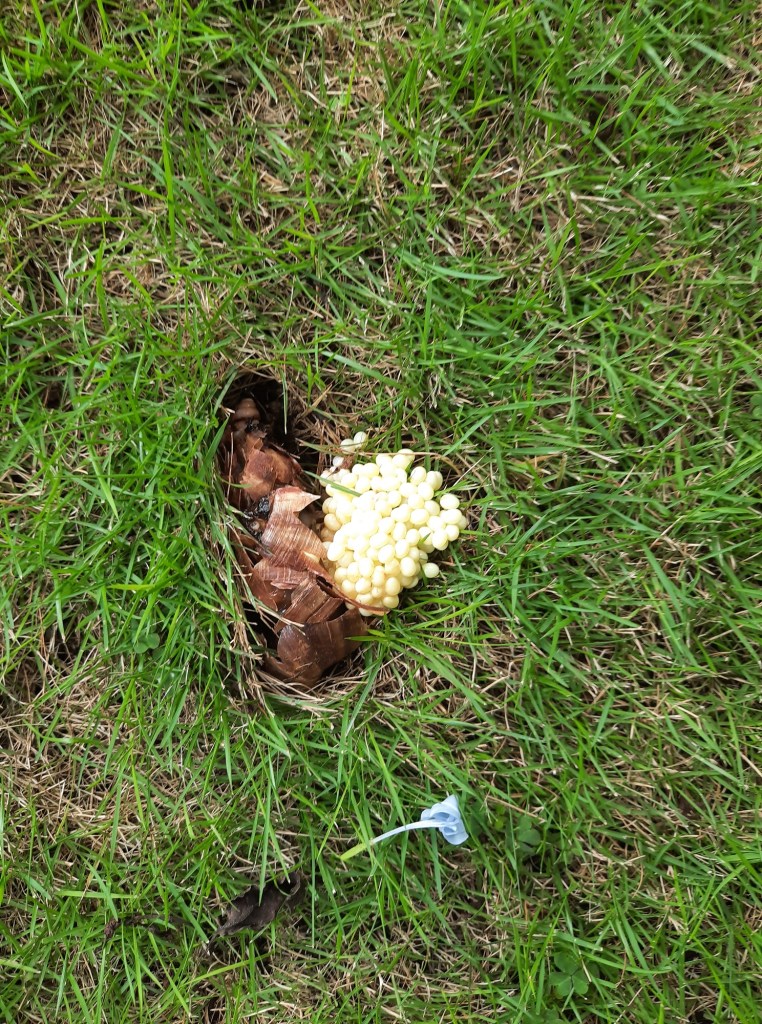
Father/mother? What does that mean? Well, if you remember your high-school biology, most snails are hermaphrodites–which means that they have the reproductive organs of both males and females. In theory therefore, they have the ability to self-fertilize. However, they don’t usually do that. They mate in the “traditional way.” As a result, both of the partners lay eggs. Each clutch has about 200 eggs on average, and each snail may lay 5-6 clutches per year.
And this high reproductive ability is a cause of great concern. Because the crushed specimen was a Giant African Land Snail, one of the most invasive species ever. A native of East Africa (mainly Kenya and Tanzania), today the snail has spread across almost the whole world, an active and aggressive pest. Given the rate of its reproduction the snail spreads like a wildfire. It is extremely adaptable, and eats about 500 species of plants, and hence poses a threat to both agricultural crops and native plants wherever it goes. Not only does it eat the plants but it is also a vector for plant pathogens, thus causing further damage to agricultural crops and native plants. It carries the rat lungworm parasite and can transfer it to humans, causing meningitis. And once entrenched, the snails are almost impossible to get rid of. Some states of the US have spent millions of dollars to eradicate the creatures, but with limited success.
But coming back to snails in general. Well, snails are gastropod mollusks, which means they are related to both octopuses and slugs. There are some species adapted to living on land—the land snails, and there are aquatic snails, which live in either fresh water or the sea. All snails carry shells into which they retreat when threatened by predators, or in unfavorable weather. They hatch out of the eggs with small shells, which grow as they grow. The shells are made of calcium carbonate, and they keep adding more of it to the edges of the shells till they are adults. They don’t have legs, but move thanks to the muscular movement of their bodies, and aided along by the mucous they secrete which helps them to reduce friction and slide along. And moving along at snail’s pace means maintaining an average speed of about half-an-inch per second. They can’t hear, but their sight is good and sense of smell even better. They live for 3-7 years. While most species are hermaphrodite, there are some which are not and have distinct males and females.
Well, we do know that snails are a delicacy in some parts of the world. But lesser known is that in places in the UK, snail-racing is a sport! Snail shells are also sometimes incorporated in jewelry. Certain varieties of snails, especially the Muricidae family, produce a secretion that is a natural dye. In ancient times, purple and blue dyes were made from these snails, and were very expensive and prized. There was also belief that snails had medicinal properties, especially for bronchial problems, tuberculosis, etc., and some of these uses are still being investigated. And not to forget, snail slime may well be a part of that anti-aging cream or moisturizer you just bought!
Coming back to my crushed snail.
I know the person who stepped on him/her did so unknowingly.
And that if that clutch of eggs had hatched, we would have hundreds of more pests to ruin our gardens.
But still I cannot but feel a little sad, at the memory of the crushed body and the doomed eggs.
–Meena


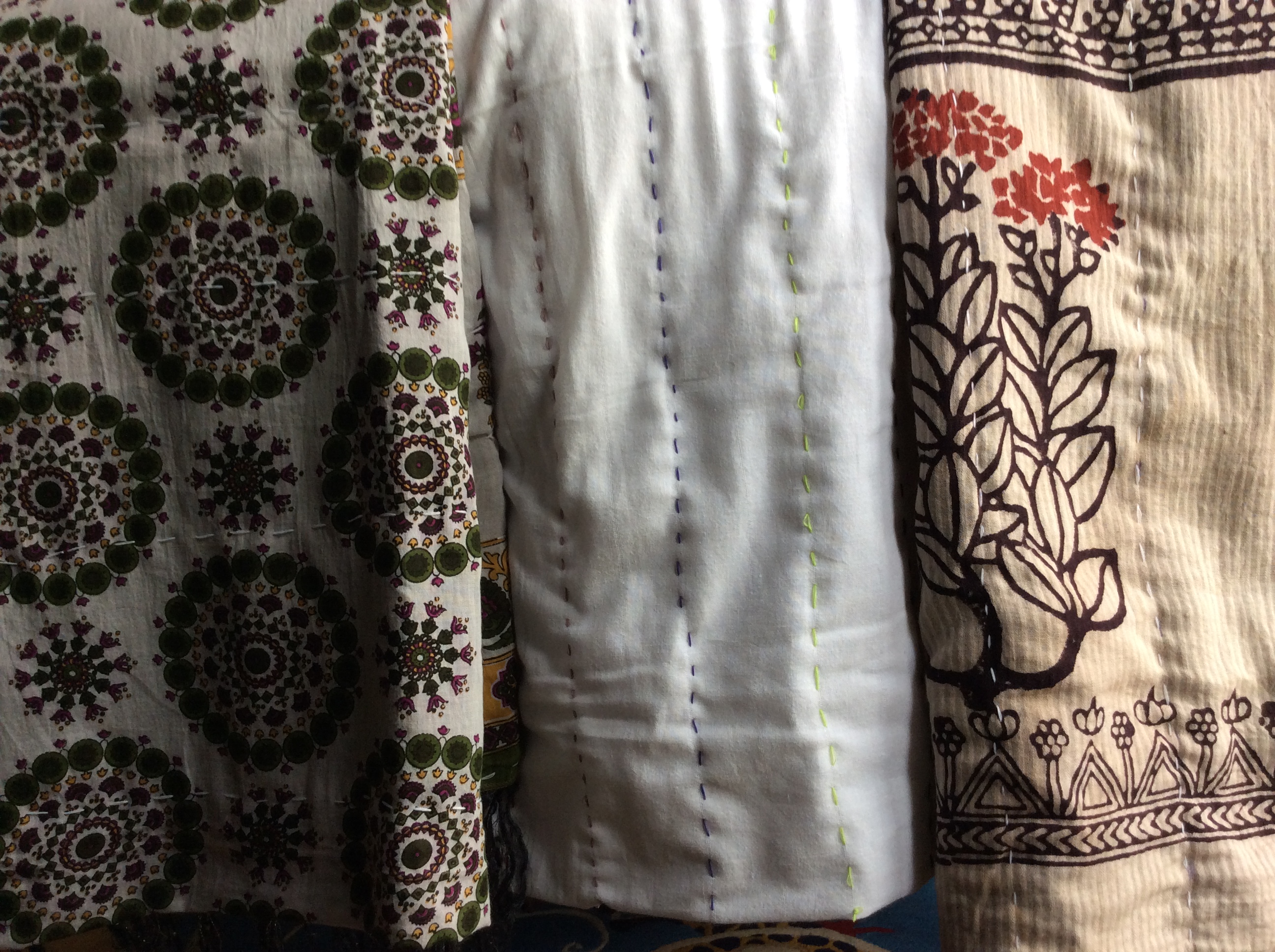 So I thought I would turn these into baby quilts. My interpretation of
