Flamboyance
Fiery 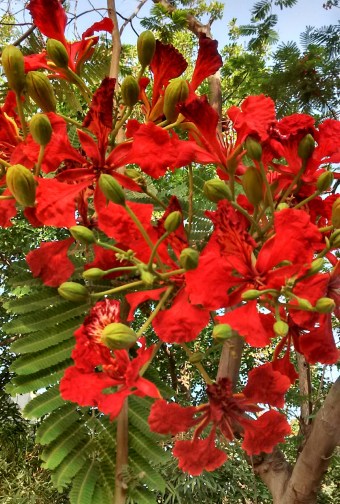 Brilliant
Blooming Bursting Flaming
Sets the tree on fire
Gulmohar
–Mamata
Musings on Life and Times: Views, Reviews, Previews, Interviews..and Advice
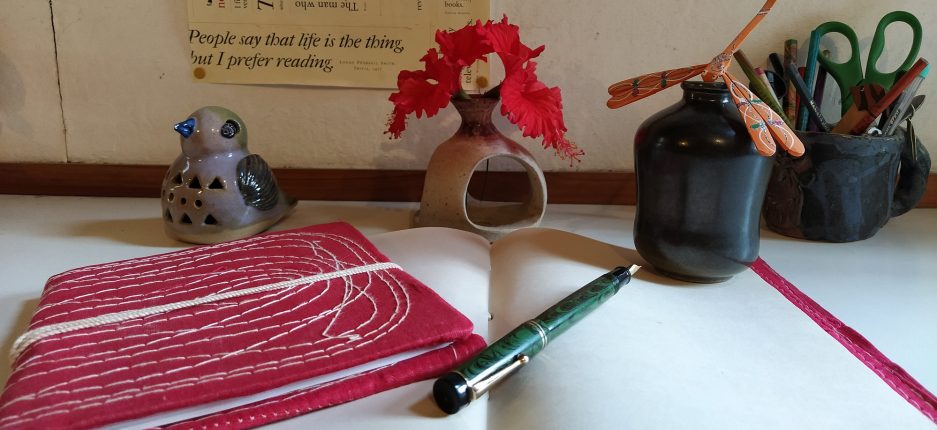
Flamboyance
Fiery Brilliant
Blooming Bursting Flaming
Sets the tree on fire
Gulmohar
–Mamata
In Indian mythology, Nandi the bull is both the guardian of Mount Kailash, and the vehicle of Lord Shiva. The worship of Shiva and Nandi goes back to the time of the Indus Valley Civilization. The bull-seals found in Mohenjodaro and Harappa have led some researchers to conclude that Nandi worship goes back many thousands of years.
A statue of a seated Nandi is often found in front of Shiva temples, facing the God. In metaphysical terms, Nandi represents the individual soul, looking to unite with the universal soul or Shiva. At a mundane level, people often use Nandi as a communication medium, whispering wishes into his ears, so that he may convey them to Shiva, who may listen to him more readily than to us!
Why suddenly this interest in Nandi? Because I was in Orissa this week, and did a three-hour road journey and also visited 5-6 villages.
Still doesn’t explain it?
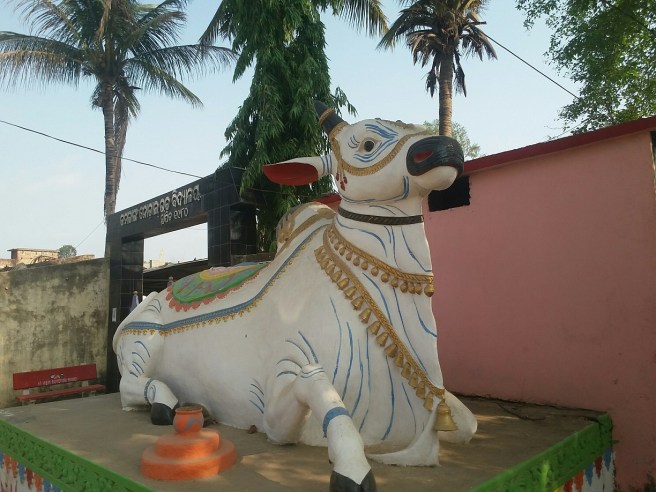
Well, it was the number of Nandi statues I saw in this time. Almost every hamlet and village had one. Pretty big and prominent. Sometimes the shrines they were in front of were smaller than the Nandis. And there were also some stand-alone Nandis! They were in all shapes and sizes. A few small, most medium sized and a few really large. Some smiling, some serious, some with inscrutable expressions. Some puny and under-fed, some healthy. Some in proportion and some not-so. But Nandi, after Nandi, after Nandi.
I have travelled to several states. I have seen ever-increasing number of stand-alone Hanuman statues; and several Shiva statues. But as far as I can recall, I have not come across so many Nandis. I am not sure why there should be so many in Orissa particularly, because traditionally, large Nandi statues are more prevalent in the South—Andhra Pradesh, Karnataka, Tamilnadu. But I do not recall that Nandi statues are found so commonly in these states.
The largest bull statue is in the Mahanadiswara Swamy temple in Kurnool, AP. It stands 15ft by 27 ft. This is followed by the bull in the Lepakshi Temple, also in AP. Other prominent Nandis are the ones at Chamundi Hills, Karnataka, Brahadishwara Temple, Tamilnadu, and of course, Banagalore’s own Bull Temple. Orissa does have one of the big 10 Nandis, at Bhanjanagar town.
But I think the state must beat all simply in the number of Nandis dotting the state scape. These are not old—would not think many are over a decade in age. It would indeed be interesting if someone could undertake a study to understand why there is such a proliferation in recent times. Wish it could be me, but sadly, I don’t think I can do it at the moment. So when I go back to Orissa, I will content myself with just looking out for them, counting them and clicking them
–Meena
From the fiery furnace 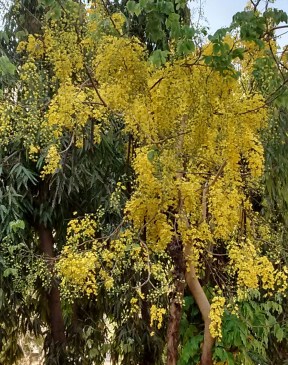
of the sun
A cascade of
molten gold.
–Mamata
What is red and green and white,
And a summer delight?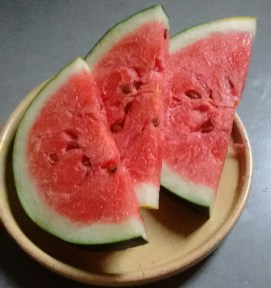
Watermelon!
This uncomplicated sweet and juicy fruit has always marked the onset of summer (prelude to the more sensuous, refined flavours of the mango!).
A recent family discussion on whether there was more to this melon than a lovely colour, sugar and water led me to explore. This is what I discovered!
Yes, it is 91.5% water, and thus a great antidote to dehydration; the juice is also full of good electrolytes which can even help prevent heat stroke.
But what else?
Watermelon is great for your health! It not just refreshes, a watermelon…
Is loaded with vitamin C and vitamin A, and contains essential minerals like potassium.
Has dietary fibre for digestive health.
Is bursting with lypocene which is considered to be a super antioxidant that prevents damage to cells and immune system.
Contains a natural substance called citrulline that is said to improved artery function and lower blood pressure, as well as protect against muscle pain. Watermelon juice before a gruelling workout may help reduce muscle soreness. But guess where citrulline is concentrated most? In the white flesh near the rind, which also has blood-building chlorophyll! So instead of throwing this away–try putting it in a blender with some lime for a healthy, refreshing treat.
And for something that tastes sinfully good, it is fat-free, and very low in sodium and calories.
Curiously the watermelon (Citrullus lanatus) wears a dual hat of being fruit as well as vegetable, belonging to the Cucurbitaceae family which includes cucumber and pumpkin.
It is believed to have originated in the Kalahari desert of South Africa. It may have been carried by seafaring merchants across the world–as far as China which is today said to be the highest producer of watermelons. It is believed that it reached the United States with the slaves from Africa. Today watermelon is the most consumed melon in the United States, where July is celebrated as National Watermelon Month!
And we thought that it was our own special summer delight!
What-a-Melon! Supermelon!
–Mamata
The small screen is definitely dominated by GOT currently. Whether the much-awaited HBO release, or the Indian elections.
GOT-HBO is a debate at some level on the divine right of kings and queens; defining bloodlines and who has the right to inherit; and on the need for popular support even if one thinks one has the ‘divine right’.
Not unlike the Indian elections!
But that is not the substance of my Election Day piece.
What’s in a Word?
It really started with a confusion about the word ‘suffrage’. We learnt it by rote in middle school Civics, as in ‘India has Universal Adult Suffrage.’ Such a strange word. Seems more related to suffering than anything else. But surely that couldn’t be!
The origin of the word is not clear. To quote Merriam Webster dictionary, ‘suffrage has been used since the 14th century to mean “prayer” (especially a prayer requesting divine help or intercession). So how did “suffrage” come to mean “a vote” or “the right to vote”? To answer that, we must look to the word’s Latin ancestor, suffragium, which can be translated as “vote,” “support,” or “prayer.” That term produced descendants in a number of languages, and English picked up its senses of “suffrage” from two different places. We took the “prayer” sense from a Middle French suffragium offspring that emphasized the word’s spiritual aspects, and we elected to adopt the “voting” senses directly from the original Latin.’
Another theory says that the voting meaning comes from the second element frangere, and the notion is “use a broken piece of tile as a ballot”, and seems to go back to the 1530s. The meaning as in “political right to vote” in English is first found in the U.S. Constitution, 1787. (https: //www. etymonline.com/word/suffrage)
Making It Universal
Well, as our Civics books told us, India has Universal Adult Franchise. At 12 years of age, I did not understand how profound that was. Each and every citizen of the country who has crossed a certain age, irrespective of gender, education, caste, creed, religion, properly ownership, can vote. And this has been in force from our very first elections in 1951-52. Many countries of older democratic tradition came to adult suffrage only by slow and painful steps. For instance, in most countries, originally only land owners could vote. Universal suffrage came to South Africa only in 1993. Between the 1890s and 1960s, many state governments in the US insisted that voters pass a literacy tests before they could be allowed to vote—a ruse to exclude African-Americans and other racial minorities from voting.
The most vigorous battles of course were for Women’s Suffrage—fought by women on the streets of many countries including the UK and the US. In most countries, there was a lag of a generation between adult men getting the franchise, and women getting it.
Women in India got this automatically from 1950. But while we had the vote from the very first elections, there were many women who did not exercise this the first time around. Here are some very interesting insights from a piece in the Economic Times: ‘During the creation of the electoral roll, a number of women, nearly all in North India, wanted to be registered not under their own names, but as “wife of..” or “daughter of…”. This was the practice in their communities and when this issue first came up in provincial elections in the 1930s, colonial bureaucrats allowed this. But now the officials of independent India refused. “The introduction of adult franchise is intended to confer on every adult, male or female, the right to participate in the establishment of a fully democratic system of Government,” the government of the United Provinces (now UP) wrote, emphasising the need that “no adult, male or female, is as far as possible left unrecorded in the electoral rolls”.
Many women could not vote in the first election: The Chief Election Commissioner of that time, Sukumar Sen, estimated that ‘out of a total of nearly 80 million women voters in the country, nearly 2.8 million failed to disclose their name, and the entries relating to them had to be deleted from the rolls. Sen decided that registrations would happen by the next elections. Votes for women, in their own identities as citizens of India, was a principle that could not be compromised.’ (https:// economictimes.indiatimes.com/news/politics-and-nation/on-the-centenary-of-womens-suffrage-a-look-at-how-india-achieved-electoral-equality/articleshow/63150595.cms).
Something to be said for the strength of conviction of the Chief Election Commissioner!
Voting Age
While most countries—over 100–have 18 as the minimum age for voting, there are some countries who hold the age as 16, and a few at 17. There are a handful of countries who have set the age at above 18. For example, South Korea’s legal voting age is 19 years; Nauru, Taiwan, and Bahrain hold it at 20 years; Oman, Samoa, Tokelau, Tonga, Singapore, Malaysia, Kuwait, Jersey, and Cameroon at 21. The United Arab Emirates has the oldest legal voting age in the world. Citizens can only vote when they attain the age of 25 or older.
Many may not remember, but in India, we started out with a voting age of 21. The Sixty-first Constitutional Amendment brought about in 1988, lowered the voting age from 21 years to 18 years.
Vote, vote thoughtfully, vote with the hope that exercising suffrage reduces suffering!
–Meena
Some want to hex it?
Others want to max it?
Who wants to jinx it?
You want to nix it?
Does someone want to tax it?
Are the protests somewhat sexist?
Is there no way to fix it?
I have it up to my eyes with it!
Nothing but to call a pox on it!
Do what you like..
Exit
Greexit
BREXIT.
Just leave me out of it!
–Meena
PS: Apologies for the terrible verse. But I am just so stressed with being assaulted with news of this!
A recent relatively short train journey was an unexpected eye opener. When we were young, travel meant long train journeys. This was a much-planned programme, and one of the highlights of a vacation whether it was the annual summer holiday at the family home, or a Diwali get-together at the home of a close relative.
It was a while since I had travelled by train. I was looking forward to re-experiencing the small things that had characterised those train journeys. One of these was the sampling of ‘speciality snacks’ of different stations. Almost every station traditionally had something sizzling—being deep fried in large cauldrons on the platform, and wrapped steaming hot in old newspaper or banana leaves, depending on the region. Between stations there was a constant stream of hawkers calling out their special wares—from masala peanuts to the fruit of the season to the ubiquitous “chai garam.” Another ritual while starting a journey was the buying of ‘filmy’ magazines and comics from the cluttered AH Wheeler stall—a treat that marked the mood of a textbook-free month.
Buoyed by these memories I embarked on my journey. The first disappointment was to not find a single newspaper vendor around. There was no AH Wheeler stall on our platform, and the one on the platform across was shut even though it was not so early in the morning. So no “time pass” magazines or newspapers. Disappointment two was the food scene. No sizzling pans and oily bhajiyas and puri bhaji. Every station had the same looking stalls with their array of packets of chips, chips, and chips and similar packaged snacks in the standard multiple ‘international’ flavours—ranging from schezwan to barbeque to French onion! Oh yes, they all had a small pile of cold stale bread pakodas and vada pao that no one seemed to want. What a homogenization of the rich, savoury and distinctive flavour of railway platform culture, and a sterile tribute to an age of rip, crunch, munch and throw-away culture.
In the train itself the story repeated itself. I think I learned a great deal of geography simply by looking the passing landscape, with my father pointing out to the different crops that were growing in the fields, the changing appearances of the people and the houses, flashes of birds, animals or trees as the train rushed by. This was supplemented by a railway timetable that listed the names of the stations en route, and comparing the arrival and departure time of our train with what was scheduled as per the time table. Even the names of different stations had their own stories and histories. Till today, I can travel for days by road or rail happily gazing out of the window.
This time it was a bizarre sight to see every person in the compartment—old and young—glued to the small screens of mobile phones as the wonderful 70mm mega screen scenery flew by unnoticed. Children whined and complained of being “bored” when they tired of whatever it was they were watching on their phone, and were presented with yet another packet of chips or frooti drink; not one parent looked up to point to the window and say, “why don’t you look out?” I watched helpless and sad…What a sad waste of opportunities.
Perhaps the ultimate blow came when some of the passengers ordered food online, which was delivered at the notified station. One young woman stopped watching her third movie on her phone only long enough to alight at the next station to pick up her order of Domino’s pizza!
–Mamata
A re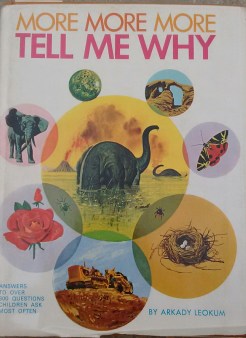 cent news item about a telephone helpline for children caught my attention. This was not the usual helpline for children in trouble or distress. Called First Question, this is an open line that children can call with questions related to science and nature, and their questions would be answered by real scientists. A novelty indeed in an age where increasingly Google is the ultimate guru that provides all answers.
This reminded me of the TELL ME WHY series. For myself and my children, these were among our favourite go-to books. These comfortingly solid volumes were not glossy nor profusely illustrated, but they were jammed with questions What, Why, How, Where, and answers to these. From the bizarre ones like ‘Are armadillos edible?’ to the logical query ‘Where does water go when it dries up?’ to the dreamy ‘How did fairy tales originate,’ to the puzzled ‘Why don’t women have beards?’ every volume had over 300 questions, and short answers that were well researched and reliable. While flipping through the pages in looking for an answer one would come across a dozen other questions that made one stop and read and wonder! A learning experience that was not compartmentalized into subjects and periods, and test papers; just an adventure in exploring and discovering.
Alas in the digital age, while the whole world’s information is at our fingertips, our children, and even we, seem to have lost the charm of wandering in search of answers, and chance discoveries. The TELL ME WHY series also seems to have gotten lost with the advent of media that are rapidly replacing physical books. However the innate curiosity of a child can never be quashed.
First Question, an initiative of the Kerala Forest Research Institute, seeks to bring back the humans in an age of AI. Launched as a response to the concern that our educational system that does not encourage children to ask questions, the Helpline, considered to be the first of its kind for children in India, is being managed by 20 research scholars from the Institute with help from around 50 subject matter experts and scientists across the state.
Students can call the helpline number 0487-2690222 from Monday to Friday between 9.30 am and 5.30 pm and ask their science-related questions in either English or Malayalam. Students from outside the state can also ask their questions in Hindi.
What a wonderful initiative, and what joy for a child to be able to talk to an adult who takes them, and their questions, seriously.
–Mamata
It’s Women’s Day, and as the media reminds us, a time to celebrate the ME! A time to indulge oneself, pamper oneself and assert oneself, with all the accomp anying gloss and glamour.
But is “all about me” really the formula for happiness? Consider this:
“Someone once asked me what I regarded as the three most important requirements for happiness.
My answer was: A feeling that you have been honest with yourself and those around you; a feeling that you have done the best you could have in your personal life and in your work; the ability to love others. Happiness is not a goal, it is a by-product. Paradoxically, the one sure way not to be happy is deliberately to map out a way of life in which one would please oneself completely and exclusively. After a short time, a very short time, there would be little that one really enjoyed. For what keeps our interest in life and makes us look forward to tomorrow is giving pleasure to other people.
It is easy to slip into self-absorption and it is equally fatal. When one becomes absorbed in himself, in his health, in his personal problems, or in the small details of daily living, he is, at the same time losing interest in other people; worse, he is losing his ties to life”.
Words of wisdom from Eleanor Roosevelt, wife of Franklin D. Roosevelt who was the President of the United States during the Great Depression and World War II. Eleanor was more than First Lady, she went on to play a leading role as a diplomat in the United Nations, and was one of the most loved and influential women of the 20th century. At the age of 76, she compiled her thoughts and experiences into a simple guide to living a fuller life based on her own philosophy on living, and informed by her personal experiences as a daughter, wife, parent, and diplomat. Titled You Learn by Living: Eleven Keys for a More Fulfilling Life, this is a simple but powerful reminder of enduring common sense ideas and heartfelt values that resonate even 60 years after the book was first published.
A good day to share her words, and remind ourselves how enriching and invigorating it is to be able go beyond the ME! Let us celebrate the power of caring and sharing!
–Mamata
There are few inventions and innovations which are ‘Made in India, For India’. We either reverse engineer, adapt, copy or adjust!
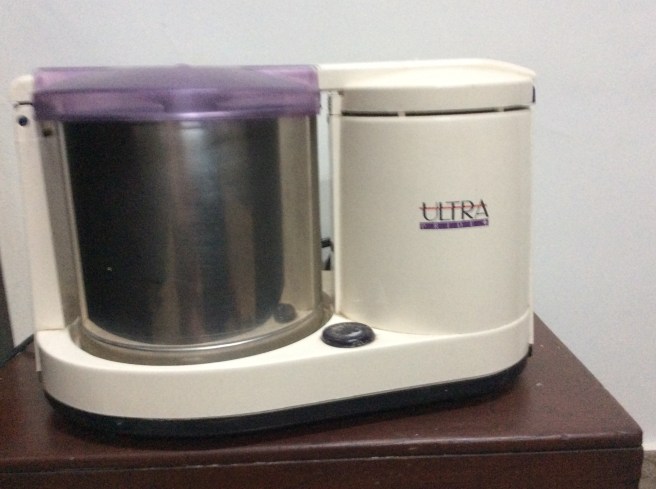 So from that perspective, I think the Coimbatore Wet Grinder is a marvel. The need for batters on an everyday basis is Indian. How can households run without a steady supply of idli batter, dosa batter, vada batter, adai batter, pesarattu batter, appam batter, paniyaram batter etc., etc.? While these dishes are all South Indian, they are extremely popular across India too.
In the days of yore, women used to grind these batters in a stone device. Frail-looking mamis turned into Karnam Malleswaris and Kunjarani Devis, wielding huge stone pestles with nonchalance! It took an hour or more of this heavy duty work to grind the breakfast batter for a large family and clean out the device.
Then came electric mixer-grinders. But always the refrain: ‘Oh, so small a jar. I have to do so many rounds for the quantity I need.’ Or ‘The motor heats up the batter as it grinds. Dosas never taste the same.’ Or ‘Uff, so much time it takes, I have to stand holding the lid.’ Because the mixer-grinders were not really conceived for our needs.
And then came WET GRINDERS! Magic! Small enough to fit in a corner of the kitchen but fairly good capacity; using the familiar stone-on-stone approach, thereby making mamis fully comfortable; no heating while grinding; and pretty easy to clean too!
An amazing individual called P. Sabapathy developed the wet grinder in Coimbatore in 1955, after much trial and error. Sabapathy introduced the grinders to other cities such as Chennai and Madurai. From the basic model, others innovated the tilting wet grinder, the table top grinder etc.
Coimbatore developed as the center for the manufacture of wet grinders. This was helped along by the fact that granite was available nearby. Also, as Coimbatore is anyway an industrial hub, manufacturing equipment, electrical motors etc. were all available within the same area. The city contributes to about 75% of the 1 lakh total monthly output of wet grinders in India. And apparently, there are 40 types of wet grinders today, from domestic to commercial. In 2007, Tamilnadu Government opened a center for manufacturing raw materials for wet grinders and a research center here.
Historian CR Elangovan has documented the history of Coimbatore wet grinders in his book ‘Automatic Aataangal: Kovaiyin Seetanam’. Alas, I cannot read Tamil. But I shall search to check if there is an English translation.
It is said that Mr. Sabapathy invented the wet grinder to save his wife labour. In the process, he has saved lakhs of women-hours. But who even knows his name? Shouldn’t he be in textbooks, as a supporter of women’s emancipation and a designer-inventor-entrepreneur of the highest order? We may even classify him as a social entrepreneur in today’s jargon! Shouldn’t he have got the Padmashri?
And coming back to one of my recent-favourite topics, the Coimbatore Wet-Grinder is GI (certified for Geographical Indicator).
–Meena
PS: This one is for my Mother in Law
 Millennial Matriarchs