
Yesterday, the results of the Delhi election were declared. Aam Aadmi Party romped home with a thumping majority.
And this is a piece about monkey business, not politics. (This is a statement of fact. Nothing tongue in cheek).
If so, then why start the piece by talking about politics?
Because monkeys taking over parts of Delhi including Parliament and high government offices is often in the news. And there was a statement made by an AAP MLA that “Monkey problem never became a poll issue”! In spite of that, the issue was serious enough that before the Assembly elections, the Delhi government planned for a census of monkeys in the city, for area-wise identification and tackling of the issue. They have roped in Wildlife Institute of India (WII), the country’s premier research institution on the subject.
So it is not like monkeys and elections don’t have a link. How could I resist the temptation?
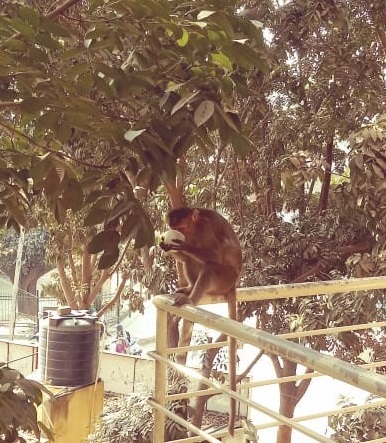 Anyway, to get to the matter on hand. For the last month or so, a group of Rhesus Macaques has been visiting our small office in Bangalore every once in a few days. The first reactions were of course ‘so cute’, and ‘shall we give them biscuits’. But as days went by, and the visits became a regular feature, they became bolder. They sat outside the door and snarled when we went to shoo them away. Several times they entered the office. And a few days ago, one of them snatched a tiffin box, went out, enjoyed the contents, and threw away the box.
The erosion of natural habitats is pushing wildlife including monkeys out of their homes. Where do they go except to cities? And our cities are very conducive for certain species. For instance, in the case of monkeys, our unorganized disposal of food and organic waste, and lack of garbage system lead to plenty of food being available, and they thrive.
Many means have been tried to keep monkeys away. In Delhi, Langurs were actually employed by the government to visit offices turn by turn and scare the Rhesus monkeys away, till this was stopped as it raised concerns about cruelty to animals (i.e., the Langurs being put to work). Following this, the government is hiring people who can mimic Langur sounds, and they go around doing this, with some success in keeping Rhesus away. A few days ago, there was a news item that Ahmedabad Airport was deploying a man dressed in a bear costume to keep away monkeys. In Bangalore, vegetable and fruit vendors often have large stuffed tigers on their carts for this purpose. (This is what we are going to try in our office too!).
Delhi has also tried translocating monkeys to forests and protected areas. But that obviously has its limits in how many can be accommodated. Himachal Pradesh has spent large sums on sterilization programs, but experts question the efficacy. Now, the Ministry of Environment, Forest and Climate Change has launched a programme with the help of National Institute of Immunology and Wildlife WII to develop a new immuno-contraception technique which will inject a vaccine to prevent female monkeys from getting pregnant. Some experts feel this is the way forward. But when this will be ready, how it will be deployed at large scale across the country, and whether it will ultimately work at scale are questions that remain.
In the meantime, the fundamental solutions remain the age-old ones: (1) vigorously prevent the destruction of natural areas, forests and habitats, and (2) manage waste better.
Not like we don’t know the answers. But …
-Meena
 At 11.11 by the clock, on the 11th of November every year (pretty palindromic, isn’t it?), at Mainz Germany, the Fools’ Constitution is proclaimed from the balcony of the Osteiner Hotel. This marks the start of the City’s Carnival, which is characterized by people wearing oversized papier-mache heads roaming around the crowds. It seems that this practice started about 80 years ago, but I could not find references as to why “schwellköpp” or ‘swollen-heads’ are an integral part of the festivities.
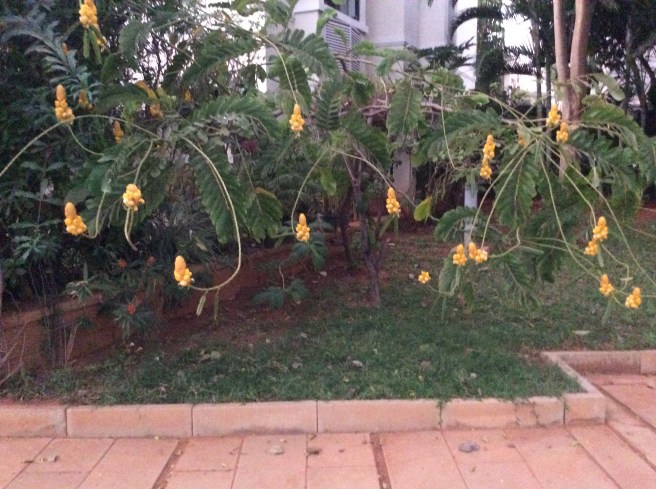 Basant Panchami went by last week. The mustard fields of Punjab must have been a riot of yellow, but my own little shrub was beautiful too!
 he English dictionary and discover that the majority of the words listed there have their origins in a variety of other languages and cultures. Who would have thought that “ze leetle zee” would have such had such an adventurous history!
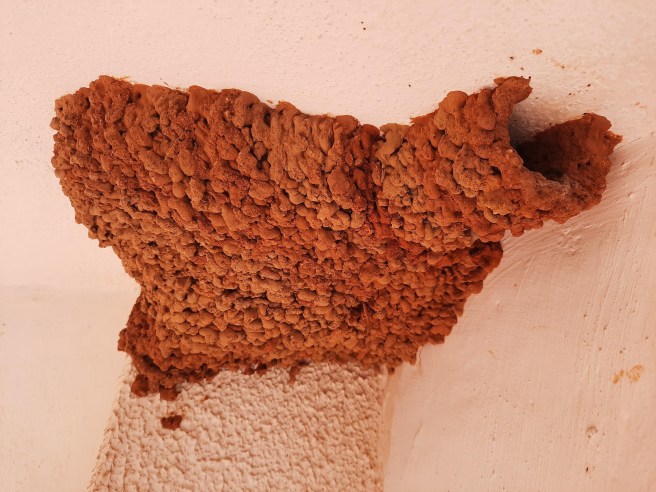 Two weeks ago that I looked up from the road, I saw a largish structure on my roof. Intrigued, I went up to try to figure out what this large mud structure was. I first thought it was the hive of some kind of wasp. But looking at the parapet below the nest, I noticed some bird droppings. And it did not take too much mental work from there on to figure out it was a bird’s nest.
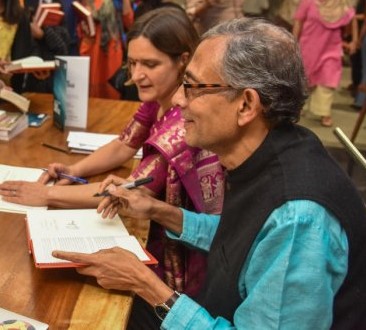 January 4 was also the day when Profs Abhijit Banerji and Esther Duflo were in conversation with Manish Sabarwal at the Bangalore International Center, and demystified RCTs, or Randomized Control Trials, the body of work which got them their newly minted Nobels. RCTs are an experimental method to do research on developmental issues like education and poverty, to find what can really be effective to solve the problems, and hence can help policy making.
 Millennial Matriarchs