
Once Upon a Time…

These four words open up windows to entire universes—unexplored, or familiar. This is how many a story begins. Stories are a life force that have imbued human life with that something extra, since the dawn of civilization. Stories are a way to convey history, culture, language, spirituality, and identity. One way to keep stories alive is storytelling. Storytelling is one of the oldest forms of communication.

20 March is celebrated as World Storytelling Day–a day to remember and remind ourselves of the magic and power of stories. What began in Sweden, on this date in 1991, as All Storytellers Day has now become a global celebration of the art of oral storytelling. On World Storytelling Day, as many people as possible tell and listen to stories in as many languages and at as many places as possible, during the same day and night.

On this day I celebrate a storyteller who collected, recreated, and created a timeless repertoire of stories. Generations of children have grown up with these tales, told and retold by parents and grandparents over the last one hundred years. This was my grandfather Gijubhai Badeka, one of Gujarat’s foremost educationists and storytellers.

In Gujarati, as in most Indian languages, the child reader had remained somewhat neglected till the middle of the nineteenth century. There was hardly any specific literature for children; only stories retold from classical Indian literature, or heroic stories from Western literature, in not very satisfactory translations. Gijubhai pioneered the creation of special literature for children that also contributed to preserving the oral tradition of literature through exploring and compiling the rich legacy of folk literature. His search for folk tales crossed the boundaries of language and country. This journey of exploration he described thus, in his seminal work titled Vaarta nu Shastra (The Art and Craft of Stories) published in 1925. “So many stories have travelled in foreign lands, so many stories have changed their religion and form; it is an adventure to trace their journeys. If we become wandering travellers with the stories, we will discover that we find one story in Tibet and will see the same story in Africa; we will discover the same story wrapped in snow at the North Pole, and yet if we wander in the Arabian desert, there it will be, but uncovered and bare…but still we recognise the story. Some stories adapt to their land, taking on the form and language of their adopted home, while others retain their origins wherever they may settle. Some stories follow the creed of universal brotherhood, they see the world as their home and go wherever they get a chance to serve and please. Some settle firmly in different countries and come to be recognised as belonging to that place. They are then only translated to reach other countries.”

Many of Gijubhai’s stories are members of this travelling band. Gijubjai transformed and localised these stories, so that they are steeped in the sounds and colours of Gujarat, and have today become not only Gujarati, but uniquely ‘Gijubhai’s’ stories. They are simply told tales characterised by a mixture of prose and rhyme. The repetition of rhymes makes for lively storytelling which listeners join in. Gijubhai retold delightful tales of ordinary people, and familiar birds and animals. With equal panache he churned out stories of common folk with common trades—tailors, potters, barbers, shopkeepers, but also kings, queens and princesses. The characters reflect basic human traits—greed, envy, fear, desire for one-upmanship. Animal tales reflect a close and symbiotic relationship between animals and people. Many open with “once upon a time”… and end “happily ever after.” A hundred years after they were written these stories still touch a cord in the child, and also the child in each of us.

Stories are older than us, they are smarter than us, they keep going, and they are a part of us even though we do not realise this. But stories need human beings to reproduce, much as we need food… we need things to keep ourselves alive.

Hungarian-born American polymath Thomas Sebeok said “…what we can do, I think, is try and create stories that are interesting enough and important enough that our grandchildren might want to tell those stories to their grandchildren — because that’s the purpose of stories, that’s what they’re for: They make live worth living and, sometimes, they keep us alive.

In my own small way, I try to carry forward the legacy of my grandfather by translating and retelling these timeless tales.

–Mamata

So Many Ways to Downtime!

A few days ago a friend said ‘What with everything closed for Corona, it is so dull and boring, wish we could just HIBERNATE.’ Probably a sensible thought, except that given the temperatures outside, it would be aestivation, rather than hibernation.

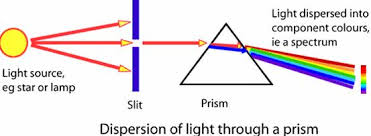
3-s2.0-B9780124095489111674-f11167-03-9780444637680AESTIVATION, lesser known cousin of hibernation, is ‘summer sleep’– a survival strategy used by many vertebrates and invertebrates to endure arid environmental conditions. Key features of aestivation, like hibernation (winter dormancy) include significant metabolic rate suppression, conservation of energy , altered nitrogen metabolism, and mechanisms to preserve and stabilize organs and cells over many weeks or months of dormancy. Even more than in hibernation, strategies to retain body water are important in aestivation, as dryness or aridity is the key trigger for the summer sleep.
A surprising number of animals aestivate—vertebrates such as lung fish, amphibians, reptiles, small mammals, and certain invertebrates such as molluscs. Bees, snails, earthworms, salamanders, frogs, earthworms, crocodiles, tortoise, etc. are examples of the aestivating animals. The duration of aestivation varies among species–some enter this state for a few months, others for a longer period.

Well, there are other kinds of ‘downtimes’ we can choose from too.

There is BRUMATION, which is the equivalent of hibernation for reptiles. Mammals hibernate and reptiles brumate, but there are other differences too. During hibernation, a mammal is sleeping and does not have to eat or drink. But brumation is not true sleep and the reptile still needs to drink water. A brumating reptile may have days where it will wake, show some activity, drink water, and then go back to its dormant state.

Or we can take the option of TORPOR, which involves lower body temperature, breathing rate, heart rate, and metabolic rate. But unlike hibernation, torpor is an involuntary state that an animal enters into as the conditions dictate. Also unlike hibernation, torpor lasts for short periods of time – sometimes just through the night or day depending upon the feeding pattern of the animal. During their active period of the day, these animals maintain a normal body temperature and physiological rates. But while they are inactive, they enter into a deeper sleep that allows them to conserve energy and survive the winter.

Or there is DIAPUASE, a form of developmental arrest in insects that is much like hibernation in higher animals. It enables insects and related arthropods to circumvent adverse seasons. Winter is most commonly avoided in colder areas, but diapause is also used to avoid hot, dry summers and periods of food shortage in the tropics.

Now, which one do you prefer?

–Meena


Forth and Back

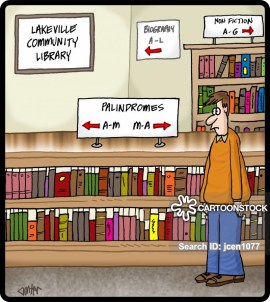
“Madam I’m Adam”. When I was young I was amused by this clever phrase because one could read it the same way from left to right and right to left. As my interest in words and love for word play grew along with me, I was always looking for such words or phrases. Somewhere along the way I discovered that a word, sentence, verse, or even number, that reads the same backward or forward was called a Palindrome. The English word Palindrome was created in the early 1600s based on Greek roots that literally mean “running back on itself” (palin meaning ‘again’ or ‘back’, and dromos meaning ‘running’.)

I began to collect examples of these, and was excited whenever I found one; one highlight being ‘A man, a plan, a canal-Panama’. Until I discovered that there were more avid collectors, and loads of such examples. Here is sharing some, from the daily use ones (that we do not even register as being palindromes) to the funny, clever ones.

Family–sweet and simple in any form: Mum, mom, amma, pop, dad, sis.

Moving on to mechanics–rotor, level, racecar, radar, refer, reviver, rotator, and repaper… (graduating to the next level as ‘Won’t I repaper? Repaper it now!’

Some simple (and sometimes silly) ones:

palindrome.jpg
Source: Google

Dennis sinned.

Don’t nod.

Never odd or even.

No lemons, no melon.

We panic in a pew.

Won’t lovers revolt now?

Sir, I demand, I am a maid named Iris.

Eve, mad Adam, Eve!

Never a foot too far, even.

Nurse, I spy gypsies, run!

Delia sailed as sad Elias ailed.

Ned, I am a maiden.

Some clever ones:

A hitman for hire: Murder for a jar of red rum.

A gross creature: Oozy rat in a sanitary zoo.

Call your mother: Mum

Sane advice: Do not start at rats to nod.

Weather forecast: Too hot to hoot.

Teutonic pride: I, man, am regal; a German am I.

Philosophical musing: Do geese see God?

Old cats: Senile felines.

On ET’s menu: UFO tofu

Bad eyesight: Was it a car or a cat I saw?

A moral dilemma: Borrow or rob?

And one curious one–Murdrum (the crime of killing an unknown man).

And our own and bona fide one: Malayalam!

A wonderful one that sounds like what it means: Tattarrattat—meaning a knock on the door. It was coined by James Joyce and used in Ulysses in 1922. It is also the longest palindromic word in the Oxford English Dictionary.

And last but not the least, there is even a palindromic word for an irrational fear of palindromes—aibohphobia! WOW!

–Mamata

Colour Me Blue

As we celebrate Holi, the Festival of Colours, here is a piece on the hues that brighten our lives.

And, in keeping with the mood of International Women’s Day, it references M.S. Subbulakshmi, doyenne of Carnatic music, and a path breaker.

Happy Holi, Happy IWD!

Last week I was reading an old-fashioned novel, where the hero’s sidekick was wearing a taupe coloured suit. Not being quite sure what ‘taupe’ was, I looked it up, and learnt that it is a dark brown colour between brown and grey and that the name originates from the French taupe meaning mole (the animal).  The name originally referred to the average colour of the French mole, but since the 1940s, its usage has expanded and blurred to mean anything greyish brown or brownish grey.

Names of many colours are derived from nature. Fuchsia was named for the colour of the flowers on the fuchsia plant, itself named for Leonard Fuchs, a 16th-century botanist. The word orange comes from the Old French orange, from the old term for the fruit pomme d’orange. The French word, in turn, comes from the Italian arancia, based on Arabic nāranj, derived from the Sanskrit nāraṅga. An inter-connected world indeed!!!!

Teal is a bluegreen colour whose name comes from that of a bird—the common teal (Anas crecca)—which presents a similarly coloured stripe on its head.

‘Puce’ is also one of the nature-colour names, but with a particularly yucky background. Puce is the French word for flea. The colour is said to be the colour of bloodstains on linen or bedsheets, even after being laundered, from a flea’s droppings, or after a flea has been crushed. Strangely it was one of Marie Antoinette’s favourite colours!

People too have lent their names to colours.

‘Mountbatten Pink’ is a naval camouflage colour close to greyish mauve. It was first used by Lord Mountbatten during World War II. When he noticed a liner ship of the colour seeming to disappear from view in the early morning light, he felt it was a good colour for naval ships to render them difficult to see at dusk and dawn, and so started applying them to his naval ships.

‘Alice Blue’ is a pale shade of azure blue, much liked by Alice Roosevelt daughter of President Theodore Roosevelt, which sparked a fashion sensation in the United States.

MSBut for a South Indian like me, the most important person-colour association has of course to be ‘MS Blue’, said to be a favourite of legendary singer M.S. Subbalakshmi.  This colour became synonymous with her after she started wearing Kanchipuram silk saris of this shade at her concerts. These were specially made for her by Muthu Chettiar, a weaver from Madurai. The savvy businessman that he was, he carefully regulated supplies to ensure enduring demand from Madras high society ladies!  It has been clarified that MS Blue is not peacock blue but ‘mid-sea blue’.

Continuing on the theme of blue, the colour of 2020 (Yes, they announce a colour for every year! A good source of income for the interior design and fashion industries) is PANTONE 19-4052 Classic Blue whose properties include instilling ‘calm, confidence, and connection’. Additionally, it is claimed that ‘this enduring blue hue highlights our desire for a dependable and stable foundation on which to build as we cross the threshold into a new era’.

Another interesting fact I learnt was that research by several academics including linguists Brent Berlin and Paul Kay has revealed that if a language had only two terms for colours, they were always black and white; if there was a third, it was red; the fourth and fifth were always green and yellow (in either order); the sixth was blue; the seventh was brown; and so on.

–Meena

Fatso

Fatso! The word always reminds of the storybooks we read in which the

garfield fat.jpg
Source: Pintrest.com

chubby baby with pink cheeks grew into a rotund schoolboy or roly-poly schoolgirl who was the butt of many jokes and cruel teasing. For many children who were actually on the plump side, it was a real-life experience that followed them through the years of teenage and adulthood. Fat characters depicted in books, movies and television are usually the bumbling comic ones, designed to raise a laugh. The simple three letter word ‘fat’ is, more often than not, used as an adjective that is derisive and pejorative.

The history of the word in the English language reveals that this was not always the case. In the late 1300s, fertile and abundant land was described as ‘fat land.’ In the 1600s, a wealthy or affluent person was described as a ‘fat’ person. This was a period when the general population suffered from poverty and food shortages, and anyone with excess body fat was recognised as being prosperous. Paintings of the Renaissance period in Europe depicted full-figured people. This was also the case in several other parts of the world, including India, where chubbiness was extolled when admiring “healthy” babies, and a skinny child would always be asked “does your mother not give you food?” In women of a marriageable age, a well-rounded body structure was desirable as it was considered suitable for future child bearing.

Changing times brought changing trends. In the 19th and 20th centuries, in the West, technology and industry made food production more stable, cheaper, and more widely available; it also introduced the wave of processed food. This, along with a rise in the overall standard of living, and more sedentary lifestyles, created new concerns, and perceptions, about weight. By the 1940–50s, ‘thinness’ became the new ideal for health and beauty. As early as March 1954, Life magazine featured an article, “The Plague of Overweight,” which characterized obesity as “the most serious health problem today.” “The uncompromising truth,” it went on, “is that obesity is caused by gluttony.” At that time, around three percent of Americans were considered obese. In 2015-2016 the prevalence of obesity in American adults was 39.8%. Today India is one of the countries in which obesity has reached almost epidemic proportions.

As medical science produces numerous reports on the health impacts of obesity, the popular culture has climbed on to the merry-go-round slogan of ‘fat is evil’. This has manifested itself in wave after wave of money-minting slimming coaches, new-fangled fad diets, and lose-weight mantras.

The social fall-out of this has been the culture of ‘fat shaming.’ Responses to this have been varied. The 1960s saw the rise of the movement of ‘body positivity’ to raise awareness of the barriers faced by fat people and highlighted the need for human rights for bigger bodies. As far back as 1969, a civil rights organisation was founded in the United States, The National Association of Advance Fat Acceptance (NAAFA) which works to eliminate discrimination based on body size, through advocacy, public education and support.

Today there is a Fat Acceptance Movement, with Fat Activists, which is working to challenge bias against fat people and end discrimination against them, especially in work places.

At the other end of the cultural spectrum, in several parts of the world, “fat is indeed beautiful.” Heavier girls and women are viewed as beautiful, wealthy and socially-accepted.  As they believe, if you are fat, people respect you; people honour you. Wherever you go, they say, “Your husband feed you fine.” In Mauritania, it is believed that a woman’s size indicates the amount of space she occupies in her husband’s heart!

Even today, in many tribes in Africa, a woman’s attractiveness is measured by her obesity, and a young woman is prepared for marriage in ways guaranteed to ˜fatten her up.” Traditionally brides-to-be would be confined to a hut where they would be fed and fed and fed on high calorie foods until they achieved the desirable size and shape.  Even today, in some places women go to fattening centres, just as in others they go on a slimming programme, before their wedding.

The Fat vs Healthy debate rages on. Every day, through every media, we are besieged by confusing and contradictory messages. Beneath all this, science seems to suggest that that body size is the result of a complex web of factors, including social and economic influences, genetics, food production and availability, urban design, land use, and advertising.

Fatso, or beanpole, beauty, it seems, is in the eyes of the beholder!

–Mamata


Wild is Wondrous!

March 3 is celebrated as United Nations World Wildlworld wildlife day 2.jpgife Day. This marks the day of signature of the Convention on International Trade in Endangered Species of Wild Fauna and Flora (CITES) in 1973. Every year on this day, events are held around the world to celebrate and raise awareness of the world’s wild animals and plants.
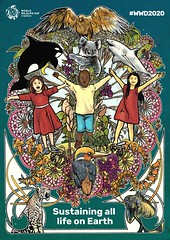
The theme of World Wildlife Day 2020 is “Sustaining all Life on Earth”. This celebrates the special place of wild plants and animals in their many varied and beautiful forms as a component of the world’s biological diversity.

India is a treasure house of biological diversity. It harbours 8% of the world’s biodiversity on just 2% of the earth’s surface. It is one of the 17 mega-diversity countries in the world with ten biogeographic zones, and an incredible diversity of habitats, flora and fauna.

Here is my small ode to this wild and wondrous land and its denizens.

I live in such a magical land

Of mountains and valleys, plateaus and sand.

Jungles and farmland, deserts, islands and seas,

Here’s to my land of biodiversity.


Biodiversity Biodiversity

It’s all about Life and Variety


In forests and fields, deserts and seas,

Animals and crops, microbes and trees.

Colours and patterns, functions and form,

To survive and thrive, adapt and transform.


Snow leopard and yak, and double-humped camels

The Himalayan cold desert is home to these mammals.

Shining blue lakes in the rugged landscape

Welcome winged visitors many coloured and shaped.


Biodiversity Biodiversity

Experience it, share it, enjoy it.


Where the mighty Ganga flows

River dolphins swim and gharials are found.

Proud tigers prowl, and deer abound

The fertile plains with bounteous yields

From forests and farmlands and fields.


Biodiversity Biodiversity

See it, taste it, smell it, feel it.


The North East is truly a garden of Eden

Full of priceless treasures, many still hidden.

Feathery ferns, bright orchids, bamboos tall

Where rhinos roam and Hoolock Gibbons call.


Biodiversity, Biodiversity

Appreciate it, savour it, explore it.


Discover that deserts are dry but alive,

Their dwellers have special tricks to survive

Store water, shed leaves, or burrow in the sand.

Why, even tigers and lions roar in this land.


Biodiversity, Biodiversity

Treasure it, enjoy it, study it.


In the Western Ghats meet a tahr, and a tiger too

Jumbos in jungles and a hornbill or two.

Colourful frogs that croak and call

Snakes and snails that slither and crawl.


Biodiversity Biodiversity

Learn from it, weave with it, heal with it.


Deccan highlands and grasslands, plateaux that soar

Dotted with buffalos, cows, goats and sheep galore

There grow seeds and cereals upon which we feast

And people who celebrate it all with their dancing feet.


Biodiversity Biodiversity

Plant it, grow it, cook it, eat it.


Deep in the seas meet clown fish and anemone in a coral jungle

Crabs, crocs and tigers in a mangrove tangle.

On islands in waters blue and green

See a megapode, a monitor, a Nicobar pigeon preen.


Biodiversity Biodiversity

Track it, live with it, delight in it!


Biodiversity Biodiversity

It’s all about Life and Variety.

Biodiversity Biodiversity

Celebrate it, protect it, conserve it!

–Mamata


National Science Day

28 February marks National Science Day in India–it is the day in 1928 when Sir C. V. Raman discovered the Raman Effect. For his discovery, Sir C.V. Raman was awarded the Nobel Prize in Physics in 1930.

The discovery of the Raman Effect itself happened at Calraman effect.jpgcutta, but Bangalore was also Sir Raman’s ‘karma bhoomi’, in that he worked at the Indian Institute of Science from 1933 till his retirement in 1948, after which he founded the Raman Research Institute in the city, and continued working there till his death in 1970.
So on this Science Day, here is a little information on one of the exciting science education venues coming up in Bangalore. Science Gallery Bengaluru, under construction in Hebbal (not too far from IISc and the Raman Research Institute), ‘will be a dynamic new space for engaging young adults at the interface between science and the arts’. The under-construction centre anticipates a footfall of about 40,000 people a year, with a focus on 15-­25 year olds. It is a multi-stakeholder collaboration, including Govt. of Karnataka, Trinity College UK, Indian Institute of Science, etc.

Scheduled to open in 2021, the Science Gallery is already active, having put up several events including ‘Submerge’ a major exhibition on Water.

And keeping with the theme of Science Day 2020 which is “Women in Science”, the Executive Director of the Science Gallery is Dr. Jahnavi Phalkey, a historian of science and technology.  The Board is chaired by Dr. Kiran Mazumdar-Shaw, and includes Dr. Geetha Narayanan.

Bodes well for Science and Women Scientists!

Let us hope that the Science Gallery will help to infuse young people with the spirit of what Sir CV Raman said: ‘Ask the right questions and nature will open the doors to her secrets.’

–Meena

Food Glorious Food!

In the past week or so, food and menus have been much in the news. The most recent being the menu which has been planned for the banquet that the President of India is hosting tonight for American President Donald Trump and his delegation who are visiting India. And then, there was the news about the Historical Gastronomica event that the National Museum in New Delhi is hosting. This event offered an Indus Valley dining experience through a “specially crafted menu that strictly includes ingredients identified by archaeologists and researchers from sites of the Indus-Saraswati civilization.” The latter event has been in the news because of the controversy over whether the people of that place and time ate ‘non vegetarian’ food or not. The controversy has generated many articles referring to the works of scholars in this area.

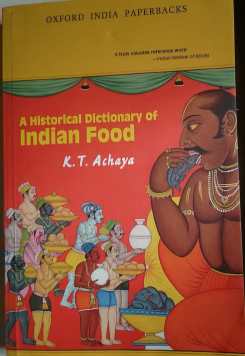
One of the food historians referred is K.T. Achaya and his auIMG-20200225-WA0000.jpgthoritative volume on the history of Indian food titled Indian Food: A Historical Companion. This led me to my bookshelf to pull out another book by this renowned authority on Indian food. This one, titled A Historical Dictionary of Indian Food followed his earlier ones. In this he attempts to bring together, in alphabetical order, material from his vast work on the subject. The book draws upon historical writing, archaeology, botany, genetics and ancient literature in Sanskrit, Pali, Tamil and Kannada to trace the gastronomic history and food ethos of India. The entries cover a wide range including recipes; narratives of visitors to India, starting with the Greeks in the fourth century; the etymological evolution of certain words, and the close links of food with ancient health systems such as Ayurveda. While this is a valuable scholarly work with meticulous and voluminous referencing, it is simply written, with a delightful menu–from A to Z–that one can dip into, and savour according to one’s own taste and appetite.
For me every entry is fascinating. For today I will share an excerpt about two elements that are the starting point of a menu and a meal—Guest and Host!

‘Guests had an honoured place in Vedic society, ranking only below the father, mother and guru. On arrival, a guest was ceremoniously received, given water to wash his hands and feet, and offered the ambrosial beverage madhuparka. In early Vedic times, if the guest was an honoured Brahmin or a member of royalty, a large bull or goat would be sacrificed in his honour, even if the guest was a vegetarian. Later this ritual became symbolic, and the guest was given a knife in token of the sacrifice, which he returned after a prayer. During the meal, the host had to be solicitous, either eating later, or finishing his own meal quickly, so as to rise early and look after his guests.

In the Manava Dharmashastra (Manusmriti) a host is exhorted in these terms: Let him, being pure and attentive, place on the ground the seasoning for the rice, such as broth and pot herbs, sweet and sour honey, as well as various kinds of hard foods that require mastication, and soft food, roots, fruits, and savoury and fragrant drinks. All these he shall present, and being pure and attentive, successively invite them to partake of each, proclaiming its qualities: cause them to partake gradually and slowly of each, and repeatedly urge them to eat by offering the food and extolling its qualities.

All the food shall be very hot and the guests shall eat in silence. Having addressed them with the question: Have you dined well? Let him give them water to sip, and bid farewell to them with the words: Now rest.’

(A Historical Dictionary of India Food K.T.Achaya (pp 96)

And so in India–Atithi Devo Bhava–The guest is God!

–Mamata

The Sparrow and The Peacock

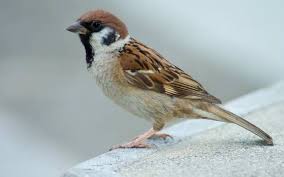
Whesparrown I was growing up in Delhi, house sparrows were very much a part of our lives. They were everywhere, and by the dozens. In fact, most children of those times got their first nature lessons by watching sparrows—the sex differentiation, how they built their nests, the eggs hatching and the parents feeding the young, their mud-bathing etc.
Everyone loved them, but that is not to say they did not give us some headaches. In the summers, they would fly into the house, and it was a mad scramble to switch off the fans and shoo the birds out before they were hit by it and died. And mothers would keep long sticks handy to chase them when they showed signs of making nests in the fan-cups.

For many years now, sparrows are not to be seen so easily. Now, the recently published ‘State of India’s Birds’ assures me that I need not worry because the population of sparrows has been stable in India for the last 25 years. I believe it, because the report is the result of a collaboration among ten of the most respected research and conservation organisations in the country. But I do know that the population has significantly declined from say 35 years ago. And I do wish I would see more of chirpy little birds.

The report also says that the population of peafowl has increased manifold. This may be attributed, it is being said, to the spread of aridity in the country. This is not all good news, as peacocks come into cultivation and eat up growing shoots, causing harm to crops.

The report identifies 101 bird species as needing special efforts for conservation, including specially raptors and water-birds.

The report is a landmark in Indian conservation efforts, because it provides good quality baseline data, which can help shape conservation efforts and their monitoring. It is also unique in that it is based on data collected by citizens across the country–10 million observations collected by over 15,500 birdwatchers across the country. Truly participatory and truly large scale. And the fact that hard-core research organizations are guiding the effort, gives authenticity to the data and findings.

Knowing is the first step to acting. Now we know to some extent what we should worry about. Time to act now!

–Meena

One Man, One Mission

Last week we wrote about Uncle Moosa and his single-handed mission to take books and reading to the remotest parts of North East India.

Here is the story of another man with a similar mission, one that he has been pursuing with undiminished passion and fervour for over 70 years! He is Mahendra Meghani. And this is the story of Lokmilap, the bookshop that he started, and which became a symbol of all that he has devoted his life to. And one to which I too have old links.

IMG_3289.jpg
Photo credit: Ajay Desai  

In the summer holidays when we used to go to Bhavnagar, our ancestral hometown, one of visits most looked forward to, was the one to Lokmilap. For us this was treasure house from which we were allowed to select a few books.  More precious, because it was perhaps the only one that stocked English language books, in addition to some of the best literature in Gujarati. We often met Mahendrabhai there, who was also a family friend, and he would show us the new arrivals including the beautifully illustrated children’s books from the Russian People’s Publishing House.

In those days this was as much as we knew about Lokmilap. Over the years as we grew, we learnt more about Mahendra Meghani and his tireless mission to take literature to “the people” in every way possible.

Mahendrabhai’s own lineage in literature goes back to his father, the famed Gujarati litterateur Zaverchand Meghani, who was given the title Lok Shayar or People’s Poet by Mahatma Gandhi. It is said that while Zaverchand took literature from people’s tongues to people’s hearts, Mahendrabhai took literature to every person, home and society.

Born in 1923, Mahendrabhai, graduated from high school in Mumbai, and joined L. D. Arts College in Ahmedabad for further education. It is said that when he was getting ready to move from Mumbai to Ahmedabad, his father advised, “It gets very hot in Ahmedabad, so make sure you cover your head with a topi”. Complying with his father’s suggestion, Mahendrabhai started wearing the khadi cap which became an integral part of his attire, and remained so through the years. After two years in Ahmedabad he returned to Mumbai to join the Elphinstone College, but left that to join Gandhi’s Quit India movement. He did not return to college, but instead helped his father with his journalistic work.  After the death of his father in 1948, Mahendrabhai went to the US to study journalism at Columbia. Living in the International Student’s House in New York, he would, every day, buy two newspapers and peruse the many pages. It is here that he also discovered Reader’s Digest.  And he found his calling! He decided to return to India and start a similar magazine in Gujarati. And so, on 26 January 1950, India’s first Republic Day, was born Milap, a monthly journal in Gujarati which set high standards of language and literature, and yet garnered a wide and faithful readership.

Tired of the hectic life in Mumbai, Mahendrabhai moved to Bhavnagar in Gujarat where the journal Milap engendered the publishing house as well as the book shop Lokmilap (meeting of people). It is through these that Mahendrabhai lived his passion to take good literature, at affordable prices, to as wide a reading public as possible. The bookshop, as he said, “included books from all publishers, but not all books from all publishers.” Lokmilap’s vision was not simply to sell books; they wanted to open windows to the best in world literature, to give people a perspective about life, and how to live life. They published hundreds of original Gujarati books, but also translated and abridged versions of classics of world literature (many of them translated by Mahendrabhai himself). More critically, the books were very nominally priced, to suit even the shallowest pocket. They introduced “pocket books”, initially to take poetry to the people, but later diversified to include a vast range of literature. Priced then, as low as 50 paise, the books sold in lakhs.

In 1969, the Gandhi Centenary year, he compiled a special collection of 400 books that celebrated Gandhi’s life and message, and a booklet titled Discovering India Book Exhibition. The books were exhibited in many countries across the world with the condition that the sponsoring organisation would buy the set, and donate it to a local library or community centre.

Mahendrabhai himself has travelled far and wide, always clad in his simple khadi attire, sharing his love for language and literature with wide and diverse audiences. In Bhavnagar he was a familiar sight, riding his bicycle no matter what the weather. His tireless quest to share the best with everyone had many facets—at one point hand grinding wheat and baking bread which he distributed, to starting a film club which screened some of the classics of world cinema, and to which he would bring people who had never before been exposed to such experiences.

The man and his mission have inspired and touched millions across generations and nations. Last month, on India’s 70th Republic Day, Lokmilap also marked its 70th anniversary by announcing its closure. Expressing the sentiment that everything that has a start will have an end; what better than the end that is brought about by the ones that made the start?  For all of us whohad taken Lokmilap as one of those comforting points of stability and continuity in lives and cities that have changed so much, it is a sense of losing moorings. But secure that the seeds of the institution have been planted deep and strong.

A man whose mission has brought the love of letters to millions, Mahendrabhai, at age 97, carries on with his writing and reading, somewhat frailer in body but indomitable in spirit.

–Mamata