
March is a significant month in the history of India’s freedom movement. On 12 March 1930 Mahatma Gandhi set out from the Sabarmati Ashram in Ahmedabad on a journey that was to cover many milestones, in more than one way.
On 2 March 1930 Gandhiji had written a letter to the Viceroy giving notice of his intention to launch a civil disobedience movement by symbolically breaking the Salt Law which in his opinion was “the most iniquitous of all from the poor man’s standpoint.” He was snubbed in return; which strengthened his resolve. He selected Dandi, a seaside village in Gujarat as the site for his symbolic gesture, and planned to walk the distance of 241 miles from his Sabarmati Ashram in Ahmedabad, along with a select band of co-workers. The date for setting off on the march was fixed for 12 March, and 6 April was the date set for the ‘breaking of the salt law” at Dandi. Gandhiji also vowed not to return to the ashram until the Salt Act was repealed, and Swaraj was won.
On March 12, 1930 at 6.30 a.m. Gandhiji, left the Ashram accompanied by 78 satyagrahis. These represented a cross-section of the people from all over the country: Andhra Pradesh, Bengal, Bihar, Bombay, Gujarat, Karnataka, Kerala, Kutchh, Maharashtra, Punjab, Rajputana, Sind, Tamil Nadu, U.P. Utkal, and even Nepal. The group included members of all communities. They fell in a wide age spectrum from 16-year-old Vitthal Liladhar Thakkar to 61-year-old Mohandas Karamchand Gandhi! The main criteria for the selection, that he personally made, was that the marchers were disciplined, and strictly adhered to the principles of ahimsa and satyagraha.
Despite so much diversity, there was one lacuna in the composition of the marchers. The group did not include any women. One of the later historians attributed this to Gandhi’s concern that the British would taunt the marchers for being cowardly and “hiding behind the women” in the battlefield. But many women were eager to join the battle. Gandhiji was inundated with letters, telegrams and personal appeals from women to permit them to take active part in the struggle. Gandhiji had other plans for their engagement. In a piece published in Young India, titled To the Women of India Gandhiji wrote: “I feel that I have now found that work. …Let the women of India take up these two activities, specialize in them; they would contribute more than man to national freedom. They would have an access of power and self-confidence to which they have hitherto been strangers.”
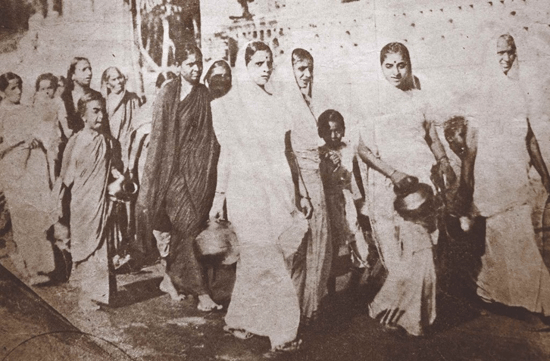
At each of the 24 villages that Gandhiji and his yatris halted for the night enroute to Dandi, Gandhiji urged women to step out of their homes and make salt locally. He also encouraged women to participate and contribute to the struggle by taking up picketing of liquor shops and foreign cloth, and taking up spinning. Hundreds of women from the neighbouring villages came to see and hear Bapu. Many of these women were unlettered, and followed strictly subscribed traditional roles. But Salt struck a common chord in every one of them. It was the ingredient that linked the domestic with the national.
Women from all walks of life took up Bapu’s clarion call with great energy and commitment. They related closely to the symbolic power of salt. As Kamaladevi Chattopdadhyay, who was on the forefront of the movement wrote: “The salt satyagraha must stand out as not only unique but as an incredible form of revolution in human history. The very simplicity of this weapon was as appealing as intriguing. So far as women were concerned it was ideally tailor-made for them. As women naturally preside over culinary operations, salt is for them the most intimate and indispensable ingredient”.
Kamlaladevi organized volunteers for a variety of programmes including prabhat pheris (dawn processions), gathering salt and brine on the beaches of Bombay, and moving across the city distributing small packages of illicitly made salt. Women in the hundreds came out onto the streets to take part in these activities. Once in the fray, women were not to be daunted nor afraid of police batons.
In the following months the movement spread across the country, as more and more women poured out of their homes to join the activities. Women started organizing prabhat pheris on the streets of Bombay and Ahmedabad, where they sang songs about the bounty of the motherland. They helped put together vanar senas, or monkey brigades, consisting of children who supported the activists in offering resistance to the British. As their presence grew, and activities expanded the police became less restrained. The women faced brutal lathi charges, and a record number ended up in prison for the first time in the history of the subcontinent.
Chroniclers of that period have noted that while the original Dandi March began with a troop of males, the subsequent events inspired an unprecedented movement of women from every walk of life to move out of the private spaces of their homes, and traditionally designated roles, and enter public spaces to join a national movement.
Jawaharlal Nehru wrote in The Discovery of India, “Here were these women, women of the upper or middle classes leading sheltered lives in their homes, peasant women, working-class women, rich women, poor women, pouring out in their tens of thousands in defiance of government order and police lathi.”
The Dandi March was a turning point not only in the history of India’s freedom movement, but also in the participation of Indian women in a political cause. It was a catalyst for women to claim public spaces in large numbers, united by a common cause.
March 8 is celebrated as International Women’s Day. In the United States the month of March is marked as Women’s History Month to honour women’s contributions in American history. In India too we must celebrate the month of March as significant, the month in which, several historic events brought the women of India into the public space, and a movement that saw the emergence of women as warriors in a non-violent war.
–Mamata

 Millennial Matriarchs