
This morning my sisters suddenly remembered our mother’s (who had a great sweet tooth) fondness for Mango Fool. This brought back so many memories of the many sweet dishes that we used to have at home, which included lots of sugary syrupy Indian sweetmeats, as well as the more subtle English ones such as custard and pies. Our combined memories recall that Mango Fool was some form of thick milk shake. Turns out that the real Mango Fool is a more sophisticated desert that includes mangoes, and whipped cream. And, of course, so many years later, the memory nudged me to dig deeper into investigating the curious name of this dessert.
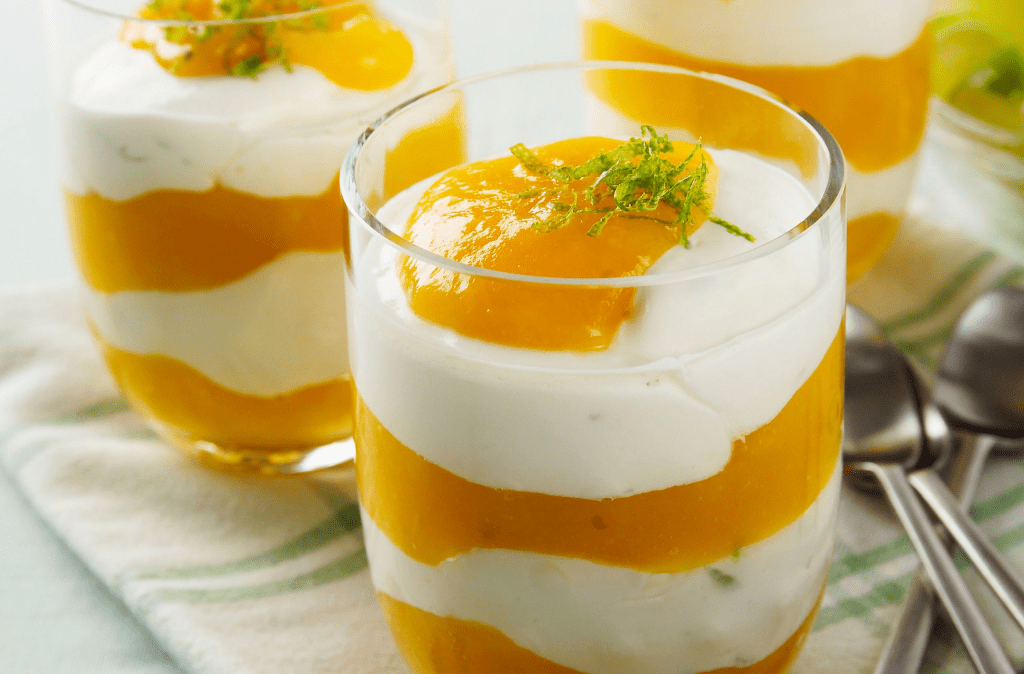
As it turns out ‘Fools’ of the fruity variety have ancient origins and a rich history. Fruit fool is a classic English dessert. Traditionally, fools were made by folding a stewed fruit (originally gooseberries) into a creamy, sweet custard. The documented origins of the desert can be traced back to the 17th century, although it is believed that some form of this existed as far back as the 15th century.
The earliest known recipe is from the time of the Merry Monarch, King Charles II in a book called The Compleat Cook published in 1665, written by an anonymous author ‘Mr WM’. The recipe was for what he called Gooseberry Foole. The recipe included cooked, mashed, and strained gooseberries, which are beaten with sugar, butter, and eggs to form a pudding-like consistency.
Take your gooseberries and put them in a silver or earthen pot, and set it in a skillet of boiling water, and when they are coddled enough, strain them; when they are scalding hot beat them well with a good piece of butter, rose-water and sugar, and put in the yolk of two or three egg, you may put rose-water into them, and so stir it altogether and serve it to the table when it is cold. Anonymous. London. 1658.
The recipe endured through the ages, and was almost no change in the one included 250 years later in the Victorian era cookbook The Art Of Cookery Made Easy and Refined.
But why the name Foole? The most popular theory to explain this is that the term comes from the old French term ‘fouler’ which meant to mash or crush. And this is what the recipe demands—that the cooked fruit be crushed or pressed before being folded into the custard mixture. In those days most fruits were cooked, because people thought that raw fruits were dangerous for health.
Another theory points out to the fact that it was an unpretentious dessert which ended a meal, just as a trifle did. Fool was another term for a syllabub or trifle (something of little value). As an etymological dictionary explained Fool is ‘a reallocation of a word for something light-headed or frivolous as a light dessert’. Perhaps these desserts were literally lighter than the stodgy traditional English desserts like Sticky Toffee Pudding, Steamed Syrup Sponge, Jam Roly-Poly, and Suet Pudding.
Whatever the theory, gooseberry remained a favoured fruit for this dessert, and the Gooseberry Fool was a popular dessert for many years. So popular that Edward Lear even incorporated it into a limerick in his A Book of Nonsense published in 1846.
There was an Old Person of Leeds,
Whose head was infested with beads;
She sat on a stool,
And ate gooseberry fool,
Which agreed with that person of Leeds.
Over time, other seasonal fruits such as strawberries, raspberries, apples, apricots, and cherries, also began to be incorporated in the recipe. Also, the custard was replaced by whipped cream which made it lighter. The combination of fresh fruit and frothy cream, served chilled, makes for a refreshing summer treat.
The ‘Fool’ part was also incorporated in the names of other desserts.
Norfolk Fool as an early type of bread and butter pudding dating back to the 17th century. It included creamy custard, dates and spices.
Westminster Fool was a sweet custard with a flavouring of rose, mace and nutmeg, poured over a penny loaf cut into six slices, soaked in sherry. (Maybe the inspiration for our own Shahi Tukra, or inspired by it!)
Boodles Fool was named after Boodle’s Club, a private exclusive gentlemen’s club founded in 1762. Ironically, in the very class-conscious British society, the club was named after its head waiter Edward Boodle! His namesake dessert featured a citrus (orange and lemon) mixture whipped with cream, poured over sponge cake, served chilled, decorated with orange slices.
Whatever the ingredients and recipe, Fruit Fools provided for a delicious finale to a meal. Today these continue to be popular as cool summer desserts. Where my mother picked up the concept and term is a mystery lost in time, and so is the actual form of her version, but the name Mango Fool is closely associated with our childhood memories of sweltering hot Delhi summers.
–Mamata

 Millennial Matriarchs