
Recently there was an article about heritage libraries in India and how some of these are in the process of being restored, renovated, and upgraded so that the rich history and legacy could be shared with a new generation of bibliophiles. Among these is Mumbai’s David Sassoon Library established in 1870 and the National Library in Kolkata the roots of which can be traced back to 1836.
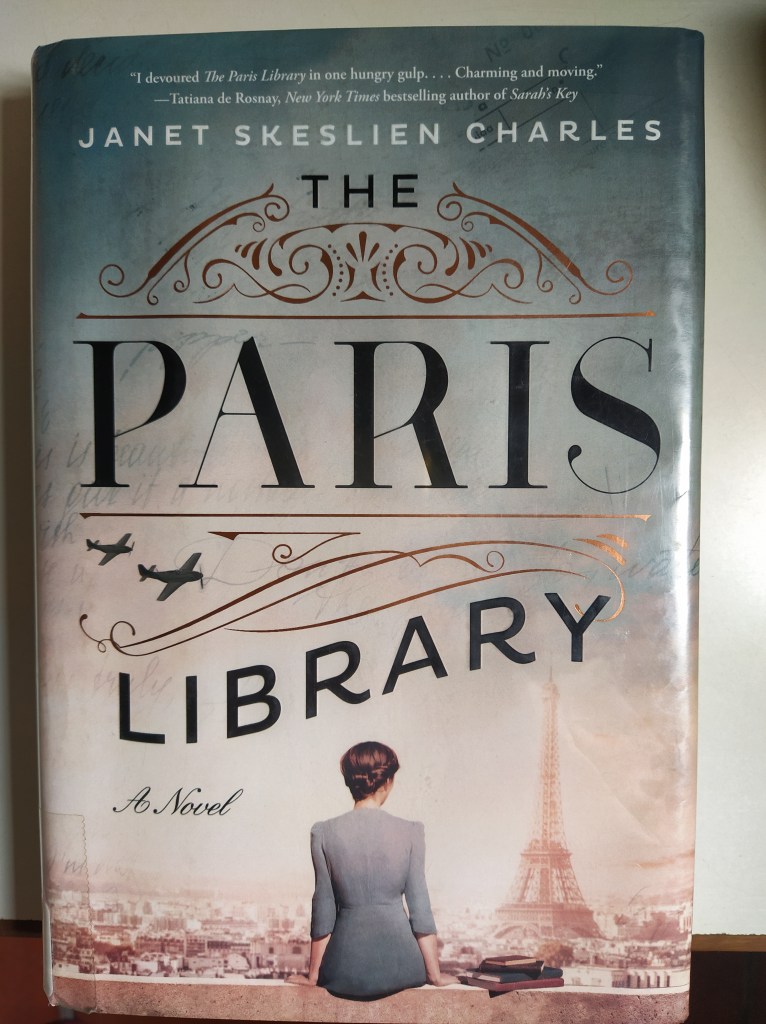
Coincidentally, around the same time I was reading a novel called The Paris Library. While the story and the two main protagonists are fictional, the library around which it revolves, and most of the other characters that are part of the story are based on real people and places. This was the American Library in Paris or ALP as it was called.
As a curious bookworm I was intrigued by this and decided to investigate further into the ALP. I discovered a fascinating history.
The seeds were sown during World War I. This was when thousands of young Americans were fighting with the Allies on the battlefronts in Europe. At this time when the main supply to the front was in the form of arms or medical equipment, the American Library Association felt that the troops needed something to engage them mentally in the midst of their grueling physical existence. So it collected books and periodicals donated by American Libraries and personal collections and shipped these to France to the Library War Service from where they were sent to military bases, training camps and hospitals where American soldiers were fighting. It is estimated that around 2 million books and five millions periodicals were shared in this way with American soldiers fighting the war far from home. One of the centres which housed part of the collection was also in Paris.
When the war ended, there was a discussion about what to do with the books that that been an important support all through the war, not just for American servicemen. During this period the citizens of Paris had also become fond of browsing through the collection of English language books in open stacks (an uncommon feature of European libraries at the time), and international newspapers and periodicals in the Paris centre. Thus although there was no plan to establish a permanent library in Paris this idea seemed to evolve and slowly take root. The thinking was that the library could also serve as a functional model to demonstrate American library methods, especially the use of the Dewey decimal system and open stacks.
Thus the decision was taken not to ship the books back but to establish a permanent library in Paris in the spirit of Atrum post bellum, ex libris lux: After the darkness of war, the light of books. This also became its motto. There was however the question of funds needed to establish and run the library, but the idea had many advocates, and contributors from all walks of life, in America and in Paris united to pledge every kind of support. This was probably an early example of crowd funding.
As a result the American Library in Paris was founded in 1920 by the American Library Association and the Library of Congress with a core collection of those wartime books. Its charter promised to bring the best of American literature, culture, and library science, to readers in France.
Having been established, there was a continuous struggle to keep it not only running but also to enhance its collections and also serve as a cultural hub. The library constantly innovated to keep itself up and running. The Library worked with sixty-five leading publishers in the United States, who sent free copies of newly published works which the Library displayed in a dedicated exhibition space. Over a thousand new books per year were acquired through this channel. Meanwhile, the Library staff, wrote widely published literary reviews of the new titles, and in 1924, they launched their own literary journal called Ex Libris, to which Ernest Hemingway and Gertrude Stein contributed. The library also formed relationships with other libraries through inter-library loans and other social organisations. The American Library in Paris quickly became a vital hub of reference services and educational outreach. Within just three years of existence, the library’s reference room was visited by 35,000 users. It founded its own children’s section in 1928 and had Story Hours for children. The library had highly qualified and dedicated staff as it invited librarians from some of the best libraries in the USA to come on sabbaticals. Some of these stayed on.
The library which grew out of World War I played a critical role during World War II. Once again it sent thousands of books to the troops fighting at the front in Europe. The library became a refuge for its habitués (regular subscribers) not just providing the comfort of books, but companionship, solidarity and solace. As one of the characters in the book puts it: Libraries are lungs, books the fresh air breathed in to keep the heart beating, to keep the brain imagining, to keep hope alive.
The library remained open even during the dark days of the Nazi occupation of Paris. Many of the American staff including its doughty librarian Dorothy Reeder stood firm, until they were forced to evacuate the country, but a handful of local staff bravely continued to run it. They themselves faced great personal risks in delivering books to the homes of some of the regular Jewish subscribers who were no longer permitted in public spaces. The library was also subject to “inspections” to check if they were harbouring any forbidden literature.
The book The Paris Library tells the story of the library and its habitués during the period of World War II. It is a heart-warming tale of the manifold power of books and the unique bonds that books create between people. As the library director Dorothy Reeder says in the book: Because I believe in the power of books—we do important work, by making sure knowledge is available and by creating community.
The story reflects that the original motto of the library: After the darkness of (another) war, the light of books.
The American Library in Paris celebrated 100 years of its founding in 2020. Even in an age where there is a deluge of information at the fingertips this library serves over five thousand members from sixty countries. It holds the largest collection of English language materials on the European continent, and is wholly community supported. It is now as much a community and cultural centre as it is a library, and its users are as diverse as its collections.
–Mamata

 Millennial Matriarchs
Ironically, wars do sometimes lead to good things. This library for instance. Amidst all the fight a library keeps some sane.
LikeLiked by 1 person
I love this piece. I have visited several community libraries in Mumbai – for children of underprivileged areas, for communities of migrant workers, for children cut off from education and resources due to the pandemic – and they have all played the same role of giving hope, expanding vistas and providing anchors in an increasingly unstable environment.
LikeLiked by 2 people