
Most prizes are given to those who have already changed the world: the Nobel, the Magsaysay, any number of national recognitions. These prizes are ways in which the world recognizes a lifetime’s work, a breakthrough discovery, timeless writing, selfless humanitarian aid. The awards in these instances are however collateral benefits. For these greats, often the wok is their own reward.
But in some cases, the prize itself is the motivator, it is the way to spur developments to change the world. Some of the most transformative technologies in human history were sparked by something deceptively simple: a prize.
A problem recognized. A deadline set for its solution. A reward announced for the solution.
And then—an open invitation to anyone bold enough to try.
Take the British Parliament’s Longitude Prize of 1714. Navigation at sea was perilous because sailors could not accurately determine longitude. The reward on offer was up to £20,000—an astronomical sum at the time. The solution did not come from a celebrated astronomer, but from a self-taught clockmaker, John Harrison. His marine chronometer worked—but recognition did not come easily. Payments were staggered, disputed, and delayed. Even when innovation succeeds, institutions do not always know how to respond.
A century later, war catalysed innovation. Napoleon Bonaparte, seeking to feed his armies, offered 12,000 francs for a reliable food preservation method. The result? Nicolas Appert’s pioneering work on canning. With his innovation, food for armies could be preserved for months and years, and could keep armies fed on long campaigns to distant lands. Explorers and sailors started depending on them, opening up new frontiers of discovery. Canned food gave a fillip to farmers, now that their produce could have extended lives. And brought convenience to dining. One competition, one process, many benefits!
These early contests reveal something important: prizes work best when the problem is urgent, the goal is clear, and the reward is meaningful enough to sustain effort over time.
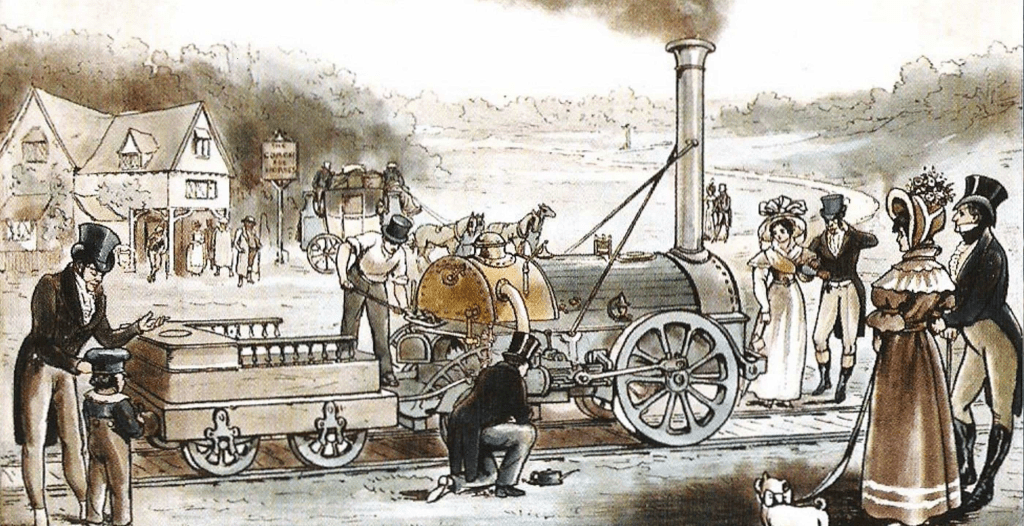
Rainhill Trials
Fast forward to the industrial age. The directors of the Liverpool and Manchester Railway had originally intended to use stationary steam engines to pull trains along the railway using cables. However, their engineer George Stephenson strongly advocated for the use of steam locomotives instead. As the railway was approaching completion, the directors decided to hold a competition to decide whether locomotives could be used to pull the trains. The Rainhill Trials of 1829 offered a prize of £500 for the best way to haul the trains. George Stephenson’s Rocket won decisively, and its design quickly became the standard for locomotives. Here, the feedback loop between competition and adoption was almost immediate.
Then came the age of flight. The Raymond Orteig Prize promised $25,000 for a nonstop transatlantic flight. Charles Lindbergh claimed it in 1927—but only after multiple failed attempts and fatal crashes by others. The prize went to Lingberg, but more importantly, it accelerated aviation as an industry.
By the late 20th century, competitions had evolved into global innovation platforms. The XPRIZE Foundation’s Ansari X Prize offered $10 million for private human spaceflight—and catalysed over $100 million in investment before it was eventually won. The DARPA Grand Challenges, with prizes of $1–2 million, helped lay the groundwork for self-driving cars.
And in the digital age, contests have become even more distributed. The Netflix Prize offered $1 million to improve its recommendation algorithm—successfully claimed, and now foundational to digital platforms. Competitions on Kaggle for machine learning and data science challenges are designed to solve complex, real-world problems using crowdsourced predictive modelling. They routinely offer prizes ranging from a few thousand dollars to over $1 million, with winning models often deployed in real-world systems.
Not all prizes, however, are claimed. The Google Lunar X Prize, sponsored by Google, famously went unawarded when no team met the deadline. And yet, several participating teams went on to become serious space ventures. More recently, the rebooted Longitude Prize on antibiotic resistance—run by Nesta with a purse of £10 million—was eventually awarded after years of global effort.
Enter the Hackathon: The New-Age Contest
If prizes defined earlier centuries, hackathons define ours.
From college campuses to corporate offices, hackathons have become the default format for innovation challenges. India, in particular, has embraced them at scale through initiatives like the Smart India Hackathon, where winning teams typically receive ₹1–5 lakh, along with visibility and recognition.
At first glance, hackathons look like a natural continuation of the prize tradition. But look closer, and a crucial distinction emerges.
Hackathons are built for speed. Typically compressed into 24 to 72 hours, they excel at generating ideas, prototypes, and energy. They uncover talent and encourage collaboration. But they are not designed for depth.
The breakthroughs that defined earlier prize competitions were the result of years of iteration, backed by incentives large enough to justify sustained commitment. Even modern competitions on Kaggle run for months, allowing refinement and optimisation. Hackathons, by contrast, often end at the stage of a promising prototype.
This is not a weakness. It is a different role.
Hackathons are the sparking mechanisms of the tech world.
Lessons for India: Moving from Events to Ecosystems
India is no stranger to ingenuity—though often of the jugaad class. We could surely use the powerful lever of structured, sustained innovation contests.
1. Define Grand Challenges That Matter Locally
India’s problems—air pollution, water scarcity, affordable healthcare—require sharply defined challenges and serious prize money. Rewards must be large enough to sustain effort beyond a weekend.
2. Open Participation Beyond Credentials
Breakthroughs often come from unexpected quarters. Platforms must include informal innovators, practitioners, and non-traditional problem-solvers.
3. Build a Pipeline, Not One-Off Events
Hackathons should be the starting point, not the endpoint. Without this pipeline, ideas from initiatives like the Smart India Hackathon risk fading away.
4. Shift from Inputs to Outcomes
Prize systems reward results, not proposals—encouraging creativity and reducing bureaucratic inertia.
5. Invest in Follow-Through
Mentorship, funding, and testing environments are what convert prototypes into deployable solutions.
6. Measure Success Beyond Winners
India must move beyond a binary view of success. Even if a prize is not claimed, the ecosystem it builds can be valuable.
Because sometimes, all it takes to change the world…is not just a prize—but a prize large enough, a timeline long enough, and a system strong enough to turn ideas into impact.
–Meena

