World Meteorology Day: A Tribute to the Father of Indian Meteorology, Dr. P.R Pisharoty

He is the one of whom Sir C.V. Raman said: ‘I would include Mr. Pisharoty in a short-list of the ablest men I have ever had working with. His personal and intellectual qualities are such as to enable him successfully to undertake the highest type of scientific and administrative work.’

Dr. Pisharoty was not just the father of Indian Meteorology, he was a world authority as well. He pushed for the use of Numerical Weather Prediction in India and if today, we have the capacity to do fairly good short, medium and long term weather forecasts, it can be traced back to the foundations he laid.

Dr. Pisharoty was called the ‘Rain Man’ of india—it is he who fully understood the nature of the Indian Monsoon, and it is this understanding which should underpin our thinking on water conservation and management. He pointed out that rains in India are very different in nature to rains anywhere else. India gets 400 million hectare meters of rain annually, with a landmass of 329 million hectares—enough to submerge our land under 1.29 meters of water per year if spread evenly. But there are areas is India with rainfall as low as 200 mm per year and areas with rainfall as high as 11,400 mm per year. Moreover, the rain in India, unlike in Europe, falls within a very short time. There are parts of India where the entire quota of annual rainfall is received in just 100 hours. Hence he pointed out, the critical need for understanding the local patterns, and for proper planning for water management. With such planning and husbanding he maintained, even the lowest rainfall area of the country could have enough drinking water throughout the year.

He was given the responsibility of exploring the use of remote sensing for India, and when he succeeded in using remote sensing to detect coconut root wilt disease in the late 1960s, the foundation for remote sensing was laid in the country.

We, the Millennial Matriarchs, had the privilege of being mentored by Dr. Pisharoty, as a member of the Governing Council of our organization. He must have been over 75 years old when we first met him (he went to office every day till the age of about 85!). We used to be sent to this giant for getting ‘scientific validation’ of the educational material we developed. The enthusiasm he had for each and every project, the wisdom he imparted ever so gently, the Sanskrit slokas he would quote to bring out a point, the patience with which he put up with rooky, cocky youngsters—the memory of it still gives me goose bumps. Dr. Pisharoty was also a member of all our promotion review committees. The twinkle in his eyes would set us at ease and put life in perspective.  I think we were too young and foolish to appreciate how privileged we were.

My deepest regret: Typical of the old school, he wrote and wrote—letters, articles, notes, comments. He once wrote me a note with an alternative interpretation of my name ‘Meenalochani’ in the Dikshiter composition ‘Meenakshi  Me Mudem’. In my various house-moves, I have misplaced it.

And two quotes from Dr. Pisharoty, which I will think on today :

‘The more you write, the better will be your handwriting; and the more you think, the sharper will be your intellect.’

‘Science is our profession as well as our life’s hobby. Government is paying us for our hobby. Amount of money which we get from the Government should not worry us very much; we are being paid for our hobby.’

Life as Poetry

For many of us a poem was something you learnt by heart and recited in a monotone before a bunch of relatives when urged by proud parents; or as you grew older, reproduced and analysed in the exam paper. The few of us that survived these stages went on to read and enjoy poetry. In all cases, poetry was always associated with something that came in and out of a book.

Many of us have not connected poetry to a living tradition. Poems were created by all sorts of people, poetry grew out of the experiences of life and living and reflected its rhyme and rhythm. It was a blend of the art and the craft of the potter, the weaver, the cowherd, the sisterhood of women who sewed together to create the most beautiful patterns.

As eloquently described, ‘Poetry reaffirms our common humanity by revealing to us that individuals, everywhere in the world, share the same questions and feelings. Poetry is the mainstay of oral tradition and, over centuries, can communicate the innermost values of diverse cultures.’

To celebrate this power of poetry, UNESCO proclaimed 21 March as World Poetry Day. In celebrating this day we recognize the unique ability of poetry to capture the creative spirit of the human mind.

Sharing a poem that reflects this very spirit.

HABIT

Last night when my work was done

And my estranged hands

Were becoming mutually interested

In such forgotten things as pulses,

I looked out of a window

Into the glittering night sky.

And instantly

I began to feather-stitch

A ring around the moon.

Hazel Hall   1921

Hazel Hall was an American poet and seamstress born in 1886. Paralysed at the age of 12, she was confined to a wheelchair. Her days were spent in an upstairs room her family house; she never left this room. To help support her mother and two sisters Hazel took in sewing and occupied herself with embroidering garments. She died in 1924.

–Mamata


In Pursuit of Happiness

March 20 has been celebrated as the International Day of Happiness following its proclamation, in 2013, by the General Assembly of the United Nations as a way to recognise the importance of happiness in the lives of people around the world.

Bhutan gave us the concept of Gross National Happiness (GNH) as a new approach to development which measures prosperity through formal principles of gross national happiness (GNH) and the spiritual, physical, social and environmental health of its citizens and natural environment. The Bhutanese government believes that every citizen’s pursuit of happiness is its main goal. This goal is actually enshrined in article 9 of the country’s constitution.

Another country that joined the race for happiness is Venezuela who has reportedly created a Ministry of Supreme Social Happiness in 2013.

In 2016 the UAE announced a National Happiness and Positivity Programme which consists of five pillars: the science of happiness and positivity, mindfulness, leading a happy team, happiness and policies in government work, and measuring happiness. It appointed a Minister of State for Happiness and also a number of Happiness Officers who would be trained at the University of California, Berkeley and the Oxford Mindfulness Centre of the University of Oxford, two of several international partners enlisted by the UAE government to ensure the success of its programme.

Closer to home, Madhya Pradesh is reported to be the first and only state in India to have created a department of happiness to boost the wellbeing of its citizens, and appointed a Minister for Happiness.

Time was, not all that long ago, when happiness was not measured by data and official policies. Happiness was not analysed and planned; it was not pursued under any DIY guidelines or international training programmes.

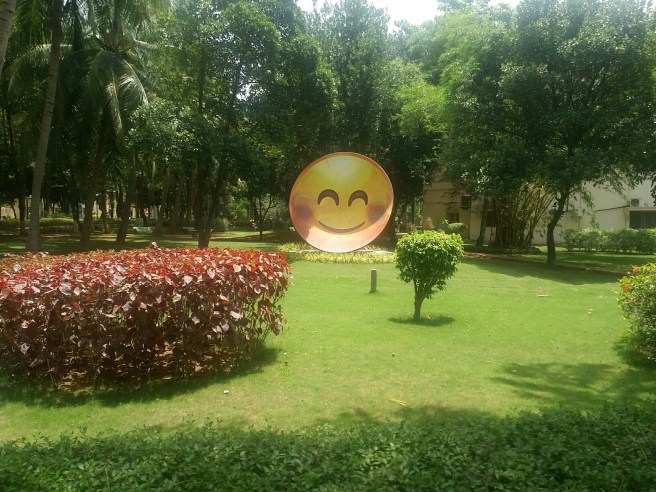
Rather happiness was what you felt (and not all the time), what you shared with your family and friends—not through ‘events’ and slogans, but over a family meal; exchanged lunch boxes in the school recess; through letters and cards, and other simple joys of life. The same was done when one was feeling sad, or tense or confused. It was a time before emoticons summed up the way we felt.

The 2018 theme for International Day of Happiness is Home. In keeping with the times, sharing an online recipe for making a happy day!

Smile, share, eat healthily, exercise, be grateful, give back, think positively, spend some time with friends and family, spend some time alone, be mindful, dream, listen to music, say thank you and mean it, compete, be charitable, say “all the more” instead of “nonetheless” – you get it. Do what makes you happy. https://happinessday.org/

In the meanwhile–from the global to the local–it had been reported that the minister for Happiness in Madhya Pradesh, whose arrest had been ordered by the court on charges of murder, had gone missing. Last heard of, the police were in hot pursuit of Shri Happiness!

–Mamata

Writing Poetry

The only other time

Ever I wrote poetry

Was when I was fifteen


And pretty awful poetry it was

Generally whiny and confused

Written in a fit of anger

Against the world (as personified by my mother or teacher)

Or from the depths of despondency

(After a ‘I’ll never talk to you’ fight with a best friend)


Never did it rhyme

Have a spark of originality

Or rhythm

Or any redeeming grace


Now that I am fifty five (plus!)

I find myself writing poetry again

As awful as before

As whiny and confused

As graceless—if slightly better spelt!


Second childhood I have heard of,

But why did no one warn me

That adolescence and the mid-life crisis

Have so much in common?

-Meena

About the Millennial Matriarchs

The MM collaboration began around 30 years ago (long before they were matriarchs!) and has resulted in several initiatives: educational projects; about 25 publications including school and college textbooks, story books, teachers’ manuals, etc.; exhibitions, films, training programs….

Other interesting shenanigans include editing the Ahmedabad edition of the Children’s Supplement of Indian Express for three years.

The MMs are:

Meena Raghunathan: Scolder-in-chief and mother-in-law to the world at large. Also, an environmental educator for two decades and CSR professional for 15 years. CSR, education, pre-school education, skilling and livelihoods are areas of professional interest. Writing and editing are personal passions.

Mamata Pandya: Scolder of the scolder-in-chief, and partner in drafting andheader 4 crafting words! An educator, writer, editor and avid crossword cracker. Lover, collector and translator of children’s books. In a continual explore, discover, think and share mode.

The blog is a leap of faith for both the Matriarchs, as technology and social media are not their areas of comfort.

But hope to get by with a little help from our friends!

MM

A Decade of Caring for Little Hearts

Tragedy comes into all our lives. And so too, it visited my friend Chitra Vishwanathan. She lost her beautiful little daughter Aishwarya who had a Congenital Heart Defect.

‘Congenital Heart Defect is a neonatal birth defect due to abnormal development of the heart that could involve the interior walls of the heart, the valves inside the heart, or the arteries and veins that carry blood to the heart or the body. Blue baby is another term used for CHD. Such babies have a blue complexion from lack of oxygen in the blood due to a congenital defect of the heart or major blood vessels.

The severity of CHD ranges from simple to complex. Simple CHDs such as a small hole between heart chambers do not require any treatment because they get corrected on its own. But complex CHDs require special medical care and multiple surgeries over a span of several years.
CHD affects approximately nine out of 1,000 new-borns and is one of the leading causes of infant mortality. Approximately 10% of infant mortality in India could be attributed to CHD alone. However, early detection and right treatment increases the chance of survival and has good long-term prognosis among new-borns. Around 90% of CHD-affected children can be treated if diagnosed early, even better if it gets detected before birth. Roughly around 1,80,000 children are born each year in India with CHD. Of these nearly 60,000 to 90,000 require early intervention.’(1)

What did Chitra do with her sense of loss and her grief? Turned it into a mission to reach as many babies with CHD as possible and try to save their lives. She set up Aishwarya Trust, which this month completes 10 years. The Trust focusses on creating awareness about CHD; undertaking massive screening camps; and free surgeries as required, in partnership with reputed doctors and hospitals. The Trust has saved 1300 young lives through surgeries in this decade–including children from Tamil Nadu, Karnataka, Puducherry, and other parts of India, along with children from 5 African nations (Rwanda, Burundi, Sudan, Nigeria, and Somalia) and Iraq. And created huge awareness about the issue through awareness and screening programs.

Thanks Chitra!

Readers, anyone you know who has turned tragedy into a mission? Do share and inspire!

–Meena

Ref (1): http://rhythmofheart.org/about-aishwarya-trust/


An Ode to Letters

For the dinosaurs who lived through the age of pen and paper, and those who may read about it in history books!

An Ode to Letters

The last time I wrote a letter? Why, just today!

I need it like therapy, at least once a day.

I do not twitter nor tweet, tho’ the world finds it so neat!

Instagram and Snapchat…What’s that?

I like my words to be spelt as they must, and sentences that don’t rust.

Alas, now I too must type my words and SEND an e-mail

Oh for the days when they were penned, and were snail mail!

I so miss the prelude, the preparation and the process…

Choosing the paper and filling the pen (with an ink called Quink!)

Trying to capture the words as they tumbled and tangled and dangled,

Protestations and lamentations, explanations and vexations.

Reports to parents, and advice to sisters, news to share and opinions to air,

Musings with friends–from mundane to surreal,

Sweet nothings to that someone special!

Drafting and crafting late into the night,

Stashing the sheets in the envelope before first light.

To the post office the following day, to weigh and decide

The stamps to be bought, and pasted on the top right side.

Then drop into the big red box with swish and a wish,

And the delicious anticipation of the letter in return… a month, a week, a fortnight,

Counting the days, awaiting the post, what a splendid way to spend days and nights!

I cannot think of anything better, than the sheer joy of penning a letter!


“The palest ink is better than the best memory.” Chinese proverb

—Mamata


Emma Watson’s ‘Eats Shoots and Leaves’ Moment

Last week, Emma Watson was seen with a tattoo at a red carpet event. The tattoo said ‘Times Up’ and was in support of the movement against sexual harassment in the workplace which is snowballing, and is a follow on from the #metoo campaign.

Laudable intent. But less-than-laudable grammar!  What really caught everyone’s eye was that the tattoo said ‘Times Up’, rather than ‘Time’s Up’. With her characteristic sense of humour, Watson responded to the criticisms with a tweet: “Fake tattoo proofreading position available. Experience with apostrophes a must.”

Everyone is talking about it! I am happy for Watson, I am happy for the movement. But most of all, I am happy for the APOSTROPHE! Difficult for a punctuation mark to get red carpet attention, but the apostrophe’s done it (yes, and I think I got the apostrophe right, see rules below!).

So maybe we should give it some attention too! When you are out tomorrow, look out for how often the apostrophe is misused. I find more ‘errors of commission’, as compared to Watson’s ‘error of omission’. For instance, within 50 metres of my house is ‘Shri Ganesh Tyre’s’. Not much further down the road is ‘Sai Krishna Sweet’s and Snack’s’. (Raghu tells me that for some reason, in his school, they used to refer to it as a ‘post office comma’).

It may be worth taking a few moments to briefly review the usage (no guarantee we will still  get it right!):

The apostrophe is used in two situations (and I quote all the rules below from https:// en.oxforddictionaries.com/ punctuation/ apostrophe): (1) to show that a thing or person belongs or relates to someone or something: instead of saying the party of Sudha, you can write Sudha’s party; and (2) an apostrophe is used to show that letters or numbers have been omitted. For instance, I’m – short for I am, or he’ll – short for he will.

The biggest controversy about apostrophes is in the its and it’s!

These are the rules to remember:

  • Its(without an apostrophe) means ‘belonging to it’: The dog wagged its tail.
  • It’s(with an apostrophe) means ‘it is’ or ‘it has’: It’s been a long day.

Wondering if apostrophes are really worth a blog? Well Lynne Truss has written a whole book on punctuation and it was a bestseller! Do read her ‘Eats, Shoots & Leaves: The Zero Tolerance Approach to Punctuation

And for more on the apostrophe, including the county which has banned it, go to

https://blog.oxforddictionaries.com/2013/05/28/do-we-need-the-apostrophe/

–Meena

Nose No-Nos

So now plastic surgeons (that’s what they were called in our days) are being asked to ‘fix’ noses so that they look good on selfies! It’s not enough to use all the technology the digital wonders provide to shape and mould, and shade and light our faces to look oh so picture perfect in every selfie, pelfie, helfie, welfie and ussie (no I did not make those up!)  taken every moment of our waking lives!  According to a 2017 poll, 55 percent of facial plastic surgeons reported seeing patients who wanted surgeries to help them look better in selfies, up from 13 percent in 2016.

Researchers are working out mathematical models to help describe how selfie cameras distort the face. They found that when taken 12 inches away, selfies increase nose sizes by 30 percent in men and 29 percent in women compared to photos taken five feet away, a standard portrait distance. And yet, in the quest for the perfect picture, cosmetic surgery is seen as the perfect answer.

What an unimaginably narcissist society we have become! Time was when noses were a distinguishing feature of one’s face. We were born with them, and we lived with them. Maternal and paternal aunts would argue about whether the new baby had the father’s nose or the mother’s nose. Characters in stories were described by their noses—the handsome hero with the Roman nose, the wicked hook-nosed witch, the cute button-nosed toddler….

When my daughter was born, my paternal aunt told me that I needed to pull her wee little nose every day to give it shape and substance. That was almost 30 years ago. Last week daughter and I took an ussie. And she looked at it and said “Mama, you and I are both growing into Grandfather’s nose!” Like it or not that’s our heritage, and makes us uniquely what we are!

–Mamata


‘Daughters’ and My Place in the Continuity of Life

Like most of life, books also happen to one in their own time. So it was only this week that I read Daughters by Bharathi Ray, a book which first came out in Bangla in 2008, and in English translation in 2011 (foreword by Dr. Amartya Sen, no less!). Historian, erudite scholar, administrator (Pro Vice Chancellor of Calcutta University, couldn’t have been an easy job!), parliamentarian (Rajya Sabha, 1996-2003), she is made a tad more personal for me because she was part of a Parliamentary Committee which visited my organization years ago, and the fact that I am mildly acquainted with her daughter Raka Ray.

Daughters is the chronicling of the stories of five generations of women of Bharathi Ray’s family—from her great grandmother, to her daughters.  No dramatic stories, but the telling of everyday life of women.

But through this, it tells many tales. That some women in every generation have fought for what they wanted, and made their own spaces. It is not always dramatic. Rather, it is the story of incremental change—maybe the kind of change that is truly sustainable.

And it is on the shoulders of these women that we stand. What we take for granted today has been possible because of them. The outliers became the role models and then the norm. When a girl who grew up in the early 1900s and was not sent to school because that was not then the norm,  shut herself up for three hours every day of her life to read and learn, in spite of the pressures of a joint family, she set the norm that women had a right to their time, and to education and learning. When a young married woman stepped out of her house in 1958 to take up a job in spite of the mild discomfort of her mother-in-law and husband, and became a teacher and moulder of young minds, she made it easier for so many women to pursue their careers.

I am neither a student of history, nor have I had the fortune of being Dr. Bharathi Ray’s student. But her book has given me an appreciation of my place in the continuity of life and women’s lives. And my responsibility to push it forward. I think this is what history should be about.

–Meena