Remember the loveable character of Mary Poppins who could fix messes in homes and families? Don’t we all sometimes wish that Mary Poppins would fly into our lives and set things straight? Someone who could discipline us to set ourselves in order? Believe it or not there is a real new-age Mary Poppins, and her name is Marie Kondo!
Who is this new Marie and what does she do? Marie Kondo is a Japanese “tidying expert!” She helps people to clear up the clutter in their homes, and guides them towards creating spaces of order and serenity.
Marie was born in Japan in a culture which celebrates beauty in simplicity. Marie grew up with the ingenious origami art of folding, artistic ikebana, beautifully orchestrated tea ceremonies, and the art of creating minimalistic but serene surroundings, as well as an inborn gift for creating order out of chaos. She added to this, a canny entrepreneurial spirit when she started her “tidying consultant” business as a 19-year old university student in Tokyo. Realising the immense need and scope of “tidiness consulting” in an age when people lives were ‘cluttered’ in every which way, she went on to write a best-selling book “The Life-Changing Magic of Tidying Up.”
Where Mary Poppins created magic with the wave of her umbrella and a catchy tune on her lips, Marie Kondo starts her process of transformation in a more oriental style by making her clients calmly meditate on how their space is special to them, and to give thanks for this. She then proceeds to gently but firmly get them to review all their possessions, and let go whatever does not “spark joy” in them, after thanking these for their service! She then advises on how to rearrange and reorganise the remaining belongings by category, following the KonMari Method.
Today Marie is a global expert with her own Netflix’s hit show “Tidying Up With Marie Kondo, and founder of KonMari Media Inc.
I admire this young woman who has found herself a natty niche, and is smart enough to make a successful enterprise out of it. But I cannot but help thinking of the generations of homemakers who have kept beautifully organised and managed homes with limited resources, but much hard work, care and creativity. For them it was a way of life, into which they were oriented by mothers and mothers-in-law. Today when we have much more of everything, except time and patience, voila, Marie Kondo is at your service!
It is the day of tributes and nationalistic fervour. The news is replete with people sharing thoughts and feelings about what India means to them. This is my small paean to what, for me, represents the essence of India. It is an ode to the saree!
I wore my first formal saree when I was 16 years old. I still remember it—a magenta-pink Venkatagiri brought by my friend’s mother from Chennai. And I fell in love with sarees. Not just the finished draped version but simply this seemingly endless flow of fabric, with its mind-blowing variety of textures, weaves, designs, and colours. It was the start of an enchanting journey of discovery—learning, over the years, about the unique features of sarees from every part of India. Luckily for me it was the period of rediscovery of the rich heritage of our textiles which manifested in national handloom exhibitions where weavers displayed their wondrous skills. Oh the excitement of adding, one by one, traditional sarees of different states—the stunning kanjeevarams; the intricate ikats; the rustling golden tussars; the vibrant bandhanis and patolas; the summery kotas, and the sturdy handlooms. With every piece was the attempt to know more about the place and people who wove the masterpieces, the dyes and the motifs, the warp and the weft. It was an exploration of my country—its geography and history, culture and tradition, and craft and craftsmanship.
I was already part of a committed saree-wearing cadre when I started my career as an environmental educator. To my delight, one of the early statements by my Director Kartikeya Sarabhai, beautifully summed up the very special features of the saree. “The saree is a designed piece of clothing worn all over India. Over the years very beautiful designs, patterns and textures have been printed and woven into the Indian saree and yet, several thousand years of Indian history has not tried to stitch the saree. It is worn in many ways and fits all sizes. It is equally good for working, dressing up or sleeping in. The final effect is the combined effort of the person who designs the cloth and the person who wears it—of the designer and the user. This is a very different concept from that of designing, say, a well-stitched dress. The garment either fits or doesn’t fit, and where it fits, leaves very little room for the wearer to be innovative in its use.”
I have worn a saree every day of my working life. I have looked forward to choosing the one for the day, and it has become the symbol of my identity. I have worn my saree at home and at work; while travelling and sleeping; rain and shine. I have experienced the joys of putting together my own collection of the multitude of woven flavours of this wonderful country, and revelling in the rich bequest that is ours to savour and share
I am saddened at the ebbing of the saree today. Appalled that it has been reduced to a hashtag; that sarees have become exclusive “designer outfits” with tips on outre ways of draping a saree or, even worse, the stitched saree! I am amused when people think I am an ‘amma from the days of yore’ when I am the only one in a large gathering wearing a saree. I am disturbed that in our race for globalisation and international Brands, we seem to be losing a crucial common thread of identity.
For me the saree represents the essential spirit of my country—the heritage and the history; the multiplicity and the uniqueness; the weaving of warp and weft to create a strong resilient fabric. It represents a unique common identity which subsumes the incredible diversity of textures and motifs. It represents the magic of being a seamless length of fabric that takes on the individual character of its wearer.
I may not wear my patriotism on my sleeve, but every time I wear my saree I celebrate the wonder that is India!
Time was, not so long ago, when photo albums were treasured family heirlooms. Looking at old photos was one of the shared activities at a family get-together, with the elders pleasurably sinking into nostalgia, and youngsters playing guessing games at identifying the people in the pictures. There was a special excitement in flipping through the pages and sharing a laugh at “how much hair dear uncle had”, as compared with his bald pate today; or comparing the picture of the slim young girl with the comfortably chubby aunt today!
Photographs recorded the phases of life—the baby pictures taken by fond parents to record milestones; the awkward and self-conscious pictures of the gawky teenage years; the fancy wedding photo album; and the next cycle of young parents, their babies and doting grandparents.
There was a certain charm in seeing these transitions through the captured images. There was also a certain ceremony attached to the process of documenting. In the early years, this took the form of special posed pictures taken by professional photographers. With cameras becoming more user-friendly and available, it brought the process closer to home, but there was still the waiting period between the giving of the film for developing and getting back the prints and the negatives to discover what they revealed! Over time the technology and format of film, cameras and processing changed. The Polaroid camera was magic in a box—click, and voila the photo appears. …And then came the mobile phones with the ease of capturing images in an instant; along with all the many many Apps to do what you wish with the image. And everyone went crazy…every second of every day to be not only recorded, but immediately shared. Followed by the anxiety of how many views and how many likes. A deluge of images, sweeping across the screen of life, fleeting, momentary and, alas not as magical as turning the pages of an album to peruse history.
And now the new rage—FaceApp! The wand that reveals what you will look like when you are OLD! Celebrities across the world are posting pictures of what technology turns them into, projecting into the future. Of course every one of them looks suitably dignified and gracefully old, and feels reassured that “I am going to age well.”
Even more thought provoking is the news that this may also be used for not-as-legit facial recognition purposes. This makes me wonder. One the one hand, for millions of millennials, self-esteem and self- image hinge on being, at all times, visible on social media and “liked”. Then how can this be selective?
I am totally flummoxed by this. Here is a generation of self-obsessed young people living in an age where Image matters most. Here are the celebrities who spend millions on “looking young”. Here are the people who believe that life is in the here and now. Here is the technology which allows you to Photoshop away every trace of wrinkle or sagging skin, every blemish or hint of the passage of time. And yet these same people are clambering on the new high of “looking old.” Sadly, if only they stopped to think, life is more complex than an App, and who can tell what traces the ravages of time and experience will leave on our visage.
As for me, I would rather browse through the passage of time from my photo albums, than fast forward to the future!
This piece is continuing Meena’s recent angst about parenting.
Indeed, parents need counselling more than the children. In many ways it seems that children today are more the receptacles of the parents’ own aspirations and, yes, peer pressures. How does the parent participate in conversations which centre around–What school does your child go to; what does she/he excel at; where did you go for your last family holiday; which are the different types of special coaching your child has… and so on. So the child has to live up to the expectations of not only the parents, but the social circles that they move in. And somewhere in all this circle of “well-meaning concern” the child begins to feel inadequate and undeserving, and there starts slow seeping of confidence, which sadly may end in extreme consequences.
At another level is the insidious guilt of the parents—for being so busy with their work and leisure; for delegating a lot of the traditional parenting tasks to external help; for not giving what they feel may be adequate time and attention; for not giving the child “the best that money can buy, after all what are we working so hard for?” This manifests in the over-concern, over indulgence and over coddling by parents; and a sense of birth right to privilege, self-centredness, and “my parents can set it right for me” on the part of the child. This too may have disastrous consequences should the well-planned map of “how we see our life” go awry.
Every generation of parents feels that the times that they live in are the most challenging, and that they require bespoke answers to child raising.
Interestingly, over 80 years ago, my grandfather Gijubhai Badheka, wrote several volumes on the challenges of parenting, with the apt title It Is Not Easy…Being Parents. Gijubhai was not trained in child psychology; but his deep concern for the welfare of the child led him to observe, reflect, and note his thoughts. He described the dilemmas faced by both parents, as well as by children, and explored possibilities of how these could be handled.
For me, these simple yet profound notings are as fundamental and relevant even today. Sharing a few excerpts, translated by me from the original in Gujarati.
The young boy strenuously clambers up two rungs of the ladder. As he raises his foot to reach the third rung, the father says, “Come down; you are too young to climb ladders. If you fall you will break your bones.”
The young girl carefully wields a knife to chop vegetables or to sharpen a pencil. The mother scolds, “Put down that knife; you will cut yourself.”
The daughter wants to put the pan of dal on the gas stove. Mother says, “You will get scalded.”
The daughter says “Can I carry the glass of water for the guest?” Mother says, “You will spill it.”
The adults are trying to solve a problem. As they discuss the child offers some suggestions. All say, “Now you don’t try to act too big for your boots.”
Every day in innumerable situations we react in this fashion, unknowingly squashing the confidence of our children. Every time it takes up a task, it hears echoes of its parents’ cautionary warnings, and drops it forthwith, overcome by the fear that it will not be able to successfully accomplish the task. If someone asks it to climb up, carry something or use a tool, it may refuse, or if forced to do so, ends up falling or spilling or hurting itself. The child ends up even more ashamed at its own inadequacy to carry out the task.
By corroding our children’s confidence, we truly do make them unable to perform. In some ways our lack of confidence and trust in our children is a reflection of our own lack of confidence.
We need to have the strength to have confidence in our children. Encouraged by that trust, our children will prove themselves more than worthy of what we have bestowed. A child is human, a human striving to grow. We must enable this growth, the blossoming of its personality.
Removed from all the outer trappings of “success,” ultimately what do we, as parents, wish for our children? I think it should be “the confidence and courage to take on life!”
The last few weeks, my newspapers have been full of news about newly-crowned Queens. There is a Miss World, and a Miss Universe, and numerous other regal titles bestowed on young girls. So far so good.
As a passive observer peeping through the window of the pages of my newspaper, over the years I have been noticing how the run-up to such pageants is becoming more and more elaborate and ostentatious. Qualifying rounds are held in different cities, in the most luxurious hotels. Several glossy pages of the paper feature spreads of photographs of the pretty young ladies going through a variety of activities in different settings, clad to the nines in appropriate designer wear. There is an ever-growing list of event partners—dress designers, hair stylists, skin gurus, make-up magicians, tutors to (re)teach the girls how to walk and talk, and so forth. And, of course how can all this work without the sponsors? So you have sponsors for everything from the eyes to the toes–Miss Expressive Eyes, Miss Dazzling Teeth, Miss Scintillating Smile, Miss Satin Skin, Miss Shining Hair—and on till there is nothing left to miss!
Possibly thousands of girls apply for these pageants with these very visions becoming the stuff of their dreams. I suspect that even as they start the process, so much time and hard-earned money is spent in preparing the portfolios to enter the race. For those “lucky” ones who make it through the various rounds, the metamorphosis begins as they are taken through the paces. But behind the scenes? A bunch of still naive girls living in close proximity, in a fiercely competitive environment–I cannot begin to imagine what the atmosphere will be like—the anxieties, the hostilities, the petty politics, the pressures. As murky as the intrigues in the court of a royal family!
The newspapers kindly give us ‘”the underprivileged outsiders” glimpses into the culminating moments of the qualifying events. The full spread pictures of an array of pretty girls with similar hairstyles, smiles and dresses makes it difficult to tell the difference between them. Until voila—we have the coronation of the Queens. Usually the brouhaha ends there. This year there has been a follow up. We also had the privilege of following the Queens as they visited their “native places”—the town or village that their family hailed from. We saw pictures of cheering crowds, motor cavalcades, cameramen and interviews and family and village elders welcoming their local girl who became Queen.
And I think—Is this the role model for all the young girls in the small towns and villages? Is this what it means to have “arrived?” Is this what parents dream of for their daughters from the day that they are born? Aspirations!
It is a very worrying trend. One observes young girls (almost children) being accompanied to beauty parlours for a host of grooming and beauty treatments. Parents spend much money on consulting nutritionists and dieticians, trainers and gyms, and of course the latest fashion in clothes. “Looking good” becomes the end all and be all. Aspirations!
An even more frightening extension of this is the pushing of young children into the numerous reality shows. I am appalled at the occasional glimpse of children cavorting to Bollywood numbers dressed in vulgar outfits and plastered with make-up. A recent piece about a five-year old girl who won a dance show talked about her childhood in a slum of Kolkata, and how she has made her parents so proud. Her dream is to live in all all-pink fairy tale house. Aspirations!
How disturbing. How sad that in a country where we are still talking about Save Our Daughters, Educate Our Daughters, we seem to be building aspirations that promote superficial showmanship, branding, and objectification of our daughters.
Among the many new medical disorders that have entered into our consciousness and everyday vocabulary in the last decade or so, a new one was added in 2005— Nature Deficit Disorder. The term was coined by Richard Louv as a way to describe the psychological, physical and cognitive costs of human alienation from nature, particularly for children in their vulnerable developing years.
As we live in our concrete jungles, increasingly cut off from the sight, sound and feel of Nature, these senses are steadily diminishing. Increasingly medical research is now proving that our sedentary lifestyles or “epidemic of inactivity” is the cause of a host of appropriately-called ‘lifestyle diseases.”
Richard Louv in his book Last Child in the Woods: Saving Our Children From Nature-Deficit Disorder expressed his apprehension at the growing phenomenon of alienation from Nature, and built a case for consciously building closer links between young children and Nature, through opportunities to go outside, be in Nature, and learn from Nature.
Times have changed—and not for the better. Almost fifteen years after Louv articulated his concern, the “wave from the West” has reached our homes in India, as it has most parts of the world. Children don’t seem to get as much opportunity to play outdoors and explore and discover independently anymore; meeting friends is usually organised and supervised in “play dates” rather than children spontaneously getting together and simply “mucking and mooching around!” Yes, there are genuine issues—safe spaces, security and time; but this over-protectiveness can actually be detrimental to children’s health, if they don’t get enough outdoor time and experiences. Difficult though it is, while we as parents, leave no stone unturned to give our children the best opportunities that money can buy for their all-round development, are we giving them enough exposure to the outdoors? For children and their development Nature is not “optional”, it is as essential as a healthy diet for growing up.
I do believe that the same formula applies equally to adults. Nature and the outdoors are vital for our physical and emotional development and well-being; it is only here that can we encounter all four non-negotiable sources for self-development: freedom, immediacy, resistance and relatedness (connection). In fact, it is for us to take the lead.
An even more alarming trend has been towards the gradual deficit of Nature, even in our language. Since 2007 the Oxford Children’s Dictionary has been dropping words related to nature to replace them with words that they felt better represented the present day and age. Acorn, Buttercup, Conker gave way to Attachment, Blog, and Cut-and-Paste. In 2015, some of the world’s most prominent authors composed an open letter of protest and alarm at this impoverishment of children’s vocabulary by replacement with words “associated with the increasingly interior, solitary childhoods of today,” and its consequent diminishment of children’s belonging to and with the natural world. A frightening manifestation of Nature Deficit Disorder. The authors expressed their distress that such culling of words would “deny children a store of words that is marvellous for its own sake, but also a vital means of connection and understanding.”
As one of the authors said, “If you can’t name things, how can you love them?”
The wonderful tradition of keeping diaries and journals is ages old. The exercise of recording one’s thoughts, memorable moments, and pouring out teen-age angst was pretty much a part of our growing up years. And now, many years down history as it were, revisiting these is a wonderful trip down memory lane. Sadly in this an age of instant communication (often only in limited characters) and fleeting memory, there seems to be no time to spend on recording what will, some day, be history—our own and that of the world we live in.
The recent engagement of the Matriarchs in developing textbooks for young children has brought us again and again to the challenge of ‘how do we instil in children a sense of history?’ Not history in terms of dates and names and events, but the idea that where each of us is today, is one point in the continuum of time and generations. In this age of small nuclear (and often single-child) families, the tradition of oral histories passed on through generations seems to be getting lost. Children need to know “where do we come from, what is our family like, what have we learnt from our family experiences and history?”
Well here is someone who is trying to address similar concerns in a new way through History Hive, the brainchild of Moon Moon Jetley, a historian and researcher, who looks beyond academia.
Moon Moon and I worked together on a project last year, and bonded over many shared interests, and love for cold coffee and French fries! I was excited when she told me about her project-in-making for trying to connect people with history in an innovative way.
This is now up and running as History Hive, with its first product My History Kit. The inspiration behind the kit is personal history and the necessity to record it. This is a hands-on creative history experience that helps its users to connect with, and record their personal history with family stories, experiences and milestones. The kit contains a journal, a map, a dice and a puzzle. The Journal is a space to write your own story, the dice is a writing prompt, the puzzle a fun element, and My History Map is a space to creatively recreate your story, not only in words but by sticking mementos of the moments—pictures, souvenirs and anything associated with the experience.
The kit can be used by a wide age group (15-95 years) and people from diverse professions–doctors, writers, lawyers, home makers, teachers, travellers, entrepreneurs, start up owners, actors, and just about anyone who wants to tell, and keep their own stories.
And now, the latest magical health food—the humble Sweet Potato.
All these years, I knew of only two ways to eat it. Boil, peel, cut, eat. Or roast, peel, cut, eat.
Now the net has tens of recipes. Outnumbered only by articles which list the benefits of eating sweet potatoes.
So were we excited when someone told us a super-simple way to grow them! Just cut the bottom half off (cook the rest!). And put this bottom half into a container of water, partly submerged in it. Put the container in a place with good light (outside for a few hours is good). Don’t forget to change the water every 3 days. And you will see magic in a week! Small leaves in shades of green, red and purple, then more leaves. Growing lush and tall
Once you see enough leaves, plant this in the ground or in a pot.
And voila, you will have your own sweet potato farm!
Be green, have fun, eat healthy!
–Meena
PS: Apparently, bandicoots and rats love sweet potatoes. So I think the first part involving the container is the easy part. Who knows what will happen when we put them in the ground!?! But we will be optimistic.
PPS: A joint project of Anuradha, Sudha and Meena.
Last week, I happened to go to Goa (regretfully, not a holiday!). The airport, as many airports across the country, is full of shops.
Apart from the usual brand shops and the special Goa memorabilia shops, I came across a fascinating outlet here. It was a ‘GIs of India’ shop!
Oh, I have jumped the gun! GI could stand for any number of things. I am referring to Geographical Indication, which is “an indication which identifies goods such as agricultural goods, natural goods or manufactured goods as originating, or manufactured in the territory of a country, or a region or locality in that territory, where a given quality, reputation or other characteristic of such goods is essentially attributable to its geographical origin and in case where such goods are manufactured goods one of the activities of either the production or of processing or preparation of the goods concerned takes place in such territory, region or locality, as the case may be.”. GI is a type of intellectual property right, which certifies a product as having originated in a specific geographic location—for instance, that the Mysore silk you just bought is indeed produced in Mysore; or the Jaipur Blue Pottery is indeed from Jaipur.
Madurai Sungudi is GI registered
India enacted the Geographical Indications of Goods (Registration and Protection) Act in 1999. The first GI product to be registered was Darjeeling Tea. Now there are 330 GI registered products—a fascinating range, from the usual suspects to the completely unexpected—from Kanpur Saddlery, to Beed Custard Apple; from Coimbatore Wet Grinder, to Varanasi Glass Beads!
The shop at the Goa Airport was very new, just being set up. But the staff were extremely enthusiastic and eager not just to sell their products, but also share information on the concept of GI shops. They said that a large chain of these was coming up across the country.
Indeed an exciting way to create a market for these amazing products, and preserve the diversity, both natural and cultural.
I’ll be on the lookout for these GI shops, for sure!
2019 has been declared as The International Year of Indigenous Languages (IYIL2019) by UNESCO. The official launch of IYIL was held on 28 January 2019. The aim of IYIL is to “draw attention to the critical loss of indigenous languages and the urgent need to preserve, revitalize and promote indigenous languages around the world”.
Of the 6000-7000 languages in the world today, about 97% of the world’s population speaks only 4 % of these languages, while only 3% of the world speak 96% of all remaining languages. A great majority of those languages are spoken mainly by indigenous peoples.
India is one of four countries, along with Nigeria, Indonesia and Papua New Guinea, with the largest number of living languages. A mammoth project to conduct a comprehensive survey of Indian languages was launched in 2010. Initiated by Prof. G.N. Devy, founder of the Bhasha Research and Publication Centre in Vadodara, and undertaken by a large team of scholars, the project called the People’s Linguistic Survey Of India (PLSI) set out to document and preserve 780 languages which are being spoken in India today. These are being published in the multi-volume People’s Linguistic Survey of India, towards providing an overview of the extant and dying languages of India, as evolved till 2011, and as perceived by their speakers. The volumes chronicle the evolution of these languages in all their socio-political and linguistic dimensions, and encapsulate the worldview of their speakers. PLSI proposes to complete its task of publishing 92 volumes by 2020.
In the last couple of years, I have had the enriching opportunity to learn about some of the indigenous people of the north east of India and a glimpse of not just the incredibly rich traditions of textiles in the region, but equally the close ties between language of the people and the language of their textiles. Not only does every tribe have their own dialect, but each dialect has wonderfully nuanced words to describe every textile that they weave, and even every motif that is woven on these.
Names of textiles of the tribes have references to the history and geography of the tribe, as well as names that literally relate to colour, size, on which part of the body they are worn, as well as referring to age and status of the wearer. There are specific shawls for elder men or women, for those who have special social status (as in the Naga the Feast of Merit shawl), for a new bride to wear to her marital home, and for covering the deceased.
As Ganesh Devy puts it “in every manner without any exception, the language we learn or use is the absolute condition of our narrative of the world and the way we see the world.”
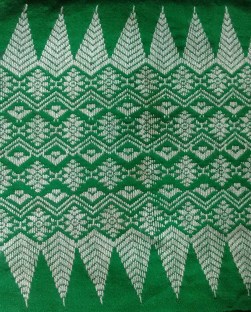
Of the numerous examples of this, is that of a textile of the Bodo Kachari tr
Aronai with Hawjagor pattern
ibe of Assam.The multi-use decorative textile called Aronai is characterised by a zig-zag motif called Hawjagor (hill pattern) in the Bodo dialect. This pattern is inspired by the hills which form an important part of the history as well as the geography of the Bodo people who settled by the foothills, on the north bank of the Brahmaputra in Assam.
It is in the names of motifs that women weave onto the textiles that the symbiosis between life, nature and culture is most evident. The names not just reflect how nature inspires form, but also reveal a keen eye for subtle detail and the richness of language to reflect this.
A common triangular motif on wrap skirts of the women of a small Naga tribe is called impeak bam. The word Impeak translates to ‘stretching out/extending/ spreading out’ and bam means ‘wings’; and the motif symbolises a flying Hornbill. While a similar but smaller triangular motif is named to mean the wings of the bird called a Swift.
Some of the motifs of the Liangmai Naga tribe in Manipur are named literally to represent elements such as fish bone (kakhara thua), cow’s teeth (kabuihu), and ripples in a lake (kazai kapai). There is even a woven line stitch line called matiang kang meaning ‘group of ants.’ These are only the tip of the iceberg of detail, as it were.
One of the traditional shawls of a small Naga tribe of the Manipur Naga Hills has a motif called inchitatpi that translates to ‘head of a long worm’ found in the woods. Another has a pattern representing cucumber seed called angi thei ru. Getting into even more minute detail, another tribe has a popular motif called aphinamik which literally means the ‘eye of a dove’.
There are patterns representing frog’s feet called sangkang nou ban and grasshoppers’ egg called changkow gum, and even a stitch called kabi n’dui where kabi translates to ‘good’ and ndui translates to ‘egg’, relating to the arrangement of eggs on a paddy plant!
What evocative words and how beautifully they capture richness of life lived in synergy with one’s environment. These are only a tiny sprinkling of the vocabulary of a tiny segment of indigenous people and languages.
Sadly with ‘modernisation’ comes homogenisation. A lot of the local weaving traditions are being replaced with mass-produced machine-made garments, and with it are lost not just the textiles and motifs but also the language that represented these.
According to UNESCO, approximately 600 languages have disappeared in the last century, and they continue to disappear at a rate of one language every two weeks. Up to 90 perccent of the world’s languages are likely to disappear before the end of this century if current trends are allowed to continue.
And Ganesh Devy expresses the Domino Effect that this has—“When a language dies, its speakers decide to migrate. First, they migrate to another language and then they physically start migrating to another region. The second thing that happens is that their traditional livelihood patterns go down. They may have some special skills and that disappears. Thirdly, a unique way of looking at the world disappears.”


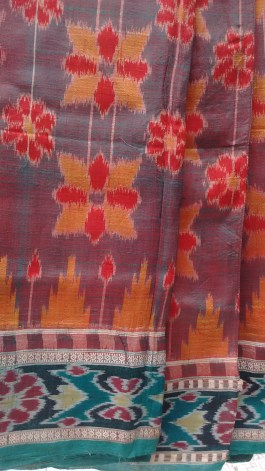 with people sharing thoughts and feelings about what India means to them. This is my small paean to what, for me, represents the essence of India. It is an ode to the saree!
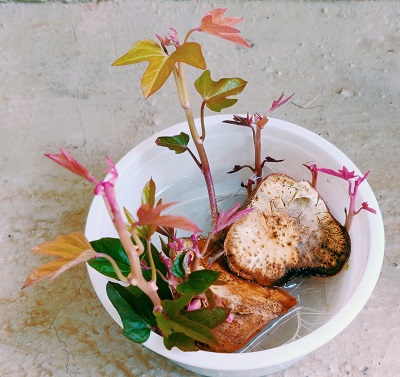 So were we excited when someone told us a super-simple way to grow them! Just cut the bottom half off (cook the rest!). And put this bottom half into a container of water, partly submerged in it. Put the container in a place with good light (outside for a few hours is good). Don’t forget to change the water every 3 days. And you will see magic in a week! Small leaves in shades of green, red and purple, then more leaves. Growing lush and tall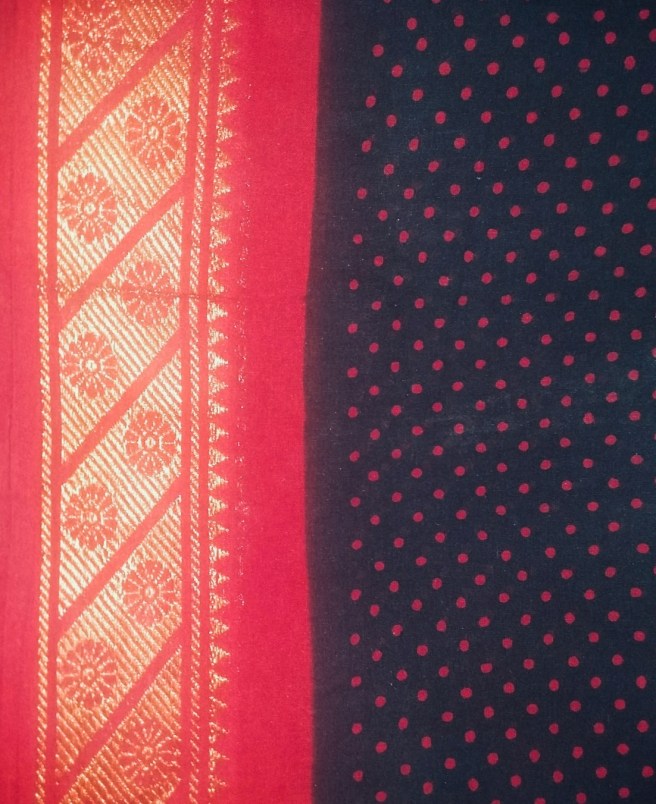
 Millennial Matriarchs