Much in Little

It is almost six months since the world as we knew it, changed. For many, this period of lockdown has also been one of unlocking some simple joys of life and living.

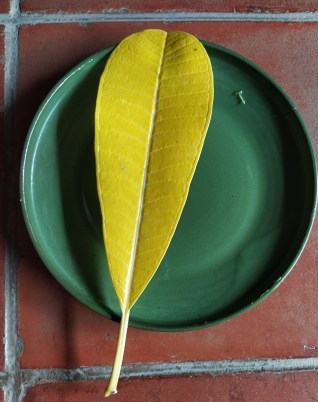
IMG_20200626_093148.jpg

A reprieve from the frenetic activities of modern life has given Nature a new lease of life. And humans, from behind their glass windows, are discovering the wonders of the world that we share with millions of other living beings. People are noticing plants, birds and insects in their immediate surroundings; they are hearing bird song and rain symphonies which had been drowned out by incessant urban cacophony and pollution. Locked inside, humans are rediscovering nature.

Humans are also rediscovering that it is possible, even satisfying, to live with what one has; that life can go on without 24/7 doings and happenings, extravagant shopping sprees, dining out, and other self-indulgences. That the quality of life is not dependent entirely on the quantum of material resources.

But this is not the first time in history. Almost 200 years ago Henry David Thoreau took a break from the often numbing routine of daily life which was driven by the need to earn a living. As he put it “the mass of men lead lives of quiet desperation.” He wondered, “Was it possible to lead a different kind of life?”

Thoreau spent two years, two months and two days living by himself in a basic wooden cabin that he built himself, on the shore of Walden Pond, near Concord, Massachusetts in America. He wanted to answer for himself the question “how simple can a life be and still be a good one?”, and to illustrate his belief of “much in little.”

As he wrote, “I went to the woods because I wished to live deliberately, to front only the essential facts of life, and see if I could not learn what it had to teach, and not, when I came to die, discover that I had not lived. I did not wish to live what was not life, living is so dear; nor did I wish to practice resignation, unless it was quite necessary.”

Even while at Walden Pond, Thoreau did not live a life of seclusion. He had visitors, and walked to the nearby village often. His experiment was more to prove that one does not have to go far in any physical sense to “get away from it all.”

During this period in 1845-46, he observed, enjoyed and recorded his observations of the natural world around him. These were to be published as Walden, one of his best known works. It also earned him the moniker Father of Environmentalism.

Thoreau was however much more than a nature writer. He wore many hats–social reformer, naturalist, philosopher, transcendentalist, scientist, and conscientious objector.

Born on July 12, 1817 in New England, USA in a middle class family, he graduated from Harvard following which he spent some years teaching in school, and also working in his father’s pencil factory. The young Thoreau was greatly influenced by Ralph Waldo Emerson who became his close friend and mentor. He began to publish essays that reflected his deeply-felt political views which were considered radical in those times. He was an outspoken abolitionist and was arrested (and jailed for one day) for resisting to pay poll tax to a government that supported slavery. This experience led him to write one of his best-known and most influential essays titled Civil Disobedience. He made a strong case for acting on one’s individual conscience and not blindly following laws and government policy. “The only obligation which I have a right to assume is to do at any time what I think right,” he wrote.

Thoreau’s non-violent approach to social and political resistance greatly influenced Mahatma Gandhi who adopted many of his thoughts while developing his concept of Satyagraha.

Following his Walden experiment Thoreau wrote extensively, although a lot of his writing was published and became well-known only after he died. He continued his daily afternoon walks in the Concord woods and kept a journal of his nature observations and ideas. He travelled and lectured, living on a modest income, till he died of tuberculosis in 1862, at the age of 45.

Thoreau, a man of simple tastes and high thinking, was indeed an original thinker of his times. The lesson he taught himself and that he tried to teach others, was summed up in the word “simplify”. That meant simplify the outer circumstances of your life, simplify your needs and your ambitions; learn to delight in simple pleasures which the world of nature affords. It meant also scorn public opinion, refuse to accept the common definition of success, refuse to be moved by the judgement of others. And unlike most who advocate such attitudes, he put them into practice.

A few years ago on a trip to the United States I had the opportunity to retrace Thoreau’s footsteps on a walk around Walden Pond, and see the modest shack where he penned his notes on nature. At that time I knew him mainly as an evocative nature writer. Today I find that his philosophy of life and living is more relevant than perhaps ever before. And Walden is so much more than a nature lover’s diary—it is an inspiring guide to changing the way we view ourselves and the life we want to live, especially in these times when we are feeling lost, and the times that will follow.

Our life is frittered away by detail. Simplify, simplify. Henry David Thoreau

–Mamata

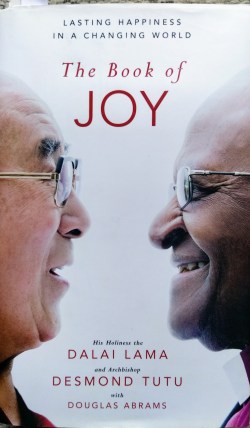
The Book of Joy

This week, 6 July, marked the 85th birthday of His Holiness the Dalai Lama. Five years ago, in 2015, to celebrate the Dalai Lama’s 80th birthday, a unique meeting took place. The Dalai Lama’s close friend the Archbishop Desmond Tutu came to Dharamshala to visit his “kindred spirit”. Both great spiritual masters and moral leaders of our time, and Nobel Prize winners, the two spent a week together—sharing their thoughts and vision, exchanging memories, and reveling in the simple joys of being together, laughing, and teasing each other.

Interestingly, four years before this meeting, when Desmond Tutu turned 80, a similar meeting between the two had been planned in Cape Town, South Africa. But the Dalai Lama was denied a visa by the South African government, bowing to pressure from the Chinese government.IMG_20200709_102817_BURST1.jpg

The Dharamshala meeting was, thus, more than special, and its purpose even more so. They took this rare occasion as a chance to sit down together, and evaluate one of life’s most important questions: how do we find joy in the face of life’s inevitable suffering? The outcome was The Book of Joy.

As the facilitator of the dialogues, and editor of the book, Douglas Abrams explains, ‘From the beginning the book was envisioned as a three-layer birthday cake: their own stories and teachings about joy, the most recent findings in the science of deep happiness, and the daily practices that anchor their own emotional and spiritual lives.’

The book documents the interactions between the two great minds through daily dialogues  over seven days, starting with identifying the obstacles to joy: fear, stress, anxiety, anger, sadness, grief, loneliness, envy, suffering and adversity, illness and fear of death.

From there the dialogues move on to explore the paths to experiencing Joy. Both the great minds emphasise that joy and happiness are by-products that spring from one’s attitudes and actions, and the cultivation of certain qualities.

What are these positive qualities that allow us to experience more joy? Four are qualities of the mind: perspective, humility, humour and acceptance. Four are qualities of the heart: forgiveness, gratitude, compassion mind: and generosity. These are the eight pillars of Joy. Each of these is discussed at length in the book.

Five years ago, the two gurus talked about the untold horrors, tragedies and suffering that the world was facing, and how to find joy whilst accepting, and yet transcending these. Today, in addition to these, the world is facing an all-encompassing and overwhelming new challenge. More than ever before, their words of wisdom may be the one’s to guide humanity through the pandemic that has been the greatest equaliser of all.

Perhaps the key to coping with the immense stress, anxiety, frustration and anger that all of us are facing during this period is Perspective. I cannot help but share some excerpts which are so relevant today.

“Yes there are many things that can depress us. But there are also are very many things that are fantastic about our world. Unfortunately the media do not report on this because they are not seen as news. …When bad things happen they become news, and it is easy to feel that our basic human nature is to kill or rape, or to be corrupt. Then we can feel that there is no hope for the future. …No doubt there are very negative things, but at the same time there are many more positive things happening in our world. We must have a sense of proportion and a wider perspective. Then we will not feel despair when we see sad things.”

“For every event in life there are many different angles. When you look at the same event from a wider perspective, your sense of worry and anxiety reduces, and you have greater joy. …If you look from one angle, you feel, Oh how bad, how sad. But if you look from another angle at the same tragedy, that same event, you see it gives me new opportunities.”

“The wider perspective leads to serenity and equanimity. It does not mean that we do not have the strength to confront a problem, but we can confront it with creativity and compassion rather than reactivity and rigidity. We are able to recognise that we do not control all aspects of any situation. This leads to a greater sense of humility, humour and acceptance.”

“The way we see the world is the way we experience the world. Changing the way we see the world in turn changes the way we feel and the way we act, which changes the world itself. A healthy perspective is really the foundation of joy and happiness.”

The book records the thoughts of the two thinkers not just through their words but also by their body language—the mischievous tugging and patting of arms, the heartfelt clasping of fingers, the respectful folding of hands and bowing, and above all the twinkling of eyes and the easy laughter of two dear friends sharing jokes, and enjoying their pudding! No wonder they are they are also known for being among the most infectiously happy people on the planet!

I myself have felt engulfed in this childlike exuberance and humour both times that I have had the privilege of attending a talk by the Dalai Lama, even as one of an audience of hundreds.

The Book of Joy has been on my bookshelf the last couple of years, but I was not in the right frame of mind to start reading it.  It is only last week that I felt the urge to read it.  I intensely related to it, and it put a lot of things in perspective.  Every word in the book is thought-provoking and profound. I know that I will go back to these again and again. Perhaps there is a time and place for everything indeed.

But, there is always time and space for Joy.

–Mamata


Family Foibles

‘Family’ has been a keyword that has defined the last two months which have been unusual and unprecedented in so many ways. Everyone seems to have rediscovered the joys of family. Celebs have shared how they are spending quality time with ‘loved ones’. Noble thoughts have been expressed on the comfort and warmth of family. Wise sayings on the value of family have been mined and brought to light.

Coincidentally even two international days that celebrate family, both proclaimed by the UN General Assembly, have fallen within this period. May 15 was International Family Day, marked every year to stress the importance of family. 1 June is designated as the Global Day of Parents, to recognize that the family has the primary responsibility for the nurturing and protection of children and emphasizing the critical role of parents in the rearing of children.

As they say, you can choose your friends but you can’t choose your family. Which means, whether you like it or not, you are stuck with them!  And truth be told, today families in close confinement and forced proximity are perhaps somewhat at the end of the tethers of togetherness.

As the lockdown across the world begin to ease, I can’t resist being a bit irreverent and sharing some random ‘alternate’ thoughts on family from some of my favourite authors.

Fifty years ago Erma Bombeck described what seems to be uncannily accurate today: “No one, not even a man and woman, can endure two weeks of complete togetherness—especially when they are married. Thus being confined with two or three children in an area no larger than a sandbox often has the appeal of being locked in a bus-station rest room over the weekend.”

And the fall out of family in lockdown can have many dimensions!

“Family is just accident…They don’t mean to get on your nerves. They don’t even mean to be your family, they just are”.  Marsha Norman

“A family is a unit composed not only of children but of men, women, an occasional animal, and the common cold”.  Ogden Nash

“Children aren’t happy without something to ignore, and that’s what parents were created for”. Ogden Nash

“Families are like fudge – mostly sweet, with a few nuts”.  Les Dawson

“The reason grandparents and grandchildren get along so well is that they have a common enemy.” Sam Levenson

“Mothers are the necessity of invention.” Bill Watterson

“When our relatives are at home, we have to think of all their good points or it would be impossible to endure them.” George Bernard Shaw

“The family. We are a strange little band of characters trudging through life sharing diseases and toothpaste, coveting one another’s deserts, hiding shampoo, borrowing money, locking each other out of our rooms, …and trying to figure out the common thread that bound us all together”. Erma Bombeck

Love them or hate them, we can’t do without them!

“Mma Ramotswe found it difficult to imagine what it would be like to have no people. There were, she knew, those who had no others in this life, who had no uncles, or aunts, or distant cousins of any degree; people who were just themselves. Many white people were like that, for some unfathomable reason; they did not seem to want to have people and were happy to be just themselves. How lonely they must be — like spacemen deep in space, floating in darkness, but without even that silver, unfurling cord that linked the astronauts to their little metal womb of oxygen and warmth”. Alexander McCall Smith

A family is like an orange, a ball composed of distinct segments, separable yet held together by some intangible but universal bonds.  Savour the flavour!

–Mamata


How Pleasant to Know Mr. Lear*

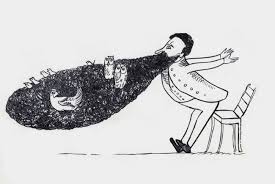
There was an Old Man with a beard,
Who said, ‘It is just as I feared!

Two Owls and a Hen
Four Larks and a Wren,
Have all built their nests in my beard.

old man.jpg
Original illustration by Edward Lear Source: Google


No this is not 2020 Corona humour, although it pithily describes one of the fallouts of the lockdown! The verse was written by Edward Lear nearly 200 years ago. Lear is popularly associated with the Limerick, and best known for his
A Book of Nonsense, which he also illustrated, that was published 1846.

Limerick is a form of nonsense verse in which the first, second and final lines end with rhyming words, while the third and fourth shorter lines have their own rhyme. In Lear’s limericks the first and last lines usually end with the same word rather than rhyming. For the most part they are truly nonsensical and devoid of any punch line or point.

Interestingly, while he is best remembered for his absurd wit, Edward Lear was a popular and respected painter of his time. Born in London on 12 May 1812, one of 21 children, Lear was forced to start earning a living when he was just 15. This he did by selling his art and by teaching drawing. In 1832 he was employed by the London Zoological Society to illustrate birds, and later went on to work for the Earl of Derby who had a private menagerie on his estate. Lear stayed there until 1836.

Around this time Lear decided to devote himself exclusively to landscape painting (although he continued to write his nonsense verse.)  Between 1837 and 1847 he travelled extensively throughout Europe and Asia. After his return to England, Lear’s travel journals were published in several volumes as The Illustrated Travels of a Landscape Painter. Lear eventually settled, with his cat Foss, in Sanremo on the Mediterranean coast at a villa he named Villa Tennyson after Lord Tennyson whom he admired. He continued to paint seriously till the end of his life in 1888.

Edward Lear had a sickly childhood, and also suffered from epilepsy and depression. But in his verses he poked fun at everything, including himself. His irreverent humour, love for the ridiculous, and cooked-up nonsense words were like cocking a snook at the prissiness and orderliness of the Victorian society that he lived in.  Also different from the expected upright behaviour which was the norm of the period, the characters in his verses often indulge in absurd and outrageous antics.

His love for silly word play “a perpendicular, spicular, orbicular, quadrangular, circular depth of soft mud”;  his weird and wonderful creatures like Moppsikon Floppsikon bear and  “diaphanous doorscraper” (stuffed rhino); the characters with names like Quangle-Wangles, Pobbles, and Jumblies remind me of another favourite—Roald Dahl.

I have always loved the nonsense verse of Edward Lear. I remember memorising and reciting The Owl and the Pussycat, perhaps his most famous poem, when I was in school. The words seemed to frisk and gambol just like the characters.

They dined on mince, and slices of quince,
Which they ate with a runcible spoon;
And hand in hand, on the edge of the sand,
They danced by the light of the moon,
The moon,
The moon,
They danced by the light of the moon.

We all need a bit of silliness in our lives, especially in these strange days of uncertainty. Today as we celebrate Lear’s birthday as Limerick Day, also marked as Owl and Pussycat Day, here is my humble offering to the memory of Mr Lear!

There was a wicked virus from Wuhan

Who said its time to cause some mayhem

I’ll travel the world for a lark

And make sure they close every park

That villainous virus from Wuhan.

*How pleasant to know Mr. Lear is the title of Lear’s self-portrait in verse.

–Mamata

.

Hail, Nightingales!

Two news items last week took me to my cache of ‘saved for a rainy (read lockdown) day’ books.

The first was that the tagline for this year’s World Health Day is ‘Support Nurses and Midwives’. April 7 is celebrated as World Health Day as it marks the anniversary of the World Health Organization which was founded in 1948.

The second news was that on April 3 Britain’s first emergency field hospital exclusively for coronavirus patients was inaugurated in the East End or docklands of London. More remarkable, that a large exhibition space, usually used for large events such concerts and conferences, was transformed into this 4000 bed hospital in just nine days. The hospital is fittingly called NHS Nightingale Hospital. Similar Nightingale hospitals are planned to be set up in different cities of UK, as emergency sites to treat coronavirus patients.

Calling these facilities Nightingale hospitals, is an apt and timely reminder of Florence Nightingale, who almost 200 years ago changed the face of nursing from a mostly untrained profession to a highly skilled and well-respected medical profession with very important responsibilities.

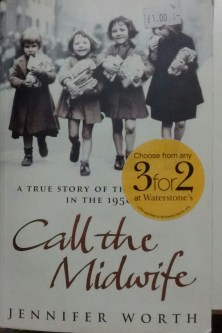
These stories took me to the book titled Called the Midwife by Jennifer Worth. The book is the memoir of the years that Jenny, this young nurse anIMG_20200407_111221.jpgd midwife spent in the poor slums of the East End of London. 23 years old and newly qualified she lived and trained as a midwife with a dedicated group of nuns St Raymond Nonnatus.

Though set in the 1950s, the conditions of the area, and the people who lived in these docklands were appalling in terms of health, hygiene and sanitation. The book recounts anecdotes that paint vignettes of the people, and the experiences as a midwife, delivering babies at home amidst challenging and often overwhelming circumstances. But where the narration could have been dark and depressing, Jenny’s description of her patients and their families brings out the touching humanity, and tough spirit that rises above the squalor. Whether it is the pen portraits of the nuns, each with a unique personality; the fellow trainees; and the soon-to-be or new mothers (from the first baby of a 14 year-old girl, to the 25th baby of a 45 year-old woman!), the book captures the power and spirit of the vocation. Rushing on their bicycles through the freezing smoggy streets with their simple delivery bags to attend a calling the middle of the night (almost 100 deliveries a month), to the daily routine of morning and evening home visits for pre and post-delivery check-ups, one cannot help but applaud the total dedication and role of the midwives.

Interestingly in India generations of children had been born at home under the hand of the local midwife or dai. Around the time when Jennifer Worth was a midwife in England, hospital deliveries started becoming more common in India. In the last fifty years, with advances in the world of medicine, and advancing technology, the traditional art and craft of midwifery was replaced with the science of sonography and Csections. Interestingly, in the last ten years or so, there seems to be a return to the traditional ways of childbirth. While at the one end of the spectrum, there are boutique clinics offering 5-star deliveries, other young women are opting to ’call the midwife’. And there is a new generation of Jennys who are undergoing the rigorous training of midwifery to qualify and practice as midwives.

It is fitting indeed that WHO has designated 2020 as the Year of the Nurse and Midwife, in honour of the 200th birth anniversary of Florence Nightingale who fought, against all odds, in the frontlines of the Crimean war. And once again, more than ever before, it is time to salute these brave and tireless soldiers who are at the frontline of the Corona war. Hail, to all these Nightingales! year of the nurse.jpg

–Mamata

Friends in Need

“They are friends waiting for us any time we want them, and they will always speak honestly to us about what really matters. They are the perfect cure for loneliness. They can be our very closest friends.” They are books, wrote Swiss-born British philosopher and essayist Alain de Botton, in a letter to children.

Today is the day to celebrate this timeless friendship. April 2 is International Children’s Book Day, a worldwide celebration to highlight children’s literature and encourage the love of reading among children. This date marks the birthdICBD.jpgay of Hans Christian Anderson one of the best known children’s writer who was born on 2 April 1805 in Denmark.

The celebration of this day began in 1967, initiated by the International Board on Books for Young People, or IBBY. Each year a different National Section of IBBY has the opportunity to be the international sponsor of ICBD. The hosting country picks the theme for the year and invites a prominent author from that country to write a message to the children of the world and a well-known illustrator to design a poster.

This year, IBBY Slovenia is hosting this day, and the theme is “A Hunger for Words.” Slovenian writer Peter Svetina has written the message for this theme. Sharing a few lines: “Words in poetry and in stories are food. Not food for the body, not food that can fill up your stomach. But food for the spirit and food for the soul.”

In the days of lockdowns when parents around the world are despairing, and desperate to “keep children occupied” why not open up a menu of books, to explore and discover, to taste and savour, and to assuage the hunger of a restless mind. This will plant the seeds of the magic of stories that will grow with them as friends, and sustain their spirit through the many unknowns that lie ahead.

Equally relevant, and perhaps one that presaged the year to come, was the theme for 2019 which was Books Help Slow Us Down. Lithuania was the host, and Kęstutis Kasparavičius the Lithuanian writer wrote this inspiring message.

“It seems that books have this wonderful quality – they help us slow down. As soon as you open a book and delve into its tranquil depths, you no longer fear that things will whizz by at a maddening speed while you see nothing. All of a sudden, you come to believe you don’t have to dash off like a bat out of hell to do some urgent work of little importance. In books, things happen quietly and in a precisely arranged order. Maybe because their pages are numbered, maybe because the pages rustle gently and soothingly as you leaf through them. In books, events of the past calmly meet events that are yet to come. …Someone who enjoys reading – be it a child or adult – is much more interesting than someone who doesn’t care for books, who is always racing against the clock, who never has time to sit down, who fails to notice much of what surrounds them. …Books help us not to rush, books teach us to notice things, and books invite us or even make us sit down for a while.”

Around the world, for perhaps the first time, we have been forced to slow down, to sit down for a while (and wonder what to do with ourselves). What better time to use this opportunity to revisit our old friends—books– that were part of our young and innocent days. And what could be more joyful than rediscovering these in the company of children? A beautiful way to celebrate this special day!

–Mamata

Once Upon a Time…

These four words open up windows to entire universes—unexplored, or familiar. This is how many a story begins. Stories are a life force that have imbued human life with that something extra, since the dawn of civilization. Stories are a way to convey history, culture, language, spirituality, and identity. One way to keep stories alive is storytelling. Storytelling is one of the oldest forms of communication.

20 March is celebrated as World Storytelling Day–a day to remember and remind ourselves of the magic and power of stories. What began in Sweden, on this date in 1991, as All Storytellers Day has now become a global celebration of the art of oral storytelling. On World Storytelling Day, as many people as possible tell and listen to stories in as many languages and at as many places as possible, during the same day and night.

On this day I celebrate a storyteller who collected, recreated, and created a timeless repertoire of stories. Generations of children have grown up with these tales, told and retold by parents and grandparents over the last one hundred years. This was my grandfather Gijubhai Badeka, one of Gujarat’s foremost educationists and storytellers.

In Gujarati, as in most Indian languages, the child reader had remained somewhat neglected till the middle of the nineteenth century. There was hardly any specific literature for children; only stories retold from classical Indian literature, or heroic stories from Western literature, in not very satisfactory translations. Gijubhai pioneered the creation of special literature for children that also contributed to preserving the oral tradition of literature through exploring and compiling the rich legacy of folk literature. His search for folk tales crossed the boundaries of language and country. This journey of exploration he described thus, in his seminal work titled Vaarta nu Shastra (The Art and Craft of Stories) published in 1925. “So many stories have travelled in foreign lands, so many stories have changed their religion and form; it is an adventure to trace their journeys. If we become wandering travellers with the stories, we will discover that we find one story in Tibet and will see the same story in Africa; we will discover the same story wrapped in snow at the North Pole, and yet if we wander in the Arabian desert, there it will be, but uncovered and bare…but still we recognise the story. Some stories adapt to their land, taking on the form and language of their adopted home, while others retain their origins wherever they may settle. Some stories follow the creed of universal brotherhood, they see the world as their home and go wherever they get a chance to serve and please. Some settle firmly in different countries and come to be recognised as belonging to that place. They are then only translated to reach other countries.”

Many of Gijubhai’s stories are members of this travelling band. Gijubjai transformed and localised these stories, so that they are steeped in the sounds and colours of Gujarat, and have today become not only Gujarati, but uniquely ‘Gijubhai’s’ stories. They are simply told tales characterised by a mixture of prose and rhyme. The repetition of rhymes makes for lively storytelling which listeners join in. Gijubhai retold delightful tales of ordinary people, and familiar birds and animals. With equal panache he churned out stories of common folk with common trades—tailors, potters, barbers, shopkeepers, but also kings, queens and princesses. The characters reflect basic human traits—greed, envy, fear, desire for one-upmanship. Animal tales reflect a close and symbiotic relationship between animals and people. Many open with “once upon a time”… and end “happily ever after.” A hundred years after they were written these stories still touch a cord in the child, and also the child in each of us.

Stories are older than us, they are smarter than us, they keep going, and they are a part of us even though we do not realise this. But stories need human beings to reproduce, much as we need food… we need things to keep ourselves alive.

Hungarian-born American polymath Thomas Sebeok said “…what we can do, I think, is try and create stories that are interesting enough and important enough that our grandchildren might want to tell those stories to their grandchildren — because that’s the purpose of stories, that’s what they’re for: They make live worth living and, sometimes, they keep us alive.

In my own small way, I try to carry forward the legacy of my grandfather by translating and retelling these timeless tales.

–Mamata

Forth and Back

“Madam I’m Adam”. When I was young I was amused by this clever phrase because one could read it the same way from left to right and right to left. As my interest in words and love for word play grew along with me, I was always looking for such words or phrases. Somewhere along the way I discovered that a word, sentence, verse, or even number, that reads the same backward or forward was called a Palindrome. The English word Palindrome was created in the early 1600s based on Greek roots that literally mean “running back on itself” (palin meaning ‘again’ or ‘back’, and dromos meaning ‘running’.)

I began to collect examples of these, and was excited whenever I found one; one highlight being ‘A man, a plan, a canal-Panama’. Until I discovered that there were more avid collectors, and loads of such examples. Here is sharing some, from the daily use ones (that we do not even register as being palindromes) to the funny, clever ones.

Family–sweet and simple in any form: Mum, mom, amma, pop, dad, sis.

Moving on to mechanics–rotor, level, racecar, radar, refer, reviver, rotator, and repaper… (graduating to the next level as ‘Won’t I repaper? Repaper it now!’

Some simple (and sometimes silly) ones:

palindrome.jpg
Source: Google

Dennis sinned.

Don’t nod.

Never odd or even.

No lemons, no melon.

We panic in a pew.

Won’t lovers revolt now?

Sir, I demand, I am a maid named Iris.

Eve, mad Adam, Eve!

Never a foot too far, even.

Nurse, I spy gypsies, run!

Delia sailed as sad Elias ailed.

Ned, I am a maiden.

Some clever ones:

A hitman for hire: Murder for a jar of red rum.

A gross creature: Oozy rat in a sanitary zoo.

Call your mother: Mum

Sane advice: Do not start at rats to nod.

Weather forecast: Too hot to hoot.

Teutonic pride: I, man, am regal; a German am I.

Philosophical musing: Do geese see God?

Old cats: Senile felines.

On ET’s menu: UFO tofu

Bad eyesight: Was it a car or a cat I saw?

A moral dilemma: Borrow or rob?

And one curious one–Murdrum (the crime of killing an unknown man).

And our own and bona fide one: Malayalam!

A wonderful one that sounds like what it means: Tattarrattat—meaning a knock on the door. It was coined by James Joyce and used in Ulysses in 1922. It is also the longest palindromic word in the Oxford English Dictionary.

And last but not the least, there is even a palindromic word for an irrational fear of palindromes—aibohphobia! WOW!

–Mamata

Food Glorious Food!

In the past week or so, food and menus have been much in the news. The most recent being the menu which has been planned for the banquet that the President of India is hosting tonight for American President Donald Trump and his delegation who are visiting India. And then, there was the news about the Historical Gastronomica event that the National Museum in New Delhi is hosting. This event offered an Indus Valley dining experience through a “specially crafted menu that strictly includes ingredients identified by archaeologists and researchers from sites of the Indus-Saraswati civilization.” The latter event has been in the news because of the controversy over whether the people of that place and time ate ‘non vegetarian’ food or not. The controversy has generated many articles referring to the works of scholars in this area.

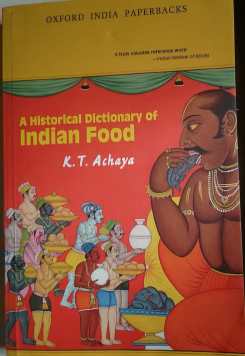
One of the food historians referred is K.T. Achaya and his auIMG-20200225-WA0000.jpgthoritative volume on the history of Indian food titled Indian Food: A Historical Companion. This led me to my bookshelf to pull out another book by this renowned authority on Indian food. This one, titled A Historical Dictionary of Indian Food followed his earlier ones. In this he attempts to bring together, in alphabetical order, material from his vast work on the subject. The book draws upon historical writing, archaeology, botany, genetics and ancient literature in Sanskrit, Pali, Tamil and Kannada to trace the gastronomic history and food ethos of India. The entries cover a wide range including recipes; narratives of visitors to India, starting with the Greeks in the fourth century; the etymological evolution of certain words, and the close links of food with ancient health systems such as Ayurveda. While this is a valuable scholarly work with meticulous and voluminous referencing, it is simply written, with a delightful menu–from A to Z–that one can dip into, and savour according to one’s own taste and appetite.

For me every entry is fascinating. For today I will share an excerpt about two elements that are the starting point of a menu and a meal—Guest and Host!

‘Guests had an honoured place in Vedic society, ranking only below the father, mother and guru. On arrival, a guest was ceremoniously received, given water to wash his hands and feet, and offered the ambrosial beverage madhuparka. In early Vedic times, if the guest was an honoured Brahmin or a member of royalty, a large bull or goat would be sacrificed in his honour, even if the guest was a vegetarian. Later this ritual became symbolic, and the guest was given a knife in token of the sacrifice, which he returned after a prayer. During the meal, the host had to be solicitous, either eating later, or finishing his own meal quickly, so as to rise early and look after his guests.

In the Manava Dharmashastra (Manusmriti) a host is exhorted in these terms: Let him, being pure and attentive, place on the ground the seasoning for the rice, such as broth and pot herbs, sweet and sour honey, as well as various kinds of hard foods that require mastication, and soft food, roots, fruits, and savoury and fragrant drinks. All these he shall present, and being pure and attentive, successively invite them to partake of each, proclaiming its qualities: cause them to partake gradually and slowly of each, and repeatedly urge them to eat by offering the food and extolling its qualities.

All the food shall be very hot and the guests shall eat in silence. Having addressed them with the question: Have you dined well? Let him give them water to sip, and bid farewell to them with the words: Now rest.’

(A Historical Dictionary of India Food K.T.Achaya (pp 96)

And so in India–Atithi Devo Bhava–The guest is God!

–Mamata

One Man, One Mission

Last week we wrote about Uncle Moosa and his single-handed mission to take books and reading to the remotest parts of North East India.

Here is the story of another man with a similar mission, one that he has been pursuing with undiminished passion and fervour for over 70 years! He is Mahendra Meghani. And this is the story of Lokmilap, the bookshop that he started, and which became a symbol of all that he has devoted his life to. And one to which I too have old links.

IMG_3289.jpg
Photo credit: Ajay Desai  

In the summer holidays when we used to go to Bhavnagar, our ancestral hometown, one of visits most looked forward to, was the one to Lokmilap. For us this was treasure house from which we were allowed to select a few books.  More precious, because it was perhaps the only one that stocked English language books, in addition to some of the best literature in Gujarati. We often met Mahendrabhai there, who was also a family friend, and he would show us the new arrivals including the beautifully illustrated children’s books from the Russian People’s Publishing House.

In those days this was as much as we knew about Lokmilap. Over the years as we grew, we learnt more about Mahendra Meghani and his tireless mission to take literature to “the people” in every way possible.

Mahendrabhai’s own lineage in literature goes back to his father, the famed Gujarati litterateur Zaverchand Meghani, who was given the title Lok Shayar or People’s Poet by Mahatma Gandhi. It is said that while Zaverchand took literature from people’s tongues to people’s hearts, Mahendrabhai took literature to every person, home and society.

Born in 1923, Mahendrabhai, graduated from high school in Mumbai, and joined L. D. Arts College in Ahmedabad for further education. It is said that when he was getting ready to move from Mumbai to Ahmedabad, his father advised, “It gets very hot in Ahmedabad, so make sure you cover your head with a topi”. Complying with his father’s suggestion, Mahendrabhai started wearing the khadi cap which became an integral part of his attire, and remained so through the years. After two years in Ahmedabad he returned to Mumbai to join the Elphinstone College, but left that to join Gandhi’s Quit India movement. He did not return to college, but instead helped his father with his journalistic work.  After the death of his father in 1948, Mahendrabhai went to the US to study journalism at Columbia. Living in the International Student’s House in New York, he would, every day, buy two newspapers and peruse the many pages. It is here that he also discovered Reader’s Digest.  And he found his calling! He decided to return to India and start a similar magazine in Gujarati. And so, on 26 January 1950, India’s first Republic Day, was born Milap, a monthly journal in Gujarati which set high standards of language and literature, and yet garnered a wide and faithful readership.

Tired of the hectic life in Mumbai, Mahendrabhai moved to Bhavnagar in Gujarat where the journal Milap engendered the publishing house as well as the book shop Lokmilap (meeting of people). It is through these that Mahendrabhai lived his passion to take good literature, at affordable prices, to as wide a reading public as possible. The bookshop, as he said, “included books from all publishers, but not all books from all publishers.” Lokmilap’s vision was not simply to sell books; they wanted to open windows to the best in world literature, to give people a perspective about life, and how to live life. They published hundreds of original Gujarati books, but also translated and abridged versions of classics of world literature (many of them translated by Mahendrabhai himself). More critically, the books were very nominally priced, to suit even the shallowest pocket. They introduced “pocket books”, initially to take poetry to the people, but later diversified to include a vast range of literature. Priced then, as low as 50 paise, the books sold in lakhs.

In 1969, the Gandhi Centenary year, he compiled a special collection of 400 books that celebrated Gandhi’s life and message, and a booklet titled Discovering India Book Exhibition. The books were exhibited in many countries across the world with the condition that the sponsoring organisation would buy the set, and donate it to a local library or community centre.

Mahendrabhai himself has travelled far and wide, always clad in his simple khadi attire, sharing his love for language and literature with wide and diverse audiences. In Bhavnagar he was a familiar sight, riding his bicycle no matter what the weather. His tireless quest to share the best with everyone had many facets—at one point hand grinding wheat and baking bread which he distributed, to starting a film club which screened some of the classics of world cinema, and to which he would bring people who had never before been exposed to such experiences.

The man and his mission have inspired and touched millions across generations and nations. Last month, on India’s 70th Republic Day, Lokmilap also marked its 70th anniversary by announcing its closure. Expressing the sentiment that everything that has a start will have an end; what better than the end that is brought about by the ones that made the start?  For all of us whohad taken Lokmilap as one of those comforting points of stability and continuity in lives and cities that have changed so much, it is a sense of losing moorings. But secure that the seeds of the institution have been planted deep and strong.

A man whose mission has brought the love of letters to millions, Mahendrabhai, at age 97, carries on with his writing and reading, somewhat frailer in body but indomitable in spirit.

–Mamata