Haiku…Then and Now

The Haiku is a 17 syllable poetic form that has been written in Japan for three hundred years. Haiku poets have, over generations, celebrated the changing seasons, and also the mystical relationship between non-related subjects. Most of the poets reflected the Zen Buddhists doctrine that all things and creatures in this world are part of the universal and interconnected brotherhood of creation.

Today the cycle of seasons is not what it used to be.  The world is apprehending, rather than celebrating Climate Change. Reports predict the dire consequences of the 1.5 degree rise in temperature, for all living things, interconnected as they are in the intricate web of life.

Among the scientists too there are poets! Some of them have tried to interpret the consequences of Climate Change in Haiku!

Interesting indeed to compare the Haikus from then and now.


Then Now
Snow is melting…

Far in the misted

Mountains

A caw cawing crow


Big, fast carbon surge

Ice melts

Oceans heat and rise

Air warms by decades


Icicles and water

Old differences

Dissolved…

Drip down together


Seas rise as they warm

Rates quicken

Last century

Melting ice joins in


Even the ocean

Rising and falling

All day

Sighing green like trees.


More warming,

Higher seas.

Maybe much higher.

Could wake sleeping giants.


Ultra-pink peony…

Silver Siamese

Soft cat…

Gold-dust butterfly…


Warming is bad news

For many species.

Once gone…

We can’t bring them back


The Then Haikus are from compilations of haiku by some of the best loved Japanese poets—Basho, Buson, Issa and Shiki.

The Now haikus are from the compilation by oceanographer Gregory Johnson (https://www.sightline.org/2013/12/16/the-entire-ipcc-report-in-19-illustrated-haiku/and  Andy Reisinger one of the contributing authors to the Intergovernmental Panel on Climate Change (IPCC) special report on 1.5 °C (https://cicero.oslo.no/no/15-graders-haiku)

–Mamata


All Alike

We live in a world, and in a time, of confrontation and conflict, a continuous battle for proving our might; so much energy poured into dividing rather than synergising.

At a time when “what makes us different” is more important than what binds us as human beings I remember a poem by one of my favourite poets that reminds us that we are really not different!

No Difference

Small as a peanut,

Big as a giant,

We’re all the same size

When we turn off the light.


Rich as a sultan,

Poor as a mite,

We’re all worth the same

When we turn off the light.


Red, black or orange,

Yellow or white,

We all look the same

When we turn off the light.


So maybe the way to

To make everything right

Is for God to just reach out

And turn off the light!

Shel Silverstein


If only something could make everything right!

Let’s take a minute to pause and ponder as the International Day of Peace is observed around the world on 21 September.

–Mamata

What Say You?

When I lived in Kenya, and learnt a little bit of Kiswahili, it was great fun to discover curious words or phrases. One of the best ones was to the local word for curd/yogurt. This was called Mazeevaa Lala—literally “sleeping milk!”

I was reminded of this recently when I chanced upon a Maltese saying My eye went with me, to mean that you have fallen asleep, as not taking your eyes with you would result in a sleepless night!

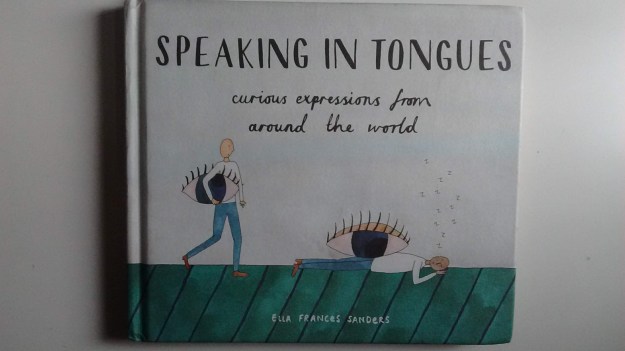
This is one of the many sayings in a delightful book titled Speaking in Tongues: curious expressions from around the world–a compilation of proverbs, idioms and sayings from different languages of the world, put together by Ella Frances Sanders. What brings the words alive are the accompanying illustrations, also by Ella who describes herself as “a writer out of necessity and an illustrator by accident.”

IMG_20180725_181146775.jpgFrom Finnish to Igbo, Armenian to Yiddish, each double spread presents delectable sayings and drawings that blend the wit and wisdom of the ages while also placing these in their cultural context.
Cannot resist sharing some:

Even the monkeys fall from trees. This well-known Japanese saying reminds that even the best and the cleverest can still make mistakes, and cautioning to keep overconfidence in check!  Perhaps the recent World Cup surprises where the superheroes fell from grace is an apt analogy!

You are my orange half. A Spanish term of endearment that means that someone is your soulmate or love of your life. Not quite sure what is so endearing about an orange, but reminded of the Amul chocolate ads that urged us to “Share it with someone you love!”

Horse horse Tiger tiger. To describe something that is so-so, or neither here nor there. This is a Mandarin expression; its origin lies in a story about a painter who painted a half tiger half horse but nobody bought it as it was neither one nor the other.

To pull someone out of their watermelons. A Romanian idiom that means to drive someone crazy! Not much light on why being in or out of watermelons can be harmful to mental health!

Stop ironing my head. An Armenian way of saying “Stop bugging me!” Popularly used when someone keeps asking irritating questions and won’t leave you alone. In many Indian languages we have our own equivalents in the form of “Don’t eat my head.”

To give a green answer to a blue question. A Tibetan reference to when the answer is completely unrelated to the question asked. Something that people in politics are adept at!

This is just a sampler of the 52 proverbs, expressions and idioms that have been passed on from one generation to another in diverse cultures. Interestingly, they reflect not just diversity, but also the sameness as it were. As I read I immediately thought of similar ones in Hindi and Gujarati, as will surely be the case in all languages. Remember how we had to memorise proverbs in our language subjects in school and what a pain it was? Maybe it is time to revisit these!

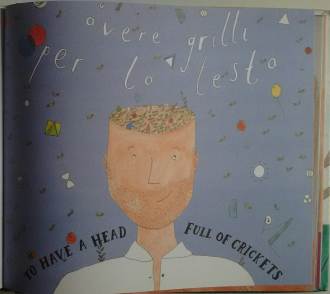
A perfect one to end with. To have a head full of crickets. 

IMG_20180725_181247.jpg

How the Spanish describe a mind buzzing with crazy, wonderful ideas, whims, and flights of fantasy…(what some would call nonsense!)

Nicely sums up how I often feel!

–Mamata

Keeping Tradition Alive

July is here. And along with it, the festival season. Pujas—a time for festivities, fun, enjoyment with the family. A time to get back in touch with our traditions. A time of solemnity and also gaiety.

6c9530db-1939-4892-bb6d-61c4e4561547-e1531315938949.jpeg


But also today, a time for stress! Who knows what the auspicious grass for Ganesh Chaturthi is? Or the prasadam to be made for Thiruvadarai? What is the rangoli to make for Rathasapthami?

And how to answer questions from the kids? Why is Naga Panchami celebrated? Who is Ekadashi? Why do we make sundal for Navaratri?

“Follow the Hindu Moon: A Guide to the Festivals of South India’, by Soumya Aravind Sitaraman, will answer all these questions and more. Brought out by Random House about 10 years ago, this magnum opus is in two volumes, totaling to over 800 pages. But don’t be put off by the weight and the bulk. The publication is erudite and comprehensive, but extremely easy to read and refer to. The text presentation is clearly organized and simple.

What really brings the book to life are the more than 400 colour plates. Beautiful, un-posed, real—they bring alive the beauty of our traditions. Whether it is the decoration of Varalakshmi or the photographs of the delicacies made for different pujas, you wish you could be there in the photo, living that moment. The photographer is Usha Kris, Soumya’s mother!

Volume 1 is called  ‘Celebrate’. It covers: “Puja Basics’—everything from aartis to vastram; ‘Embracing the Almighty’—a guide to pujas;   ‘ Getting organized’—pooja checklists to annual festival planner; and ‘Celebrate’—detailed walkthroughs for every festival of South India, including procedures, observances, rituals, sankalpams, stories, etc.

Volume 2 called ‘Understand’ has sections on everything from ‘Reading the Panchanga’ to shlokams, to naivedya recipes, and festival-specific rangoli designs.

The books work at several levels: as a ‘Do-it-yourself’ guide for novices; as a reference book on details for experienced mamis; and as a fascinating browse for anyone.

At first look, Rs. 3500 seems a bit of an investment. But this book is bringing to you almost those many years of tradition!

So whether you are an experienced puja veteran, or a student in the US who wants to celebrate festivals the traditional way, or an ‘armchair cook’ like me, you are going to enjoy this book. So buy it for yourself. Or share the joy of a festival and gift it to a loved one!

–Meena

Ode to Libraries

As is probably, by now, evident, the Millennial Matriarchs are bookworms. We grew up with books, and we need books just as much, or more, as we grow older.

The enervating summer afternoons bring back so many memories of the joy of discovering, devouring, savouring, hoarding, exchanging, borrowing, and drowning in books, and more books. And, libraries were the dream destination of summer holidays.

Sharing some eloquent words that describe the power (and perils!) of libraries.

 Don’t Go Into The Library

The library is dangerous–

Don’t go in. If you do

You know what will happen.

It’s like a pet store or a bakery—

Every single time you will come out of there

Holding something in your arms.

Those novels with their big eyes.

And those no-nonsense, all muscle

Greyhounds and Dobermans,

All non-fiction and business,

Cuddly when they are young,

But then the first page is turned.

The doughnut scent of it all, knowledge,

The aroma of coffee being made

In all those books, something for everyone,

The deli offering of civilisation itself.

The library is the book of books,

Its concrete and glass and wood covers

Keeping within them the very big,

Very long story of everything.

The library is dangerous, full

Of answers, if you go inside,

You may not come out

The same person who went in.

Alberto Rios       Contemporary American Chicano poet

–Mamata


Life as Poetry

For many of us a poem was something you learnt by heart and recited in a monotone before a bunch of relatives when urged by proud parents; or as you grew older, reproduced and analysed in the exam paper. The few of us that survived these stages went on to read and enjoy poetry. In all cases, poetry was always associated with something that came in and out of a book.

Many of us have not connected poetry to a living tradition. Poems were created by all sorts of people, poetry grew out of the experiences of life and living and reflected its rhyme and rhythm. It was a blend of the art and the craft of the potter, the weaver, the cowherd, the sisterhood of women who sewed together to create the most beautiful patterns.

As eloquently described, ‘Poetry reaffirms our common humanity by revealing to us that individuals, everywhere in the world, share the same questions and feelings. Poetry is the mainstay of oral tradition and, over centuries, can communicate the innermost values of diverse cultures.’

To celebrate this power of poetry, UNESCO proclaimed 21 March as World Poetry Day. In celebrating this day we recognize the unique ability of poetry to capture the creative spirit of the human mind.

Sharing a poem that reflects this very spirit.

HABIT

Last night when my work was done

And my estranged hands

Were becoming mutually interested

In such forgotten things as pulses,

I looked out of a window

Into the glittering night sky.

And instantly

I began to feather-stitch

A ring around the moon.

Hazel Hall   1921

Hazel Hall was an American poet and seamstress born in 1886. Paralysed at the age of 12, she was confined to a wheelchair. Her days were spent in an upstairs room her family house; she never left this room. To help support her mother and two sisters Hazel took in sewing and occupied herself with embroidering garments. She died in 1924.

–Mamata