
That is surely the mantra of the Stick Insect! Known for one of the most effective camouflage strategies in Nature, the stick insect resembles the twigs among which it lives. It belongs to the order Phasmatodea, which includes the other master camouflaguer, the leaf insect. In fact, the name Phasmatodea derives from the Greek word phasma, meaning an apparition, phantom, or ghost.
The order Phasmatodea has over 3000 species in all—but how can one be sure, when many of them may be so well-hidden that they are impossible to detect! India has about 150 of these species. These creatures are related to grasshoppers, crickets, and mantises.
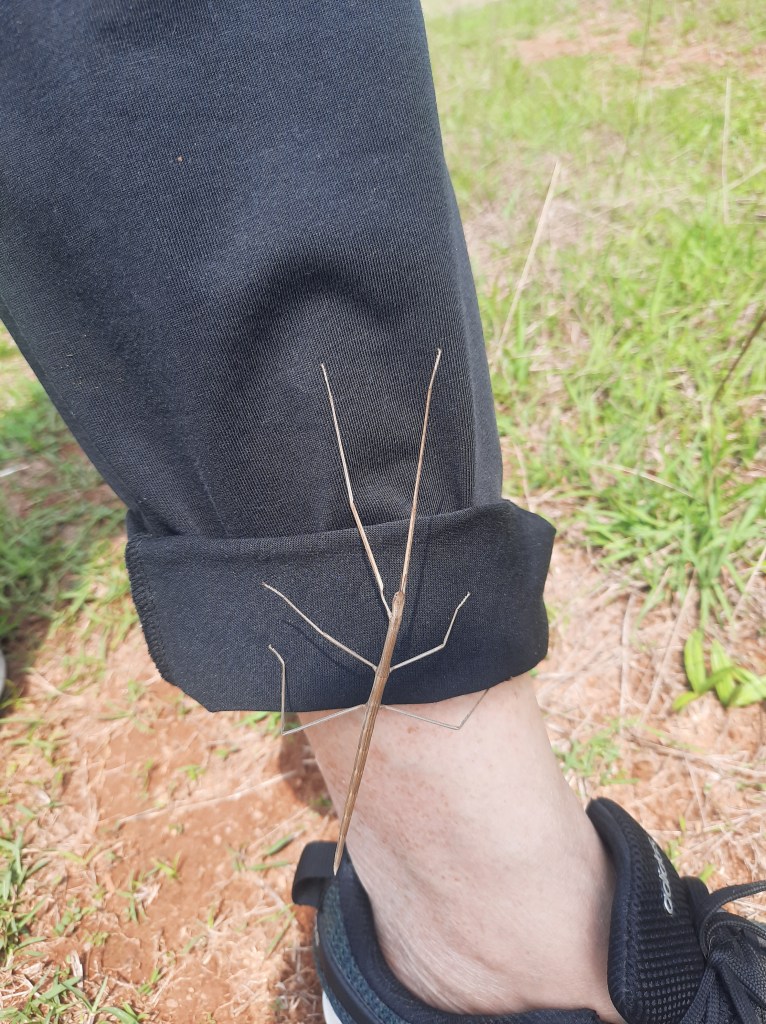
We were recently in the Western Ghats, where we encountered a beautiful Stick Insect. About 6 inches in length from the forward-legs to the tip of the body, it rode on a friend’s leg for a part of our walk through the wilderness. Going by stick insect standards, it was a only a moderately sized one, given that these insects range in length from the half-inch-long Timema cristinae of North America, to the 13-inch-long Phobaeticus kirbyi of Borneo. The latter measures over 21 inches with its legs outstretched, making it one of the world’s longest insects. Female stick insects are normally larger than their male counterparts. They are usually brown, green, or black, but some are brightly-coloured or striped. Some have wings. All continents except Antarctica have stick insects, though they are most abundant in the tropics.
The stick insect, also called the walking stick, spends most of its time up on trees, munching on leaves. When it senses a predator such as a bird approaching, it practically freezes, blending with the twigs and branches around it. In fact, studies suggest that some species have honed the ability to mimic the motion of twigs swaying in the wind to deceive even particularly observant predators. Stick insects are largely nocturnal and spend most of their days lying motionless on or under plants, and only coming out at night to feed. Unfortunately, the stick insects’ defences are not effective against bats which hunt by echo-location rather than sight, and these may be their most dangerous predators.
Even though their camouflage is extremely effective against most predators, they have several other tricks up their sleeves. Some species have evolved to release foul-smelling chemicals to deter predators, while others can secrete a liquid that temporarily blinds their enemies. Even if a predator spots a stick insect, it usually grabs a leg, which is the most prominent part of the insect. But that doesn’t bother our insect too much, because many of the species can detach the leg and scramble away—only to grow back the lost limb later.
And these master-tendencies start even at the egg stage! The females of some species lay eggs that look like plant seeds. This puts off carnivorous insects from eating the eggs!
Some of the stick insect species are today endangered, and the numbers of some are falling—thanks largely to habitat destruction and pesticide use. Another threat to these gentle insects is collection for the pet trade. Carausius morosus, the ‘common’ or ‘Indian’ or ‘laboratory’ stick insect, which has its origins in India, is one of the species of Phasmatodea often kept as pets by schools and individuals.
Alas, however well a creature has evolved to protect itself against natural threats, there is little protection against humans!
–Meena
.










 Millennial Matriarchs