Slugs and Snails

Snails: UGGGGG!

Slugs: UGGGGGGGGGGG!

Yes, that indeed is the normal reaction.  Both of these creatures are gastropods, a type of mollusk. They are both soft-bodied creatures which are covered with mucus—and it is this which usually makes people go ‘UGGGG’. But they need the mucous to stop them from drying out.

Gardeners hate them too, because some species of slugs and snails (S&S) feed on live plant material. These species are particularly fond of eating soft fleshy leaves and seedlings. Some slugs which stay underground tunnel holes in potatoes and other tubers. Snails and slugs are sporadic pests in those places where damp conditions prevail.

And yes, there are worrisome trends too. Some species of exotic snails and slugs can destroy native biodiversity and multiply madly. They have no natural predators when they travel out of their native lands, and so thrive.

In India, 1500 species of land snails have been reported, but the number of species of slugs is limited. Of these, nine species of snails and 12 species of slugs are pests, including the Giant African Snail, which is a serious problem with regards to fruits, vegetables and ornamental plants specially in the east, northeast and south; the common snail, Helix spp. ;  the  common garden snail; and the black slug.  

These gastropod-pests are a worldwide problem. For instance, the Giant African Snail is native to East Africa. But it has spread to many, many parts of the world, either by stowing away on ships, or being deliberately brought to other countries for experiments, as pets etc. And wherever it has travelled, it is creating problems– over 500 plant species may be targeted by the giant African snail, including most vegetables, legumes, ornamental plants, banana, citrus, etc.


But wait! Before we condemn them outright, we must understand that slugs and snails are generally beneficent to the environment and have a key role to play in the ecosystems, as they are recyclers, feeding on dead leaves, dung and sometimes even on dead animals. They play a useful role in composting.  And as important, they are an important food source for birds, beetles and reptiles.

Snails and slugs

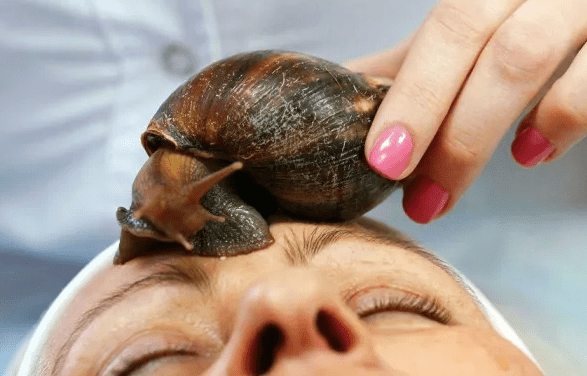
And in recent years, the fashion world has taken to these gastropods in a big way. Snail mucin and slug slime have become popular in the world of beauty. Gastropod slime has been shown to have many beneficial properties–antibacterial, anti-inflammatory and antioxidant, anti-tumoral, anti-aging, tissue regeneration, wound healing etc. Snail mucin contains antioxidants that may help reduce signs of aging like wrinkles, uneven skin tone and sagging. Studies indicate that snail mucin helps with skin regeneration and protects against damaging free radicals.

And let us also recognize that the seriously devastating snails and slugs are often introduced exotic species. There is never anything fundamentally ‘wrong’ about any species. They fit and have a role in the ecosystem where they have evolved. But a species can be in the ‘wrong place’, and then they can cause devastation.

So yes, it is up to us humans to ensure S&S stay where they belong, and don’t travel.

But there is no doubt people, especially gardeners don’t like them. And this is why a wildlife NGO in the UK, The Herts and Middlesex Wildlife Trust and Royal Horticultural Society (RHS) want to challenge negative perceptions. The  organisers want to create a positive image for snails and slugs by showing people how they contribute to ecosystems. Campaign organisers hope that by learning to “appreciate and co-exist” with snails and slugs, gardeners can adopt a more environmentally friendly approach. The trust, with the RHS, has produced a guide with tips to “live harmoniously alongside slugs and snails”.

And here is some S&S Trivia

Slugging is a slang term for a skin care technique that involves applying an occlusive moisturizer to one’s face, typically before sleep, primarily as a way to prevent moisture loss.

Slugging-it-out is to fight, argue, or compete with someone until one person wins.

Sluggish isbeing lazy and slow.

Sluggish in the computer world is when you use human-readable terms in a URL instead of a database number or some other form. It supposedly originated when programmers became too “lazy” to look up a proper code or ID for a website, and began naming them using words. Those “lazy URLs” became slugs.

And FYI: Snails move at a pace of 0.029 miles per hour, or 153 ft per hour. If we convert that to human speed, that’s the equivalent of walking almost 3.2 km per hour. Not too bad! So in this too, it seems snails are getting unnecessary flak!

S&S are nice fellows. Let’s not blame our problems on them!

-Meena

See also:

https://wordpress.com/post/millennialmatriarchs.com/3209

https://wordpress.com/post/millennialmatriarchs.com/2617

PIC: https://www.medicaldaily.com/snail-slime-touted-latest-miracle-beauty-product-243080

Crabby, Crabby…

At the moment–June 22 to July 22—we are in the zodiac sign of Cancer. The sign is called Cancer from the Greek word for crab. Cancer constellation represents the giant crab that attacked Hercules during the second of his twelve labours. It was sent by the goddess Hera to distract Hercules as he battled the water serpent Hydra. Hercules ended up killing the giant crab with his club. In the skies, the crab constellation is a medium-sized one which has ten suns with their own planets.

Down on earth, crabs are members of the animal group called crustaceans—creatures which mostly live in water, have a hard shell, a segmented body, and jointed appendages. Lobsters, shrimps, barnacles are also members of this group. Crabs have five pairs of legs. The first pair has large pinching claws that help with feeding and defence. Three pairs help the crab walk, and last pair may be broad and flattened to serve as paddles for crabs that swim. Though crabs can walk forwards, they generally walk sideways. This is because they have stiff, jointed legs, and find it easier and faster to walk sideways.

There are at least 7,000 species of crab, and they can be found in all oceans and in fresh water. Some crabs even live on land, often several miles from water. They come in a great range of sizes from tiny pea crabs measuring about 2.5 centimeters across, to the giant crab of Japan which may span over 30 centimeters across and measure 4 meters from tip to tip of its stretched out legs.

Some types, including the blue crab, the Dungeness crab, and the king crab, are often eaten by humans. But apart from their nutritional value to humans, and economic value as a major industry, they play a key role in the ecosystem. They are vital food sources for sea animals. The smaller ones recycle nutrients as filter feeders, and the larger ones serve as food for large aquatic mammals. Terrestrial crustaceans are important because they are decomposers of dead organisms. Small crustaceans eat substantial amounts of algae keeping the plant in check, which helps keep the water clear and ensures that sea-grass beds can access to light and oxygen.

crab
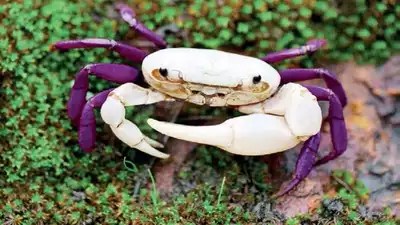
Ghatiana dvivarna

India has about 125 species of crabs. The Western Ghats alone, a biodiversity hotspot, is home to 75 species. A new species was discovered here as recently as 2022.

Belonging to Ghatiana genus of fresh water crabs, the new species is called ‘Ghatiana dvivarna’, the name being a combination of the Sanskrit words dvi (two) and varna (colour). The crab is a beautiful white and red-violet.

All this information is very important. But surely there could be more interesting ways to present it?

That is what the Crab Museum in Margate UK tries to do! This museum’s objective is ‘to roll science, humour and philosophy into a unique and satisfyingly baffling day out’! The founders of the museum believe that ‘“’everyone learns better when they’re laughing’”’, and take a goofy approach to their displays. And it seems to be working! The Museum saw over 80,000 visitors last year, and parents report that their children are more engaged here than in many other conventional institutions.

The dioramas, exhibits, text-labels are all planned with humour in mind, even as they are informing the viewers about crab anatomy, mating habits and the importance of these creatures to marine ecosystems. But the Museum goes further—it uses crabs as an entry point to discussing bigger issues, including environmental issues, climate change, capitalism and colonialism.

Other museums are taking note of these unconventional approaches. As reported in the New York Times, ‘Chris Stringer, of the Natural History Museum in London, said in an email that the museum’s silly approach leads to learning “by stealth.” It “teaches more in a small space and short time than many others with far larger budgets.’

We may not be able to visit the Crab Museum at Margate but crab-lovers can participate in their annual Crab Joke Competition. Last year, there were 700 entries, so the competition is quite stiff. One of the top shortlists was:

Why did the crab get bad grades? Because it was below C level!


Jokes apart, we must be aware that various environmental dangers beset crabs. Research says about one-sixth of all freshwater crab species have an elevated risk of extinction, and there are any number of ‘threats to marine species, including illegal and unsustainable fishing, pollution, climate change and disease’. 

So in this month of Cancer, let’s spare a thought for crabs and their well-being.

–Meena

Pic acknowledgement: TOI

Juneteenth

That is not a word that we in India are very familiar with. Not surprising. Though the ‘Day’ is about a historical event that took place over 150 years back, it officially became a federal holiday in the US only in 2021.

It goes back to the American Civil War. After the Union won, President Abraham Lincoln issued the Emancipation Proclamation which declared the over three million enslaved people living in the Confederate states to be free. However, those were not the days of instant communication. It took over two years before the news reached the people of Texas! It was when Union soldiers arrived in Galveston, Texas, on June 19, 1865, that the state’s residents finally learned that slavery had been abolished. The formerly enslaved African-American community immediately started celebrations with prayer, feasting song, and dance. Over time, the name ‘Juneteenth’ a portmanteau of the words “June” and “nineteenth” started being used for this day.

Since then, the day has been celebrated in Texas, with the first official Juneteenth celebrations held on June 19, 1866, marked by prayer meetings and the singing of spirituals. People wore new clothes as a way of marking their newfound freedom. Over the next few years, African-Americans in other states started celebrating the day as well, making it an annual tradition. Celebrations continued to spread across the United States and typically include prayer and religious services, speeches, educational events, family gatherings and picnics, and festivals with music, food, and dancing. Juneteenth became a state holiday in Texas in 1980, and a number of other states subsequently followed suit.

It still took a long time for it to be recognized at the national level. It was only in 2021 that Juneteenth was made a federal holiday. Activist Opal Lee played a huge part in making this happen. Born in 1926 in Texas, Opal Lee was a teacher. One of the formative events of her life was when her house was burnt down in 1939. The house was in a predominantly white area, and obviously, the fact that a black family had bought a house there was uncomfortable for some people. On June 19, 1939, 500 white rioters vandalized and burned down the home. Opal realized that 19 June had been chosen for a reason and was very symbolic.

Opal was always at the forefront of organizing the community, and played a lead role in Juneteenth celebrations. This gathered momentum when she retired, and she became a relentless campaigner for having Juneteenth declared a federal holiday. For many years, she organized a march of 2.5 miles, to represent the 2.5 years it took for the news of their emancipation to reach the African-Americans in Texas. She promoted a petition for a Juneteenth federal holiday at Change.org, and the petition received 1.6 million signatures. In 2021, when Opal was 94, her dream came true and President Biden finally signed the Bill. Opal was an honoured guest at the function. Slowly, over time, the day started being celebrated outside the United States too, to recognize the end of slavery and to honor the culture and achievements of African Americans.

Here is something that Lincoln wrote about slavery, which is worth pondering:

If A. can prove, however conclusively, that he may, of right, enslave B. — why may not B. snatch the same argument, and prove equally, that he may enslave A?–

You say A. is white, and B. is black. It is color, then; the lighter, having the right to enslave the darker? Take care. By this rule, you are to be slave to the first man you meet, with a fairer skin than your own.

You do not mean color exactly?–You mean the whites are intellectually the superiors of the blacks, and, therefore have the right to enslave them? Take care again. By this rule, you are to be slave to the first man you meet, with an intellect superior to your own.

But, say you, it is a question of interest; and, if you can make it your interest, you have the right to enslave another. Very well. And if he can make it his interest, he has the right to enslave you.’

And to see how he relates it to democracy:

‘As I would not be a slave, so I would not be a master. This expresses my idea of democracy. Whatever differs from this, to the extent of the difference, is no democracy.’

Wise men know how to capture universal truth in a few words!

–Meena

AJT Johnsingh: The Highest Standards of Wildlife Research

A few days ago came the sad news of Dr. AJT Johnsingh’s passing. And for once, mainstream media covered this event—from AIR to Times of India to Hindu to several other national and regional papers. 

For media to so widely cover the passing of a wildlife researcher is sure indication that there was something special about him. And indeed there was.  He was one of India’s best and most respected field researchers. And even more, he put all that knowledge into practice in conservation.  He strongly believed that knowledge should not lie in books, but be used to develop better policies and practices to support conservation on the ground.

Born to teachers who were both nature-lovers and outdoor people, he grew up in a small town called Nanguneri in Tirunelveli district of Tamil Nadu. His parents encouraged him to be outdoors, and family outings generally meant picnics in the wilderness areas of the Western Ghats. They were early and important influences in his love for nature. Another source of inspiration was Jim Corbett, whom he read avidly when young, and whose approach to conservation he admired—it was an approach that was unsentimental, and doing what needed to be done, extending to killing maneaters when there was no other way out.

JC Daniel of BNHS whom he first met when trekking up in the Kalakad hills in 1971, and who mentored him at various stages in his career, was a great influence.  George Schaller,  American mammalogistbiologistconservationist and author recognized by many as the world’s preeminent field biologist, studying wildlife throughout Africa, Asia and South America, was a role model for Johnsingh.

AJT went to St. Xavier’s College, Palayankottai, and then Madras Christian College, Tambaram. He started his career as a professor at Ayya Nadar Janaki Ammal CollegeSivakasi, He worked as a postdoctoral fellow at the Smithsonian Institution in Washington, D.C. He returned to India in 1981 to work with the Bombay Natural History Society. In 1985, he joined the faculty of newly-established Wildlife Institute of IndiaDehradun, and helped shape this premier institute which has developed the cadre of India’s current wildlife professionals. He retired as the Dean WII in 2005. In this period WII trained over 300 managers and several M.Sc Wildlife and PHD students.

He was the first Indian to carry out field research on free-ranging large wild mammals. He focussed particularly on the dhole (wild dog) in Indian forests. His research in the early years focused on the ecology and prey-predator relationships of dhole, other carnivores and ungulates in Bandipur National Park. His interest and research covered several large mammals, and his knowledge of many species saw him on the IUCN Asian Elephant Specialist Group, as well as the Cat, Canid, Bear, and Caprinae Specialist Groups. He also researched the Mahseer fish.

Tigers also fascinated him. He is credited with having taken the first good photo of a tiger in Bandipur. Talking about this photo in an interview to Sanctuary, he said: ‘ For years, no one had been able to take a clear picture of a tiger in Bandipur. Because my dhole study area was littered with tiger spoor, I always carried a camera around ‘just in case’. On May 23, 1978, around 7 a.m., I was sitting eight metres up on a mango tree in the Ministerguthi nullah, which was frequented by tigers whose pugmarks could easily be seen and whose spray markings, I could smell. I sat for around 45 minutes, barely breathing when a movement in the tall grass caught my eye. The tiger walked towards a clearing right in front of me and when it reached a patch of sunlight, I whistled and with a perplexed look on its face, it froze staring straight at me. But the moment it heard my camera shutter, it vanished. Interestingly, I cannot stop smiling whenever I see this picture.’

He authored several research papers, but what got him know widely across the general public where his three popular books: ‘Field Days: A Naturalist’s Journey through South and Southeast Asia’ (2005), ‘Walking the Western Ghats’ (2015) and ‘On Jim Corbett’s Trail and Other Tales From the Jungle’ (2018). He also edited two volumes of The Mammals of South Asia which in total has 69 chapters.

AJT was decorated with many honours including the Distinguished Service Award by the Society for Conservation Biology, the Carl Zeiss Wildlife Conservation Award, the ABN AMRO Sanctuary Lifetime Wildlife Service Award, ‘Kirloskar Vasundhara Sanman’ and Salim Ali Conservation Award.

The government also respected and valued his expertise. He was on the Standing Committee on the National Board for Wildlife, Government of India, and served for three years as a member of the National Tiger Conservation Authority. He was also a Padma Shri awardee. His voice, opinion and work contributed to the creation of wildlife areas including the Kalakkad-Mundanthurai Tiger Reserve.

We at CEE had the opportunity to interact with Dr. Johnsingh on different occasions when we sought his expertise on various projects. Two in which I was personally involved where he was on the Advisory Committee were the Snow Leopard Education project, and the ‘School Education to Support Asian Elephant Conservation’ project. In the days prior to Zoom and video calls, we could not get into discussions with him, but sent him drafts on which he gave his insightful comments.

The conservation world and India have lost a unique researcher and spokesperson who had the knowledge and courage to speak out, and the stature to be listened to. As a message from his family puts it: ‘The Green Warrior has landed safely in his Valhalla, after a war well fought, to save mother nature, for all mankind.’

And to end with a quote from him which underlines the spirit behind his research: “I used to ask questions about wildlife that no one could answer. So I began to search for answers myself by observing animals. Curiosity is the greatest trigger for good science.

RIP, Dr. AJT Johnsingh.  Your passing is personal loss to your family and friends, and as great a loss to the wildlife and environment you worked so hard to protect.

–Meena

.

Shady Environment-Talk

June 5: Marked as Environment Day across the world since 1973.

The world has come a long way since the time in 1972 when such a day was mooted. Not only in terms of becoming more aware about the environment and taking action, but also in terms of the planetary boundaries being pushed to the brink through not taking enough action!

With the environment being such a widely talked-about issue, every actor—governments, businesses, civil society– have taken these issues on board.

Which is very good.

Till it is not.

The ‘till it is not’ includes corporates and other entities passing themselves off as environmentally or socially friendly when they are not. How do they do this? Here are a few terms that are used in the context of the many, many shades of these tricks:

  • Green Washing is undertaking misleading promotion of products or policies as environmentally friendly when in reality, they are not—often exaggerating the benefits while hiding the true or non-existent environmental impact. Common and insidious, such examples may range from misleading ads, to misleading recycling claims, to unverifiable carbon footprint claims, and every PR stunt in the book.
  • Blue Washing, indulged in by some of the largest corporations across the world, is the practice of businesses to sign up for the UN Global Compact and use their association with the United Nations to enhance their image and shift attention from their controversial business practices.
  • Carbon Washing is when companies make misleading or unsubstantiated claims about their carbon impacts or initiatives.
  • Social washing is similar to green washing, but in the context of being socially conscious–corporations wrongfully trying to market themselves as socially responsible.
  • Purple Washing is when a state or organization appeals to women’s rights and feminism in order to deflect attention from its doing nothing, or in fact actually harming these rights. 
  • Pink Washing is when companies try to create a false impression of being LGBTQ friendly while doing nothing to make life for their LGBTQ employees easier.
  • Rainbow Washing is similar to the above, when corporations use the rainbow symbol or colours, while being involved in activities that are damaging to LGBTQIA+ community 
  • Vegan Washing is when companies promote their products through appeals to compassion for animals, while actually causing animal suffering

Of recent times, the vocabulary of Green Washing has got even more nuanced! Here are some subtle variations:

  • Green Shifting: This is a subtle move, wherein companies highlight consumer choices, thus transferring responsibility to them, rather than highlighting their sustainability efforts.
  • Green Lighting: This trend is about corporations highlighting a particularly environmentally friendly aspect of their operations, in an effort to divert attention from less sustainable practices elsewhere in the company.
  • Green Rinsing: This involves businesses frequently changing ESG targets without genuine accomplishment, thereby making it hard for stakeholders to track their progress.

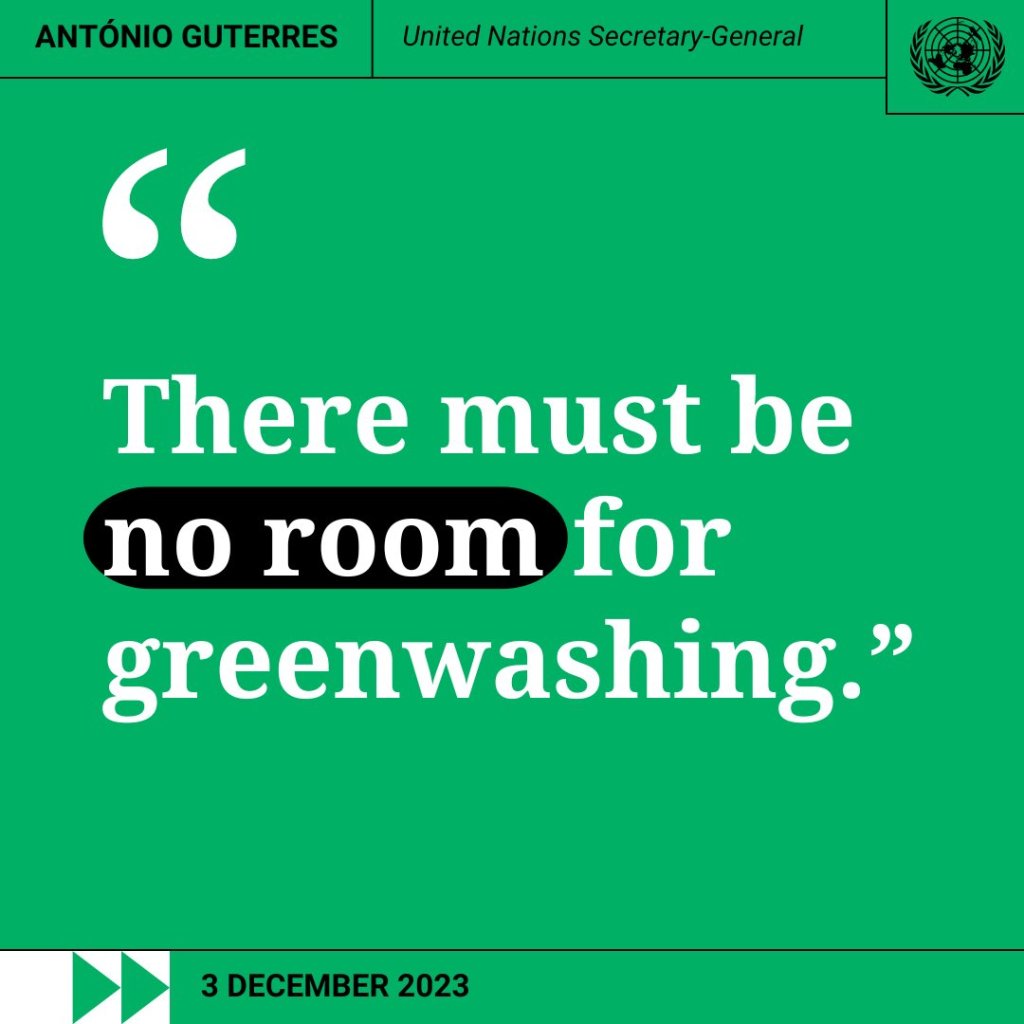
The UN warns about the seriousness of the harm that Green Washing (and allied colour-washes) can cause. In the context of climate change, the UN points out that: ‘Greenwashing presents a significant obstacle to tackling climate change. By misleading the public to believe that a company or other entity is doing more to protect the environment than it is, greenwashing promotes false solutions to the climate crisis that distract from and delay concrete and credible action.’

They identify many tactics of green washing including:

  • :‘Claiming to be on track to reduce a company’s polluting emissions when no credible plan is actually in place.
  • Being purposely vague or non-specific about a company’s operations or materials used.
  • Applying intentionally misleading labels such as “green” or “eco-friendly,” which do not have standard definitions and can be easily misinterpreted.
  • Implying that a minor improvement has a major impact or promoting a product that meets the minimum regulatory requirements as if it is significantly better than the standard.
  • Emphasizing a single environmental attribute while ignoring other impacts.
  • Claiming to avoid illegal or non-standard practices that are irrelevant to a product.
  • Communicating the sustainability attributes of a product in isolation of brand activities (and vice versa) – e.g. a garment made from recycled materials that is produced in a high-emitting factory that pollutes the air and nearby waterways.’

The UN urges us all to be more responsible by:

  • Learning more about green washing techniques so that we are more discerning
  • Make better consumer choices by buying only from companies whose green claims have been substantiated
  • Taking into account a product’s lifecycle and its environmental impact through every stage of making, use and disposal.

This Environment Day, let’s become better watch-dogs for the environment by getting more savvy about this colour palatte!

–Meena

Wise Words on Democracy

Election fever is well upon us. Not just us in India. An estimated third of the world goes to the polls this year.

A good time to pause and reflect on what people who have contributed so much to the shaping of our nation have said about democracy?

The first section is devoted to quotes taken from the discussions in the Constituent Assembly of India in 1949. The later section reflects Gandhiji’s thoughts on the subject.

‘What is democracy? I define it, in one word. Democracy is accommodation. Any person who does not understand this small definition of democracy, cannot be a democrat at all. ‘(Shri R. V. Dhulekar)

‘If we are going to have a democratic form of Government we should have as real democracy as possible by giving as much power to as small a unit as practicable so that the individuals composing the unit may have easy and ready remedy ..’. ( Shri B. P. Jhunjhunwal)

‘..the strength of democracy lies in the character of the people and their representatives.’ (Shri B. M. Gupte)

Constitution of India
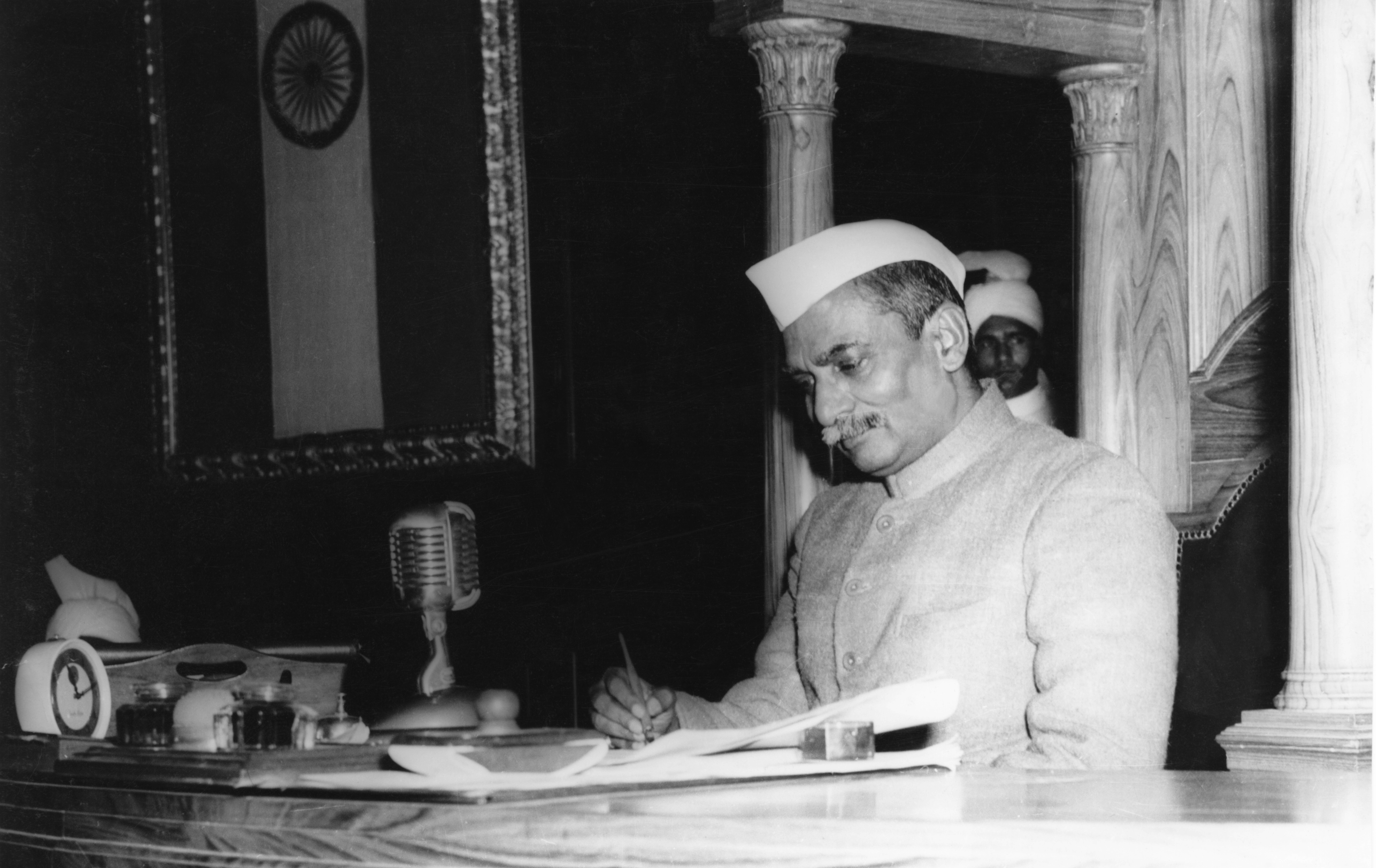
Dr. Rajendra Prasad, President of the Constituent Assembly, signing the Constitution of India.

‘The essence of democracy is not so much the existence of what are called political parties, etc., but the essence of democracy is the effective participation of the individual in the actual government of the country. The greater and more effective the participation of the individual in the government, the greater is the democracy, because democracy is still only an ideal which has yet to be reached by humanity.’ (TJM Wilson)

‘..Gandhiji  said that true democracy rose not from the top but from the bottom. Power and authority should not be centered at the top but should be distributed among the people at the base of society. Then alone can true democracy be established and then alone can people enjoy freedom.’ (Shri Kamlapati Tiwari)

‘We must observe the caution which John Stuart Mill has given to all who are interested in the maintenance of democracy, namely, not “to lay their liberties at the feet of even a great man, or to trust him with powers which enable him to subvert their institutions“. There is nothing wrong in being grateful to great men who have rendered life-long services to the country. But there are limits to gratefulness. As has been well said by the Irish Patriot Daniel O’Connel.. no nation can be grateful at the cost of its liberty. This caution is far more necessary in the case of India than in the case of any other country. For in India, Bhakti or what may be called the path of devotion or hero-worship, plays a part in its politics unequalled in magnitude by the part it plays in the politics of any other country in the world. Bhakti in religion may be a road to the salvation of the soul. But in politics, Bhakti or hero-worship is a sure road to degradation and to eventual dictatorship. (BR Ambedkar)

‘We must not to be content with mere political democracy. We must make our political democracy a social democracy as well. Political democracy cannot last unless there lies at the base of it social democracy. What does social democracy mean? It means a way of life which recognizes liberty, equality and fraternity as the principles of life.’  (BR Ambedkar)

From: Discussion in the Constituent Assembly of India. 1949.

Gandhiji on Democracy

‘I understand democracy as something that gives the weak the same chance as the strong.’

Democarcy is ‘..”the art and science of mobilizing the entire physical, economic and spiritual resources of all….in the service of the common good of all”

‘There is no human institution but has its dangers. The greater the institution the greater the chances of abuse.  Democracy is a great institution and therefore it is liable to be greatly abused. The remedy, therefore, is not avoidance of democracy but reduction of possibility of abuse to a minimum.’

‘..if individual liberty goes, then surely all is lost, for, if the individual ceases to count, what is left of society? Individual freedom also can make a man voluntarily surrender himself completely to the service of society. If it is wrested from him, he becomes automation and society is ruined. No society can possibly be built on denial of individual freedom.’ ‘In the democracy which I have envisaged, a democracy established by nonviolence, there will be equal freedom for all. Everybody will be his own master.’

Profound perspectives indeed, and we would do well to reflect on them, and to think about the fundamentals of democracy, which are:
1) Respect for basic human rights,
2) A multi-party political system paired with political tolerance,
3) A democratic voting system,
4) Respect for the rule of law,
5) Democratic governance, and
6) Citizen participation

Democracy is much more than election day and inking the finger!

–Meena

Pic: http://www.nbpgr.ernet.in

Vasco da Gama Lands in India

526 years ago to the day yesterday (May 20), the first European made it by the sea route to India. This was the Portuguese Vasco da Gama who landed in Kozhikode (Calicut), Kerala. And the history of globalization and the colonization of India by Europeans started.

The discovery of the sea route to India was a milestone in world affairs. It provided access to the spice trade, which otherwise happened overland—more time consuming, more risky and more expensive. Vasco da Gama first came to India via the Cape of Good Hope, and became the first to link Europe and Asia by an ocean route—one that traversed the Atlantic and the Indian oceans. This enabled Portugal to establish colonies all the way from Africa to Asia, and dominate the trade between Asia and Europe for decades. The Dutch, the English, the French and the Danish lagged by almost a century before they could challenge the Portuguese for supremacy in these seas.

Vasco da Gama
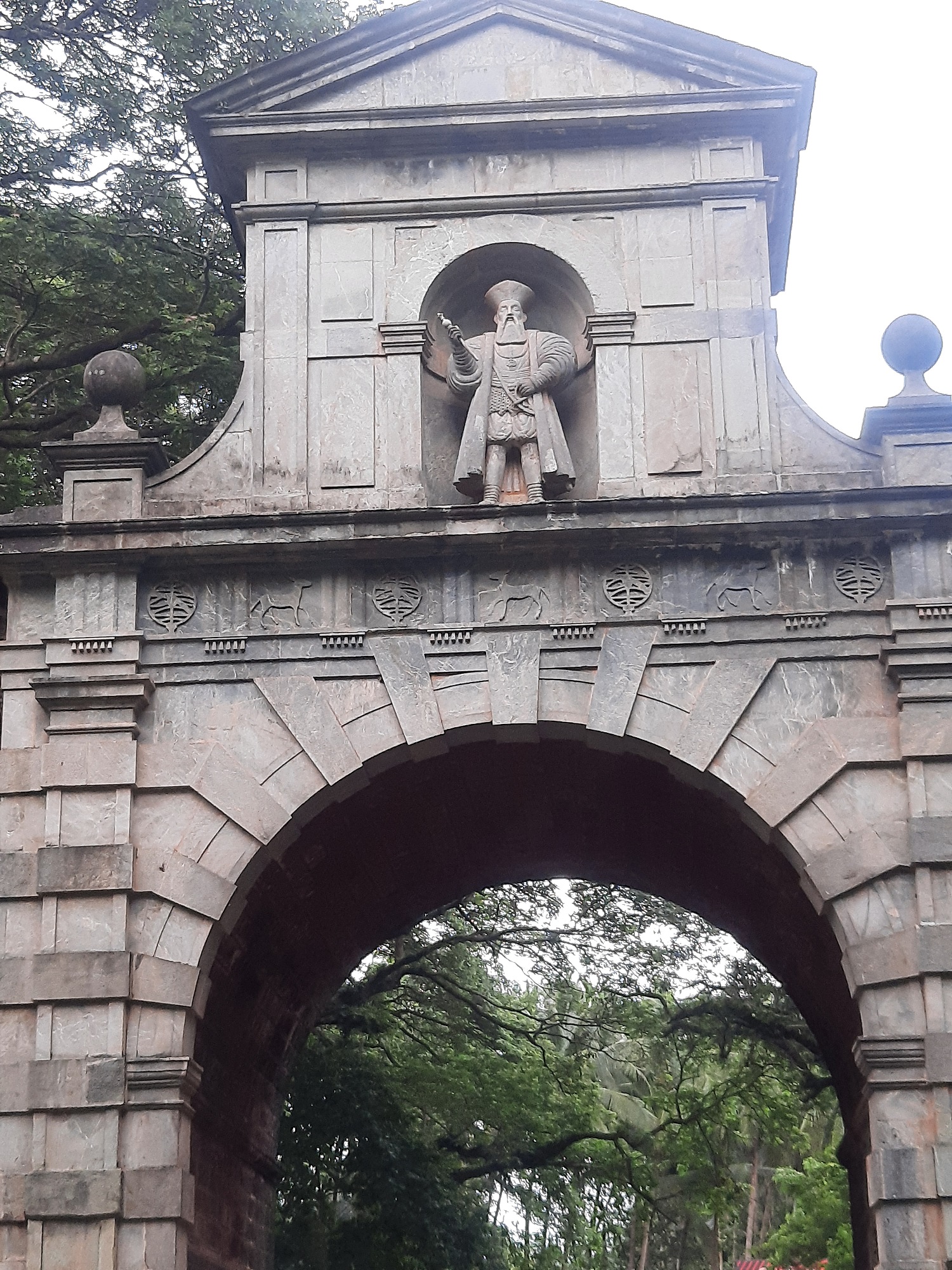
Statue of Vasco da Gama, Viceroy’s Arch, Old Goa, Velha Goa

There can be no questions about da Gama’s courage, enterprise, skills and sheer sense of adventure in venturing out into unknown waters, and persisting for almost two years in the voyage to finally make it to India.

But even as one celebrates this spirit of human endeavor, it is necessary to question many of the motives and actions.

Da Gama, in his interactions with the Zamorin (ruler) of Calicut was always less than respectful. The Zomorin received da Gama with the respect due to a visitor from foreign shores, but da Gama had no clear answers to why he was visiting India, and gave the Zamorin such trivial gifts from the Portuguese king that no one would quite believe that da Gama was a royal ambassador and not some small-time merchant. This resulted in the Zomorin refusing Vasco da Gama’s request for permission to leave a representative behind to look after the merchandise he had not been able to sell. Further, local officials insisted on his paying customs duty like any other trader. This irritated the entitled da Gama, and he kidnapped and carried away some Nairs and sixteen fishermen when he left the shores.

But the most damning incident occurred during his next visit—the Second Armada. His ships reached India in October 1502. At the same time, a ship named Mirim carrying about 400 Muslim pilgrims including 50 women, had set out from Calicut for Mecca. Da Gama’s ships intercepted Mirim, looted the ship, locked in the passengers including the owner and an ambassador from Egypt, and burned them to death. Only about 20 children were spared on the condition that they would convert to Christianity. Da Gama watched the whole gory incident through the porthole of his ship.

Da Gama had come this time with the objective of signing a trade treaty with the Zamorin. After the pilgrim ship incident, the Zamorin hesitated to take on the Portuguese head-on and indicated his willingness to sign a treaty. But Da Gama had an atrocious condition—that the Hindu Zamorin expel all Muslims from his territory before negotiating the treaty. The Zamorin was appalled and refused. A very senior priest, Talappana Namboodri, known to both sides was sent to Da Gama to try to sort out things. But da Gama labelled him a spy, and had the priest’s lips and ears cut off. He had a pair of dog’s ears to his head before sending him away. But this was not the end of the matter. So infuriated was da Gama that he had the Portuguese fleet bombard the unfortified city of Calicut for nearly two days from the sea, severely damaging it. He also captured several ships, cut off the crew’s hands, ears and noses, dispatching them to the Zamorin with a note wherein he said that he would be happy to reset the relationship to a positive note once the Zamorin had paid for the items plundered well as the gunpowder and cannonballs used to bombard Calicut! Things escalated, and there was a sea battle which da Gama won. He also started trade with Cochin and Cannanore which were at war with Calicut.

Da Gama’s fortunes in Portugal declined for some decades after this journey, and he lay low. In 1594, with the new King’s blessings, he set out again for India, now with the title of Viceroy. This time he landed in Goa. He set out immediately to strengthen the Portuguese domination along the East Coast. However, it was not for long. He contracted malaria and died three months later in Kochi.

The Portuguese were the first Europeans to colonize India, and the last to leave! Vasco da Gama not only laid the foundation for this, but also for the ‘divide and rule’ strategy—turning one religion against another, one kingdom against another– which served future colonizers well.

Heroes in their time and country, leaving behind troubling legacies.

–Meena

Tree Architecture

About three decades ago, a new colleague joined our organization. During introductions, obviously the topic of what he had done-where he had done came up. It was an impressive pedigree—a Ph.D from JNU, under the legendary professor of ecology Dr. P.S. Ramakrishna. So far, so good. But his elaboration of what he had done his Ph.D on was what threw all of us. ‘Tree architecture’, he said casually, as if was a term we used day in and day out.  And embarrassing to admit, though we worked at Centre for Environment Education and should have been up with all terms ecological, none of us had heard this one. Dr. Ram Boojh Yadav, our new colleague educated us.

Last week, as I was doing my piece on topiary or tree-shaping, not surprisingly these memories came back to me. If topiary is about humans shaping trees as per their whims, tree architecture is about trees growing as they are destined to. So I thought I should re-visit that term which mystified me so many years ago, and try to learn a little more about it. So here goes…

When you look at a tree that you are familiar with, even from a distance and maybe even without leaves and flowers, you usually know what tree it is, e.g., mango vs. neem vs. Ashoka. And when it comes to botanists and arborists, obviously they can distinguish and identify many more just by looking at the silhouette.

Tree silhouttes

How does this happen? The answer is tree architecture or the study of the form of trees, which started gaining ground as a formal discipline in the 1970s, and has been use for a long time in management of trees. It is the branch of science that explains why a tree looks how it looks.

Tree architectures studies characteristics like type of branching, type of extension growth, branch orientation, flowering position etc. This is done by observing and schematising many individuals of the same species, in all life stages, to try to identify the ‘building plan’ of that species.’   To cite a researcher: ‘Plant architecture tries to identify fixed and repetitive phenomena in plant structures, valid for all individuals of the same species or even valid for multiple species.

So why does a tree look how it looks? Well the basic reason is genetics. Each tree species has a genetic blueprint of how it would ideally develop. And this goes back to its evolutionary history. For instance, the higher mechanical stresses imposed on trees that are native to windy areas makes them put down more wood to strengthen their structure, and consequently trees growing in such areas develop shorter but thicker trunks, branches, and roots. In contrast, trees that grow in sheltered areas will grow taller and thinner to improve their chances of reaching the light.

But the expression of this genetic blueprint depends on the site where an individual tree is growing—the soil, light, water, wind and other such factors that it finds there. These are the site conditions.

And the last are the environmental influences—has it experienced lightning, storms, insect infestations, human interactions, etc.

The science of tree architecture is based on subdividing trees into groups with similar characteristics (e.g., type of branching, type of extension growth, branch orientation, flowering position). Research has shown that all trees in the world fall into one of 23 architectural models—in other words, there are 23 tree building plans in the world!

Go on out there. Take a walk, get some exercise, breathe in some fresh air. And look at tree building-plans!

–Meena

Thanks: https://www.validtreerisk.com/resources/Documents/News/Tree%20Architecture%20

Celebrating Tree-shapers: World Topiary Day

Have you seen deer walking across a traffic island in the middle of a crowded urban space? Or perhaps elephants in your city garden? Well, that is topiary.

Topiary, as per the Britannica, is ‘the training of living trees and shrubs into artificial, decorative shapes’. It is an ancient art, going back to the time of the Romans. In fact, Gaius Matius Calvinus, a contemporary of Julius Caesar is supposed to have been one of the first practitioners, and Caesar is said to have popularized it all over the Roman Empire.

There are three fundamental types of topiary:

  • Shrub topiary which consists of shrubs which are designed and shaped in various shapes and sizes. Very experienced gardeners do the cutting freehand, while others use frames.
  • Vine topiary, wherein vines and climbers are encouraged and shaped to grow in various topiary forms
  • Moss topiary where a frame is filled with wet moss and the chosen plant, and grown in the desired shape.

Whatever the type of topiary, it is an endeavour which requires ongoing work, care, patience and expertise

The fortunes of topiary have waxed and waned. After a long lull, the Italian Renaissance, which saw the flowering of many arts, also saw the revival of topiary. It became the rage in Italy, France (including in the Versailles), and with the Dutch and English.  The British took to it with passion, and it was found not only in the homes of the rich and the famous, but also in the modest gardens of peasants and tradesmen. Imagination was the only limit, with ships, fantastical beasts and human figures, all roaming the lawns.

Till topiary went overboard. And it was the mighty pen which defeated the scissors. Alexander Pope wrote a satirical essay “Verdant Sculpture” criticizing over-the-top topiary, and as a result, by the 1720s and ‘30s, topiary fell out of favour and was cleared from most prominent English gardens. The Levens Hall Garden was one of the few which escaped, and is today the oldest topiary gardens, with 30,000 bedding plants carved in a variety of shapes.

Till topiary was again revived in the 1840s. Not at the same scale, but it became moderately popular.

In its own unique forms, topiary has been quite popular in Asia too. China and Japan have practiced it for many centuries, with the objective of helping the trees achieve their “natural” form. Even the popular bonsai is a form of topiary.  Japanese Zen Gardens make extensive use of different topiary techniques.

Topiary
Topiary at Delhi Airport

In 2021, a new event, World Topiary Day, was created by the owners of one of the world’s oldest topiary gardens, the Levens Hall and Gardens in Cumbria, UK, which dates from 1694. World Topiary Day marked on May 12th every year, celebrates ‘… the fantastic art of topiary (shaping and cutting particular types of tree into geometric shapes and forms that resemble common objects and people) and its heritage within the world of gardening’, and seeks to inspire ‘…keen gardeners and lovers of al fresco living to adopt topiary’s style and structure within their own private gardens.’

A new award for topiary has also been announced as recently as this year and the ‘…search is on for Britain’s best topiary artists thanks to the inaugural Topiary Awards, which are now open for entries until May 31.’

In India too, many gardens and public spaces have examples of topiary. But sadly, after the initial enthusiasm, they are not maintained well, and therefore go out of shape. 

India is however home to the tallest topiary as per the Guinness Book of Records. This is the Samban-Lei-Sekpil in Manipur, started in 1983, which has now reached 18.6 m (61 ft) in height. The plant used is Duranta erecta, a shrub common in Manipuri gardens. It is shaped into a tiered structure called ‘sekpil’ that honours Umang Lei, the forest god.

Here is to tree-shapers, tree-barbers, tree-architects and their tribe, for adding green landmarks and a touch of whimsy to our lives.

–Meena

The Flowers of War

The media has been full of the 50th anniversary of the Carnation Revolution over the last week. It happened in Portugal. And apparently, Portugal wasn’t even a respectable democracy 50 years ago! Since a coup in May 1926, Portugal was under an authoritarian regime. In 1932, Antonio Salazar took over as Prime Minister, and remained at the helm of affairs till 1968 and continued to hold the reins of power tightly, with little say for the people in anything. He alo would not give up Portugal’s large overseas territories including Goa, Daman, Dadra and Nagar Haveli. In India of course, the Indian armed forces invaded, and supported by the local freedom fighters, took over in 1961. Portugal continued fighting long-drawn colonial wars in other parts of the world. Within Portugal also, it was an authoritarian rule. Finally, in 1974, the people of Portugal lost patience. On 25th April, there was a largely peaceful coup led by members of the Armed Forces Movement and backed by civilians from all walks of life. It began to be called the Carnation Revolution because there were almost no shots fired. It being the carnation season, the markets were full of carnations, and people started giving them to each other and also placed them in the muzzles of the soldiers’ guns, as well as in their button holes.  It was a happy ending!

Flowers
Bouquet of Flowers in a Vase Georgius Jacobus Johannes .Getty Open Access

Many subsequent peaceful revolutions have been named after flowers, including: The Tunisian revolution of 2010-11 is called the Jasmine Revolution in honour of the country’s national flower In the Rose Revolution in Georgia in 2003, Opposition leader Mikhail Saakashvili carried a rose into parliament when he demanded the resignation of President Eduard Shevardnadze, while protesters in the streets gave long-stemmed roses to soldiers called out to stop them. The President resigned. The 2005 Tulip Revolution in Kyrgyzstan forced President Askar Akayev to flee the country. 

But the association of wars with flowers goes further back than that. The famous War of Roses was a long-drawn series of inter-generational wars for the British throne. Fought over 30 years starting 1455, the war was between the House of Lancaster and the House of York, descendants of two sons of Edward III who reigned from 1330-1377. Amidst  claims and counter-claims to the throne almost as complicated as between the Pandavas and Kauravas, the war raged till Henry Tudor (later Henry VII) who represented the claim of the House of Lancaster, won the Battle of Bosworth, and sealed the claim by marrying Elizabeth of York, the daughter of the Yorkist King, thus uniting the two houses. The War of Roses is so called for the symbols of the two sides—the white rose of York and the red rose of Lancaster. After the marriage of Henry and Elizabeth, the symbol was combined in a way that overlaid the white and red roses.

But the oldest of flower-wars has to be war over the parijata tree fought between Krishna and Indira. The origin of the story goes back to the Harivamsam (1st or 2nd century BCE). In this tale, Narada gives Krishna a single enchanting blossom of the parijata flower from the special tree in Indra’s garden. Krishna is with his senior-wife Rukmini at the time, and gives it to her. When the junior-wife Satyabhama hears of this, she is angry beyond belief and is only pacified when Krishna promises to fetch her the tree itself from the heavenly garden. However, Indra refuses to part with the tree, and Krishna has to fight a mighty battle—which of course he wins. And the parijata is brought to earth and planted here. (See ‘Heaven’s Flower’ https://wordpress.com/post/millennialmatriarchs.com/164)

So flowers can cause wars. And they can stop wars.

It’s a choice we have to make today!

–Meena