The Timeless Wisdom of Gandhi

This week, up until Oct 2, the posts will be dedicated to remembering Gandhiji. This issue, it is quotes from his writing, focussing on the ethical foundations of economics. As relevant today, as ever. As relevant at an individual level, as for a country. Food for thought indeed.

Earth provides enough for every man’s need, but not every man’s greed.

Popularized by Gandhi

Civilization, in the real sense of the term, consists not in the multiplication, but in the deliberate and voluntary reduction of wants.

Complete Works of Mahatma Gandhi. Vol 44, 103-104.

This mad rush for wealth must cease, and the labourer must be assure, not only of a living wage, but a daily task that is not mere drudgery.

Young India, 13 Nov 1924.

I must confess, I do not draw a sharp or any distinction between economics and ethics.  Economics that hurt the well-being of an individual or nation are immoral and therefore sinful. Thus the economics that permit one country to prey upon another are immoral. It is sinful to buy and use articles made by sweated labour.

Young India, 13 Nov 1924.

We may neither take nor keep a superfluous thing..

Harijan. 31 March, 1946.
The real meaning of economic equality is ‘To each according to his need.’

Harijan. 31 March, 1946.

A certain degree of physical harmony and comfort is necessary, but above a certain level it becomes hindrance instead of help. Therefore the ideal of creating an unlimited number of wants and satisfying them seems to a delusion and a snare.

CWMG. Vol  63. 241.

I will give you a talisman. Whenever you are in doubt, or when the self becomes too much with you, apply the following test. Recall the face of the poorest and weakest man whom you may have seen, and ask yourself if the step you contemplate is going to be of any use to him. Will he gain anything by it? Will it restore to him a control over this own life and destiny? In other words, will it lead to Swaraj for the hungry and spiritually starving millions? Then you will find your doubts and your self melt away.

CWMG. Vol 89. 125.

Economic equality …mean(s), however, that every will have a proper house to live in, sufficient and balanced food to eat, and sufficient khadi with which to cover himself. It also means that the cruel inequality that obtains today will be removed by purely non-violent means.

Harijan. 18 August, 1940.

–Meena

These are from a compilation I was lucky enough to work on, launched at the Gandhi Ashram by Mr. Steven Rockefeller, to commemorate the Tenth Anniversary of the Earth Charter.

Sarabhai, K., Raghunathan M., Modi A. (Compiled). Earth Charter & Gandhi: Towards a Sustainable World. Ahmedabad. Centre for Environment Education. 2010.

Women Who Inspire

‘It is necessary that no matter what section of society she belongs to, every woman has to know three things: one, she has to know her body, how it works, so that nobody can use it or tamper with it against her will. Two, every woman has to have a skill that can generate income for her. This is very important so that she is not dependent on anyone for her survival. And three, every woman should be broadly aware how the democratic structures and institutions of our country work—be it the gram panchayat, the state assembly, the national parliament, or our unions, cooperatives, federations and associations, so that she knows she belongs to them and can someday participate in them.’

mushroom farming

So says Ms. Ela Bhat, in her Introduction to Sudha Menon’s ‘Leading Ladies. Women Who Inspire India’. And when it comes from the wisdom, the gravitas and the experience of Ms. Bhat, we better take it seriously!

‘Leading Ladies’ is a compilation of the life stories of 15 eminent women-achievers. As the author herself says, many of them have been written about quite often—Amrita Patel, Kiran Mazumdar-Shaw, Vinita Bali, etc. But every author and piece does throw some new light, does surface some new angle. And there are some lesser-written about heroines too. I was particularly taken with the stories of Lila Poonawala, Mallika Srinivasan and PT Usha. While the criteria of selection are not spelt out, I don’t think it is much of a point to quibble about–the women featured come from a variety of backgrounds—business, to non-profit work, to sports.

The author has been lucky enough to spend considerable time with each of the featured women, and hence, there is both detail and affection in the writing of the pieces.

Positive stories and stories of achievers are inspirational and important. Especially important are stories of women who fight the odds, break stereotypes, venture into new territories, and come out winners. The book is an easy read, in a story-telling kind of style.

Good weekend or in-flight reading. Read it yourself and gift it to young women you know. And especially, I wish colleges and educational institutions would buy this for their libraries.

–Meena

Leading Ladies. Women Who Inspire India. Sudha Menon. Fortytwo Bookz Galaxy. 2010.

Business as Usual

 “Business history gave me the opportunity to look at the experiences of individuals. Individuals who built organizations; individuals who built companies, individuals who responded to situations and responded to change. Then I began to have some kind of understanding of what Indian society is like. What are the forces in the Indian society that egg people on to certain things” said Prof Dwijendra Tripathi, Kasturbhai Lalbhai professor of Business History at IIM Ahmedabad, and the founder of the discipline in India.

Like any historian, he believed that studying the past led to a better understanding of the present. Today, India wants to ‘Make in India’. It wants every graduate and school dropout to be an entrepreneur, a job creator rather than a job seeker. There cannot be a time when it is more critical to study Indian business history.

India was fortunate to have a pioneer like Prof Tripathi who laid the foundations of this discipline way back in the ‘60s and ‘70s. But even today there are few Indian Business Schools which teach the subject. I wonder if there are any pure history departments which teach it at all!!!

His passing away on Sept 5 this year has led to a flurry of articles and pieces (including this one). Maybe it will also lead to serious debates on the place of the study of Business History for the development of Indian Business.

Some things change, some don’t! It is up to us to learn from the past to plan for the future.

‘Another disincentive to movement was a network of customs barriers. According to Moreland, these barriers–chowkies, as they were called-existed in 1600 and later. Most likely, they existed even earlier. As a result, the cost of transportation over a distance of 200 or 300 miles doubled the price of the commodity. The harassing and corrupt practices of the customs authorities added to the trials and tribulations of the situation’.

Indian Entrepreneurship in Historical Perspective: A Re-Interpretation Author(s): Dwijendra Tripathi Source: Economic and Political Weekly, Vol. 6, No. 22 (May 29, 1971)

–Meena

For me, Prof Tripathi was a gentle presence on the IIM-A campus, a ready smile for anyone he met.

The Race to be Wise: A Ganesha Tale

With Ganesh Chaturthi wishes!

‘Narada is here, Narada is here’, called Murugan to his elder brother Ganesha.5F27BFBF-2569-4CCB-9260-42B589B98DF0Narada’s visits were always exciting.  He travelled all over the three worlds and he had a nose for gossip and scandal.  He picked up news from here and there, and made sure people at the next stop got to know it.  He spoke so wittily, and sang and joked…there was never a dull moment when he was around.  And he brought such interesting gifts too!

Ganesha and six-headed Murugan rushed over to the main reception hall, where their parents Shiva and Parvati were receiving Narada.  The first greetings and exchanges were already over when the two boys arrived, and they could do their share of talking and asking and answering.

When the excitement and the decibel level had come down a little, Murugan the impulsive one asked Narada: ‘Narada, have you got anything for us?  Any new toy? Any wondrous weapon?  An interesting book?  A playful pet?’

‘Oh! I had almost forgotten!’ said the mischievous Narada, who had probably been waiting to be asked.  ‘Of course, I have something for you!  Something rare and precious, one of its kind’.

‘What, What?  Tell me quickly.  Is it for me or for everyone?  Must I share it with Brother?  Tell me!’ implored Murugan.

‘Well, I don’t know whom it is for.  There is but one piece.  I shall give it to your parents and they must decide as they think fit’, said Narada, looking forward to the trouble this was going to lead to.  He handed over a luscious, rich yellow-orange mango to Parvati.  The fruit was obviously no ordinary mango–it shone with the lustre of gold and smelt divine.

A mango?  Is it a very sweet one? Asked Ganesha, a little confused.

‘Not only the sweetest, tastiest and most flavoursome mango in the world, it is also the fruit of wisdom.  He who eats it will be the wisest among gods and humans,’ said Narada.  ‘It is indeed a special fruit, for there is no other like it in the world.  So I thought, who else to give it to but Shiva and Parvati?’

Murugan got down to business.  ‘Ma, I think you should give me the fruit, I am the youngest and so I must get it, if there is only one.  Anyway, you always give Ganesha everything.

‘That is not true Kartikeya’ said Shiva.  ‘You get an equal share of everything–often more, for you throw such tantrums.’

‘I do NOT throw tantrums’, said Murugan, promptly losing his temper.  ‘Ma always favours Ganesha.  She is always making modaks and laddus for him.  For me, nothing.  And you also.. you always praise him for being intelligent and for knowing the scriptures.’

‘Enough Subramania.  You know both of you are equally dear to me–my two eyes.  Vinayaka is the older, so he gets more of some things.  But you are the younger, so you get the preference in certain other things.  That is how it has to be ‘, said Parvati.  ‘But in this case, I am not sure who should get the fruit.  You are both brave boys, intent on doing good in the world, proud and intelligent.  The wisdom this fruit will give you, I know both of you will put to good use.  What shall we do?  Let your father and I have a talk so we can decide.’

Shiva and Parvati conferred while everyone waited, impatient but silent. Murugan paced up and down, while Ganesha sat quietly by, playing with his pet, vehicle and companion, the shrew.

At last Shiva spoke: ‘We have decided to set a test for the two brothers, to see who deserves the sweet fruit of wisdom.  Both brothers shall set out immediately, and he who circles the world three times and comes back here first, shall get the fruit.  Is that agreeable with you, Kartikeya, Ganesha?

Murugan was quite happy.  He knew he was much faster and more skilled at physical activities than his brother.  The test was set up so that he could win! ‘ Its fine by me.  How can I have a problem when my parents have decided?’ he said.

Ganesha smiled his slow smile.  ‘I agree‘ he said. ‘My wise mother and father have decided it is to be so.  I know that it must be the right way.’

Murugan went into a flurry of preparations.  He called his trusted peacock who flew faster than the winds.  He sharpened his spear and unfurled his flag.  Ganesha stood quietly, a thoughtful look on his face.

’Come Brother, get on with your preparations.  Nothing ventured, nothing won,’ called out Subramania, just a little mockingly.

‘I will see you off, little brother, before I leave on my journey.  A minute here or there will not make a difference to me,’ said Ganesha calmly.

‘Yes, that is true.  Well, I am off now.’  Kartikeya mounted his peacock, and in a flurry of flapping wings, he was off.

Hours later, weary and sweaty, dusty and damp, but sure that he had won the competition, he approached Mount Kailash.  He could see the crowd of people gathered there, looking up at him.  He could see his mother and father, Narada, all the minor gods, courtiers. But what was this?  Sitting at his parents’ feet … could it be Ganesha?

There was no way he could have come back ahead of him! His peacock had flown faster than ever before.  The winds had aided him.  He had used all his skills to steer the easiest path.  No, it just was not possible that Ganesha could have been faster than him.  Then what was it? Had he not gone at all, knowing that he would not be able to beat his younger brother?  No, that could surely not be true.. his brother would not give up without even trying.  Confused, Kartikeya landed back.

‘Welcome, my son.  We are glad to see you back safely,’ said his father as he rose to greet him. ‘And you have really been fast.’

Shiva turned to the waiting people.  ‘Now the time comes to declare the winner,’ he said.

Subramania was still confused.  What was going on?  Ganesha looked so calm and tranquil, he could make out nothing from his face.

‘I congratulate both of you, my sons.  Subramania has performed a wondrous physical feat.  He has gone around the world three times, faster than any God, human or demon has ever till date.  He is indeed incomparable.  I wish I could give him the fruit, but I cannot.’

‘Why,  why? You said I was the fastest,’ said Murugan, turning in confusion to his father.

‘Because my son, your brother went around the world much faster.  No, not the globe, not the physical world,’ explained Shiva.  ‘He went around us, his parents, three times, and it took him but a moment.’

‘I don’t understand.  What is this all about?’  Subramania was vexed and perplexed.  Was it some kind of a joke?

‘I will explain, little brother, why I did that.  For dutiful children, their parents are the world.  Moreover, with parents like ours, the mighty Shiva and Parvati, they are the greatest of Gods, they are indeed the world.  They are the repositories of all knowledge, all wisdom, all power.  What need is there to go any further?  If I go around them, I have gone around the world.’ said Ganesha.

The crowds cheered.  For indeed, was there a world without Shiva and Parvati?  Was there a world beside Shiva and Parvati?  Ganesha was indeed wise and deserved the fruit of wisdom.  Even Subramania was convinced. He could win any race against his brother, but when it came to racing minds, it was another matter!

And so Ganesha became the wisest of the Gods.

–Meena

From ‘Elephantasy’. Centre for Environment Education.

A Register of Opportunity

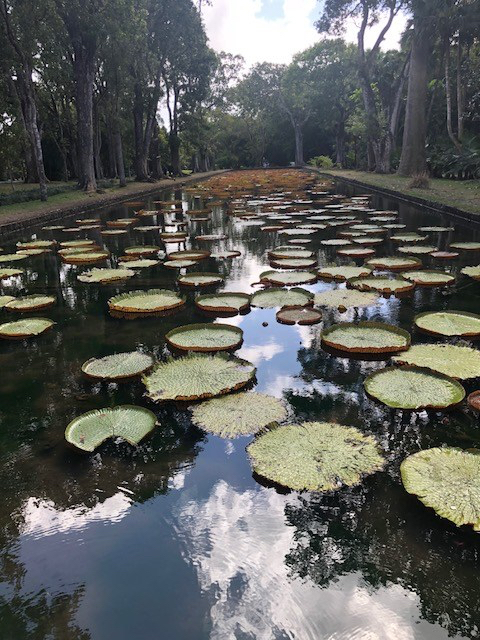
BDB307A0-742C-4A7E-B7E0-18323D154F33As botanic gardens go, the Sir Seewoosagu Ramgoolam Botanic Gardens in Mauritius are not large. 92 acres to Bangalore’s Lal Bagh of 240 acres to put it in perspective (but of course we need to factor in the size of the two countries!).  We don’t need to dwell on the variety of flora, both endemic and exotic, on display there. Nor the few but interesting animals—specifically some deer and some huge tortoises. The only endemic Mauritian mammal, a bat, the Peropus niger, may also be spotted on the trees, it is said.

But it was not all this that really fascinated me. Let me tell you what did.

Little shelters dot the gardens. At the shelter overlooking the beautiful lily pond was2C9A861B-73C8-4075-9652-6A6A1E1591B9 a table. And on the table was a register. I sneaked a peak into the register. And this is what I saw: Several entries each day on the condition of the pond, the leaves, the flowers; the birds and insects seen. And a sketch of the pond, done at the same time every day, showing where flowers had bloomed and where there were buds. And it was not only the lily pond. There was a similar register at the lotus pond, and some other spots in the garden. As I flipped the pages, I could see that no day was missed, no entry casual

What seriousness of purpose and systematic application, to a job that may seem not to have any particular outcome. But the person behind the system and the people implementing it obviously know the importance.  After all, scientific method consists of : ‘systematic observation, measurement, and experiment, and the formulation, testing, and modification of hypotheses.

The Botanic Garden in Mauritius is definitely doing its part! It is obvious that they know the value of keeping systematic notes and data. It may seem trivial, but who knows what it may lead to? After all, research is one of the stated objectives of Botanic Gardens, Zoos, Aquaria and all such facilities do. And keeping such meticulous notes may be the single most important contribution they can make.

Are we in India at all using such opportunities? I am not sure!

An excerpt from Darwin’s Beagle Notebooks. He observed and noted down everything around him—flora, fauna, geology, weather conditions, animal behaviour. And at the end of the day, changed human understanding of the world! Without his notes, he may not have reached his conclusions!

Extraordinary numbers of Turpin —

 drinking bury head above eyes — Will drink when a person is within 2 yards of them about 10 gulps in minute.

Noise during cohabitation.

Eggs covered by sand soil from 4 to 5 in number — require a long time before they are hatched.

Eat Cacti in the dry Islands

Yellow Iguana1 intestine full of Guyavitas & some large leaves

All morning descended highest Crater — Glassy Feldspar — red glossy scoriæ:

Iguana1 — shakes head vertically;, hind legs stretched out walks very slowly — sleeps — closes eyes — Eats much Cactus:

run walking from two other carrying it in mouth — Eats very deliberately, without chewing — Small Finc[h] picking from same piece after alights on back —

In the Tent generally 85-80˚ —

Trade wind & sun 77˚ or 78 —

On Rock out of wind 108˚ — —

http://darwin-online.org.uk/content/frameset?

A Seven Point Something Guide to Coping with the Big C

My friend Anita, who told her story in BRAVELY BATTLING THE BIG C had many people reach out to her after they read the blog, to tell her how much it had helped them. Hence she decided to share a few things which might help them further. Here goes…

–Meena

1.Do not panic. Take action as swiftly as possible. Time is of the essence. Once you have got the diagnosis, there is no time to be wasted. It is a disease which anyway presents itself very slowly and sometimes not very typically. That is why many a times, it is not diagnosed until last.  So don’t waste even a moment once you know.

2.Choose your oncologist with care. This is extremely important as you are going to stay with this doctor for a very long time, at least 4-5 months for sure! So it becomes imperative that you have a good rapport with your him/her. Believe me, that’s half the battle won ! Once you have taken the decision, have firm faith in your doctors.

3.Solicit help of your near and dear ones. It is hard to accept the situation any which way. But to face it alone without the support of your loved ones makes it that much harder. You need a lot of emotional strength during this period and there is nothing like having your dear ones encouraging you, looking after you, supporting you.

4.Take care of your nutrition and exercise. Surgery, chemotherapy, radiation..all of this take a heavy toll on our body. The only way to throw out the toxins is to have good nutrition. Healthy fresh food during the entire period of treatment is an absolute must. This helps guard against secondary infections which can delay the treatment. So it is important to take good care of food. No eating out during this time should be the mantra. And of course, exercise is a must. I know the energy levels are depleted beyond imagination but half an hour of brisk walking is essential…if only to remind ourselves that we can walk! The hormonal treatment adds quickly to body weight. And don’t forget the chemo dose you get is directly related to your body weight. So why not reduce some weight and save money too, besides feeling fitter!

5.Cry buckets behind closed doors but put up a brave front when you face people. Crying is inevitable when you have such a big disease to tackle. The chemotherapy and its side effects only make it worse. You tend to become emotionally unstable and cry for no apparent reason all the time. It’s okay, cry it out. But wipe your tears when you are with people. For you get courage when you show courage..you don’t know how strong you are till being strong is the only option.

6.A s in pregnancy, with cancer too there are many old wives tales .People will tell you it’s your karma and blah blah. Or of some miracle cure. Do not listen to other people’s stories. You need only positive inputs and positive attitude. Surround yourself with people who can make you laugh and make the situation lighter. Concerted efforts of scientists are focused on understanding the disease and cure, and it is unlikely that some diet or herb or cure is likely to be the answer ! Listen only to your Doctors.

7. Have faith in yourself and modern medicine to combat the disease. Your happiness and wellness depend only on you. If you bravely, resolutely fight it out ,the disease will soon be on its way out! Just treat this as another challenge in your life which has to be dealt with and vanquished, and so it will be!!!


The Dodo and The Myna

The Dodo is the textbook example of man’s role in driving other species to extinction. This defenceless bird was hunted and harried to disappearance through the appearance of humans on the uninhabited island of what is now called Mauritius. Sailors on the high seas—the Arabs, the Portuguese and then the Dutch, discovered and re-discovered the pristine isle. For dodos, the beginning of the end was in 1598 when the Dutch discovered them on the island. Dodos were flightless birds, and also fearless because they had never encountered predators. So when humans appeared with their guns and weapons, they had no clue how to protect themselves. Moreover, humans brought along dogs, cats, pigs, rats—all which hunted the birds and raided their nests. Till there were none left.

8887BB0D-6F92-4CD0-AE58-EDF689F6A0AA

But if this is a story of man’s role in the loss of a species, what follows is an equally sorry tale of havoc cause by man’s deliberate introduction of a species into an alien eco-system. And on the very same island of Mauritius!

Sugarcane did and continues to play a key role in the economy of Mauritius. The sugarcane crop in Mauritius was beset by grasshoppers, which ate the leaves. In the 1780s, the French deliberately introduced mynas to the island to help control these. To a certain extent they did, but soon enough the mynas figured out the local lizards were easier to catch than the grasshoppers, and so made the lizards the mainstay of their diet. One consequence of this was that the insects that the lizards fed on multiplied, as they now had no predators! And even more seriously perhaps, the mynas themselves became pests to native species. Mynas are by nature aggressive and raid nests for eggs and newly hatched chicks. They compete with native birds for nesting sites. In Mauritius, they have been known to compete with an endemic species, the endangered Echo Parakeet, for nesting spaces.

Island ecosystems are very special. Human interventions can have disastrous results. To quote the IUCN Island Ecosystem Specialist Group:

‘Earth is home to over 100,000 islands, which support 20% of global biodiversity. The characteristics of size, shape and degree of isolation make many of these islands ecologically and culturally unique.

However, these same characteristics also make islands fragile and vulnerable ecosystems. Islands have the highest proportion of recorded species extinctions. Eighty percent of known species extinctions have occurred on islands and currently 45 percent of IUCN Red List endangered species occur on islands.’

Mauritius and all islands are beautiful and special! Let’s hope that we humans can preserve what makes them special, and leave the generations to follow this precious legacy.

An interesting aside:  A Mughal-time painting found in St. Petersburg  shows a dodo along with several Indian birds. The painting is believed to be from the 17th century and is attributed to the artist Ustad Mansur. The bird depicted probably lived in Emperor Jahangir’s zoo in Surat!

–Meena

Bravely Battling the Big C

I requested my friend who has resolutely conquered her cancer to share her experiences, and she generously agreed, though it was not easy for her to re-visit this part of her life. And what I realized is that you need 4Cs to battle the Big C: Courage of the person concerned, Caring Family, Compassionate Doctor and a network of Concerned Friends.

I share her story in first person and have the conviction that she has left it behind forever.

–Meena

It’s hard to go down memory lane to the fateful day when I got to know that I had the dreaded C disease. It was so hard to accept that diagnosis and to be able to actually say the word: CANCER!

A17DE18F-B261-4714-B3C5-D772E24CF012

‘Oh my God ! it can’t be happening to me…’ was obviously the first thought.

It took Dr Sarin less than five minutes and a physical examination to deliver the verdict which sealed my fate. But the journey to get to this point was not an easy one. I had been going from pillar to post, from doctor to doctor to doctor in my country of residence for a full year, and nobody so much as even suspected anything this drastic. I used to repeatedly get a ulcer on my left nipple which was not amenable to any treatment –I tried allopathy, homeopathy, ayurveda…you name it! I visited all streams of experts…GP, Dermatologist, Gynaecologist. Finally, as luck would have it, I came across a surgeon who suggested a biopsy, and on getting the result, he suspected something and asked me to go to India immediately.

A friend of mine had taken me for this biopsy. She immediately got into action and contacted her cousin in Delhi who knew a thing or two about doctors there. Though I have my whole family in Delhi and I belong to Delhi, here was a friend in this alien country who helped me to not only find an ACE DOCTOR, but took the pains to ensure I got to see the doctor—from arranging the appointment to everything.. all without my knowledge. She contacted my sisters and gave them the doctor’s contacts and my appointment time.

So Jan 23, 2017..can I ever forget this date !! I met Dr Sarin with 10 of my family members. There were tears and tears and tears all around as Dr Sarin gave her verdict. But I have to say, if ever there was an angel in a doctor’s guise, it was Dr Sarin. She tried to soften the blow as much as possible. Convinced my family that this was the easiest cancer to handle and that it was completely curable. We latched on to every single word she uttered and put our complete faith on her.

My Paget’s disease needed to be dealt with immediately. Straight on, we dived into a whirlpool of tests and more tests! Mercifully Jan 26th was a National holiday, so I got some respite to catch my breath! My surgery was planned for Jan 27th morning. God was surely holding my hand! I say so because I didn’t get time to think about what had hit me, everything was moving so fast (and trust me that’s the best way to go about it!). On Friday morning, I went into the OT. I was constantly praying to my Sai to hold my hand through this ordeal even as I saw doctors and nurses preparing for the operation. Dr Sarin came to me in the pre-surgery room, talked to me and gave me courage. There I saw my Sai Baba on her locket and suddenly I felt that He would work through Dr.Sarin’s hands and cut away my cancer. I was ready for the surgery. Everything went off well ..I was sent home the next day.

While all looked well, the tissues were sent for a detailed exam. On the third day when I went back for check-up, I was shocked to learn that a gene mutation had been found and I needed hormone therapy (Herceptin) for a year to completely take care of my problem. BUT to give that, they had to give me 6 cycles of chemotherapy. OMG! Once again I was in Dr Sarin’s room flooding it with tears. I could not handle the thought of chemotherapy. Apart from everything else, I could not accept the thought of losing hair and becoming bald. And also the fact that I would have to stay back for 4 1/2 months at least, to finish six rounds of the three-weekly chemo sessions.

Then started the second phase of my treatment journey. We had left Delhi about 10 years before this incident. I have two sisters and a brother-in-law living in Delhi and a hoard of school and college friends whom I had been close to. By God’s grace they all came forward and were there for me. They were like my suraksha chakra. I can never thank them enough or do anything to repay their love and support and courage which helped me go through this trial.

For after this, it was never-ending trips to Apollo every Monday and Thursday. I decided to look upon these as my outings! Remember in chemo we have to be confined to a room in the most sanitized atmosphere possible ! Oh God ! how seriously we took it..my US-based sons would send us Dettol wipes in huge dibbas and Chlorex to clean the floor. My husband was quite depressed through it all…he felt sad and guilty as he could not be there with me. But he had a job to keep and cancer is an expensive affair !

My sons would put a positive spin on everything. They’d say ‘Mummy, when will you ever get so much attention in your life? Just take it in your stride and go through it bravely. We have to come out a champ from this ordeal. Sai Baba is with you, providing all support. You have to do your bit by hanging in there.’

And that was true. I had the best doctors treating me. Dr Sarin is nothing less than God for me. Her healing touch was enough to lift my spirits every time I met her. With every passing chemo, she would say, ‘chalo one more done, ab to katam hone wala hai…’, and I would feel happy that we were crawling towards the end, slowly but surely. May God give her long, blessed life! My medical oncologist Dr Manish Singhal, took care of all the side effects so beautifully that I had minimum discomfort (that the minimum is also difficult to handle is another matter!).

Then again, the hardest part was to lose my hair…however much you may be prepare for it, it does make you cry!!!! I lost mine after the second chemo, but again my children had already sent me wigs, so I didn’t have to move around bald. Dr Sarin, Pooja, Dr Parag and my whole family would always pull down my scarf and urge me to have the confidence to move around like that!

I had my whole family rallying around me. My nutrition was being well taken care of..Nariyal pani first thing in the morning, healthy palak parantha for breakfast, anar mid morning etc etc. The whole meal plan was  ‘cooked fresh, fresh, fresh’.

All in all my sisters were a great source of strength for me during my difficult period.The two who were in Delhi physically present with me through it all and with whom I took turns to stay with for months on end and my sister from afar praying for me and cheering me up always!

My sister from Dubai too gave me immense strength through it all.As soon as she heard about my diagnosis,she took the next flight and was by my side for the surgery. Then all through my chemotherapy days she kept sending me beautiful scarves and prayer threads and what have you! Twice more she flew down to spend time with me.She is an excellent cook n as we know during chemo the taste buds really go for a toss .She would prepare yakhni and other delicious stuff that would appeal to my palett.It was a delight to have her around whenever she could make it ! Its because of her prayers and best wishes that I stand strong today !

I used to sleep a lot, something that came naturally to me after every chemo. In each cycle, in the first week, I only slept.  The second week onwards, felt a bit stronger. The third week was the golden week when was all ok. My relatives made a ritual of entertaining me on the day before the next chemo. In the safe period, we would go out for a movie followed by dinner. So in this way, I saw six movies and ate in six plush restaurants to mark my six chemos. Perks of being a patient!!

I felt God all around me, as if He had sent these people to lovingly look after me, and all I had to do was to be a little brave and keep my eye on the light at the end of the tunnel.  I thanked God a million times every day for giving me these people to help me through my most difficult times.

I tried my best not to let myself be dragged down by negative thoughts. I used to always go to the temple on the Apollo premises before going in for chemo. It gave me immense strength. A quirky habit I developed was that I wanted a room facing the temple only. That had become my good omen. After two chemos, they knew i wouldn’t take a room on the other side!

After the six chemos were over, I was finally given the go ahead to go back to my home and country to continue with Herceptin for the rest of the year, and then come back for a check-up. In Feb 2018, my last Herceptin was administered. I flew to India end of March and got my check-up done by Dr Manish Singhal, Dr Parag and my dearest Dr Ramesh Sarin, and got the ALL CLEAR signal.

The relief in my heart is difficult to express in words. When Dr Sarin told me I could have my chemo port removed, I was as unbelieving as I was the day I was told that I needed one!

Thank you, Apollo Hospital!

I love my doctors and I love my family and friends, who with the grace of God, brought me to this day where I have left cancer behind….hopefully forever!


Travel PANIC…..

I regret planning a holiday before I leave. And once I am ‘there’ I don’t want to think of home!

So here is a list of things I panic about:

  1. Packing: Have I enough clothes? Have I too many clothes? Have I the right clothes? How do I fit in the walking shoes and the formal shoes and the chappals? Is it going to rain? Do I need an umbrella? Is it going to be cold? Do I have enough woollies? Do I really need them? What medicines should I take? Did I pack my chargers? Am I going to read two books or three? Are the books too heavy?EB301699-D567-4B7B-A138-124C3458A90C
  2. Money: Do I have enough? Do I need all these credit cards? Have I got them safe yet handy? Am I going to lose my money? Are my cards going to get pinched? What is the exchange rate? Shall I change money at the airport or the city? What if I don’t change at the airport and don’t find an exchange easily? Am I going to get gypped?
  3. Documents: Did I put in all the papers I need? Do I have all the hotel contacts, the visa documents, the whatever, the whatever? Have I got copies of all of them? What if I lose them?
  4. Connectivity: Will my phone work? Are the charges going to kill me? Will I be able to regularly access email?

And of course..

  1. Work: Did I forget to do something important? Is what I sent the Boss OK, or is he/she going to want some changes? If so, how will it get done? Is there going to be a crisis just in this one week? Are the skies going to fall?
  2. Home: What about thieves and burglars and break-ins? Do all those wicked people know I am away? Are they watching for a chance? Are they planning for a break-in?

And the most predominant one in my life currently…

  1. Older people: Is my mother going to be OK when I am away? Even if she doesn’t fall ill, is she going to panic herself sick because I am away? What if the doctor doesn’t respond promptly? Does she have all her medicines? Does she have all contact numbers??

But the learning for life, which I have to remind myself about before every trip…..

Crises do break out, but they get managed somehow.

Wallets do get whacked, but there is not much one can do.

We do over-pack and under-pack, but never learn to do better next time.

And we do live to travel another day.

So no point worrying, just go!

–Meena

Yes, you got it right. Just got back from a holiday!

The Train Reached the Station….

And all I could see was fire and smoke! Everything outside seemed to be burning. I could hear cries of ‘Allah ho akbar’ and ‘Hey Ram’. There was not a soul on the platform. We and the other newly married couple from our bogey got down. We didn’t know what to do—we just stood there for a few minutes, with all our luggage. I was holding the ‘chumbu’ that had not fitted into any trunk. My veena, wrapped in old sarees, lay at my feet.  I had no clue what was going on. My husband looked worried, but I did not know what he was worried about. We had thought that athimber (my husband’s sister’s husband) would come to the station to take us home. We had heard that there was some trouble in Delhi, and thought that surely he would have arranged for transport. But there was no one there.

Then a porter appeared. He came to my husband and they started speaking in Hindi. I could only understand a few words of Hindi at that time, so I don’t know what they said.

After a lot of discussion, the porter hurried away and returned with a cart of some kind. We loaded all our luggage onto this. But the veena would not fit in—the neck stuck out. So my husband picked it up. I was still carrying the chumbu.

My husband only said ‘Walk fast. Don’t make a noise’.

I could not understand where we were going. We got down from the sloping end of the platform and crossed some tracks and kept walking along the tracks. They were going so fast, I was finding it difficult. I was hungry—the GT was supposed to have reached at 5 o’clock in the morning, but it had reached at 5 o’clock in the evening.

As we walked along, there were houses on the sides. They all looked the same. It was some colony. We saw not a soul on the way. I could not make out whether anyone lived in the colony or they were all empty houses.

It was difficult to manage all the luggage in the cart as we walked over the uneven ground. There were trunks with clothes. Two holdalls. My mother had tied up vessels and kitchen items in old sarees. Then there were tins with different types of sweets and savories. My father had bought a blue glass jar from his lab supplier because I loved them. My mother had filled it with mixture ordered from the hostel. She told me I could use the bottle later to store something in the kitchen. Suddenly the blue jar fell down and broke. Tears came to my eyes, but I did not dare cry. We just kept walking on.

After about half an hour of walking, the porter stopped the cart near one of the houses. He went to the door and knocked softly. Someone looked out of the window. On seeing the porter, he came to the door and opened it slightly. He was dressed like a watchman.

They whispered to each other. Then the porter signaled to us to take the luggage into the house. The house was full of piles of luggage.  The watchman shifted a few pieces here and there and made some space for our luggage. We brought in the pieces one by one and put them there.

I asked my husband in Tamil: ‘Are we going to leave the luggage here? All the silver vessels are here. How can we leave them?’ My heart was sinking. My mother had bought two large oval plates and two tumblers specially for my coming to my husband’s house for the first time.

He just hissed at me to keep quiet. He took the porter and watchman to a corner, said something to them and gave them lot of money. We walked out.  The veena was in my husband’s hands—it was too big and odd shaped—we could not put it in the room. And for some reason, I was still carrying the chumbu.

When we had walked a few minutes, I saw a huge railway water spout gushing water. I ran to it. Only when I started drinking did I realize how hungry and thirsty I was. I drank and drank. Then we walked on. We had now left behind the colony and were in the city. My husband told me there was a curfew on but it was relaxed for an hour and so we had to hurry and reach home. But I didn’t know what a curfew was.  We walked quietly along the side of the lanes.

And then the horror! A man came running from one direction. There was another man chasing him. He caught up with him, and in front of our eyes, he drove a knife into the first man. Blood spurted out. I was going to scream, but my husband clamped his hand on my mouth. The killer pulled the body and threw it into the gutter on the side of the road and ran away. He had not noticed us.

I asked my husband why that man had killed the other one, what was happening? But he just gestured to me to keep quiet and walked on.

By the time we reached home, it was dark. It was not our house, my husband told me. ‘This is Tagore Road. My sister’s house. Our house is in Lodhi Road—too far away.’

We went in. Our brother-in-law was there and 2 other families who were sheltering there because their own areas were not safe. My sister-in-law and mother-in-law had gone to our house in Lodhi Road to get the house ready for us, but had got stuck there.

The ladies welcomed us and did aarti. One of them said ‘Are you hungry? There is some arisi upma we made in the morning. You can have that’. Never had food tasted so good. But there was not much. Even as we were eating this, the ladies started cooking dinner. There was a murungakka tree in the garden. So they made murungakka sambhar and rice. This was the menu for the next three days, both for lunch and for dinner.

In the night, all the ladies slept in one room. We each would keep a cloth with red chili powder in it, and a heavy stone (ammi) or something like that next to our pillows. The ladies told me that if anyone should come into the house, I should throw the chili powder in their eyes. The men would go out in groups and do rounds of the colony. They had piled up stones and reapers across the lane entrance.

I was fifteen years old at that time. The year was 1947.

–Meena

This is the true story of the day my athai (father’s sister) landed in Delhi as a new bride, in the midst of the Partition.