World Disability Day: December 3

The disabled are often called the most ignored minority.

2011 Census reports indicate that there are about 2.68 crore disabled people in India–2.21% of the population. But NGOs and others who work in this field feel that this is too conservative an estimate. According to them, the figure is more like 5-8% of the population.  World Bank data suggests the number is between 4 and 8 crore. And this is expected to increase steeply, as age-related disabilities grow and traffic accidents increase.

The most tragic part of this is that many of the disabilities in our country are preventable. A large number of mental and physical disabilities arise from lack of nutrition and proper health care for pregnant mothers and young children. Many irreversible disabilities are linked to poor nutrition of the mother—e.g., anemic conditions. Similarly deficiency of Vit. A in childhood may lead to blindness; deficiency of iodine may lead to mental retardation. Similarly, immunization coverage and disabilities are clearly correlated.

If infants and the very young are vulnerable, so are the old. Over 23% of visual impairment in India is due to cataract—a normal phenomenon associated with aging, and one which is correctable. But thousands in our country live without vision because they cannot access or afford the simple surgery required.

Other statistics which should disturb us: Close to 40% of school age children with disabilities are not in school. If the children do not go to school, they can never hope to be employable. This feeds the poverty-disability cycle.

In India, figures indicate that the number of disabled in employment actually fell between 1991 and 2002! Though there is legislation for 3% reservation in government sector, this is seldom fulfilled. And how can it ever be, if the disabled don’t get an education? If public transport and offices are not accessible to the disabled? If our own attitudes prevent us from employing the disabled?

On paper we have laws and policies for inclusivity in education, for reservation in jobs, for access to public spaces, etc., etc. But on the ground, there is little happening. The first barrier is in our minds—if we can truly accept that there are no ‘disabilities’, only ‘different abilities’, we may be able to see our way to building a more inclusive society. Just as I can’t sing, there are some who cannot speak! Just as I can’t dance, there are some who cannot walk! I don’t think of myself as any the less because of these lacks. Why then should I think of people who cannot speak or walk as different?

We need to translate attitude to action: Check if your child’s school has a policy for inclusive education, and if there are indeed differently-abled children. If not, gently bring it up in the next PTA meeting. Encourage your ward’s school or college to have traffic education sessions. Ensure that your own ward does not break traffic rules. Check your organization’s employment policy to see if there is anything about employing differently-abled people. If not, lobby for it! Spread the message for proper nutrition and immunization for pregnant women and young mothers. Support cataract operations through service organizations. Write to the managers of public spaces if they do not provide disability access.

Each of us may take a different route. But go on, make a resolve to make small difference on the 3rd of December!

–Meena

It’s Getting Hot, Hot, Hot!

Chilies have been on my mind since my visit to the Agriculture Mela last week, where this picture was taken by my friend. And then, another friend who went trekking to the Northeast brought me back the super-hot special chilies from there. The blog today is more an excuse to share the picture, than anything else! But now that we are on the topic, here goes:

Untitled

The chili is the fruit of a plant belonging to the genus capsicum of the family Solanaceae. Capsicum is aptly derived from the Greek word ‘Kapsimo’ meaning ‘to bite’. The plant originated in South America, probably in Peru, and was domesticated as early as 5000 B.C. Christopher Columbus carried chili seeds from South America to Spain in 1493, and from there they have spread across the world. They were introduced in South Asia in the late 15th/ early 16th century by the Portuguese, and today we cannot imagine any of our cuisines without them (except maybe Kerala!).

When we talk of the heat of chilies, a reference to the pungency is natural. But how is pungency measured? The Scoville scale is a measure of the pungency (spiciness/heat) of   spicy foods, as recorded in Scoville Heat Units (SHU). This is based on the concentration of capsaicin,  the alkaloid responsible for the ‘heat’.  The scale is named after its creator, American pharmacist Wilbur Scoville, whose 1912 method is known as the Scoville organoleptic test. Originally, the SHU rating was given based on this test, which got people to taste and rate. But obviously, this was quite subjective. Today, liquid chromatography is used. The unit of measurement remains SHU.

The hottest chili in the world is the Trinidad Moruga Scorpion from Trinidad and Tobago. This pepper is rated at a 2,009,231 SHU.

India’s hottest, and World Number Four, is the Bhut Jolokia (Ghost Pepper) from Nagaland. On the Scoville scale, this measures a whopping 1,041,427 SHU.

Some other special chilies of India:

Kashmiri Chili: Known more for its colour than its spice.

Guntur Chili: The Guntur Sannam S4 is the chili responsible for the spiciness of the famously spicy Andhra cuisine.

Birs’ Eye Chili Dhani: Grown in the Northeast, this tiny chili packs a very spicy punch.

Kanthari Chili: These chilies grow in Kerala and become white when mature.

Mundu Chili: Grown in Tamilnadu and Andhra, they are small and round, with a thin skin. The are not too spicy, but have a unique flavour.

Jwala Chili: Grown primarily in Gujarat.

Byadagi Chili: This chili grown in Karnataka are long and have a thin skin. When dried, they have a crinkly appearance.

Maybe next time you are at a restaurant and want to sound very well-informed, you can ask the waiter what the SHU level of a dish is!

–Meena

PS: Thanks Anu, for the pic, and Sudha for the chilies.


Festival of Farming

20181117_120113_resizedThe annual Krishi Mela is an event Bangaloreans look forward to. Organized in November every year, the 3-day Mela showcases the latest in agriculture and livestock related developments—from technologies, to equipment and tools, to new varieties of seeds, to green farming.

First a word about the Gandhi Krishi Vignana Kendra (GKVK), the venue of the mela. This amazing 1300+ acre campus has a hoary history. More than a century ago in 1899, Her Excellency Maharani Vani Vilasa, Regent of Mysore donated 30 acres of land for an Experimental Agricultural Station at Hebbal, which initiated research projects related to agriculture. In 1963, the Government of Mysore decided to establish University of Agricultural Sciences (UAS) along the lines of Land Grant College system of USA and passed the University of Agricultural Sciences Bill. It granted 1300 acres to the GKVK Campus.

UAS was inaugurated by Dr Zakir Hussain, then Vice President of India, on 21st Aug 1964. Speaking at the event, he set the institute a lofty mandate: “By bringing about significant improvement in every phase of rural life, by much needed change in methods of production, by influencing the whole outlook of the rural community and rural home, by giving them a new vision and new hope, this university will be able to make great contribution to national welfare”.

The Krishi Mela sees visitation in the lakhs—from farmers to students to urbanites interested in agriculture, it is a joyous (though somewhat hot and tiring) occasion.

For farmers, it is an opportunity to see the latest advancements in the field of agriculture; to interact with agro-business companies and see demonstrations of agricultural implements; to get advice from university researchers on best methods of farming for a particular crop; and be exposed to practices like biological control of insects, organic farming in polyhouses, setting up biogas plants and extracting biodiesel.

For a layperson like me, it is an occasion to buy seeds and gardening implements; get some advice on how to look after plants; get to know something about the complexities of farming; marvel at things like a 70 kg bunch of bananas and a magnificent Gir bull; and gawk at sights like a drone which can be used for spraying pesticides. Also to partake of a traditional lunch (Menu: ragi muddu, palya, rice-rasam, curd-rice and a sweet) at Rs.50!

For me, the best thing about bringing such a mela into the heart of a city like Bangalore is the value it has as a reminder to us of who feeds us, and the challenges they face to do so!

Waste not…..

RecycleEarth_mediumNot many years ago, people returning from the US or England would relate shocking stories of how people there threw away everything—from TVs to beautiful containers to cars to old clothes. And we used to pride ourselves that in India, we re-cycled and re-used everything. Horlicks bottles were used to store pickles or dals. Bournvita tins became containers for masala powders. Bed sheets became pillow covers, which became shopping bags.

But now, ‘we’ are ‘them’!

Have you looked into your garbage bin recently? Have you noted how quickly it fills up? With changing lifestyles, we are buying more and more, and throwing away more and more. Today, In metro cities in India, an individual produces an average of 0.8 kg/ waste/ person daily.

India produces about 65 m tonnes of urban waste annually, out of which 5.6m tonnes consist of plastic waste, 0.17m constitute of biomedical waste, 7.90m tonnes constitute hazardous waste while 15 lakh ton is e-waste.

You may not want to do the exercise of researching the contents of your dustbin, so here are some facts. On the average, garbage is made up of 35% organic material, 30% paper, 12% construction related wastes, 9% plastics, 6% glass, 3% metal, and then miscellaneous.

The problem with garbage is that though you may throw it ‘away’, there is really no ‘away’! It is out of your house, but on the street. It is off the street but in a dumper. It is out of the dumper, but in a landfill. And at each stage, there are problems.

Just to understand what the problem is, just looks at the facts and figures below.

  • Banana peel – 3 to 4 weeks
  • Paper bag — 1 month
  • Cotton rag — 5 months
  • Wool sock — 1 year
  • Cigarette butt — 2 to 5 years
  • Leather shoe — 40 to 50 years
  • Rubber sole (of the shoe) — 50 to 80 years
  • Aluminum can (soft drink can) — 200 to 500 years
  • Plastic jug — 1 million years
  • Styrofoam cup – unknown–forever?
  • glass bottle – unknown–forever?

So what can we do as individuals? The mantra is ‘Reduce, re-use, recycle’.

REDUCE

Don’t create waste in the first place! Buy only what you need. Use all that you buy. Avoid heavily packaged products. Avoid disposable items like paper plates and plastic spoons. Buy the largest size package for those items that you use often.

REUSE

Reuse items – use them over and over until they are completely worn out. Borrow or share items you don’t use very often. Donate unwanted items. Repair items, instead of throwing away and buying new. Refill bottles. Plastic bags can be used for many times over. Use your imagination, not the trash can!

RECYCLE

Recycle means taking something old and making it into something new. Old newspapers, plastic bottles, glass bottles and jars, aluminum and steel cans can all be recycled. Sell these to the ‘kabadi wallah’.  Not only does it keep items out of the landfill, recycling conserves natural resources. For example, making newspaper out of old newspaper saves a valuable natural resource – trees.

And compost, compost, compost!

Think about it and see if you want to make these your New Year Resolutions!

–Meena

A Crusader for Women’s Health

Ashoka Fellow Indu Capoor is Founder-Director of Centre for Health, Education, Training and Nutrition Awareness (CHETNA), based in Ahmedabad, India, an organization she started when she was just 23 years old. This was in the early 1980s when the young nutritionist had a vision of an India where the health and nutrition of marginalised women and children mattered. So when she was asked by a multilateral funding agency to write a proposal, she wrote a note going well beyond a project. She proposed an institution that would work as a bridge between policy and practice. And CHETNA, or Centre for Health, Education, Training and Nutrition Awareness, was born. Chetna means awareness in Hindi.

Ms-Indu-Capoor-1

Indu is an old friend and a senior colleague. Yesterday, I met up with her for an hour and we chatted about many things, including the subject closest to her heart—woman and child health. Here is the interview.

Me: Indu, you have been in this field for over 3 decades. What still remains the major challenge to women and child health.

Indu: Women’s self-esteem, self-confidence and agency. Somehow you can link everything back to these. Poverty is of course a major issue, but social practices and beliefs are as significant.

For instance, take anaemia. About 50% women in India are anaemic and this is the major cause of underweight children being born, and other childhood problems. There is a lot of focus on child health, but I think we have to focus on the root cause—the health of the mother. If we fix that effectively, the problem is solved. But it is still true that women do not get enough food, or enough nutrition. Their food is not a priority. A young girl, at her in-laws place, has no say on what she eats. During pregnancy, it is important that a woman eats to her liking. But is that really possible? And the women themselves believe that they are the last priority.

I can never get over the fact that at my wedding, one of the vows I was supposed to take was that I would first ensure that my husband, children and guests were fed before I ate! I obviously refused to take the vow. But this is how deeply it is ingrained. We have to socialize boys and girls to understand that nutrition of young girls is extremely important.

Me: Have you seen any positive changes?

Indu: Yes, I do see changes in women’s confidence, mobility, decision making space etc. in urban areas, and the borderline poor. But not in the really poor.

In fact, ‘livelihood development’ and outside work sometimes adversely affect these women because their work burden increases hugely. No one else in the house shares domestic work, and in addition, she has to go out and work. This has implications for her health and well-being.

Me: This is worrying. Any other such concern areas?

Indu: Yes. Spiralling food prices, pollution, market forces, cost of medicines, loss of food diversity, all of these have huge implications for nutrition in general and women’s nutrition and health in particular.

Me: What is one critical action which can help in this situation?

Indu: I think we must consider each and every policy from a gender angle. We must ask: ‘how will this affect the health and well-being of women, especially marginalized and poor women’? And only then can we finalize the policy.

–Meena

For more: Read ‘A Shared Destiny: My Journey with CHETNA’ published by Academic Foundation is about Indu’s journey in of 3+ decades in the field of woman and child health.

Speaking of Statues

Towering statues are the flavour of the month, so it seems appropriate to talk of statues to one of India’s towering personalities. I am not sure if there is (or it is even possible to have), a census of statues that so generously dot India’s landscape. But if there were to be one, my feeling is that the place for top numbers would be close-run thing between Gandhiji and Dr. Ambedkar. In fact, the latter may win. (One cannot say if the position will be held for long though, because if we were to include gods, it seems to me, the number of Hanuman statues may soon overtake that of any human!)

But coming back to the topic. Dr B.R. Ambedkar, the tall leader who probably did more to change the social landscape of India than anyone else, is commemorated with statues across India—big ones, small ones; proportionate ones, ones completely out of proportion; well-made ones, not so well-made ones. But three common threads across almost all of them: (1) They are most often blue in colour, (2) Dr. Ambedkar is always be shown wearing a suit, and (3) they will depict Dr. Ambedkar in one of two poses.

C490A0A5-78DD-4848-B1F2-3F75396EF192

Intrigued, I did a little surfing and found (mainly from journalistic sources), some interesting information:

Why Blue?

Dr. Ambedkar started a party known as Scheduled Caste Federation (whose name was later changed to Republican Party of India). The colour of the party was blue — Royal blue to be more specific. It is said that he choose blue as the Dalit colour, to set it apart from all other parties. With this strong association of the colour blue with Dr. Ambedkar, his clothes are always shown as blue (it seems even in real life, for the last 20-30 years of his life, he most often wore blue).

Why a Suit?

Dr. Ambedkar was a symbol of struggle and success of Dalits. His status as a teacher and his rise to the high level of Chairman of the Constitution Drafting Committee were unimaginable in those days and were empowering beyond measure. And Western clothing–the suit–was a part of this re-imagining of the possibilities. His wearing a suit had a huge impact on the marginalized and oppressed, a matter of pride. And hence, he is always shown wearing one in his statues.

The Poses

Sculptor Vinay Wagle explains in a magazine article (Outlook) that there are two main poses of Ambedkar statues: (1) the ‘lecture’ pose, wherein left hand is behind and the right hand raised with the finger pointing forward. This is supposed to symbolize his teacher status. (2) the ‘Parliament’ pose, where he has a book in his left hand, and his right hand is raised, symbolizing his position as the Father of our Constitution.

He was not only a lawyer, but he had Ph.D from Columbia University and another one from the London School of Economics. As well as two honorary one! He was Principal of the Govt. Law College Bombay and Chairman of the Governing Board of Ramjas College University of Delhi. Justifiable indeed, the ‘lecturer pose’!
He was called to the Bar at Gray’s Inn, was India’s first Law Minister and chaired the Constitution Drafting Committee. The Constitution drafted under his leadership has been called ‘first and foremost a social document’. ‘ The majority of India’s constitutional provisions are either directly aimed at furthering the aim of social revolution or attempt to foster this revolution by establishing conditions necessary for its achievement. Justifiable indeed, the ‘Parliament pose’!

Recently I have seen a huge, very well crafted statue of Dr. Ambedkar, sitting in a statue-making yard. But it is golden! My friends tell me they are also seeing more of these. They do look better than many a blue one, but I cannot help wondering about the spirit!

–Meena

Stitch and Rip

I am clumsy and so often put rips and tears on my clothes, and break my buttons. I only have to look at food and I put on weight. Between these two tendencies, I need to stitch up tears, and let out clothes.

So the two most important ‘simple machines’ in my life are the Needle Threader and Stitch Ripper. Simple, but oh, what amazing inventions. For those who don’t know what these are, here is a brief.  And even if you are young and sharp-eyed and the super sorted-out, do not scoff at these, for the day will come when you need them!

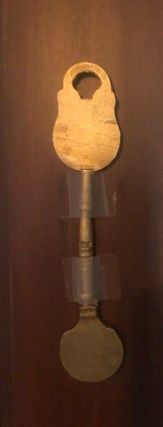
Needle Threader: A needle threader is a small sewing tool designed to help pull a thread through the eye of a sewing needle.

When exactly the first needle threader was invented is unknown, but within the European context it is likely to be an eighteenth or early nineteenth century development. There were various forms of nineteenth century needle threaders. But the one most commonly in use even today is a late nineteenth century form which consists of a small plate (often stamped with a profile image of a woman), with a diamond shaped loop of fine steel wire attached to it. The wire loop is flexible and easily passes through the eye of a needle. The sewing thread is passed through the loop and the loop (with thread) is then pulled back through the needle eye.

A number of needle threading devices were patented in the United States in the early 1900s, including Herman Trzeciak’s model patented in 1924 and Carl J. Schuster’s design in 1945. The first automatic needle threader incorporated into a sewing machine was designed by Juki in 1978.

Seam Ripper: There doesn’t seem to be much agreement on who invented this but there is a patent application by Allie  M. Minter, from Petersburg, Colorado in the US and Canada, in 1903.

Seam rippers are an item designed for breaking or undoing sewn stitches, often on seams. A seam ripper is also known as a ‘stitch unpicker’, ‘quick unpic’ and a ‘quick unpick’. (I call them Stitch Rippers). Typically, seam rippers have two spokes, one sharp and the other blunt, connected by a handle, while the intersection is usually a sharp blade.

I sometimes have nightmares of a gangsta (or a lady older and clumsier than me), holding me up with a gun (or pair of knitting needles), and saying “Your Needle Threader or your Stitch Ripper”. I have thought this horrific scenario through. I will part with the Stitch Ripper. One can substitute a safety pin to do this function (albeit a bit clumsily). But for the Needle Threader, there is no substitute!

–Meena


Hiss Gets Knotty

How Hiss hated his name! Every second snake in his class was called Hiss. Surely, his parents could have been in a little more imaginative!

1AB2ED81-7C33-4870-B4A8-791154B428A3

Now the only thing he could do was to get himself a prefix or suffix to his name. Like his cousin Happy Hiss, who got that name because he was always laughing and joking. Or his friend Speedy Hiss, who got that name because he was the fastest slitherer around! He was very envious of his senior Astro Hiss, who got his name because he knew the names of all the stars and constellations in the sky, and was forever looking through his telescope. And of course of the school captain Hero Hiss, who got his name because he was a whiz at all games and helped the school win every match and tournament.

But our Hiss didn’t have any special characteristics. He was just a normal little snake.

Secretly, Hiss’ ambition was to be called Naughty Hiss. It sounded such fun. But Hiss wasn’t naughty at all. He didn’t sneak into people’s houses just to scare them, like some of his friends. He didn’t hang upside down from trees by his tail as some of his cousins did, just to irritate their mothers. He didn’t participate in ‘curls’ where about 15-20 of his friends would curl themselves into a ball and roll pell-mell down slopes, giving old ladies the hysterics.  He didn’t like to do such things. He was really a very well-behaved and nice snake!

But still in his heart he longed to be called Naughty Hiss!

So he thought and he thought and he thought.

And one day, during his Scout class, when the teacher was teaching them to tie themselves up into knots, an idea struck him!

Why not be called Knotty Hiss? That sounded just like Naughty Hiss!

If he practiced and practiced his knots, he could be the best knotter around, and then he would be called Knotty Hiss!

So he secretly practiced and practiced tying himself up in to different kinds of knots, not just the ones his Scout Master taught him

He practiced his Reef Knot

And the Sheepshank

The Bowline

And the Timberhitch

And of course his favourite Constrictor Knot…after all, he was one!

And when he had practiced and practiced for many a day and many a night….

He was the best!

No one could tie themselves up into knots as quickly as our Hiss could.

And that is how Hiss got Knotty, for everyone started calling him Knotty Hiss.

He couldn’t have been more pleased!!!!

–Meena

My Tribute to Mother India

‘Mother India’ considered one of Bollywood’s classics, was released 61 years ago today (Oct 25). It was India’s first entry for the Oscars.

I saw the film when I was in my twenties, probably on Doordarshan. I remember thinking it was over-dramatic, over-emotional, over-the-top. It just seemed too much–one woman facing one tragedy after the other; struggling every day, every month; everyone out to exploit her. And still holding nobly to her values.

30 years have taught me quite a few lessons. One of them is that there is a Mother India in every street, in every lane.

This was brought home to me poignantly only last week, when I had occasion to spend a lot of time with the lady who takes care of our office. At personal inconvenience, she was going out of her way to help me in my time of need. The time we spent together gave me insights into her life.

Born in a family of agricultural labourers, she dropped out of school at 10, to take care of younger siblings. At 12, she joined her mother in the fields. Her father died of cancer, and things got even worse. She did any work she could get—from labour on construction sites, to digging wells, to everything in between.

At about 17 or 18, she was married off. Her mother was told that the groom was on the verge of getting a permanent government job, and she would live a life of comfort. The husband was semi-handicapped, but more devastating to her, completely lazy and good-for-nothing. As a three-month bride, she started work as a domestic help.

Life went its usual course. A son came along, on whom she pinned all her hopes. The husband worked at casual jobs about 10 days a month. The other 20 days, he lazed around the house. She slaved from 5 a.m. to 6 p.m. every day of the month, at multiple jobs, to put the son through a good school, and he got his polytechnic diploma.

She thought her troubles were almost over. The son, rather than find a job, announced he wanted to get into engineering through lateral entry. She was thrilled—an engineer in the family. She worked harder than ever, as the husband lazed, and the son bought himself a motor cycle and fancy phone in keeping with his status as an engineering student.

One year went by and then tragedy struck. She found that her son, not being able to cope with his studies, had quietly dropped out of college without even telling her; that he was using the money she was giving him for fees and expenses, on feeding his bike with petrol and hanging out with friends.

With the help of relatives, friends, and well-wishers all around, the son has been coaxed, cajoled, threatened and re-admitted into college. Several fingers are crossed. Who knows what he will do?

I have worked with the mother for four years now. It seems impossible to believe, but she has never taken a day off. She is there half an hour before us, and stays half an hour after the last of us leaves, to clean and close up. I have never known her not to smile. I have never known her to take any shortcuts. I have never known her to ask for money. I have never known her to not sympathize and offer a cup of tea if I complain of headache. I have never known her being backward in helping any of us. I have never known her to be less than dignified or gracious.

I have known this Mother India. Look around. I would wager that a woman you meet today will be a Mother India. The sheet anchor of her family and community. Acting with integrity and dignity in every situation. Holding up her bit of the sky with a smile, in the face of every hurdle life throws her way.

I salute the makers of ‘Mother India’. They say art is about capturing universal truths and presenting them in the idiom of the times. And now, when I have seen something of the world, I believe this is so, and that there is nothing over-blown about Mother India.

I salute the Mother India in every woman around me.

–Meena

PS: I lost my mother last week. And I salute her cheerfulness, her courage, her love, her compassion, and the joy she spread around her through her long life.


Making India Safe for Women

Big names tumbling out of the closet and into disgrace and shame. Every morning and every evening, additions to MeToo.

But workplace sexual harassment is only one part of what women in India have to face. The fundamental issue is ‘Is India safe for women?’

And the answer sadly is ‘No’. It is highly unsafe and becoming increasingly so. What we euphemistically used to call ‘eve teasing’ has been with us for ages. My friends from Kerala recall with horror their college days and how afraid they were to walk alone, to even raise their eyes from the ground or stay late in college. In Delhi of course, it gets more physical with groping hands and lewd gestures.

But now, there are horror stories which one has never heard before. For instance, how many incidents of acid throwing are reported every month? And in most cases, it is because the girl has rejected the boy’s advances.

Mind-shattering reports of abuse of children. Why just children, even infants! Of incest and abuse by fathers and uncles and brothers. Were these always there or is something sick in us growing out of control?

Cell phone camera photos and video clips of girls taken with or without their knowledge or consent are another potent tool in the hands of miscreants. In an example of how technology can be misused, these are passed on through MMS or put up on the website. There are instances of young innocent schoolgirls who have been driven to the edge of insanity and suicide, thanks to some boys in their class taking photos and threatening to circulate them, and blackmailing them into all kinds of activities.

And of course, the classic Pre-natal Determination of Sex—scanning to ascertain the sex of a child, and killing the unwanted girl child. Do we need a better example of how India at once lives in several centuries—the atavistic boy child preference aided by high-tech? So what if such scanning is illegal?

The solution then is not to make an example of one rapist, to go after one high profile editor/film-maker/what have you who has tried to take advantage of girls working for him, or to bring in the moral police. Each incident looks like one deviant exception, but taken together, they form a frightening picture of a society where something is seriously wrong. Why is this happening? Where do we begin to set it right? Whose responsibility is it—the education system, the media, parents, the law makers, the law enforcers….? It is time to introspect and face unpleasant truths.

And then go on to act on the truths we discover.

Otherwise India will be unsafe for one half of its people.

–Meena