A Crusader for Women’s Health

Ashoka Fellow Indu Capoor is Founder-Director of Centre for Health, Education, Training and Nutrition Awareness (CHETNA), based in Ahmedabad, India, an organization she started when she was just 23 years old. This was in the early 1980s when the young nutritionist had a vision of an India where the health and nutrition of marginalised women and children mattered. So when she was asked by a multilateral funding agency to write a proposal, she wrote a note going well beyond a project. She proposed an institution that would work as a bridge between policy and practice. And CHETNA, or Centre for Health, Education, Training and Nutrition Awareness, was born. Chetna means awareness in Hindi.

Ms-Indu-Capoor-1

Indu is an old friend and a senior colleague. Yesterday, I met up with her for an hour and we chatted about many things, including the subject closest to her heart—woman and child health. Here is the interview.

Me: Indu, you have been in this field for over 3 decades. What still remains the major challenge to women and child health.

Indu: Women’s self-esteem, self-confidence and agency. Somehow you can link everything back to these. Poverty is of course a major issue, but social practices and beliefs are as significant.

For instance, take anaemia. About 50% women in India are anaemic and this is the major cause of underweight children being born, and other childhood problems. There is a lot of focus on child health, but I think we have to focus on the root cause—the health of the mother. If we fix that effectively, the problem is solved. But it is still true that women do not get enough food, or enough nutrition. Their food is not a priority. A young girl, at her in-laws place, has no say on what she eats. During pregnancy, it is important that a woman eats to her liking. But is that really possible? And the women themselves believe that they are the last priority.

I can never get over the fact that at my wedding, one of the vows I was supposed to take was that I would first ensure that my husband, children and guests were fed before I ate! I obviously refused to take the vow. But this is how deeply it is ingrained. We have to socialize boys and girls to understand that nutrition of young girls is extremely important.

Me: Have you seen any positive changes?

Indu: Yes, I do see changes in women’s confidence, mobility, decision making space etc. in urban areas, and the borderline poor. But not in the really poor.

In fact, ‘livelihood development’ and outside work sometimes adversely affect these women because their work burden increases hugely. No one else in the house shares domestic work, and in addition, she has to go out and work. This has implications for her health and well-being.

Me: This is worrying. Any other such concern areas?

Indu: Yes. Spiralling food prices, pollution, market forces, cost of medicines, loss of food diversity, all of these have huge implications for nutrition in general and women’s nutrition and health in particular.

Me: What is one critical action which can help in this situation?

Indu: I think we must consider each and every policy from a gender angle. We must ask: ‘how will this affect the health and well-being of women, especially marginalized and poor women’? And only then can we finalize the policy.

–Meena

For more: Read ‘A Shared Destiny: My Journey with CHETNA’ published by Academic Foundation is about Indu’s journey in of 3+ decades in the field of woman and child health.

Speaking of Statues

Towering statues are the flavour of the month, so it seems appropriate to talk of statues to one of India’s towering personalities. I am not sure if there is (or it is even possible to have), a census of statues that so generously dot India’s landscape. But if there were to be one, my feeling is that the place for top numbers would be close-run thing between Gandhiji and Dr. Ambedkar. In fact, the latter may win. (One cannot say if the position will be held for long though, because if we were to include gods, it seems to me, the number of Hanuman statues may soon overtake that of any human!)

But coming back to the topic. Dr B.R. Ambedkar, the tall leader who probably did more to change the social landscape of India than anyone else, is commemorated with statues across India—big ones, small ones; proportionate ones, ones completely out of proportion; well-made ones, not so well-made ones. But three common threads across almost all of them: (1) They are most often blue in colour, (2) Dr. Ambedkar is always be shown wearing a suit, and (3) they will depict Dr. Ambedkar in one of two poses.

C490A0A5-78DD-4848-B1F2-3F75396EF192

Intrigued, I did a little surfing and found (mainly from journalistic sources), some interesting information:

Why Blue?

Dr. Ambedkar started a party known as Scheduled Caste Federation (whose name was later changed to Republican Party of India). The colour of the party was blue — Royal blue to be more specific. It is said that he choose blue as the Dalit colour, to set it apart from all other parties. With this strong association of the colour blue with Dr. Ambedkar, his clothes are always shown as blue (it seems even in real life, for the last 20-30 years of his life, he most often wore blue).

Why a Suit?

Dr. Ambedkar was a symbol of struggle and success of Dalits. His status as a teacher and his rise to the high level of Chairman of the Constitution Drafting Committee were unimaginable in those days and were empowering beyond measure. And Western clothing–the suit–was a part of this re-imagining of the possibilities. His wearing a suit had a huge impact on the marginalized and oppressed, a matter of pride. And hence, he is always shown wearing one in his statues.

The Poses

Sculptor Vinay Wagle explains in a magazine article (Outlook) that there are two main poses of Ambedkar statues: (1) the ‘lecture’ pose, wherein left hand is behind and the right hand raised with the finger pointing forward. This is supposed to symbolize his teacher status. (2) the ‘Parliament’ pose, where he has a book in his left hand, and his right hand is raised, symbolizing his position as the Father of our Constitution.

He was not only a lawyer, but he had Ph.D from Columbia University and another one from the London School of Economics. As well as two honorary one! He was Principal of the Govt. Law College Bombay and Chairman of the Governing Board of Ramjas College University of Delhi. Justifiable indeed, the ‘lecturer pose’!
He was called to the Bar at Gray’s Inn, was India’s first Law Minister and chaired the Constitution Drafting Committee. The Constitution drafted under his leadership has been called ‘first and foremost a social document’. ‘ The majority of India’s constitutional provisions are either directly aimed at furthering the aim of social revolution or attempt to foster this revolution by establishing conditions necessary for its achievement. Justifiable indeed, the ‘Parliament pose’!

Recently I have seen a huge, very well crafted statue of Dr. Ambedkar, sitting in a statue-making yard. But it is golden! My friends tell me they are also seeing more of these. They do look better than many a blue one, but I cannot help wondering about the spirit!

–Meena

Stitch and Rip

I am clumsy and so often put rips and tears on my clothes, and break my buttons. I only have to look at food and I put on weight. Between these two tendencies, I need to stitch up tears, and let out clothes.

So the two most important ‘simple machines’ in my life are the Needle Threader and Stitch Ripper. Simple, but oh, what amazing inventions. For those who don’t know what these are, here is a brief.  And even if you are young and sharp-eyed and the super sorted-out, do not scoff at these, for the day will come when you need them!

Needle Threader: A needle threader is a small sewing tool designed to help pull a thread through the eye of a sewing needle.

When exactly the first needle threader was invented is unknown, but within the European context it is likely to be an eighteenth or early nineteenth century development. There were various forms of nineteenth century needle threaders. But the one most commonly in use even today is a late nineteenth century form which consists of a small plate (often stamped with a profile image of a woman), with a diamond shaped loop of fine steel wire attached to it. The wire loop is flexible and easily passes through the eye of a needle. The sewing thread is passed through the loop and the loop (with thread) is then pulled back through the needle eye.

A number of needle threading devices were patented in the United States in the early 1900s, including Herman Trzeciak’s model patented in 1924 and Carl J. Schuster’s design in 1945. The first automatic needle threader incorporated into a sewing machine was designed by Juki in 1978.

Seam Ripper: There doesn’t seem to be much agreement on who invented this but there is a patent application by Allie  M. Minter, from Petersburg, Colorado in the US and Canada, in 1903.

Seam rippers are an item designed for breaking or undoing sewn stitches, often on seams. A seam ripper is also known as a ‘stitch unpicker’, ‘quick unpic’ and a ‘quick unpick’. (I call them Stitch Rippers). Typically, seam rippers have two spokes, one sharp and the other blunt, connected by a handle, while the intersection is usually a sharp blade.

I sometimes have nightmares of a gangsta (or a lady older and clumsier than me), holding me up with a gun (or pair of knitting needles), and saying “Your Needle Threader or your Stitch Ripper”. I have thought this horrific scenario through. I will part with the Stitch Ripper. One can substitute a safety pin to do this function (albeit a bit clumsily). But for the Needle Threader, there is no substitute!

–Meena


Hiss Gets Knotty

How Hiss hated his name! Every second snake in his class was called Hiss. Surely, his parents could have been in a little more imaginative!

1AB2ED81-7C33-4870-B4A8-791154B428A3

Now the only thing he could do was to get himself a prefix or suffix to his name. Like his cousin Happy Hiss, who got that name because he was always laughing and joking. Or his friend Speedy Hiss, who got that name because he was the fastest slitherer around! He was very envious of his senior Astro Hiss, who got his name because he knew the names of all the stars and constellations in the sky, and was forever looking through his telescope. And of course of the school captain Hero Hiss, who got his name because he was a whiz at all games and helped the school win every match and tournament.

But our Hiss didn’t have any special characteristics. He was just a normal little snake.

Secretly, Hiss’ ambition was to be called Naughty Hiss. It sounded such fun. But Hiss wasn’t naughty at all. He didn’t sneak into people’s houses just to scare them, like some of his friends. He didn’t hang upside down from trees by his tail as some of his cousins did, just to irritate their mothers. He didn’t participate in ‘curls’ where about 15-20 of his friends would curl themselves into a ball and roll pell-mell down slopes, giving old ladies the hysterics.  He didn’t like to do such things. He was really a very well-behaved and nice snake!

But still in his heart he longed to be called Naughty Hiss!

So he thought and he thought and he thought.

And one day, during his Scout class, when the teacher was teaching them to tie themselves up into knots, an idea struck him!

Why not be called Knotty Hiss? That sounded just like Naughty Hiss!

If he practiced and practiced his knots, he could be the best knotter around, and then he would be called Knotty Hiss!

So he secretly practiced and practiced tying himself up in to different kinds of knots, not just the ones his Scout Master taught him

He practiced his Reef Knot

And the Sheepshank

The Bowline

And the Timberhitch

And of course his favourite Constrictor Knot…after all, he was one!

And when he had practiced and practiced for many a day and many a night….

He was the best!

No one could tie themselves up into knots as quickly as our Hiss could.

And that is how Hiss got Knotty, for everyone started calling him Knotty Hiss.

He couldn’t have been more pleased!!!!

–Meena

My Tribute to Mother India

‘Mother India’ considered one of Bollywood’s classics, was released 61 years ago today (Oct 25). It was India’s first entry for the Oscars.

I saw the film when I was in my twenties, probably on Doordarshan. I remember thinking it was over-dramatic, over-emotional, over-the-top. It just seemed too much–one woman facing one tragedy after the other; struggling every day, every month; everyone out to exploit her. And still holding nobly to her values.

30 years have taught me quite a few lessons. One of them is that there is a Mother India in every street, in every lane.

This was brought home to me poignantly only last week, when I had occasion to spend a lot of time with the lady who takes care of our office. At personal inconvenience, she was going out of her way to help me in my time of need. The time we spent together gave me insights into her life.

Born in a family of agricultural labourers, she dropped out of school at 10, to take care of younger siblings. At 12, she joined her mother in the fields. Her father died of cancer, and things got even worse. She did any work she could get—from labour on construction sites, to digging wells, to everything in between.

At about 17 or 18, she was married off. Her mother was told that the groom was on the verge of getting a permanent government job, and she would live a life of comfort. The husband was semi-handicapped, but more devastating to her, completely lazy and good-for-nothing. As a three-month bride, she started work as a domestic help.

Life went its usual course. A son came along, on whom she pinned all her hopes. The husband worked at casual jobs about 10 days a month. The other 20 days, he lazed around the house. She slaved from 5 a.m. to 6 p.m. every day of the month, at multiple jobs, to put the son through a good school, and he got his polytechnic diploma.

She thought her troubles were almost over. The son, rather than find a job, announced he wanted to get into engineering through lateral entry. She was thrilled—an engineer in the family. She worked harder than ever, as the husband lazed, and the son bought himself a motor cycle and fancy phone in keeping with his status as an engineering student.

One year went by and then tragedy struck. She found that her son, not being able to cope with his studies, had quietly dropped out of college without even telling her; that he was using the money she was giving him for fees and expenses, on feeding his bike with petrol and hanging out with friends.

With the help of relatives, friends, and well-wishers all around, the son has been coaxed, cajoled, threatened and re-admitted into college. Several fingers are crossed. Who knows what he will do?

I have worked with the mother for four years now. It seems impossible to believe, but she has never taken a day off. She is there half an hour before us, and stays half an hour after the last of us leaves, to clean and close up. I have never known her not to smile. I have never known her to take any shortcuts. I have never known her to ask for money. I have never known her to not sympathize and offer a cup of tea if I complain of headache. I have never known her being backward in helping any of us. I have never known her to be less than dignified or gracious.

I have known this Mother India. Look around. I would wager that a woman you meet today will be a Mother India. The sheet anchor of her family and community. Acting with integrity and dignity in every situation. Holding up her bit of the sky with a smile, in the face of every hurdle life throws her way.

I salute the makers of ‘Mother India’. They say art is about capturing universal truths and presenting them in the idiom of the times. And now, when I have seen something of the world, I believe this is so, and that there is nothing over-blown about Mother India.

I salute the Mother India in every woman around me.

–Meena

PS: I lost my mother last week. And I salute her cheerfulness, her courage, her love, her compassion, and the joy she spread around her through her long life.


Making India Safe for Women

Big names tumbling out of the closet and into disgrace and shame. Every morning and every evening, additions to MeToo.

But workplace sexual harassment is only one part of what women in India have to face. The fundamental issue is ‘Is India safe for women?’

And the answer sadly is ‘No’. It is highly unsafe and becoming increasingly so. What we euphemistically used to call ‘eve teasing’ has been with us for ages. My friends from Kerala recall with horror their college days and how afraid they were to walk alone, to even raise their eyes from the ground or stay late in college. In Delhi of course, it gets more physical with groping hands and lewd gestures.

But now, there are horror stories which one has never heard before. For instance, how many incidents of acid throwing are reported every month? And in most cases, it is because the girl has rejected the boy’s advances.

Mind-shattering reports of abuse of children. Why just children, even infants! Of incest and abuse by fathers and uncles and brothers. Were these always there or is something sick in us growing out of control?

Cell phone camera photos and video clips of girls taken with or without their knowledge or consent are another potent tool in the hands of miscreants. In an example of how technology can be misused, these are passed on through MMS or put up on the website. There are instances of young innocent schoolgirls who have been driven to the edge of insanity and suicide, thanks to some boys in their class taking photos and threatening to circulate them, and blackmailing them into all kinds of activities.

And of course, the classic Pre-natal Determination of Sex—scanning to ascertain the sex of a child, and killing the unwanted girl child. Do we need a better example of how India at once lives in several centuries—the atavistic boy child preference aided by high-tech? So what if such scanning is illegal?

The solution then is not to make an example of one rapist, to go after one high profile editor/film-maker/what have you who has tried to take advantage of girls working for him, or to bring in the moral police. Each incident looks like one deviant exception, but taken together, they form a frightening picture of a society where something is seriously wrong. Why is this happening? Where do we begin to set it right? Whose responsibility is it—the education system, the media, parents, the law makers, the law enforcers….? It is time to introspect and face unpleasant truths.

And then go on to act on the truths we discover.

Otherwise India will be unsafe for one half of its people.

–Meena

And The Butterfly Flapped its Wings…

Edward Lorenz articulated this metaphor to imply that a small, inconsequential-seeming event can have huge unforeseen effects. He in fact drew the metaphor from weather phenomena, specifically, the details of a tornado (the exact time of formation, the exact path taken) being influenced by minor perturbations such as the flapping of the wings of a distant butterfly several weeks earlier.

Ironically, the cyclone that just struck Orissa and part of Andhra Pradesh coast, and caused heavy damage, is called TITLI—butterfly. Was the agency which names cyclones aware of this?

Anyway, the name is not the point. The damage is. As in the after-math of every disaster, lives and livelihoods have to be restored. And we have to learn from each disaster how to proof ourselves better against future disasters, and how we can handle the relief and rehab phases better.

These lessons are important for us. 87 per cent of India’s land is prone to one or the other kind of disaster—floods, droughts, cyclones, earthquakes etc. India is second among all countries affected by disasters every year. Over 50 million people are affected by disasters every year, and on an average, over 1 million houses damaged.

Cyclone is a natural disaster of meteorological or climatic origin. It is classified as an ‘immediate onset disaster’ (it manifests its complete effects in 1-7 days). The Bay of Bengal and Arabian Sea experience about 6-7 per cent of the world’s annual cyclones. The majority occur from October to December, and a smaller number in April-May. Though the percentage of cyclones hitting the Indian Ocean region is low, the wind speeds are moderate and the cyclones are relatively short lived and smaller in size, they cause heavy damage when they strike the coastal areas of Bay of Bengal. This is because the conditions of the region favour huge storm surges. The combination of high astronomical tide, shallow water and the special coastal configuration of north Bay of Bengal result in the generation of devastating storm tides.

These are the natural reasons. But humans have contributed hugely too. The destruction of coastal forests is a major issue. Mangrove tidal forests are natural cyclone barriers and invaluable protectors. But alas, these are disappearing. Rice paddies and prawn farming are cited as some of the reasons for this.

So Titli came and caused destruction. The preparedness and timely actions of the State and Disaster relief agencies have ensured that the destruction was less devastating that it could have been. But still, nine lives were lost.

Today is International Day for Disaster Reduction. A day to pledge that we will commit ourselves to at least halt the human exacerbation of destruction due to disasters, and to stand by those impacted by them.

–Meena

Acknowledgement: ‘Dealing with Disasters: Awareness, Preparedness, Response.’ Meena Raghunathan, Avanish Kumar. Centre for Environment Education. Ahmedabad. 2004.

A Tribute to Wildlife Researchers

Ravi Chellam, as a student and then faculty of Wildlife Research Institute of India, did his research on Gir lions. His work on understanding the lions, their threats, and the work he did for recommending an alternative habitat, were a huge contribution. This piece is a tribute at a time when his recommendations should be taken very seriously. Equally it is a tribute to so many other wildlife researchers from WII and other institutions, whose courage and commitment have helped preserve our biodiversity.

The following pieces are excerpts from Ravi’s piece ‘A Roaring Career’ in a publication titled ‘Walking The Wild Path’.

On the excitement of wildlife research:

‘A radio-collar is a piece of wildlife research equipment, which consists of a radio transmitter that is mounted on a collar made of some tough material.  The transmitter constantly emits signals, which enables the researcher to track and locate the animal that is carrying it.  The collar is for fixing the transmitter on the animal.  A very wide variety of organisms have been studies by this method of radio-telemetry, ranging from whales, elephants, lions, tigers, snakes, to even very small birds like the hummingbird.

Shortly, we heard the regular rustling of the leaf litter, a clear indication that a large animal was approaching us.  A large male lion emerged out of the shadows of the forest and it immediately saw the tethered buffalo.  It looked around, as if to check that there were no human being around and then rushed to kill the buffalo bait.  As the lion locked its jaws around the neck of the buffalo, it presented a clear and close enough target for Dr. Johnsingh.  The dart went into the rump of the lion.  Startled by the loud report of rifle, the lion left the bait and walked away into the forest.

We waited for about ten minutes, to allow time for the drug to take effect.  Then I cautiously led the search team to locate the darted lion.  It had not gone very far.  It was lying on the ground, barely one hundred meters from the bait.  I threw a level of immobilisation.  The lion responded by slowly lifting its head, and it was evident that the drug had taken its effect; but to safely work with the animal, we needed to give it an additional top up dose.  I crept up to the lion with two of my assistants and we soon physically restrained the drugged animal by sitting on its head and rump.  This enabled the delivery of the additional dose of drug by means of an injection.

Once the lion was completely immobilised, we fixed the radio-collar around its neck, took the required measurements of the lion’s body, treated the minor external injuries, weighed it and then left it in a cool place to recover.  I sat at the safe distance to monitor its recovery.’

And, on the vulnerability of the Gir lions:

‘Based on the results of my doctoral research I surveyed potential lion habitats to locate a suitable site for the translocation.  In January 1995, I submitted my report to the Government of India and since then efforts are underway to manage the forests of Kuno-Palpur in Madhya Pradesh for making them suitable for lions.

If this translocation effort is undertaken and succeeds, it will be a majof step in ensuring the log-term conservation of the lions and a major personal achievement for me.  Translocating large carnivores and ensuring their successful establishment in a new habitat is not an easy task.  People resident in the forest and the adjoining areas will always be worried about their personal safety and that of their livestock when a population of large carnivores is established.

Additionally, great care needs to be taken to ensure that the animals are captured and transported without causing any physical injury to them.  There are also many political angles to be considered.  This is in a way part of the challenge of doing wildlife conservation.’

From ‘Walking the Wild Path’. Mamata Pandya, Meena Raghunathan (eds). Center for Environment Education. Ahmedabad. 1999.


Will I Hear the Lion Roar?

Reports of the deaths, within a few weeks, of 23 lions of a pride in Gir Forest, the only home of the Asiatic Lion, have deeply disturbed us all.

Historically, the range of the Asiatic lion included South-eastern Europe, Black Sea basin, Caucasus, Persia, Mesopotamia, Baluchistan, and the Indian subcontinent from Sind in the west to Bengal in the east. (IUCN). Today Panthera leo persica is confined to the Gir Forest and its environs, in Saurashtra, Gujarat.

As per a 2015 census, there were only 523 lions and they were all in the Gir area. Nowhere else in the world!

‘The lions face the usual threats of poaching and habitat fragmentation. Three major roads and a railway track pass through the Gir Protected Area (PA). Also, there are three big temples inside the PA that attract large number of pilgrims, particularly during certain times of the year. There has been an increase in lion population, and more than 200 lions stay outside the PA. Though the conflict is not high now, with changing lifestyles and values these may increase in the future. There are also cases of lions dying by falling into the unguarded wells around the Gir PA.’ says WWF.

But the single most serious threat could be the fact that the population is confined only to one place. It is well established scientifically that any such population is vulnerable to threats of various types.

One obvious danger is the risk of genetic inbreeding arising from a single population in one place.

But the other, even more serious risk, as IUCN puts it, is: ‘The small pocket of distribution of the Asiatic lions has led IUCN to consider them an endangered species, in fears that if an epidemic or forest fire were to break out, the whole population of Asian lions would be wiped out from the wild.’

The worst fears are coming true. A single episode has brought a whole pride to the brink in a few days. What is the guarantee that the epidemic will not spread? We can only pray.

For decades, biodiversity and conservation experts have been advocating that some lions from Gir be re-located to another suitable habitat, after proper research and preparation, so as to create another viable population. It is not that efforts have not been made. Palpur Kuno Sanctuary in Madhya Pradesh has been identified, numerous studies undertaken and a lot of preparation done.

But Gujarat has refused to let the lions be re-located, claiming that these lions are the Pride of Gujarat.

No doubt they are! But they are also the universal heritage of humankind. The loss of a species is irretrievable and irreversible. When we lose a species, we lose something of ourselves. In such a situation, is there a ‘mine’ and a ‘yours’? Or is there only an ‘ours’?

Vasudhaiva kudumbakam.

–Meena


Swadeshi and My Ratnam Pen

“(Swadeshi) means production and distribution of articles manufactured in one’s own country.”

“Swadeshi is that spirit in us which restricts us to the use and service of our immediate surroundings to the exclusion of the more remote…  In the domain of politics, I should make use of the indigenous institutions and serve them by curing them of their proved defects. In that of economics, I should use only things that are produced by my immediate neighbours and serve those industries by making them efficient and complete where they might be found wanting.”

Mahatma Gandhi

For Gandhiji, swadeshi was the key to independence. To him, swadeshi had several dimensions including the political—revolving around revival of indigenous institutions and their strengthening; and the economic—as a powerful tool for local production and therefore decentralized livelihoods.

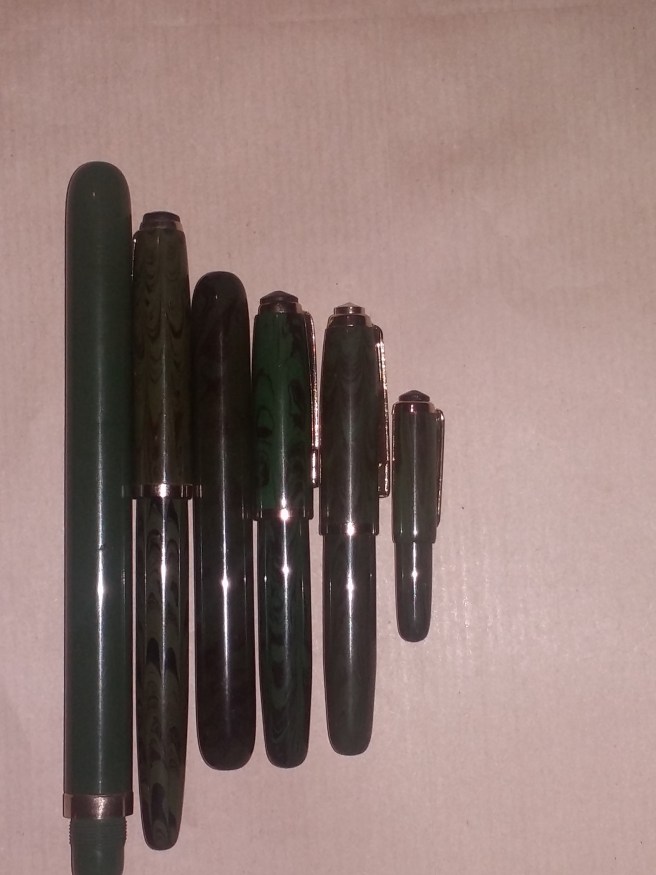
Which brings me to the story of my Ratnam/Guider pen. Inspired by Gandhiji’s call for swadeshi, K.V. Ratnam started manufacturing fountain pens in Rajahmundry, Andhra Pradesh in 1932. Mr. Ratnam sent one of the pens to Gandhiji in 1935, and Gandhi wrote back to him (presumably with the gifted pen).  The shop(s) proudly display the quote: “I have used it and it seems to be a good substitute for the foreign pens one sees in the bazars.” Nehru is said to have made a trip to the shop during one of his visits to AP, to get himself a pen or two. One wonders which of his literary works were penned with a Ratnam! Ratnam pens were symbols of self-reliance and national pride!

My Rajahmundry Trip Helped Me With an Innoavtive Birthday Gift for My Husband

AFFD4873-7031-484F-8189-C6EF792B50F3

Today, Rajahmundry boasts more than one shop which are offshoots of this legacy of hand-made pens—two Ratnam Pen shops run by Mr. K.V. Ratnam’s two sons, and the Guider pen shop which also claims its lineage to this.

I have had the fortune of visiting Rajahmundry and two of these shops. It was an experience to go to the back of the shop and see a workman turning the pen and shaping it by hand! I bought more pens in more sizes and colours than I know people who still write with fountain pens! But those to whom I have gifted them, cherish them.

Not only for the historical connection, but also these pens write beautifully and are beautifully hand-crafted. They are highly prized by pen collectors and orders come in from across the world.

I may not be written about in history, but I can write with a piece of history!

–Meena

P.S: Even as the nation gears up to mark Gandhi Jayanti, here is a sad piece of news:

97-year-old school founded by Bapu closes as funds dry up – https://timesofindia.indiatimes.com/city/rajkot/97-year-old-school-founded-by-bapu-closes-as-funds-dry-up/articleshow/65987400.cms?utm_medium=referral&utm_campaign=iPadapp&utm_source=email