Women and the Vaccine

8A469CF6-0898-430D-A845-0891A2DF7944

Lady Mary Montagu

In 2020, it is not surprising that there are many women playing a prominent part in developing vaccines to protect us against the current scourge—Covid 19. I know nothing about this field, but a casual search threw up many names—Prof Sarah Gilbert, Dr. Kizzmekia Corbett, Dr. Nita Patel. And Dr. Patel had a good explanation—she says that lab work in science is mostly done by women, so it is not surprising that women are prominent in the race to find the vaccine.

But it was not always so. Even though women have played a critical role in the development of many vaccines, they have not always got their due.

A8B3BB67-7240-4270-8ABC-F7F482BB6F30Polio was a dreaded disease in the early 20th century. It left death in its wake, but even more, it paralysed. Till date, there is no cure for polio, and the only defence is vaccination. Jonas Salk rightly deserves the credit for the polio vaccine, but there were two women, without whose work things would not have happened as they happened, when they happened. One was Dr. Isabel Morgan of Johns Hopkins University, whose work was a turning point in understanding host immunity to polio and on use of killed-virus (vs. live-virus) as the basis of vaccines for this disease. The other was Dr. Dorothy Horstmann of Yale and her team, whose work is said to have paved the way for oral polio vaccines.

Other women to whom we owe a safer world are: Dr. Anna Wessels Williams, who developed a diphtheria vaccine; Drs. Pearl Kendric and Grace Eldering who developed a vaccine for whooping cough; Dr. Margeret Pittman, whose work led to the vaccine against meningitis and pneumonia; Dr. Anne Szarewski, whose breakthroughs helped to develop vaccines against cervical cancers; and Dr. Ruth Bishop who led the team which developed a vaccine against rotavirus which is a major cause for diarrhoea in children.

But the best for the last! The most amazing story is of the woman who introduced the concept of immunization to the Western world, Lady Mary Montagu. Born in 1689, she was a path-breaker in many ways. But her contribution to vaccination is the one we are going to focus on here. She was a brilliant and beautiful woman, whose beauty was marred by an attack of smallpox in 1715. Earlier she had lost her brother to it. So it was no wonder that the deadly disease was something she worried about where her children were concerned. Lady Mary’s husband Lord Edward Montagu was posted to Constantinople as Ambassador in 1716. There she interacted closely with Turkish women and got to know their customs. One of these was the practice of variolation, wherein women would take the pus from the smallpox blister of someone who had a mild case of the disease, and introduce it into the scratched skin of uninfected children. Lady Mary observed that children thus infected never did contract the disease seriously.

She developed such a strong belief in this that she got the Embassy surgeon to inoculate her five year old son.

When she got back to England, she promoted this procedure with all her passion, but the medical establishment blocked and resisted it. The reasons are probably two-fold—it was seen as an Oriental folk treatment, not a Western, scientific one. And it was being promoted by a woman!

In 1721, a smallpox epidemic struck England, and Lady March had her daughter also inoculated. She persuaded the Princes of Wales on the efficacy of this, and the Princess had her two daughters inoculated. And though it took a long, long time for Jenner to come along and develop a safer technique of vaccination, using cowpox rather than smallpox virus, the concept started taking root, and the foundation for vaccination had been laid!

With thanks to all the back room girls (and boys) helping find vaccines and cures, as well as all front line workers.

–Meena

 

Have You Ever Seen, A Penguin Come to Tea?

Why would a Penguin ever come to tea? But so goes the nursery rhyme my foster-grandchild and I are currently hooked on.

If I were to write the poem, I would say

‘Have you ever seen, a penguin out at sea’.

Would make a bit more sense.

Of course, the other argument is, why should nursery rhymes make sense?

6A7544E4-A7BF-48E0-9512-51C1F4F1AFDCBut that is not the subject of the blog today. April 25th is marked as World Penguin Day, and that is the occasion of the blog. This day coincides with the annual northern migration of Adelie penguins.
Any ‘Day’ is a way to focus attention and raise awareness about an issue. Penguins evoke immediate love and interest. And hence are a great species to highlight when it comes to conservation education in general, and education about the species in particular. Alarmingly, of the 17 recognized living species, 11 have been listed as Vulnerable or Endangered, and hence awareness about penguins is important. And talking about penguins also ensures we talk about the health of the waters where they spend 75 percent of their lives.

It was only very recently that I saw my first-ever penguins in the wild. It was an unforgettable experience—a visit to the Omaru Penguin Colony in New Zealand, where visitors can spend a few hours freezing on stands, waiting for Little Blue Penguins to come home to their colony for the night. And believe me, it was worth every chilly bone to see this phenomenon. Groups of ten or more penguins coming in over a period of about an hour, after spending the whole day in the waters feeding—for themselves and to regurgitate for their children. What a hard life! The Little Blue Penguins are really tiny, just about a foot high. And we were lucky enough to see pair of chicks—cuddly balls of down.

And to end, some trivia:

  • The origin of the word ‘penguin’ is not clear. It may either be derived from a synonym for ‘great auk’, a bird familiar to Europeans who thought penguins looked like auks when they first saw them. (Great auks are flightless birds not related to penguins. They became extinct in the 19th century).  Or it could be from the Latin pinguis, which means fat or oil.
  • Some prehistoric species of penguins stood almost as tall and heavy as an adult human. Today, the largest species, the Emperor Penguin, stands at about 3 1/2 feet.
  • Although except one, all species are found only in the Southern Hemisphere, most do not live in extreme cold areas like the Antarctic. Many are found in temperate areas too.
  • There are two names for penguin collectives—when there is a group of them in water, they are called a ‘raft’. When there is a group on land, it is called a ‘waddle’.

Here is to World Penguin Day, may their tribes increase!

–Meena

The Kardashian of Trees

Heroing and highlighting individual trees is a great way of drawing attention to trees in general, and to reinforce the value of nature, wildlife and biodiversity.

An example of a successful initiative in this direction is the  European Tree of the Year contest started in 2011, inspired by an older competition which originated in the Czech Republic in the late nineties. According to the Czech Environmental Partnership Foundation which started it all: ‘Tree of the Year is a contest looking for a tree with a story. The aim of the contest is to empower people and get local communities involved in the environmental and local heritage protection. We believe that by gathering around a tree, people are more likely to take action again in the future for other environmental causes and for the wellbeing of the community.’

The process of selecting the European Tree of the Year starts with a well set-out voting process at the national level of the participating countries (16 this year), and ends with a finale consisting of online voting to select from among the national winners.

Now the competition is moving to other parts of the world: In 2016, Sri Lanka started the Asian Tree of the Year, with India, Nepal, Malaysia and Singapore joining in soon after. Canada, Australia and Russia have also held national competitions, though not on an annual basis.

Beautiful old trees, with history and cultural connections to the community have found their spot under the sun through this process, and also generated a lot of public interest, involvement and learning.

Sounds good! But what has all this to do with the title?

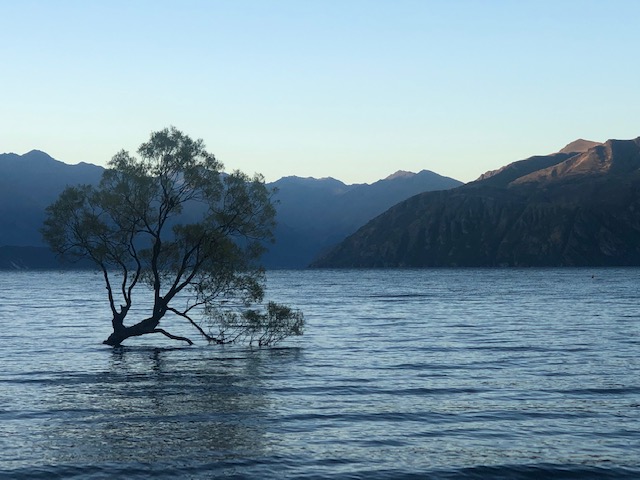
CF37A480-1747-49E9-9F79-48FCA5BAC580The connection is a tree that is reputed to be the most instagrammed tree in New Zealand, almost a symbol of NZ tourism. On a recent trip there, we were urged to set aside time to see the tree, specifically around sunset. So we worked around our program to ensure we got to the spot—a stretch of a beach—well ahead. We drove past a few times, keenly looking at the beach. We could see some people, but nothing special in the way of trees. We asked natives and tourists alike, and they all pointed us to the same area which our GPS had shown us, and which we had passed, looking in vain for a landmark. We decided to make our way down to the beach anyway. Lo and behold, there were many, many people there, jostling for some spot (we could not figure out what the spot was for), all setting up professional looking camera equipment. It came to a pass when we had to ask a friendly-looking lady what everyone was waiting to photograph, where the famous tree was, and what it was about. She kindly pointed to this spindly willow tree, standing a few feet into the waters of the beautiful Wanaka Lake, against a beautiful background of majestic mountains. But the tree itself? In my mind, this will forever define and exemplify ‘under-whelming’. ‘Why is the tree famous’, we asked many around us in bewilderment. While there was some story of how it was part of a fence and had survived in the water for several years, the general consensus was that it was famous because it was famous! So famous , it even has its own insta handle #ThatWanakaTree.

Does the title begin to make sense?

But yes, surely is a lesson to countries like ours, where we have such unimaginable treasures of cultural and natural heritage, but simply are not able to create anywhere near a proportionate buzz!

–Meena


Walk Your Way to Health

A031C896-84DB-4EBA-BAE1-E567F0CAD18D

This week we marked World Health Day.

And walking is my trusted route to good health. It is the only exercise regimen that I have been able to stick to. And I have tried several:

  1. Swimming: Tried about 15 times, but could not manage to learn.
  2. Gymming: If it was not the traffic, it was complete mismatch with the age of the people around. Never feels good to up the average age of a room single-handedly.
  3. Cycling: Oh, the ups and the downs! My muscles ache and my breath doesn’t hold
  4. Exercising at home: I can find an excuse a day after the first three days, to not follow the regimen.

So walking it has been for the last 25 years and more—starting from long before the obsession with counting steps. About 50 minutes of brisk (hopefully) walking every day.

The Mayo Clinic assures me—and I believe them–that regular brisk walking can help me:

  • Maintain a healthy weight
  • Prevent or manage various conditions, including heart disease, high blood pressure and type 2 diabetes
  • Strengthen bones and muscles
  • Improve mood
  • Improve balance and coordination

And in these days of lockdown, it is still a possible form of exercise. It not only helps the body, but just the act of getting out of the house into the fresh air and seeing people even if only from afar, definitely contributes to well-being.

Maybe the lockdown will help walking become a lifelong habit for some. But for me, it was the peer pressure of ‘walking with a friend’ that worked. My friend Kiran and I decided at some stage to walk every morning at 6.15 a.m. on the IIM-A campus. The very thought that the other would be standing impatiently at the gate if one was late, was enough to get us out of bed and out the door most days. And if we did not, we had to be pretty inventive in coming up with excuses.

But for many years now, I have been walking by myself. And my trusty companion is my XONE music player. This is something I picked up at the Vizag airport over five years ago. This is a nifty little device—headphones with built in storage, with huge capacity and no wires. It seems to be developed in India. I think I have about 1500 songs stored. The battery lasts me a week on one charge. People who see me walking regularly jokingly ask if I have ears, as this is always glued to my ears.

So find a way to get yourself into the habit of walking, and find a way to stay hooked! While I may not go so far as to say ‘My God is the God of Walkers. If you walk hard enough, you probably don’t need any other god’ (Bruce Chatwin), I will swear by walking for a sense of all-around well-being.

–Meena


Pencil Day

Not many may have heard of it, but 30 March is observed as National Pencil day in the US. If you think of it, the humble pencil is an implement that needs to be celebrated. There is not a single child who has not begun its education without a pencil. Even with all the new and emerging means for ‘writing’ every teacher believes that the pencil is with what it all starts—working with pencils gives the child the motor coordination necessary for more advanced tasks.

Pencils started being used sometime in the mid-1500s, when a large deposit of graphite was discovered in Cumbria, England. The particular deposit of graphite was extremely pure and solid, and could easily be sawn into sticks, and people started to do so, using the sticks for writing. However, graphite being very soft, it needed some casing. Initially, the sticks of graphite were wrapped in thread or sheepskin. In the 1560s, a couple in Italy started hollowing out bits of wood and putting sticks of graphite into them. Shortly after, the idea of making two halves of a cylinder of wood and sandwiching the graphite seems to have dawned and so the pencil, as we know it, was born. Today pencils are made by mixing fine ground graphite and clay powder with water to form strings which are then placed in a kiln to harden, then dipped in oil or wax, which seeps into the tiny holes to make it smoother for writing. These are then encased in wooden cylinders.

So which of these landmarks does March 30 celebrate? None really, because all these specific dates are lost in history. March 30 of 1858 is the day on which Hymen Lipman of the USA received the first patent for attaching an eraser to the end of a pencil. And USA decided to mark this day in his honour as Pencil Day.

Apparently, the pencil business in India is controlled by four major players—Doms Industries which make Doms pencils; Hindustan Pencils, which makes the familiar Apsara and Natraj brands; Camlin (now Kokuyo Camlin) is another significant presence; and finally Maharashtra Pencils, which is the smallest of them. The market leader is Hindustan Pencils, which has 45 per cent of the market share. It produces about 8 million pencils a day!

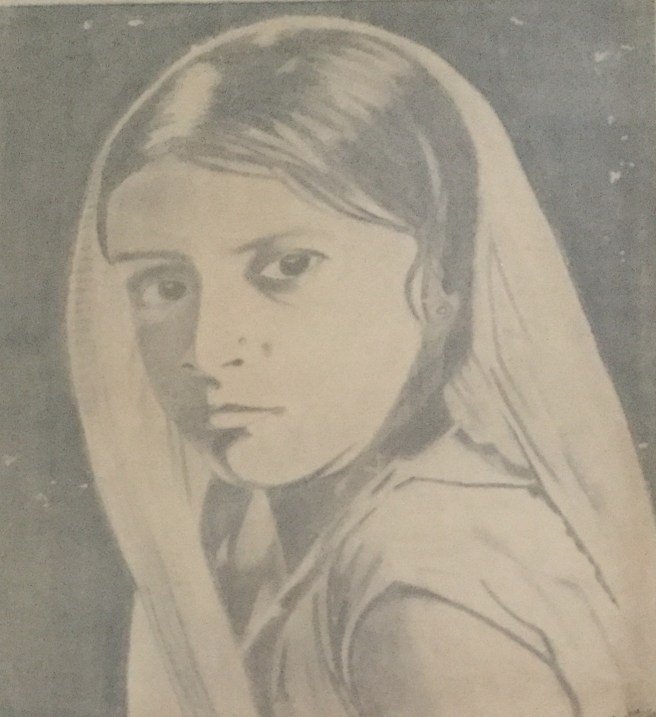
A2947853-F525-4B83-B57D-9C879A334925Pencil sketch, V. Raghunathan, using 3B and 4B pencils. 1980.
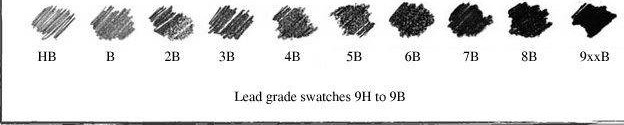
HB pencils were the pencils most of us used. In fact, anything else was left to the more ‘arty’ types. The notation ‘HB’ is a part of the European system of classification, using a continuum from “H” (for hardness) to “B” (for blackness), as well as “F” (for fine point). The system was developed in the early 20th century by Brookman, an English pencil maker. The US of course must be different from the rest of the world, and uses a numeric system of #1 to #4 to classify pencils.

A106B150-9534-4B3D-8270-9FC59A2A34E1

So on this Pencil Day, make sure to write a few lines with a pencil. Believe me, it is a very special feeling, and you will realize how much you miss it! Not only the hand-feel, may be it will bring back memories of school and childhood!

And to end, some Pencil Facts:

Chemistry was not very well developed in the 1500s when the graphite mine was discovered and the substance was thought to be lead. Hence it was called plumbago (Latin for “lead ore”), and even today, though pencils don’t have any lead, they are called lead pencils.

Every year, about 82,000 trees are cut down to make the close to 2 billion pencils manufactured worldwide. Each tree can yield about 1,70,000 pencils.

A typical pencil can draw a line about 55 km long.

–Meena


Sighting Snowflakes In Bangalore

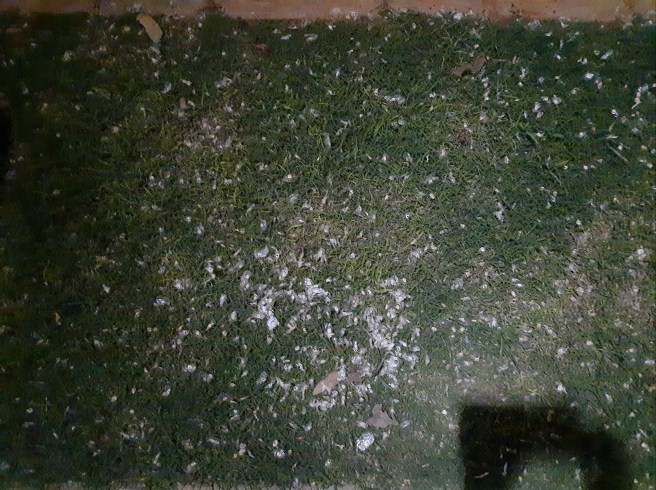
I came out of my house one evening and the green grass was sparkled over with hundreds of what-looked-like-snowflakes. And as I lifted my head to look up, I saw thousands of transparent winged seeds snowing down from the trees all around. It was a magical sight.

My housing complex has a large number of African Tulip Trees, and these were the sources of the ‘snow’. This native of Africa’s tropical forests (Spathodea campanulata) is an invasive species in some parts of the world, but fortunately does not seem to be a problem in India.

B8280DE8-67A2-433F-9555-2A0C839436CD

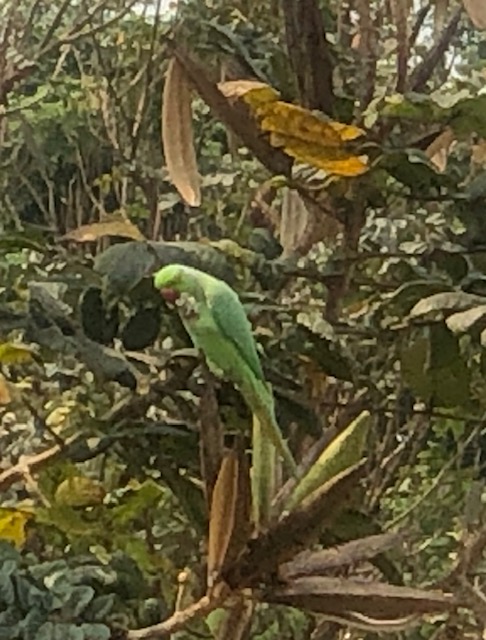
For a few months, these trees were in bloom, clusters of bright orange flowers, each individual flower the shape of a tulip. The trees used to be a riot of colour and sound, with the dozens of birds which came to sip the nectar from the flowers. Then these flowers turned to seeds—when mature, these are brown and woody. And now the seedpods are bursting, releasing the 500 or so seeds that each pod has. Each seed is tiny and covered in a transparent polythene-like covering, which floats down lazily to the ground. And at this stage too, there are birds that visit the tree-yesterday I saw a parakeet feasting on the seeds and releasing the empty cases to float to the ground.

68811143-005D-42A1-BBF5-06B5CB2BD4A2It was like my textbook coming alive. ‘Seed Dispersal Mechanisms’ is what I think the lesson was called. And it described dispersal by wind, by water, by animals and birds, by ballistic action, etc.

I could only marvel at the tree for producing and sending down thousands of seeds every season. Sadly, for most to be swept away by the gardeners. Presumably, the very large number of seeds the tree has evolved to produce is to make up for the very small probability of any of them actually growing into an adult tree.

I can only hope a few of the ones I have seen this season manage to escape and are able to fly a decent distance away from the attention of gardeners and home owners, and land on un-managed land and fulfil their function!

–Meena

PS: While urging our readers to take all precautions and stay safe, MM will try extra-hard to focus on everything other than Corona during these difficult times. Life is beautiful!


So Many Ways to Downtime!

A few days ago a friend said ‘What with everything closed for Corona, it is so dull and boring, wish we could just HIBERNATE.’ Probably a sensible thought, except that given the temperatures outside, it would be aestivation, rather than hibernation.

3-s2.0-B9780124095489111674-f11167-03-9780444637680AESTIVATION, lesser known cousin of hibernation, is ‘summer sleep’– a survival strategy used by many vertebrates and invertebrates to endure arid environmental conditions. Key features of aestivation, like hibernation (winter dormancy) include significant metabolic rate suppression, conservation of energy , altered nitrogen metabolism, and mechanisms to preserve and stabilize organs and cells over many weeks or months of dormancy. Even more than in hibernation, strategies to retain body water are important in aestivation, as dryness or aridity is the key trigger for the summer sleep.

A surprising number of animals aestivate—vertebrates such as lung fish, amphibians, reptiles, small mammals, and certain invertebrates such as molluscs. Bees, snails, earthworms, salamanders, frogs, earthworms, crocodiles, tortoise, etc. are examples of the aestivating animals. The duration of aestivation varies among species–some enter this state for a few months, others for a longer period.

Well, there are other kinds of ‘downtimes’ we can choose from too.

There is BRUMATION, which is the equivalent of hibernation for reptiles. Mammals hibernate and reptiles brumate, but there are other differences too. During hibernation, a mammal is sleeping and does not have to eat or drink. But brumation is not true sleep and the reptile still needs to drink water. A brumating reptile may have days where it will wake, show some activity, drink water, and then go back to its dormant state.

Or we can take the option of TORPOR, which involves lower body temperature, breathing rate, heart rate, and metabolic rate. But unlike hibernation, torpor is an involuntary state that an animal enters into as the conditions dictate. Also unlike hibernation, torpor lasts for short periods of time – sometimes just through the night or day depending upon the feeding pattern of the animal. During their active period of the day, these animals maintain a normal body temperature and physiological rates. But while they are inactive, they enter into a deeper sleep that allows them to conserve energy and survive the winter.

Or there is DIAPUASE, a form of developmental arrest in insects that is much like hibernation in higher animals. It enables insects and related arthropods to circumvent adverse seasons. Winter is most commonly avoided in colder areas, but diapause is also used to avoid hot, dry summers and periods of food shortage in the tropics.

Now, which one do you prefer?

–Meena


Colour Me Blue

As we celebrate Holi, the Festival of Colours, here is a piece on the hues that brighten our lives.

And, in keeping with the mood of International Women’s Day, it references M.S. Subbulakshmi, doyenne of Carnatic music, and a path breaker.

Happy Holi, Happy IWD!

Last week I was reading an old-fashioned novel, where the hero’s sidekick was wearing a taupe coloured suit. Not being quite sure what ‘taupe’ was, I looked it up, and learnt that it is a dark brown colour between brown and grey and that the name originates from the French taupe meaning mole (the animal).  The name originally referred to the average colour of the French mole, but since the 1940s, its usage has expanded and blurred to mean anything greyish brown or brownish grey.

Names of many colours are derived from nature. Fuchsia was named for the colour of the flowers on the fuchsia plant, itself named for Leonard Fuchs, a 16th-century botanist. The word orange comes from the Old French orange, from the old term for the fruit pomme d’orange. The French word, in turn, comes from the Italian arancia, based on Arabic nāranj, derived from the Sanskrit nāraṅga. An inter-connected world indeed!!!!

Teal is a bluegreen colour whose name comes from that of a bird—the common teal (Anas crecca)—which presents a similarly coloured stripe on its head.

‘Puce’ is also one of the nature-colour names, but with a particularly yucky background. Puce is the French word for flea. The colour is said to be the colour of bloodstains on linen or bedsheets, even after being laundered, from a flea’s droppings, or after a flea has been crushed. Strangely it was one of Marie Antoinette’s favourite colours!

People too have lent their names to colours.

‘Mountbatten Pink’ is a naval camouflage colour close to greyish mauve. It was first used by Lord Mountbatten during World War II. When he noticed a liner ship of the colour seeming to disappear from view in the early morning light, he felt it was a good colour for naval ships to render them difficult to see at dusk and dawn, and so started applying them to his naval ships.

‘Alice Blue’ is a pale shade of azure blue, much liked by Alice Roosevelt daughter of President Theodore Roosevelt, which sparked a fashion sensation in the United States.

MSBut for a South Indian like me, the most important person-colour association has of course to be ‘MS Blue’, said to be a favourite of legendary singer M.S. Subbalakshmi.  This colour became synonymous with her after she started wearing Kanchipuram silk saris of this shade at her concerts. These were specially made for her by Muthu Chettiar, a weaver from Madurai. The savvy businessman that he was, he carefully regulated supplies to ensure enduring demand from Madras high society ladies!  It has been clarified that MS Blue is not peacock blue but ‘mid-sea blue’.
Continuing on the theme of blue, the colour of 2020 (Yes, they announce a colour for every year! A good source of income for the interior design and fashion industries) is PANTONE 19-4052 Classic Blue whose properties include instilling ‘calm, confidence, and connection’. Additionally, it is claimed that ‘this enduring blue hue highlights our desire for a dependable and stable foundation on which to build as we cross the threshold into a new era’.

Another interesting fact I learnt was that research by several academics including linguists Brent Berlin and Paul Kay has revealed that if a language had only two terms for colours, they were always black and white; if there was a third, it was red; the fourth and fifth were always green and yellow (in either order); the sixth was blue; the seventh was brown; and so on.

–Meena

National Science Day

28 February marks National Science Day in India–it is the day in 1928 when Sir C. V. Raman discovered the Raman Effect. For his discovery, Sir C.V. Raman was awarded the Nobel Prize in Physics in 1930.

The discovery of the Raman Effect itself happened at Calraman effect.jpgcutta, but Bangalore was also Sir Raman’s ‘karma bhoomi’, in that he worked at the Indian Institute of Science from 1933 till his retirement in 1948, after which he founded the Raman Research Institute in the city, and continued working there till his death in 1970.
So on this Science Day, here is a little information on one of the exciting science education venues coming up in Bangalore. Science Gallery Bengaluru, under construction in Hebbal (not too far from IISc and the Raman Research Institute), ‘will be a dynamic new space for engaging young adults at the interface between science and the arts’. The under-construction centre anticipates a footfall of about 40,000 people a year, with a focus on 15-­25 year olds. It is a multi-stakeholder collaboration, including Govt. of Karnataka, Trinity College UK, Indian Institute of Science, etc.

Scheduled to open in 2021, the Science Gallery is already active, having put up several events including ‘Submerge’ a major exhibition on Water.

And keeping with the theme of Science Day 2020 which is “Women in Science”, the Executive Director of the Science Gallery is Dr. Jahnavi Phalkey, a historian of science and technology.  The Board is chaired by Dr. Kiran Mazumdar-Shaw, and includes Dr. Geetha Narayanan.

Bodes well for Science and Women Scientists!

Let us hope that the Science Gallery will help to infuse young people with the spirit of what Sir CV Raman said: ‘Ask the right questions and nature will open the doors to her secrets.’

–Meena

The Sparrow and The Peacock

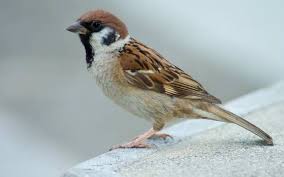
Whesparrown I was growing up in Delhi, house sparrows were very much a part of our lives. They were everywhere, and by the dozens. In fact, most children of those times got their first nature lessons by watching sparrows—the sex differentiation, how they built their nests, the eggs hatching and the parents feeding the young, their mud-bathing etc.

Everyone loved them, but that is not to say they did not give us some headaches. In the summers, they would fly into the house, and it was a mad scramble to switch off the fans and shoo the birds out before they were hit by it and died. And mothers would keep long sticks handy to chase them when they showed signs of making nests in the fan-cups.

For many years now, sparrows are not to be seen so easily. Now, the recently published ‘State of India’s Birds’ assures me that I need not worry because the population of sparrows has been stable in India for the last 25 years. I believe it, because the report is the result of a collaboration among ten of the most respected research and conservation organisations in the country. But I do know that the population has significantly declined from say 35 years ago. And I do wish I would see more of chirpy little birds.

The report also says that the population of peafowl has increased manifold. This may be attributed, it is being said, to the spread of aridity in the country. This is not all good news, as peacocks come into cultivation and eat up growing shoots, causing harm to crops.

The report identifies 101 bird species as needing special efforts for conservation, including specially raptors and water-birds.

The report is a landmark in Indian conservation efforts, because it provides good quality baseline data, which can help shape conservation efforts and their monitoring. It is also unique in that it is based on data collected by citizens across the country–10 million observations collected by over 15,500 birdwatchers across the country. Truly participatory and truly large scale. And the fact that hard-core research organizations are guiding the effort, gives authenticity to the data and findings.

Knowing is the first step to acting. Now we know to some extent what we should worry about. Time to act now!

–Meena