
A Magical Walk

I remember it well—a mere 400 metre walk on our office campus in Ahmedabad. That day we were walking along the path that all of us took regularly; walking along with us was Professor HY Mohan Ram, a member of our Governing Council, who was there for the Council meeting. As we walked, Professor Mohan Ram talked—gently, softly, but with passion and excitement, pointing out plants that we saw every day, but, as we realised, we never really ‘looked at’.

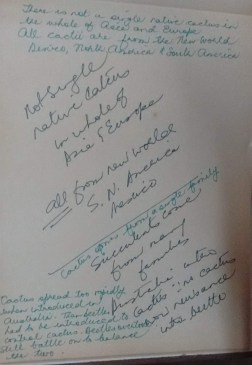
“Look at this one”, he pointed at a plant, “this is Aduso. Its botanical name is Adhatoda vasika which means ‘that which the goat will not touch’. This is what is used for making medicines for cough and cold.” Going just two steps ahead, “You know the cactus, but did you know that there is not a single native cactus in the whole of Asia and Europe? All cactii are from the New World—Mexico, North America and South America.” ”Look at this magnificent neem tree.  Its botanical name Azadirachta indica comes from the Arabic for azad meaning ‘free’ and drakhta meaning ‘tree’. This is thought to be a tree indigenous to India, but there is some doubt if it is originally Indian. It may have originated on the Burma border and come to Bangladesh from there.” “Did you know that Lutyens, when planning the landscaping of Delhi’s roads, planted only native species. Each avenue was planted with one species of fruit tree.” Three steps ahead, we come to the white flower commonly called Chandni. Professor tells us, “Have you noted carefully the arrangement of petals of flowers? Most flower petals are usually in multiples of 3 or 5 (except in the case of the mustard flower).” “Many high school students know this as the shoe flower that they got for dissection in the exams. But why the name shoe flower? Because it is used to polish shoes! Its other name is hibiscus, and is believed to have originated in China.”

IMG_20170822_090553807.jpg

Professor HYM had a fascinating story for every step that we took, drawing attention to the tiniest of flowers that we carelessly trampled underfoot, to the towering culms of bamboo. The path that took us 5-7 minutes to traverse became a magical mystery tour that took close to two hours. Through his eyes the blur of vegetation turned into a veritable treasure trove, with each plant glowing with its own special attributes.

Not long after this visit, Meena and I invited Professor HYM to contribute to a collection of tales of ‘Nature Heroes’ that we were putting together. He graciously agreed, and shared with us some of his journey, experiences and inspirations in a piece titled Reflections of a Botanist.  He writes “I have not pursued any single course. I have done what interests me and not what is in style. I have a deep interest in Indian classical music and photography.”

He concludes the piece with this, “What enlightenment have I received as a student of plant biology? I wish I could be like a tree: deep-rooted and firmly fixed, bearing a lofty bole and a broad canopy, continuously absorbing, synthesizing and renewing, unmindful of stresses and insults, resilient to changes and perpetually giving.”

In the passing away of Professor HY Mohan Ram the world has lost not only a botanist par excellence, but a much loved and respected teacher, researcher, and writer. For us, the Matriarchs, Professor Mohan Ram will always be remembered as a gentle, unassuming guide with a twinkle in his eyes, and a life-long inspiration whose visits to the Centre were like the Open Sesame to a fascinating world of flora.

A page from my notes on the Walk!  (Date 22 August 1998)
IMG_20180620_115125823.jpg


–Mamata

Cacophony

Just about fifteen years ago, as I lay in bed at night, I could hear the howling of jackals, the rhythmic beat of the distant train, hoots of owls, and the chorus of frogs after the first rains. I would waken to the call of the Sarus cranes, and the meowing cry of the Jacanas in the open ground across from my house.

Today I lie awake all night to the rattling, shattering clangour of the monstrous mechanical cranes and concrete mixers as they dig deep into the soil where the Sarus sang and Jacanas nested, and from where rise the gigantic metal skeletons of multi-storey towers. On the weekends I can no longer listen to the music that used to be a part of our evenings, over the incessant honking, beeping, screeching and yelling from the traffic jams outside my gate, as a noisy, rambunctious crowd heads for the ‘happening’ mall that looms in neon-lit glory, where once the buffalo wallowed and the froggies sang.

Our lives are so cluttered with noise, we do not know silence any more. We are almost afraid of the quiet. We get anxious if we are not continuously reassured by the hum, buzz or ringtone of our phone…Why no calls, no messages, no alerts?? Does nobody ‘like’ us anymore? We feel unmoored without the 24/7 din around us. Is there a moment in our day when we can hear simply silence?

On a visit to Bali last year I learned about Nyepi–the Day of Silence. This day falls (usually in March) on the day after the dark moon of the spring equinox when the day and night are of approximately equal duration. It marks the start of “Caka” year – Balinese New Year – which is celebrated over six days. The first two days are marked by parades, noise and revelry, and Nyepi falls on day 3. The observance of the Day of Silence is based on an ancient myth that, after the boisterous and active celebrations of day 1 and day 2, the Island goes into hiding to protect itself from the evil spirits, fooling them to believe that Bali, enveloped in an atmosphere of complete tranquility and peace, is a deserted Island.

The quietest day of the year is guided by the four precepts:
No fire or light, including no electricity.
No form of physical working other than that which is dedicated to spiritual cleansing and renewal.
No movement or traveling.
Fasting and no revelry/entertainment or general merrymaking.

Everyone stays indoors, engaged in fasting, prayer, meditation, reflection and introspection—erasing the clamour, and cleansing the body and spirit. What a wonderful tradition and even more, how wonderful that it is so well honoured and celebrated in spirit and deed, even today.

If only we could all disconnect from the din, and connect within.

STOP PRESS!

This year for Nyepi all phone companies on the island of Bali agreed to shut down the mobile internet for 24 hours. Imagine a day without internet, Facebook and Instagram and instant messaging apps! And this, on one of the world’s most popular and busy tourist destinations! Yes, they did it, and survived!

–Mamata


A Feast for all the Senses

Mango

Mango looks like gift-wrapped sunbeamsIMG_20180608_203804.jpg

Mango sounds like ‘slurp’

Mango smells like only a mango can

Mango tastes like Kesar    (*pick your favourite!)

Mango feels like one can survive the summer after all!

Ah Mangifera indica!


About 1,500 varieties of mango are grown in India, including 1,000 commercial varieties. Each of the main varieties of mango has a unique flavour.

* Take your pick!

IMG_20180608_203550.jpg

1. Taimoorlang
2. Husnaara

3. Aabehayat

4. Zawahiri
5. Dussheri
6. Chosa
7. Lucknowi
8. Langra
9. Neelum
10. Rumani
11. Alphonsa
12. Bombay Green (Sarauli)
13. Banganpalli
14. Samar Behest Chausa
15. Fazli 16. Kishenbhog 17. Himsagar 18. Gulabkhas 19. Zardalu 20. Airi   21. Malkurad (Goa) 22. Kesar 23. Rajapuri 24. Jamadar(Gujarat) 25. Beneshan 26. Bangalora
27. Suvarnarekha 28. Mulgoa 29. Raspuri 30. Badami 31. Allampur Beneshan 32. Himayuddin 33. Jehangir 34. Cherukurasam 35. Bathua 36. Bombai 37. Sukul
38. Fernandin 39. Mankurad 40. Vanraj 41. Mundappa 42. Olour 43. Pairi 44. Safeda
45. Raspoonia 46. Mithwa Sundar Shah 47. Mithwa Ghazipur 48. Taimuriya
49. Sharbati Begrain 50. Gilas 51. Nauras 52. Rasgola 53. Hardil-aziz 54. Cherukurasam
55. Peddarasam 56. Totapuri 57. Kothapalli Kobbari 58. Chinna Rasam 59. Cheruku Rasam 60. Pedda Rasam 61. Mallika 62. Ratole 63. Kaju
64. Himayat 65. Khatta Meetha 66. Panchadara Kalasa 67. Manjeera
68. Amrapali 69. Arkapuneet 70. Sindhu

Source: http://www.festivalsofindia.in/mango/varieties.aspx

–Mamata

The Upside-Down Tree

A Tree-Tale on the occasion of World Environment Day

I first saw a Baobab tree in Tsavo National Park, on safari in Kenya. With a huge bulging trunk and branches that looked like roots spreading in a wide canopy, it was unlike any tree I had seen. I was intrigued. As I read more about Africa I found that this tree, which was native to Africa, Madagascar, and Australia, played a significant role not only in the ecology, but equally the folklore of these regions.

Across Africa, there seem to be many stories passed on from generation to generation, that explain why the Baboab looks the way it does. One of the most popular, and my favourite one, goes like this.

The first Baobab grew near a small lake, along with many other trees. One day it saw its reflection in the water, and it was shocked. It saw a huge fat trunk covered in bark that looked like the wrinkled hide of an old elephant; small leaves and pale flowers.

Now this Baobob was a complainer. “Why did you make me so ugly?” it asked the Creator. “Why did you make me so big and fat? Why can’t I be tall and slender like the Palm tree?” “Why is my bark so rough and tough? Why can’t I have a smooth trunk like the Mahogany tree?” “And such insignificant flowers, why not bright ones like those of the Tulip tree?”

And the Baobab went on whining and complaining, comparing itself to every other tree, and feeling short-changed in every aspect. Until finally the Creator had enough! In a fit of exasperation, he came down and yanked the Baobab up from its roots, and replanted it upside down! No longer could the Baobab see its reflection, and no longer could it compare and contrast!

But the Creator could not be heartless. The vain whiner had to be taught a lesson, but after all this too was one of his own creations! So the Creator gave the Baobab some special features that would make it one of the most valued of trees for countless other living beings, including humans.

This Tree of Life, as it is called by some tribes in Africa, creates its own ecosystem, as it supports the life of countless creatures, from the giant elephants to the thousands of tiny creatures scurrying in and out of its crevices. Weaver birds nest in its branches and owls and Hornbills roost in its hollows; baboons and warthogs devour the seedpods and the fruit; bush babies and fruit bats drink the nectar and pollinate the flowers. The tree can store hundreds of litres of water in its trunk, an adaptation to the harsh drought conditions of its environment. This water is tapped in dry periods by elephants and Bushmen.

P1130244.JPGEvery part of the tree is valuable for the local communities; its lumber is used for storage, its bark is pounded to make rope, fishnets, mats, baskets, paper and cloth. More recently, its fruit has joined the ranks of international Superfoods–it is known to contain six times as much vitamin C as oranges, twice as much calcium as milk, and plenty of B vitamins, magnesium, iron, phosphorous, and antioxidants.
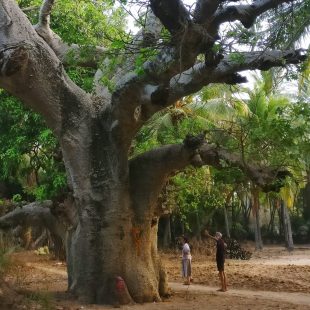

Baobabs can reach up to 75 feet in height, and the trunk can grow more than 60 feet wide. Humans have used the hollowed trunks for a variety of purposes—from a post office, to a jail, and even a pub!

Baobabs are some of the longest living of trees, believed to live for more than 2000 years!  When they do die, they simply rot from the inside and suddenly collapse, leaving a heap of fibres, and so the local belief is that they do not die at all, but simply disappear!  No wonder the Bushmen call it the Magic tree!

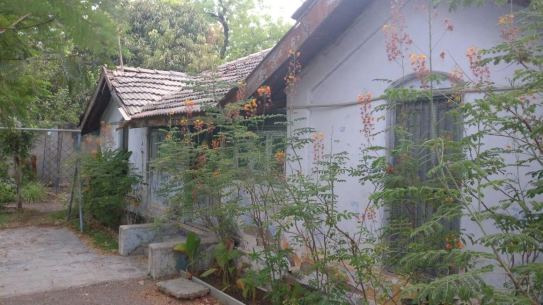
Some years after I returned from Kenya, we visited Diu, an island just off the coast of Gujarat. As we walked around, we were astonished to come across a Baobab tree! Solidly ensconced in majestic, solitary splendour among the Hoka palms and green fields, it brought back memories of our Safari days!  No one seemed to know when and how it came to be there. Thereafter, on our annual Diu trip with the children, we all eagerly looked forward to spending a morning exploring the Baobab. Over the years, as the children grew, it remained a reassuring and comforting presence. This year, the Baobab was introduced by my now-grown daughter to her husband, as an old friend!

IMG-20180519-WA0003.jpg

Happy World Environment Day!

–Mamata

Average is Normal

It is that time of the year again. It is the season of Superlatives. Exam results with Beyond Belief percentages, pictures of the Highest Scorers in the papers, magazines listing the Best Colleges, coaching classes advertising Record-breaking Achievers. So many wonder-kids? Are there no ‘average’ children anymore?

Even several years ago, I remember meeting my children’s classmates’ mothers when we were summoned to meet the teachers after the exam results were given. I heard exchanges about the achievements of the respective prodigy—prizes for painting, dancing, skating, swimming and more. Class toppers, school leaders all. I wondered, if every child is so brilliant, are there any simply ordinary children in the class?

I began to have doubts about my own parenting responsibilities and skills. Well, I did try to get the children to go for swimming coaching, largely because their cousins were going too (50% success—my daughter picked it up, and my son did not), dance lessons (my daughter did last a couple of years, but never made it till an arangetram!), and karate (my daughter made it till the first camp, my son till the white-one belt!).  Neither they, nor I, seemed to have the endurance run the gauntlet and emerge a Winner every time!

As parents who followed a relatively laissez-faire style of parenting, our considerations were mainly that the children were given the space to simply be, and blossom as they will. But as they grew, it became increasingly difficult to cope with the expectations of a competitive system. Still we thought that we were managing ok within the larger environment. We got a jolt one fine morning, when our son was denied readmission into Class 11 in the same school he had studied in for 10 years, because he missed the “cut off” by a couple of marks. Imagine the devastation for a fifteen year old. The experience that followed is a story in itself. One of the outcomes was that we decided that we did not wish our daughter (who was even less equipped to cope with a mindlessly competitive system) to go through this. Despite being told that “this is the system, your children and you will need to learn to swim with the tide, or sink”, we actively explored alternatives….and found them.

The children made it through! Today they are in the ‘system’ as it were, without being sucked into its vortex. They may not meet the generally accepted norms of Mainstream Success. (“Settled” so to speak, with six-figure earnings, car and apartment, designation, the skills to compete ruthlessly …and burn out at 35). They are following somewhat unconventional paths; they continue to explore, and discover new passions, new horizons, and new accomplishments. They are rich in experience, life skills, and relationships. They have the confidence to be themselves, and “not just another brick in the wall”.

Perhaps the greatest freedom we can offer our children is to allow them to think differently, and more importantly, to act differently.  Gunter Pauli

peanuts flaws

From Peanuts by Charles Schulz

Simple Joys of Summer

Come May, and it was time to begin the summer excursion from Delhi to “home town” Bhavnagar, in Gujarat. This entailed a long hot dusty meter-gauge train trip to Baroda or Ahmedabad, complete with bedrolls, surahis of water and much food carried, and bought from the stations. Some years later when the first Deluxe train with AC sitting coaches was introduced, it was the very height of luxury! One’s best outfits were to be worn en route, and there was much anticipation about choosing comics and magazines from the AH Wheeler stall on the platform. That was only Part 1. Part 2 involved an equally long and hot and dusty onward bus on the state transport or ‘ST’ bus. And then, we were there!

Bhavnagar had the double bonus in that both my paternal and maternal family homes were in the same town…and within a stone’s throw of each other! Two houses, two sets of aunts and uncles, and two sets of cousins! Where was the question of feeling bored, or not knowing what to do next? Most of the morning was spent in doing nothing much, while waiting for one’s turn to have a bath. As the hours rolled from breakfast to lunch, one of the assigned duties was to go up to where the home-grown mangoes were laid out to ripen, and pick the ones for lunch. Another one was digging ice cubes out of the dinosaur-age fridge and making a bucketful of cold water to drink. As one grew older, the duties graduated to squeezing the pulp out of the dozens of mangoes, and learning how to roll chapatis! Replete with mango ras and an array of newly-made pickles it was time for a long siesta, with the gaggle of old and young, lying down from wall to wall in the central room, with the vetiver or khus ‘chicks’ keeping out the glare and keeping us cool. (Another assigned duty was sprinkling water on the chicks).

Post-siesta special outings involved a ghoda gaadi (tonga) ride into the ‘bajaar’ accompanied by an aunt. Walking through the crowded market with halts to buy thread for embroidery, or fabric for summer clothes was indeed an adventure. And then, the delicious process of ‘designing’ one’s own clothes…to be executed by the family tailor who sat at his machine, day after day, in the verandah, whirring out baby-doll pyjamas, ruffled frocks, and basic petticoats and bloomers! (The person whose clothes were being tailored on the day was assigned to ensure that the tailor was kept well supplied with food and water). Talk about bespoke wardrobes!

As soon as the peak heat of the day abated, it was time to walk across to the other house. More cousins, more food and more fun and games….learning to ride the bicycle; pretending to swim in the 6 by 6 feet water tank; trying to get on to the roof with clay tiles (and being scolded by granny); climbing trees, and huffing and puffing up the  hill to the temple…After sunset, when the grand-aunts came by, it was time to sit on the steps and the jhoola, and listen in on the family gossip!

Dinner in the open chowk, all seated in a circle on the wooden paatlas, with much noise and merriment. (Later this evolved into several tables of varying heights put together to form a long dining line). Bedtime involved tying of mosquito nets and making of beds–in the front courtyard or on the flat terrace, depending on which house we were spending the night at. And, falling into a blissful slumber, under the starry sky, after a day well-spent.

And so the summer passed…until it was time to start the trek back. No helicopter parents, no scheduling, no planning, no personality development classes, no activity clubs, no life-coaching, no play dates! We drifted along languorously, and yet every day was packed. A good time it was indeed, to be young!

Last week I visited the home town. Much has changed. Only one of the beloved homes still stands, empty now; but housefuls of memories remain, as fresh as if it were yesterday.

IMG-20180517-WA0001.jpg

–Mamata

Ode to Libraries

As is probably, by now, evident, the Millennial Matriarchs are bookworms. We grew up with books, and we need books just as much, or more, as we grow older.

The enervating summer afternoons bring back so many memories of the joy of discovering, devouring, savouring, hoarding, exchanging, borrowing, and drowning in books, and more books. And, libraries were the dream destination of summer holidays.

Sharing some eloquent words that describe the power (and perils!) of libraries.

 Don’t Go Into The Library

The library is dangerous–

Don’t go in. If you do

You know what will happen.

It’s like a pet store or a bakery—

Every single time you will come out of there

Holding something in your arms.

Those novels with their big eyes.

And those no-nonsense, all muscle

Greyhounds and Dobermans,

All non-fiction and business,

Cuddly when they are young,

But then the first page is turned.

The doughnut scent of it all, knowledge,

The aroma of coffee being made

In all those books, something for everyone,

The deli offering of civilisation itself.

The library is the book of books,

Its concrete and glass and wood covers

Keeping within them the very big,

Very long story of everything.

The library is dangerous, full

Of answers, if you go inside,

You may not come out

The same person who went in.

Alberto Rios       Contemporary American Chicano poet

–Mamata


Living Together in Peace

In 1900 the poet Rabindranath Tagore dreamt of a world that has “not been broken up into fragments by narrow domestic walls…a world where the mind is without fear and the head is held high.” Several generations of students (including yours truly) recited the stirring lines with passion.

In 1971 John Lennon imagined a world where “There’s no countries…Nothing to kill or die for, And no religion too. Imagine all the people living life in peace.” A whole generation of young people (including yours truly) joined the chorus in a spirit of optimism and hope.

Sadly the world seems to have gone in the completely opposite direction. Today people seem to exist in a state of war…not just a war between nations but an insidious war between every kind of difference imaginable—colour and creed, race and religion, gender and age…what you wear and what you eat… Anything to kill or die for.

What a sad era when it is easier to smash an atom than a prejudice.”  Albert Einstein

Imagine—the United Nations has to dedicate a special day (16 May) as the International Day of Living Together in Peace. And to remind us that living together in peace is all about accepting differences and having the ability to listen to, recognize, respect and appreciate others, as well as living in a peaceful and united way.

Peace Poem

If there is to be peace in the world

There must be peace in the nations.

If there is to be peace in the nations

There must be peace in the cities.

If there is to be peace in the cities

There must be peace between neighbours.

If there is to be peace between neighbours

There must be peace at home.

If there is to be peace at home

There must be peace in the heart.

Author Unknown


If only…..


–Mamata

Supermom

It is building up to Mother’s Day again! As we are reminded by all the mushy gushy ads—a day to thank dear mummy with gifts galore! There is even on offer, an online course that will teach mothers “how to re-connect back to you, let go of mummy guilt, practice self care, gratitude and how to turn mundane tasks into magical mindful meditations. Learn how to feel connected, content and calm on your motherhood journey!”

This made me smile! If only mothers had the time and energy to take such a course! “Hey Presto! Look kids, Mummy is Connected!!”

Being a mother seems to get harder every day—you have tiger moms, helicopter moms, soccer moms, and more. I am reminded of the early phase of my own motherhood journey. We did not bear such titles, nor wear such mantles. We were simply hassled mothers!

I think back to the many years when, waking at dawn, I used to pack bags of clothes, boxes of food, and paraphernalia for the day, for two infants, and take ourselves off (the whole caboodle being dropped by husband, on a trusty scooter) to my office by 9.15 every morning. I was indeed blessed to have a crèche on the premises, but that did not excuse me from taking back, at the end of a long demanding working day, piles of soiled diapers (yes, dear ‘Pamper’ed mommies, it was before the days of disposables!)… all to be washed and dried and repacked the next morning. Coming home tired and cranky, while the children were fresh and raring to go, one barely made it through the evening of domestic chores (packing into a couple of hours an entire day’s agenda), till one collapsed with exhaustion, only to rise and shine again the following day.

Somewhere along that journey I wrote a little poem.

Superwoman

A song of those in mid-career,

who start a family.

Coping with home and job and kids,

with never a moment free.

No breathing time from dawn till night,

nor energy to take stock of life.

Burdened with the nagging guilt,

of being an inadequate housewife.

Juggling all the fronts at once,

trying to keep the balls aloft.

A precarious state it is indeed,

never sure if the battle’s won or lost.

Few realise the task it is

unless they really wear the shoes.

“Where am I going, and where is arriving?”

These are the superwoman’s true blues!

Dedicated to all those who are today, where I was yesterday! This too shall pass!

–Mamata


A Soft Pause

I like the comma! It is perhaps my favourite among the punctuation marks! Many years ago when I started out as an editor, it was a comfort and joy to work with Kiran, my “commarade”, who an equally ardent follower of the comma! Over the many years of copy editing since then, I am finding that the comma is increasingly dispensed with (as are most punctuation marks, as emoticons take over). Most people see no use or value in it, or maybe they haven’t ever paused to think about it!

Ah commas, these often overlooked tiny squiggles that lend order, and often sense, to a sentence. While a full stop ends a sentence, a comma indicates a smaller break–as a soft pause that separates words, clauses, or ideas within a sentence.

Indeed that is what it was always meant to be. The word comma itself comes from Greek word koptein, which means “to cut off.” The comma, as we know it, was introduced by a 15th century Italian printer Aldo Manuzio as a way to separate things.

While word lovers like us value the comma, it takes a master word-crafter like Pico Iyer to eloquently express these sentiments.

“The gods, they say, give breath, and they take it away. But the same could be said — could it not? — of the humble comma. Add it to the present clause, and, of a sudden, the mind is, quite literally, given pause to think; take it out if you wish or forget it and the mind is deprived of a resting place. Yet still the comma gets no respect. It seems just a slip of a thing, a pedant’s tick, a blip on the edge of our consciousness, a kind of printer’s smudge almost. Small, we claim, is beautiful (especially in the age of the microchip). Yet what is so often used, and so rarely recalled, as the comma — unless it be breath itself?

(In Praise of the Humble Comma. Essay in Time Magazine 24 June 2001)

So there is the humble comma, and then, as I discovered, there is the Oxford comma! The Oxford or ‘serial’ comma is an optional comma before the word ‘and’ at the end of a list: We sell milk, cheese, and icecream. It is known as the Oxford comma because it was traditionally used by printers, readers, and editors at Oxford University Press.

While this may seem not so important to worry about, this little squiggle before an ‘and’ can create hilarity, or confusion. For example if you write ‘I love my parents, Amitabh Bachchan, and Mary Kom’ without that little squiggle before the ‘and’, you may end up, unwittingly,  being the offspring of AB and MK!  

A comma, then, is a matter of care. Care for words, yes, but also, and more important, for what the words imply!

–Mamata