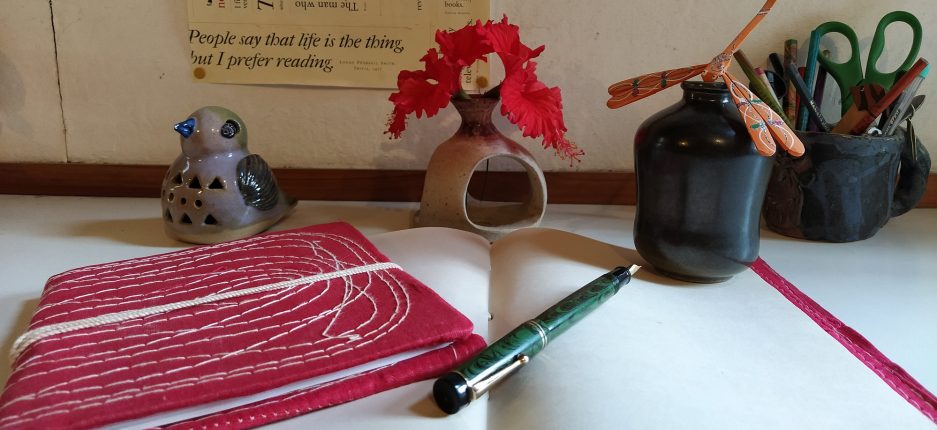
Ode to Libraries

As is probably, by now, evident, the Millennial Matriarchs are bookworms. We grew up with books, and we need books just as much, or more, as we grow older.

The enervating summer afternoons bring back so many memories of the joy of discovering, devouring, savouring, hoarding, exchanging, borrowing, and drowning in books, and more books. And, libraries were the dream destination of summer holidays.

Sharing some eloquent words that describe the power (and perils!) of libraries.

 Don’t Go Into The Library

The library is dangerous–

Don’t go in. If you do

You know what will happen.

It’s like a pet store or a bakery—

Every single time you will come out of there

Holding something in your arms.

Those novels with their big eyes.

And those no-nonsense, all muscle

Greyhounds and Dobermans,

All non-fiction and business,

Cuddly when they are young,

But then the first page is turned.

The doughnut scent of it all, knowledge,

The aroma of coffee being made

In all those books, something for everyone,

The deli offering of civilisation itself.

The library is the book of books,

Its concrete and glass and wood covers

Keeping within them the very big,

Very long story of everything.

The library is dangerous, full

Of answers, if you go inside,

You may not come out

The same person who went in.

Alberto Rios       Contemporary American Chicano poet

–Mamata


Living Together in Peace

In 1900 the poet Rabindranath Tagore dreamt of a world that has “not been broken up into fragments by narrow domestic walls…a world where the mind is without fear and the head is held high.” Several generations of students (including yours truly) recited the stirring lines with passion.

In 1971 John Lennon imagined a world where “There’s no countries…Nothing to kill or die for, And no religion too. Imagine all the people living life in peace.” A whole generation of young people (including yours truly) joined the chorus in a spirit of optimism and hope.

Sadly the world seems to have gone in the completely opposite direction. Today people seem to exist in a state of war…not just a war between nations but an insidious war between every kind of difference imaginable—colour and creed, race and religion, gender and age…what you wear and what you eat… Anything to kill or die for.

What a sad era when it is easier to smash an atom than a prejudice.”  Albert Einstein

Imagine—the United Nations has to dedicate a special day (16 May) as the International Day of Living Together in Peace. And to remind us that living together in peace is all about accepting differences and having the ability to listen to, recognize, respect and appreciate others, as well as living in a peaceful and united way.

Peace Poem

If there is to be peace in the world

There must be peace in the nations.

If there is to be peace in the nations

There must be peace in the cities.

If there is to be peace in the cities

There must be peace between neighbours.

If there is to be peace between neighbours

There must be peace at home.

If there is to be peace at home

There must be peace in the heart.

Author Unknown


If only…..


–Mamata

Supermom

It is building up to Mother’s Day again! As we are reminded by all the mushy gushy ads—a day to thank dear mummy with gifts galore! There is even on offer, an online course that will teach mothers “how to re-connect back to you, let go of mummy guilt, practice self care, gratitude and how to turn mundane tasks into magical mindful meditations. Learn how to feel connected, content and calm on your motherhood journey!”

This made me smile! If only mothers had the time and energy to take such a course! “Hey Presto! Look kids, Mummy is Connected!!”

Being a mother seems to get harder every day—you have tiger moms, helicopter moms, soccer moms, and more. I am reminded of the early phase of my own motherhood journey. We did not bear such titles, nor wear such mantles. We were simply hassled mothers!

I think back to the many years when, waking at dawn, I used to pack bags of clothes, boxes of food, and paraphernalia for the day, for two infants, and take ourselves off (the whole caboodle being dropped by husband, on a trusty scooter) to my office by 9.15 every morning. I was indeed blessed to have a crèche on the premises, but that did not excuse me from taking back, at the end of a long demanding working day, piles of soiled diapers (yes, dear ‘Pamper’ed mommies, it was before the days of disposables!)… all to be washed and dried and repacked the next morning. Coming home tired and cranky, while the children were fresh and raring to go, one barely made it through the evening of domestic chores (packing into a couple of hours an entire day’s agenda), till one collapsed with exhaustion, only to rise and shine again the following day.

Somewhere along that journey I wrote a little poem.

Superwoman

A song of those in mid-career,

who start a family.

Coping with home and job and kids,

with never a moment free.

No breathing time from dawn till night,

nor energy to take stock of life.

Burdened with the nagging guilt,

of being an inadequate housewife.

Juggling all the fronts at once,

trying to keep the balls aloft.

A precarious state it is indeed,

never sure if the battle’s won or lost.

Few realise the task it is

unless they really wear the shoes.

“Where am I going, and where is arriving?”

These are the superwoman’s true blues!

Dedicated to all those who are today, where I was yesterday! This too shall pass!

–Mamata


A Soft Pause

I like the comma! It is perhaps my favourite among the punctuation marks! Many years ago when I started out as an editor, it was a comfort and joy to work with Kiran, my “commarade”, who an equally ardent follower of the comma! Over the many years of copy editing since then, I am finding that the comma is increasingly dispensed with (as are most punctuation marks, as emoticons take over). Most people see no use or value in it, or maybe they haven’t ever paused to think about it!

Ah commas, these often overlooked tiny squiggles that lend order, and often sense, to a sentence. While a full stop ends a sentence, a comma indicates a smaller break–as a soft pause that separates words, clauses, or ideas within a sentence.

Indeed that is what it was always meant to be. The word comma itself comes from Greek word koptein, which means “to cut off.” The comma, as we know it, was introduced by a 15th century Italian printer Aldo Manuzio as a way to separate things.

While word lovers like us value the comma, it takes a master word-crafter like Pico Iyer to eloquently express these sentiments.

“The gods, they say, give breath, and they take it away. But the same could be said — could it not? — of the humble comma. Add it to the present clause, and, of a sudden, the mind is, quite literally, given pause to think; take it out if you wish or forget it and the mind is deprived of a resting place. Yet still the comma gets no respect. It seems just a slip of a thing, a pedant’s tick, a blip on the edge of our consciousness, a kind of printer’s smudge almost. Small, we claim, is beautiful (especially in the age of the microchip). Yet what is so often used, and so rarely recalled, as the comma — unless it be breath itself?

(In Praise of the Humble Comma. Essay in Time Magazine 24 June 2001)

So there is the humble comma, and then, as I discovered, there is the Oxford comma! The Oxford or ‘serial’ comma is an optional comma before the word ‘and’ at the end of a list: We sell milk, cheese, and icecream. It is known as the Oxford comma because it was traditionally used by printers, readers, and editors at Oxford University Press.

While this may seem not so important to worry about, this little squiggle before an ‘and’ can create hilarity, or confusion. For example if you write ‘I love my parents, Amitabh Bachchan, and Mary Kom’ without that little squiggle before the ‘and’, you may end up, unwittingly,  being the offspring of AB and MK!  

A comma, then, is a matter of care. Care for words, yes, but also, and more important, for what the words imply!

–Mamata


He Said It!

My day started well. This morning my newspaper informed me that May 5 is being celebrated as World Cartoonists Day! That brought a smile to my face even before I turned to the daily cartoon strips in my newspapers…something I do before I read the headlines. Faced with the continuous ‘breaking news’ of a world gone mad and bad in every which way, the cartoons remind me that, depending on what lens you use to see the world, there can still be something to laugh about!

Quite by coincidence, I recently read the autobiography of R.K. Lakshman, India’s best known cartoonist, illustrator, and tongue-in-cheek commentator on life and times.  Lakshman was an essential part of my growing up and growing older, as it was for at least two generations of Indians. Lakshman’s You Said It! daily cartoon provided a glimpse into the world through the eyes of the silent spectator, the Common Man.

Reading his autobiography The Tunnel of Time provided a peep into  Lakshman—the man himself, as he rambled through memories of places, people and events with humour, wit and yes, some irreverence! Since the time he can remember he wanted to be an artist. “An artist is what I wanted to be…I decided that I would pass my examinations but I never attempted to get high marks….My parents and elders were a great help, for they never took it seriously when one of the sons got pitiably low marks or even failed!”

As the youngest of 6 sons (one of whom was the famous author R.K. Narayan) and 2 daughters Lakshman grew up in a big household; he was left to himself all day, happily spending his time playing or drawing. So much so, that his parents did not realise that it was time that he was sent to school until a visiting uncle noticed him at home when all other children of his age were at school. He was promptly taken to the nearby municipal school—kicking and crying! From where the young Lakshman promptly ran away, and resumed play, until some months later another visitor took him back to the school. And there he stayed; as he says, “I moved year after year, class after class,” all the time filling the margins of his notebooks with sketches and doodles. The same continued through college days until he graduated with a BA degree; and immediately moved to Madras to try and get a job in one of the newspapers while his elders “as usual generously cheered me on my way into the world.”

As we continue to travel through the tunnel of time with the budding and determined cartoonist we learn about attempts and adventures as he makes his way into the world as an aspiring cartoonist, until he eventually became a cartoonist for the Times of India, and there he remained for the next five decades!

For all of us who imagine that a cartoonist just has a Eureka moment and with a few swift strokes produces a cartoon, it was indeed revealing to learn what it really took to put the Common Man on the front page every morning without fail. “I would be at the drawing board in the office exactly at 8.30 in the morning, reading and concentrating on news items, political analyses, editorial commentaries, opinions, spending the time tormenting myself, waiting hopelessly for the muse of satire to oblige me with an idea for next day’s cartoon before the deadline. When the idea did at last dawn, the rest of the work was comparatively easy. It was like shooting a movie—choosing a suitable setting, selecting the characters, compressing the script into a brief caption. By then I would have put in six hours of continuous work. Mentally and physically exhausted I would go home. But the sense of fulfilment and creative satisfaction would be immense.”

R.K. Lakshman shares delightful anecdotes about his travels and his many interesting friends, his close encounters with the powers that be, and the highs and lows of chronicling the facts and foibles of every aspect of social and political life. The Tunnel of Time is a treat of a read.

–Mamata


WHODUNNIT? THEYDUNNIT!

I love detective stories! From the time I cut my teeth on Enid Blyton’s Famous Five, Secret Seven and Fatty and gang, I was hooked on mysteries, and the sleuths who cracked them. As I am sure many other 10-year olds have done, I even attempted, with a cousin, to write The Mystery of the Missing Pillow.

Graduating to the classic Arthur Conan Doyle and Agatha Christie I began to enjoy not just the answer to ‘whodunnit?’ but equally the cleverly crafted plots, and distinguishing nuances of the sleuths who cracked the cases, starting with Sherlock Holmes and Dr Watson, and Hercules Poirot and Jane Marple, right up to the ‘traditionally built’ Mma Ramotswe. Over the years I have discovered, and delighted in, the quirky characters of the detectives created by writers in many parts of the world. I continue to explore, and discover, new and exciting detective fiction authors and add to my list of favourite detective characters.

On my last visit to the British Library I chanced upon a book called the Detection Collection. It was a collection of short stories by a number of authors I like. What made me curious was reading that the book was first published to celebrate 75 years of the Detection Club, and republished in 2015 to mark 85 years.

Digging deeper, I discovered that The Detection Club comprises the cream of British crime writing talent.  It was founded in 1930/1929/1932 (ambiguity surrounds the exact year) on the cusp of the Golden Age of detective, crime and murder mystery fiction which began in the early 1930s. The club’s first president was GK Chesterton, and since then the mantle of presidency has passed to some of the most significant names in the history of crime fiction including Agatha Christie, Dorothy L Sayers, Julian Symons and HRF Keating.

The Club in true British club tradition has a Constitution and Rules dating back to 1932. As described by one of its members “It is a private association of writers of Detective Fiction in Great Britain, existing chiefly for the purpose of eating dinners together at suitable intervals and of talking illimitable shop…if there is any serious aim behind the avowedly frivolous organisation of the Detection Club, it is to keep the detective story up to the highest standards that its nature permits, and to free it from the bad legacy of sensationalism, claptrap and jargon with which it was unhappily burdened in the past.”

Besides contributing individual stories to The Detection Collections, the writers have also occasionally come together to create a multi-authored single novel. One of these, published in 1932 was titled The Floating Admiral. Each chapter was written by a different Detection Club member and at the end of the book most of them also offered their solutions to what happened, and who had perpetrated the murder!

Imagine the best writers of detective fiction in Great Britain coming together three times a year—to dine, to exchange ideas, and to plot murders! Theydunnit!

“The detective story is the normal recreation of noble minds.” Philip Guedalla

–Mamata

The Pelican Has Landed

Raghu often lectures in various places. One of his favourite places to do so is the Silver Oaks School, a unique school in many ways. When he went for a talk there a few years ago, they gave him a potted plant. It looked pretty nondescript. We just left the pot on the verandah and watered it occasionally. But then, a few months later, it burst into flower! The flower whose pic you see below! Pretty exotic! It never grew very much but gave about 2-3 flowers a year, and were we proud of it! All our visitors made quite a fuss over it. We asked the gifters the name of the plant, but they didn’t know.


587DC86C-34EC-4AB3-BC37-7B731F2EC546

20180415_091803And then we moved to Bangalore, and decided to plant it in the ground. And were we in for a surprise! It was a climber, and boy, did it climb. It climbed to the first floor and went all over the terrace rails and roof. And flowers? About a hundred a year! Huge purple ones, with yellow centres. And very cute kind of seed pods—they burst into a parachute shape when they were dry. Our house became known for this creeper which was all over the roof.

Everyone was fascinated with the flowers, though a lot of people were a bit uncomfortable—as we sometimes are, especially with some types of orchids.

Then a friend decided to do a bit of research, and told us it was a Pelican flower (Aristolochia grandiflora). With that lead, we did our own research, and figured this was Aristolochia littoralis, a sort of cousin of the Pelican flower.

Apparently, these flowers are called Calico flowers (because they look like cloth?). Or Elegant Dutchman’s Pipe, because the flowers look like Sherlock Holmes’ pipe (now why would that be? Holmes was not Dutch to the best of my knowledge. But he may have been elegant, I concede.)

A lot of people had commented that our flower looked kind of carnivorous. But actually, it is not. Apparently, it is pollinated by flies and it does trap the fly inside to ensure pollination, but lets it out in a day or two, when the job is done. So machinating yes, but carnivorous no (sensitive readers, please excuse my anthropomorphism).

Nor do the flowers smell of dead carrion, as the books say they do. At least, ours don’t!

This plant, which is a native of South America, is an invasive species in Australia. But hopefully, not here. A lot of friends asked for the seeds but they couldn’t propagate it, so while my plant grows and grows, at least it is not spreading.

—Meena

11F045B5-D9BB-42B3-B5A7-5786F6E548E1

Bibliophile’s Supermarket

Know the feeling you get when you walk into your favourite store with gift coupons to be spent on whatever takes your fancy! The delicious sense of anticipation, the excitement of browsing the shelves, the difficult decision making…should you get clothes? Something for the house? Toiletries or accessories? You spend a happy time wandering and comparing before you make up your mind. You go home happy with a bag of goodies–an afternoon well spent!

That is just the feeling I get when I go to a library! Faced with an array of books, what could be more fun than to browse? What do I feel like this month—something light and happy? Something thrilling and gripping? Something serious and profound? A favourite familiar author? Best seller or Booker winner? Decisions, decisions!

This wonderful feeling has been a part of my life ever since I fell in love with books. The B.C. Roy Children’s Reading Room, more familiarly known as Shankar’s Children’s Library—a haven through the hot Delhi summer vacations; Grover’s hole-in-the-wall lending library in the neighbourhood market where one graduated from Archie comics to Mills and Boons! The American Centre library where one discovered the classics and the contemporary.

Moving cities, the first thing one looked for was the nearest library. In Nairobi it took the form of the next-door neighbour’s collection of crime and detective fiction which kept the suspense going! In Ahmedabad it was Raju’s circulating library that provided a menu of “time-pass” options. And now the British Library beckons every month. At the rate of 4-5 books a month, I seem to be running out of books to borrow. Panic!

But till then, every day is World Book Day for me!

–Mamata

MKG–LLB MD(Hon)

“His vocation to be a medical healer was deeper than his vocation to practice law.  He practiced law for about 20 years and then quit forever (though vigorously engaged in politics); his medical healing of sick individuals continued throughout the rest of his life.”

A recent lecture by Dr Mark Lindley at the Sabarmati Ashram in Ahmedabad explored Gandhi’s persona as a healer, and health advisor as well as practitioner. Lindley himself wears many hats! An internationally renowned musicologist, as well as an ecological economist, he is also a Gandhi scholar with particular interest in Gandhi’s views on health.

While I was aware of Gandhi’s strong and passionate views on health, diet and lifestyle, a lot of which can be found in his seminal work Key to Health, Lindley’s talk revealed several new aspects of Gandhi which I felt would be interesting to share.

We all know that Mohandas Gandhi went to England in 1888 when he was 18 years old to study law, under advice from family elders. What is perhaps not as well known is that Gandhi’s own desire was to study medicine there. At that point however, apparently the popular perception that becoming a barrister would be an ‘economically’ more practical choice prevailed.

The idea resurfaced around 1908 after he had already been practising law in South Africa. Gandhi may have felt that he could serve people better by practicing medicine than by practicing law. This time, it was the fact that studying medicine would involve vivisection that led him to reject the idea. During his visit to London in 1909, he wrote to a friend that a certain doctor there “…tells me that in the course of his studies he must have killed about fifty frogs. An examination in physiology without this, he tells me, is not possible. If this is so, I have absolutely no desire to go in for medical studies. I would neither kill a frog, nor use one for dissecting if it has been specially killed [by someone else] for the purpose of dissection.”

Interestingly Gandhi’s writings soon after that visit reflect a radical change of view. In Hind Swaraj which he wrote on board the ship while returning from England in 1909, Gandhi vociferously avers “I was at one time a great lover of medical profession. It was my intention to become a doctor for the sake of my country. I no longer hold that opinion.”

“It is worth considering why we take up the profession of medicine. It is certainly not taken up for the purpose of serving humanity. We become doctors so that we may obtain honours and riches. I have endeavoured to show that there is no real service of humanity in the profession, and that it is injurious to mankind. Doctors make a show of their knowledge, and charge exorbitant fees. …The populace, in its credulity and in the hope of ridding itself of some disease, allows itself to be cheated.”

Reading these lines, 109 years later, I was struck by how much this sounds like some of the concerns about the medical profession today!

As the famous French epigram goes “plus ça change, plus c’est la même chose”, in other words “the more things change, the more they stay the same.”

–Mamata