
Verse and ‘Worsifier’

Every time I come across a crossword clue which calls for filling the name of a South American mammal, the first lines that come to mind are:

The one-l lama, he’s a priest.

The two-l llama he’s a beast.

And I will bet

A silk pajama

There isn’t any three-l llama.

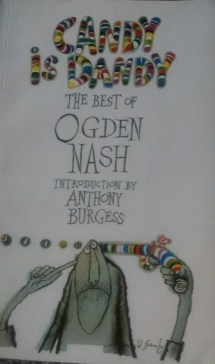
One of my favourite verses from one of my favourite poets—Ogden Nash! Frederic Ogden Nash was born on August 19, 1902, in the city of Nashville in America. Nash was a college drop-out who tried his hand at different jobs before joining the marketing department at the publishing house Doubleday. At the age of 29, he received international acclaim with Hard Lines, his first collection of humorous poems published in 1930. Following this, he left his job to concentrate fully on writing. He was a keen observer of American social life, and his writing anti-establishment. His tongue-in-cheek humour, and often irreverent poems caricatured the pretentious middle-class mentality of America in the thirties and forties. He wrote prolifically, over 500 poems including long winding verses, pithy two-liners, and take-offs on sonnets , ballads and limericks with his own inimitable play with, and, on words.

Nash considered himself a “worsifier.” He had a wicked sense of humour, and a clever way with words that always make me chuckle, no matter how many time I read his poems.

To celebrate Ogden Nash, sharing some of my old favourites, on creatures big and small.

The Cow 

The cow is of the bovine ilkIMG_20190820_151218.jpg
One end is moo, the other milk.

 The Germ

A mighty creature is the germ.

Though smaller than the pachyderm.

His customary dwelling place

Is deep within the human race.

His childish pride he often pleases

By giving people strange diseases

Do you my poppet, feel infirm?

You probably contain a germ.

The Ant

The ant has made himself illustrious

Through constant industry industrious.

So what?

Would you be calm and placid

If you were full of formic acid?

 The Fly

God in His wisdom made the fly

And then forgot to tell us why.

The Mules

In the world of mules

There are no rules.

 The Kitten

The trouble with a kitten is

THAT

Eventually it becomes a

CAT.

 The Octopus

Tell me. O Octopus. I begs.

Is those things arms, or is they legs?

I marvel at thee. Octopus;

If I were thou, I’d call me Us.

While his observations on the human race are somewhat lengthier, here are some short and snappy classics!

The Baby 

A bit of talcum

Is always walcum.

 The Parent

Children aren’t happy with nothing to ignore

And that’s what parents were created for.

 Birthday on the Beach 

At another year

I would not boggle

Except when I jog

I joggle.

 Crossing the Border

Senescence begins

And middle age ends

The day your descendants

Outnumber your friends.

 Introspective Reflection

I would live all my life in nonchalance and insouciance

Were it not for making a living, which is rather a nouciance.

Luckily for him, and for us, Ogden Nash could make a living from his insouciance, and his verse delights us even today!

–Mamata


Ode to the Saree

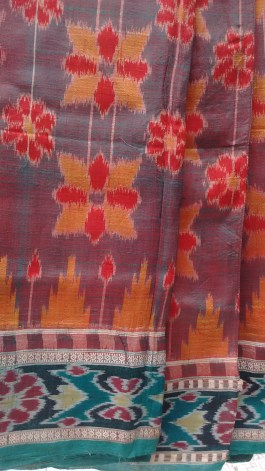
It is the day of tributes and nationalistic fervour. The news is replete IMG_20190815_101428069.jpgwith people sharing thoughts and feelings about what India means to them. This is my small paean to what, for me, represents the essence of India. It is an ode to the saree!

I wore my first formal saree when I was 16 years old. I still remember it—a magenta-pink Venkatagiri brought by my friend’s mother from Chennai. And I fell in love with sarees. Not just the finished draped version but simply this seemingly endless flow of fabric, with its mind-blowing variety of textures, weaves, designs, and colours. It was the start of an enchanting journey of discovery—learning, over the years, about the unique features of sarees from every part of India. Luckily for me it was the period of rediscovery of the rich heritage of our textiles which manifested in national handloom exhibitions where weavers displayed their wondrous skills. Oh the excitement of adding, one by one, traditional sarees of different states—the stunning kanjeevarams; the intricate ikats; the rustling golden tussars; the vibrant bandhanis and patolas; the summery kotas, and the sturdy handlooms. With every piece was the attempt to know more about the place and people who wove the masterpieces, the dyes and the motifs, the warp and the weft. It was an exploration of my country—its geography and history, culture and tradition, and craft and craftsmanship.

I was already part of a committed saree-wearing cadre when I started my career as an environmental educator. To my delight, one of the early statements by my Director Kartikeya Sarabhai, beautifully summed up the very special features of the saree. “The saree is a designed piece of clothing worn all over India. Over the years very beautiful designs, patterns and textures have been printed and woven into the Indian saree and yet, several thousand years of Indian history has not tried to stitch the saree. It is worn in many ways and fits all sizes. It is equally good for working, dressing up or sleeping in. The final effect is the combined effort of the person who designs the cloth and the person who wears it—of the designer and the user. This is a very different concept from that of designing, say, a well-stitched dress. The garment either fits or doesn’t fit, and where it fits, leaves very little room for the wearer to be innovative in its use.”

I have worn a saree every day of my working life. I have looked forward to choosing the one for the day, and it has become the symbol of my identity. I have worn my saree at home and at work; while travelling and sleeping; rain and shine. I have experienced the joys of putting together my own collection of the multitude of woven flavours of this wonderful country, and revelling in the rich bequest that is ours to savour and share

I am saddened at the ebbing of the saree today. Appalled that it has been reduced to a hashtag; that sarees have become exclusive “designer outfits” with tips on outre ways of draping a saree or, even worse, the stitched saree! I am amused when people think I am an ‘amma from the days of yore’ when I am the only one in a large gathering wearing a saree.  I am disturbed that in our race for globalisation and international Brands, we seem to be losing a crucial common thread of identity.

For me the saree represents the essential spirit of my country—the heritage and the history; the multiplicity and the uniqueness; the weaving of warp and weft to create a strong resilient fabric. It represents a unique common identity which subsumes the incredible diversity of textures and motifs. It represents the magic of being a seamless length of fabric that takes on the individual character of its wearer.

I may not wear my patriotism on my sleeve, but every time I wear my saree I celebrate the wonder that is India!

–Mamata

Two Sides of the Mirror

Time was, not so long ago, when photo albums were treasured family heirlooms.  Looking at old photos was one of the shared activities at a family get-together, with the elders pleasurably sinking into nostalgia, and youngsters playing guessing games at identifying the people in the pictures. There was a special excitement in flipping through the pages and sharing a laugh at “how much hair dear uncle had”, as compared with his bald pate today; or comparing the picture of the slim young girl with the comfortably chubby aunt today!

Photographs recorded the phases of life—the baby pictures taken by fond parents to record milestones; the awkward and self-conscious pictures of the gawky teenage years; the fancy wedding photo album; and the next cycle of young parents, their babies and doting grandparents.

There was a certain charm in seeing these transitions through the captured images. There was also a certain ceremony attached to the process of documenting. In the early years, this took the form of special posed pictures taken by professional photographers. With cameras becoming more user-friendly and available, it brought the process closer to home, but there was still the waiting period between the giving of the film for developing and getting back the prints and the negatives to discover what they revealed! Over time the technology and format of film, cameras and processing changed. The Polaroid camera was magic in a box—click, and voila the photo appears. …And then came the mobile phones with the ease of capturing images in an instant; along with all the many many Apps to do what you wish with the image. And everyone went crazy…every second of every day to be not only recorded, but immediately shared. Followed by the anxiety of how many views and how many likes. A deluge of images, sweeping across the screen of life, fleeting, momentary and, alas not as magical as turning the pages of an album to peruse history.

And now the new rage—FaceApp! The wand that reveals what you will look like when you are OLD! Celebrities across the world are posting pictures of what technology turns them into, projecting into the future. Of course every one of them looks suitably dignified and gracefully old, and feels reassured that “I am going to age well.”

Even more thought provoking is the news that this may also be used for not-as-legit facial recognition purposes. This makes me wonder. One the one hand, for millions of millennials, self-esteem and self- image hinge on being, at all times, visible on social media and “liked”. Then how can this be selective?

I am totally flummoxed by this. Here is a generation of self-obsessed young people living in an age where Image matters most. Here are the celebrities who spend millions on “looking young”. Here are the people who believe that life is in the here and now. Here is the technology which allows you to Photoshop away every trace of wrinkle or sagging skin, every blemish or hint of the passage of time. And yet these same people are clambering on the new high of “looking old.” Sadly, if only they stopped to think, life is more complex than an App, and who can tell what traces the ravages of time and experience will leave on our visage.

As for me, I would rather browse through the passage of time from my photo albums, than fast forward to the future!

–Mamata

Gentle Birdman Leaves Us

Many mornings, sitting in our little garden with our cups of tea, as we watch the birds already busy going about their day’s business, we may spot one that we had not seen before. And before it disappears we say, “Bring Lalsinhbhai’s book and let’s find out what this is.” Lalsinhbhai’s handy bird book is always close at hand. With the help of the beautiful life-like illustrations we open to the description, and always learn so much more than the name of the bird. Written in simple conversational Gujarati, Lalsinhbhai’s bird books are over and above the traditional description of birds. They capture nuances of birds that make them truly our Lifelong Companions, as one of his books is titled.

Lalsinhbhai Raol, passionate nature lover, the birdman of Gujarat, and an inspiration to countless nature lovers, passed away recently. For the Matriarchs, who both stepped into the charmed campus of CEE with relatively little prior exposure to the natural world, he was one of the wonderful guides that gently led us to explore and discover the world of birds.

Lalsinhbhai was then working with CEE on a book series called Introduction to Nature. For many generations, Salim Ali’s book had been the Bible for all birdwatchers. Lalsinhbhai’s series, in Gujarati, not only opened up the fascinating world of birds to non-English speaking audiences, but also opened windows to the birds of Gujarat—starting with the most commonly found birds, to birds of wetlands, of grasslands, and of the forest and its environs. Lalsinhbhai not only translated his long years of bird observation into succinct, interesting descriptions, but also coined appropriate Gujarati names for several of these.

His was a quiet, unobtrusive presence on CEE campus, but whenever you met him, he would always have a gentle word of concern and encouragement, and an exciting bird fact to share.IMG_20190801_110849.jpg

I had the privilege of sharing his great knowledge and passion when he kindly agreed to be the author of NatureScope Birds, one of a series of Teachers’ Manuals that I was editor of. This involved not only putting together a compendium of information about Indian birds in a teacher and student-friendly style, and also linking this with relevant and exciting activities that could be easily done. For me this was a greatly enriching and inspiring collaboration. Even today, I often dip into the book for facts, ideas, and activities with the confidence that every word is accurate and vetted by an expert ornithologist.

Meena has her own special memories of learning from Lalsinhbhai. I had the privilege to work with Lalsinhbhai on developing a proposal for a project of Bird Study for the Visually Challenged almost 30 years ago. It was a unique project, in that its purpose was to make ‘bird watching’ possible without the ‘watching’. Recorded bird sounds were of course an important part; but we also proposed providing tactile experiences such as touch-and-feel albums of feathers; collection of birds’ nests; true-size models of birds, birds’ feet, beaks, eggs; and trips to bird areas to experience the environment, sounds, etc. As always, Lalsinhbhai could empathise with the needs, and gave wonderful insights and ideas. The Ministry of Human Resources accepted the proposal and the team carried out a very successful project in Ahmedabad.

We feel fortunate for having known, and learnt from this gentle soul. May his spirit always soar high with the birds that he so loved.

–Mamata and Meena


It’s Not Easy…Being Parents

This piece is continuing Meena’s recent angst about parenting.

Indeed, parents need counselling more than the children. In many ways it seems that children today are more the receptacles of the parents’ own aspirations and, yes, peer pressures. How does the parent participate in conversations which centre around–What school does your child go to; what does she/he excel at; where did you go for your last family holiday; which are the different types of special coaching your child has… and so on. So the child has to live up to the expectations of not only the parents, but the social circles that they move in. And somewhere in all this circle of “well-meaning concern” the child begins to feel inadequate and undeserving, and there starts slow seeping of confidence, which sadly may end in extreme consequences.

At another level is the insidious guilt of the parents—for being so busy with their work and leisure; for delegating a lot of the traditional parenting tasks to external help; for not giving what they feel may be adequate time and attention; for not giving the child “the best that money can buy, after all what are we working so hard for?” This manifests in the over-concern, over indulgence and over coddling by parents; and a sense of birth right to privilege, self-centredness, and “my parents can set it right for me” on the part of the child. This too may have disastrous consequences should the well-planned map of “how we see our life” go awry.

Every generation of parents feels that the times that they live in are the most challenging, and that they require bespoke answers to child raising.

Interestingly, over 80 years ago, my grandfather Gijubhai Badheka, wrote several volumes on the challenges of parenting, with the apt title It Is Not Easy…Being Parents.  Gijubhai was not trained in child psychology; but his deep concern for the welfare of the child led him to observe, reflect, and note his thoughts. He described the dilemmas faced by both parents, as well as by children, and explored possibilities of how these could be handled.

For me, these simple yet profound notings are as fundamental and relevant even today. Sharing a few excerpts, translated by me from the original in Gujarati.

The young boy strenuously clambers up two rungs of the ladder. As he raises his foot to reach the third rung, the father says, “Come down; you are too young to climb ladders. If you fall you will break your bones.”

The young girl carefully wields a knife to chop vegetables or to sharpen a pencil. The mother scolds, “Put down that knife; you will cut yourself.”

The daughter wants to put the pan of dal on the gas stove. Mother says, “You will get scalded.”

The daughter says “Can I carry the glass of water for the guest?” Mother says, “You will spill it.”

The adults are trying to solve a problem. As they discuss the child offers some suggestions. All say, “Now you don’t try to act too big for your boots.”

Every day in innumerable situations we react in this fashion, unknowingly squashing the confidence of our children. Every time it takes up a task, it hears echoes of its parents’ cautionary warnings, and drops it forthwith, overcome by the fear that it will not be able to successfully accomplish the task. If someone asks it to climb up, carry something or use a tool, it may refuse, or if forced to do so, ends up falling or spilling or hurting itself. The child ends up even more ashamed at its own inadequacy to carry out the task.

By corroding our children’s confidence, we truly do make them unable to perform. In some ways our lack of confidence and trust in our children is a reflection of our own lack of confidence.

We need to have the strength to have confidence in our children. Encouraged by that trust, our children will prove themselves more than worthy of what we have bestowed. A child is human, a human striving to grow. We must enable this growth, the blossoming of its personality.

Removed from all the outer trappings of “success,” ultimately what do we, as parents, wish for our children? I think it should be “the confidence and courage to take on life!”

–Mamata


Hidden Figures, No Longer

This is the week of moon missions—past, present and future. Fifty years since the first man walked on the moon, and very soon, India’s own Chandrayaan-2  will become the first space mission to make a soft landing on the South Pole of the moon. Another ‘first’ worth celebrating is the fact that this moon mission is being led by two women, along with a team that comprised 30 per cent women. While programme director Muthayya Vanitha has nurtured Chandrayaan-2 over the years, the journey will be navigated by mission director Ritu Karidhal. Much to be proud of indeed!

Interestingly, while today women are rightfully making the headlines in science and technology, the scene was very different just 60 years ago. The booIMG_20190718_102016.jpgk titled Hidden Figures: The American Dream and the Untold Story of Black Women Mathematicians Who Helped Win the Space Race traces the true story of black female mathematicians who worked as ‘computers’ (then a job description of those who did calculations by hand) at NASA, during the space race. The book describes how the three mathematicians Katherine Johnson, Dorothy Vaughan, and Mary Jackson, overcame discrimination and racial segregation, with determination and hard work, to use their brilliant mathematical minds to contribute substantially to some of America’s greatest achievements in space.
The book traces the period from the 1930s through the 1960s in America, when women were still expected to be at home, and faced social, racial and gender discrimination.  Through sheer tenacity, force of will, courage and intellect, these women scientists ensured their stamp on history.

Written by Margot Lee Shetterly, herself an African-American, whose father was a research scientist at NASA during that period. His accounts of the work, and of his co-workers inspired her to research and tell the story of some of these women whose contributions were hardly known, let alone recognised. Shetterly is the founder of The Human Computer Project which is an endeavour to recover the names and accomplishments of all of the women who worked as computers, mathematicians, scientists and engineers at the NACA and NASA from the 1930s through the 1980s.

Just this year, the street outside NASA’s headquarters has been named “Hidden Figures Way”, in belated honour of these three African-American women whose work helped pave the way for future generations at the space agency.

The book Hidden Figures has also been adapted as a film by the same name, which captures the spirit of the book, although not the details of the work environment at the NASA Langley Research Centre, and the lives and experiences of these women.

In the meanwhile we are proud to honour all the women who are, rightfully, no longer simply hidden figures. What all the women (hidden and otherwise) do have in common is the passion that drove them to achieve their dreams.

As Ritu Karidhal has said “Since my childhood, I realised that science was not just a subject for me, it was a passion. When you are passionate about something, it just keeps you going, it doesn’t matter who is in front of you or what obstacles comes.”

Yes, even the sky is not the limit for those who not just dream, and but also dare!

–Mamata


Musings on the Moon

The moon is in the news! This week marks 50 years since the first man landed on the moon, and the papers are full of it, including reminiscences of that milestone year–1969. This took me back to my own association with the moon landing. It was my final school year, and we were told by all our teachers that this was a sure bet as a topic for the essay in our English and Hindi Board papers. So we read all that we could find, and mugged up the names and the dates, and the famous quote “That’s one small step for man, one giant leap for mankind”—the first words by Neil Armstrong as he stepped onto the moon (20 July 1969), and wove them into our creative writing practice.

Those were simple times. Television had still not come to our home. The whole family would avidly listen to the All India Radio news read by familiar comforting voices as they conjured up word pictures of events at home and abroad (the highlight of which was the live broadcast of the Republic Day parade on 26 January). Newspapers in black and white print, and sometimes fuzzy photographs provided the visual support to the audio coverage. We first saw a colour picture of the moon landing in the Span magazine published by the American Cultural Centre.

Being a teenager in Delhi was more about innocent pleasures, than pressures and angst. We had real friends (not virtual) with whom we spent all our time, in school and at each other’s homes, plied with home-cooked food by the much-loved aunties. We had music playing on LPs—Beatles and Woodstock; and the occasional Beat Show, when one of the parents offered to pick us all up and ferry us home for a giggly night-spend together. But we also sated ourselves on the rich offering of music, theatre and art that was easily accessible in Delhi in the 1970s. Books were our BFFs, and sources varied, from the American Library to the hole-in-the-corner neighbourhood lending library.

We were one of the early (now reviled) Khan Market gangs, when ‘hanging out’ meant simply walking around Khan (then not so up-market), and treating ourselves to a coke! Choices were limited, and aspirations were achievable—to join the Administrative Services or become a college lecturer if you were an ‘arts type’, or to become a doctor or engineer. Cut-off marks in lists were in the 60s, and annual fees in the best colleges were still in three figures.

And yet we all got somewhere meaningful, in our own ways, even though by today’s standards we did not “arrive in style” as it were. And we are still there, doing our best to live by our values, in a very different age. It has, after all, been quite an age–half a century–since those days. Since then science and technology have indeed made a giant leap forward, We can be proud that very soon our own moon mission Chandrayaan-2 will be up and away on its way to land on the moon.

Even as we now have the ability to probe the crevices and craters of the distant moon, wonderfully, the moon has not lost its magic for the dreamers and the poets and painters. moon.jpg

We need the moon more than its needs us—look up at the full moon today, and you will know why!

–Mamata


WEIGHTS AND MEASURES

On 20 May this year the definition of kilogram changed. The new definition fits in with the modern definitions for the units of time (second) and distance (metre).

weights

Most of us grew up using the metric system which is an internationally recognised decimalised system of measurement used to measure everyday things such as the mass of a sack of rice, the height of a person, the speed of a car, and the volume of fuel in its tank.

It is interesting to go into the history of this system. The metric system was introduced by the French after the French Revolution at the end of the 18th century, at a time when there was a chaotic state of thousands of traditional units of measurement in use. Twelve scientists were appointed to organise a universal and accurate system of measurement. They chose ‘metre’ after the Greek word for measure ‘metron’; and for simplicity of multiplying and dividing they decided to base it on the number ‘ten.’ One metre was to be one-tenth millionth of one quarter of the circumference of the Earth, measured from the Pole to the Equator.

By 1795 all metric units were derived from the metre, including the gram for weight and the litre for capacity. At first people were reluctant to accept the new measures but in 1840 they were legally enforced and there were punishments for those who refused to use the metric system.

The history of the predecessor to the Kilometre—the Mile, can be traced back to the Romans who invented a way of measuring distance in footsteps. A Mile was a thousand footsteps. The Romans marked their miles with special stones called Milestones.

Measuring land was difficult in olden days. Sometimes fields were measured according to how much land could be ploughed by a pair of oxen in one day.  In an unusual way of measuring land—if someone wanted to buy land, coins were put around the edges of the piece of land with all the coins touching each other. The cost of the land was said to be the number of coins that it took to surround it.

Today the global standards for measurement are set by the International Bureau of Weights and Measures which is located in Sevres near Paris. It is this international laboratory where international standards are kept; national standard copies inspected, and metrological research is conducted. The General Conference on Weights and Measures (CGPM), with diplomatic representatives of some 40 countries, meets every six years to consider reform. The conference selects 18 scientists who form the International Committee for Weights and Measures that governs the bureau.

As science advances so does precision, and today measurements are finely honed towards a hundred per cent accuracy. Thankfully, for most of us laymen this fine tuning does not mean too much change. News reports assured us that the ‘new improved’ kilogram would not impact weight watchers or grocery shoppers.

–Mamata


Aspirations

The last few weeks, my newspapers have been full of news about newly-crowned Queens. There is a Miss World, and a Miss Universe, and numerous other regal titles bestowed on young girls. So far so good.

As a passive observer peeping through the window of the pages of my newspaper, over the years I have been noticing how the run-up to such pageants is becoming more and more elaborate and ostentatious. Qualifying rounds are held in different cities, in the most luxurious hotels. Several glossy pages of the paper feature spreads of photographs of the pretty young ladies going through a variety of activities in different settings, clad to the nines in appropriate designer wear. There is an ever-growing list of event partners—dress designers, hair stylists, skin gurus, make-up magicians, tutors to (re)teach the girls how to walk and talk, and so forth. And, of course how can all this work without the sponsors? So you have sponsors for everything from the eyes to the toes–Miss Expressive Eyes, Miss Dazzling Teeth, Miss Scintillating Smile, Miss Satin Skin, Miss Shining Hair—and on till there is nothing left to miss!

Possibly thousands of girls apply for these pageants with these very visions becoming the stuff of their dreams. I suspect that even as they start the process, so much time and hard-earned money is spent in preparing the portfolios to enter the race. For those “lucky” ones who make it through the various rounds, the metamorphosis begins as they are taken through the paces. But behind the scenes? A bunch of still naive girls living in close proximity, in a fiercely competitive environment–I cannot begin to imagine what the atmosphere will be like—the anxieties, the hostilities, the petty politics, the pressures. As murky as the intrigues in the court of a royal family!

The newspapers kindly give us ‘”the underprivileged outsiders” glimpses into the culminating moments of the qualifying events. The full spread pictures of an array of pretty girls with similar hairstyles, smiles and dresses makes it difficult to tell the difference between them. Until voila—we have the coronation of the Queens. Usually the brouhaha ends there. This year there has been a follow up. We also had the privilege of following the Queens as they visited their “native places”—the town or village that their family hailed from. We saw pictures of cheering crowds, motor cavalcades, cameramen and interviews and family and village elders welcoming their local girl who became Queen.

And I think—Is this the role model for all the young girls in the small towns and villages? Is this what it means to have “arrived?” Is this what parents dream of for their daughters from the day that they are born? Aspirations!

It is a very worrying trend. One observes young girls (almost children) being accompanied to beauty parlours for a host of grooming and beauty treatments. Parents spend much money on consulting nutritionists and dieticians, trainers and gyms, and of course the latest fashion in clothes. “Looking good” becomes the end all and be all. Aspirations!

An even more frightening extension of this is the pushing of young children into the numerous reality shows. I am appalled at the occasional glimpse of children cavorting to Bollywood numbers dressed in vulgar outfits and plastered with make-up. A recent piece about a five-year old girl who won a dance show talked about her childhood in a slum of Kolkata, and how she has made her parents so proud. Her dream is to live in all all-pink fairy tale house. Aspirations!

How disturbing. How sad that in a country where we are still talking about Save Our Daughters, Educate Our Daughters, we seem to be building aspirations that promote superficial showmanship, branding, and objectification of our daughters.

–Mamata

Nature Deficit Disorder

Among the many new medical disorders that have entered into our consciousness and everyday vocabulary in the last decade or so, a new one was added in 2005— Nature Deficit Disorder. The term was coined by Richard Louv as a way to describe the psychological, physical and cognitive costs of human alienation from nature, particularly for children in their vulnerable developing years.

As we live in our concrete jungles, increasingly cut off from the sight, sound and feel of Nature, these senses are steadily diminishing. Increasingly medical research is now proving that our sedentary lifestyles or “epidemic of inactivity” is the cause of a host of appropriately-called ‘lifestyle diseases.”

Richard Louv in his book Last Child in the Woods: Saving Our Children From Nature-Deficit Disorder expressed his apprehension at the growing phenomenon of alienation from Nature, and built a case for consciously building closer links between young children and Nature, through opportunities to go outside, be in Nature, and learn from Nature.

Times have changed—and not for the better. Almost fifteen years after Louv articulated his concern, the “wave from the West” has reached our homes in India, as it has most parts of the world. Children don’t seem to get as much opportunity to play outdoors and explore and discover independently anymore; meeting friends is usually organised and supervised in “play dates” rather than children spontaneously getting together and simply “mucking and mooching around!” Yes, there are genuine issues—safe spaces, security and time; but this over-protectiveness can actually be detrimental to children’s health, if they don’t get enough outdoor time and experiences. Difficult though it is, while we as parents, leave no stone unturned to give our children the best opportunities that money can buy for their all-round development, are we giving them enough exposure to the outdoors? For children and their development Nature is not “optional”, it is as essential as a healthy diet for growing up.

I do believe that the same formula applies equally to adults. Nature and the outdoors are vital for our physical and emotional development and well-being; it is only here that can we encounter all four non-negotiable sources for self-development: freedom, immediacy, resistance and relatedness (connection). In fact, it is for us to take the lead.

An even more alarming trend has been towards the gradual deficit of Nature, even in our language. Since 2007 the Oxford Children’s Dictionary has been dropping words related to nature to replace them with words that they felt better represented the present day and age. Acorn, Buttercup, Conker gave way to Attachment, Blog, and Cut-and-Paste. In 2015, some of the world’s most prominent authors composed an open letter of protest and alarm at this impoverishment of children’s vocabulary by replacement with words “associated with the increasingly interior, solitary childhoods of today,” and its consequent diminishment of children’s belonging to and with the natural world. A frightening manifestation of Nature Deficit Disorder. The authors expressed their distress that such culling of words would “deny children a store of words that is marvellous for its own sake, but also a vital means of connection and understanding.”

As one of the authors said, “If you can’t name things, how can you love them?”

–Mamata

crabs claw close 2.jpg
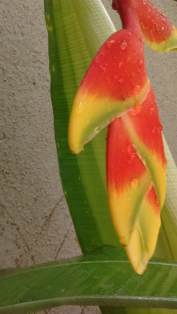
A flower by any other name…Crab’s Claw