New Master Craftsmen

Last week Meena wrote about Master Craftsmen. From Vishwakarma, the  legendary master architect and craftsman and an era when manual skills were highly respected and valued, to the present day when such skills are not as highly valued, as a result of which skilled craftspeople are increasing hard to come by.  

In an age when manual work, with attention to the minutest detail and quest for perfection is often eclipsed by industrialized mass production, there is a small and surprising band of new-age Vishwakarmas. This is the league of Lego enthusiasts who spend hours and days (and considerable manual dexterity) putting together little blocks to create mind-boggling structures.

Nathan Sawaya is considered to be the first artist to use Lego bricks in fine art. A high-powered attorney, he would come home and build with Lego bricks as a way to relax. Eventually he gave up his law career to dedicate himself to Lego art. Today his sculptures which range from a 20-foot-long Tyrannosaurus Rex skeleton to a tiny tree consisting of one brown piece on the bottom and one green piece on the top, are exhibited in galleries.

A Chinese artist Ai Weiwei recreates classic paintings using Lego bricks. Among these is the famous painting by French painter Claude Monet called Water Lilies. Weiwei has recreated this as a 15-metre-long art piece using 650,000 Lego blocks.

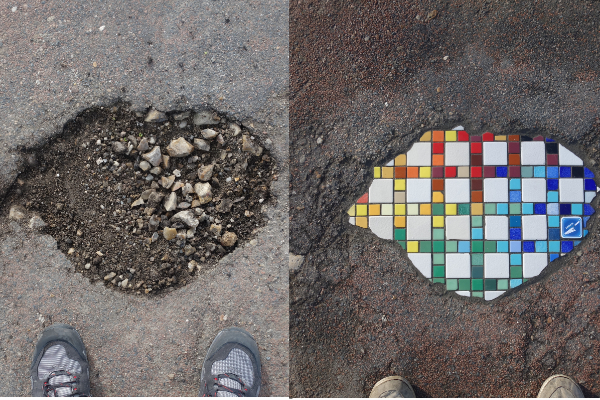
Other artists around the world have used Lego blocks on many occasions to pass a message of social awareness, or simply to entertain the imagination. Street artist Jan Vormann fills in cracks and crevices in damaged walls with Lego building blocks. He calls this ‘art meets functionality approach to repairs’ Dispatchwork. Today there is a worldwide network of people inspired by him who contribute to this creative repair approach.

Lego is usually associated with a children’s hobby kit. It is considered the epitome of an educational toy, and Lego sets have long gained a place at the top of the list of the world’s most popular toys. 

Interestingly the simple interlocking block-shaped toys that we know today as Lego bricks were the invention of a Danish master carpenter and joiner named Ole Kirk Christiansen. In 1932 when Europe was in the throes of the Great Depression, Christiansen opened a small woodworking shop in the village of Billund, with his son Godtfred who was just 12 years old, to manufacture stepladders, and ironing boards from left-over wood. They soon expanded their products to include wooden toys like simple yo-yos, trucks and ducks on wheels, made out of birch wood. In 1934 they gave their business the name Lego, a contraction of the Danish words leg godt meaning ‘play well’.

The company soon built its reputation as a high-quality toy manufacturer and business spread. The company itself grew from only six employees in 1934 to forty in 1942. The product line also expanded to include clothes hangers, a plastic ball for babies, and some wooden blocks.

It was in 1947 that the company made the move that would define its future.  Lego bought a plastic injection-moulding machine, which could mass produce plastic toys. By 1949, Lego was using this machine to produce about 200 different kinds of toys, which included a plastic fish, a plastic sailor, and small plastic bricks which had pegs on top and hollow bottoms, allowing children to lock the bricks together and create structures which simple wooden blocks could not. The ‘automatic binding bricks’ as they were called, were the predecessors of the Lego toys of today. In 1953, the automatic binding bricks were renamed Lego bricks. In 1957, the interlocking principle of Lego bricks was born. But these bricks were not too sturdy, and they did not stick firmly to each other.

In the meanwhile Lego had been working on a stud-and-tube design that facilitated the bricks to snap together firmly. They obtained a patent for this in 1958. This was the game-changer. The new system gave children the chance to build something sturdy, without it wobbling, or coming undone. Lego also made sure that new bricks were always compatible with old ones. In fact Lego has not changed the design of its bricks since 1958 when they got a patent for what is called the “universal system” so that each piece is compatible with all other pieces, regardless of the year or set it belongs to.

As the interlocking blocks grew in popularity, it was observed that children used the bricks in innumerable different ways to create more than just single structures. This led to the Lego Sets which had additional components like vehicles, street signs, bushes etc. to create streets and cities. The landmark addition of the wheel (around brick with a rubber tyre) in the 1960s brought in numerous new possibilities. With the production of 300 million tiny wheels per year, Lego out-manufactures the world’s biggest tyre manufacturers! The younger children were roped in to Lego-land with the launch of the larger Duplo bricks for pre-schoolers. 

The 1970s saw more additions to Lego sets–miniature figures (referred to as a minifig) with moveable arms and feet to populate the Lego towns; castles and knights to create a medieval world; pirates to sail on high seas, and astronauts to ride into space, and almost everywhere that a child’s imagination could take it.

The introduction of the immensely popular themes like Star Wars and Harry Potter contributed to the soaring sales, making this a multi-billion dollar industry. However it is heartening to find out that Lego has a strict policy regarding military models. They do not make products that promote or encourage violence. According to the company “Weapon-like elements in a Lego set are part of a fantasy/imaginary setting, and not a realistic daily-life scenario.”

Despite the scale and volume of production, there is no compromise on quality. The process used to mould the bricks is so accurate that only 18 out of one million bricks fails to meet quality standards. The original founder Ole Christiansen believed strongly in the values of creativity, individuality and, above all, quality. The Lego Group’s motto, “Only the best is good enough” was created in 1936, and is still used today.

Today there is a large international AFOL (Adult Fan of Lego) community. One of the challenges in the Lego world is to become a “master builder”. Coincidentally one of the most expensive Lego items is the Taj Mahal set which has over 6000 pieces to construct the Taj Mahal. Where centuries ago master craftsmen toiled with slabs of marble to create this magnificent timeless edifice, today the new master craftsmen work with plastic bricks to create its replicas.

–Mamata

Health Activist: Banoo Coyaji

Among the recently announced Magsaysay Awards is Dr Ravi Kannan, an Indian surgical oncologist who has revolutionized cancer treatment in Assam through people-centered health care. 

The citation for the award lauds the doctor’s ‘devotion to his profession’s highest ideals of public service, his combination of skill, commitment, and compassion in pushing the boundaries of people-centered, pro-poor health care and cancer care, and for having built, without expectation of reward, a beacon of hope for millions in the Indian state of Assam, thus setting a shining example for all.’

The Ramon Magsaysay Award, Asia’s premier prize and highest honour, recognizes greatness of spirit shown in selfless service to the peoples of Asia.

Thirty years ago this award was conferred upon another Indian doctor whose life and work reflected the same spirit that the above citation lauded. She was Dr. Banoo Jehangir Coyaji who was not only a medical practitioner, but an activist who used her profession and passion to change the lives of thousands of women in remote geographical areas.

Banoo Coyaji was born on 7 September 1917 in Bombay. She was the only child of Pestonji, a civil engineer, and Bapamai Kapadia. She spent her early childhood with her parents, but when she started schooling, her mother sent her to live with her grandparents in Pune, where she attended the Convent of Jesus and Mary. Thus Banoo grew up in a large loving household among aunts, uncles and cousins; while the family was affluent, the children were brought up to be disciplined. While many Parsis of the day were supportive of the British, Banoo’s family was nationalistic. Banoo herself was deeply influenced by Gandhiji and his philosophy.  

One of the big influences in Banoo’s life was the family doctor Edulji Coyaji who was known in Pune for treating the poor as well as the rich. It is he who encouraged the young school graduate Banoo to study medicine. Sixteen-year old Banoo joined St. Xavier’s College in Bombay for pre-medical studies, following which she pursued medical studies at Grant Medical College in Bombay, completing her MD degree in 1940. In the meanwhile she met Jehangir Coyaji, her mentor Edulji’s younger brother, and an engineer. The two married in 1941 after Banoo completed her degree. In 1943, she moved back to Pune where Jehangir worked, to set up house. Although she had an MD in gynaecology, Banoo joined Dr Edulji in his general practice. One day Dr Edulji told her that she was to go to KEM Hospital, as they were in urgent need of a doctor.

KEM was a private charity hospital that had been founded in 1912 by Pune’s leading citizens. When Banoo entered the hospital in May 1944 it had only forty beds. Primarily a maternity hospital, most of the patients were poor women, many who came from remote areas when their medical condition had reached a critical stage. The women also came with other medical issues so the small staff had to be prepared to treat any emergency. The workload was relentless and they worked over 18 hours a day. Banoo and her husband moved into a flat above the hospital so that she was able to attend to her young son, as well as her patients.

In 1947 Banoo and her husband were among the millions who witnessed India’s tryst with destiny as we became an independent nation. Around this time Banoo also made her first major intervention at KEM hospital. Having treated, over the years, women whose health had suffered due to child bearing issues (too many children, too early or late pregnancies, and the toll of unattended childbirth) Banoo opened Pune’s first birth control clinic. She was joined by Shakuntala Paranjpe a social worker and family-planning advocate who helped her reach out to women and promoted birth control classes for local women. This was a revolutionary initiative for the time.  

This was the start of many new developments that took KEM hospital from being a small maternity hospital to become a full-fledged general hospital, and one of the leading charitable institutions in Pune. To achieve this Banoo had to be continually fund-raising, adding new equipment and wards as and when she got funds. All the while she took no pay from the hospital.

Working tirelessly to maintain and grow the hospital, Banoo had no time to attend to something that had always been at the back of her mind. This was the question of what was happening in the villages from where patients often came with serious health conditions. In the late 1960s Banoo felt that it was important that the medical services should reach the villagers before the villagers needed to come to the city for treatment. She began exploring how KEM’s services could provide this outreach. Her team started by identifying a poor rural drought-prone area in Vadu Block, about 40 km from Pune. She approached the Health Secretary of Maharashtra government with the offer that the hospital run the block’s Primary Health Centre. This was agreed upon. In 1972, KEM set up a small outpatient clinic in Vadu. Maternal and child care, and family planning were the early priorities of the programme. From the beginning, KEM had emphasized the importance of research linked to its ongoing medical and public health programmes. In 1972, Banoo Coyaji seized an opportunity to establish a research society at the hospital.

While the first step to outreach had been achieved, Banoo felt that this was still a treatment service to those who came to the clinic. She felt that it was preventive care which could make a real difference, which addressed not the symptoms but the causes—sanitation, clean water, nutrition, and antenatal care. She felt that this would be best done by the local people themselves. Thus she asked each village to recommend a man and a woman who could be trained to serve as part-time health volunteers. The newly recruited volunteers underwent a comprehensive three-week training with a holistic approach to health and a healthy environment. The volunteers returned to their villages as community health guides, forming the grassroots base of a pyramid of healthcare services connecting their villages with KEM hospital at the top.

As the experiment showed results, there were suggestions that it be scaled up. In 1980 the model was introduced into the adjacent blocks of Kendur and Nhavra, where the village panchayats had passed a resolution inviting them to come. But the implementation had numerous challenges. However by the mid-1980s, Banoo Coyaji’s multifaceted interventions in Vadu were bringing about a quiet transformation, not just in human health but in the health of the local environment, and in the capacity and confidence-building of the local population, especially the women. 

By 1987, many elements of the Vadu model were accepted by Maharashtra state. These included KEM’s process for selecting and training village health guides, its insistence upon retraining middle-level health officers and on continuing education for its field staff, and its effective patient referral and grassroots record-keeping systems. This model was later used in many developing countries.

In 1988, with the help of the Indian Council of Medical Research, Coyaji launched the Young Women’s Health and Development Project to support an experimental training programme for girls. Aside from lessons in health, hygiene, personal development, and family life, the girls also studied population issues, the status of women, and the importance of education for girls. A second component of the programme involved learning vocational skills such as sewing, knitting, embroidery, crochet, and making costume jewellery and decorative items.

Thus Banoo Coyaji’s vision and the work of the KEM-trained volunteers went well beyond health and family planning to encompass literacy, livelihood options, legal advice, and even the support to question social issues like dowry. It was always a challenge, but as Banoo said All social change is slow. And very profound social changes indeed are needed before India’s women can achieve their full potential.

Dr Banoo Coyaji continued to work for the causes dear to her heart till she passed away on 15 July 2004. In addition to the Magsaysay Award she received many national and international awards, including the Padma Bhushan.  

–Mamata

Teacher? Teacher!

In the run up to Teacher’s Day which is celebrated in India on 5 September every year, there will be numerous pieces about outstanding teachers, teachers who have changed the lives of students, and other inspiring stories.

Sadly, even as we felicitate and celebrate teachers such as these, there are also disturbing reports about teachers who, perhaps, could leave life-long scars on the children that they have the opportunity to mould and nurture. These belong to the mass of average teachers who are “teachers” in name but not in deed. What do they make of their job, which is really speaking a means of livelihood, and even that, which is insecure?

Take this piece, titled Confessions of a Teacher.  

I am a teacher. I saw an article entitled ‘Teacher’s Confessions’ and thought, why not pen down my own confessions?

I have been in teaching for years now. As a requirement to becoming a teacher, I had at that time, to study the science and principles of education. I have not learnt much more, since then.

I go to public libraries but rarely touch teaching related journals. A glance at the librarian’s issue book will show several books against my name, but none related to education.

I am certainly in the habit of reading. In the early years I was busy studying the textbooks and related material. But the textbooks don’t change often. I now need only to glance at the books. My reading list now includes dailies and monthlies and some assorted fiction.

After school hours I rarely discuss education-related topics. My discussion includes topics such as someone’s dismissal or promotion, forms and examinations, higher authorities or fellow teachers, booksellers, and so on.

During recess time, my colleagues gather for a cup of tea. We talk of many things. But never do we talk about how to teach, teaching aids, or students.

The school timings are fixed. The curriculum is set. The school bell heralds the passage of time, and students are prepared for the examinations. The systems are in place. I go to school. Teach the lessons for the day. I carry out my tasks and keep the order – partly by force, partly by wit, partly through my image, and largely through the set disciplinary systems of the school.

I don’t get into the depths of any subject. There is no time; just enough to complete what will be part of the exams. Students will take longer, and explanations will have to be made to the authorities.

I know the students by name, or those that know their lessons, and those that do not. I do not know anything about their family, their friends, their own personalities. We are not close. I know their minds, but not their hearts.

I see who comes first, and who is last. I do not know about their physical strengths and weaknesses. Those who finish their work and bring it to me, are clever; those I like. The rest are duds; I do not like them. Between us there is no affection. How can there be trust? They are afraid of me; and I exert my authority over them.

Once I leave the school, I scarcely think of them, save perhaps, one who might have been greatly disrespectful. Each to our own homes. Perhaps, as I lie down the thought may cross my mind that as the exams near, I will have to speed up the revision, for which I’d use the recess.

I haven’t seen the home of the children. Nor have I shown them my home. I do not have such a relationship with them.

I dream that I will be promoted till some day I become headmaster. I will complete my term of service, retire and enjoy my pension. I hope to save a little before I am too old. That is why I have to take tuitions.

I wish that I am well thought of in my community, that I can educate my children so that they get good jobs, and I can marry them off before I enjoy old age.

It is for this that I wish to work. Today the profession of teaching is, for me, an activity, a job. In all this, the ideals of education, the changing principles and practices of teaching, the desire to bring new changes in the field – all this is not in one, where will they come from?

I would like to explain clearly what my position is today. My state is like this; I presume my fellow teachers are in a similar situation.

If we think that this is a familiar scenario, it may come as a surprise that this was written in 1932 (nearly a hundred years ago). The author is Gijubhai Badheka an eminent educator who helped to introduce Montessori education methods to India. Disturbed by the dark educational system of that time, he embarked on his journey into the realms of education, and left behind a rich legacy of work and writing.

More about Gijubhai and his work on www.gijubhaibadheka.in.

Several generations later, the dilemmas about what makes a ‘good teacher’ continue to engage educators.

A hundred years after Gijubhai wrote some of his seminal works on education, Sir Ken Robinson one of the eminent contemporary thinkers on education propounded a critique of the school system. His TED talk Do Schools Kill Creativity? is one of the most watched talks. He urged schools to transform teaching and learning to an experience personalized for every student involved.

His words resonate closely with Gijubhai’s angst about the state of education, and his dream for a transformative educational system

Role of the Teacher    

The problem is that over time, all kinds of things have gotten in the way of it – testing regimes, league tables, unions’ bargaining rights, building codes, professional identities, the concerns of various pressure groups, ideology of various political parties. It’s very easy for people to spend all day discussing education without mentioning the students at all. But all of this is a complete waste of everybody’s time if we forget that our role is to help students to learn. Therefore, the question is: what should they learn and how do we best do that?

All the great education systems and schools know that. It’s why they invest so heavily on the selection of teachers, why they insist on getting people who don’t just have good degrees, or have them at all. They want people who know their material, but they also know that teaching depends upon a whole set of pedagogical skills and a love of the process. It’s more than the transmission of direct content. It’s about having a set of skills focused on facilitating learning. (Sir Ken Robinson)

A teacher’s work is like flowing water. The fulfilment of the work of education is not in teaching one or two subjects… Real education lies in making humans aware about their own unending strengths. (Gijubhai Badheka ‘Note to Teachers’ 1920)

Some food for thought.

–Mamata

More Than Just a Library

Recently there was an article about heritage libraries in India and how some of these are in the process of being restored, renovated, and upgraded so that the rich history and legacy could be shared with a new generation of bibliophiles. Among these is Mumbai’s David Sassoon Library established in 1870 and the National Library in Kolkata the roots of which can be traced back to 1836.

Coincidentally, around the same time I was reading a novel called The Paris Library. While the story and the two main protagonists are fictional, the library around which it revolves, and most of the other characters that are part of the story are based on real people and places. This was the American Library in Paris or ALP as it was called.

As a curious bookworm I was intrigued by this and decided to investigate further into the ALP. I discovered a fascinating history.  

The seeds were sown during World War I. This was when thousands of young Americans were fighting with the Allies on the battlefronts in Europe. At this time when the main supply to the front was in the form of arms or medical equipment, the American Library Association felt that the troops needed something to engage them mentally in the midst of their grueling physical existence. So it collected books and periodicals donated by American Libraries and personal collections and shipped these to France to the Library War Service from where they were sent to military bases, training camps and hospitals where American soldiers were fighting. It is estimated that around 2 million books and five millions periodicals were shared in this way with American soldiers fighting the war far from home. One of the centres which housed part of the collection was also in Paris.

When the war ended, there was a discussion about what to do with the books that that been an important support all through the war, not just for American servicemen. During this period the citizens of Paris had also become fond of browsing through the collection of English language books in open stacks (an uncommon feature of European libraries at the time), and international newspapers and periodicals in the Paris centre. Thus although there was no plan to establish a permanent library in Paris this idea seemed to evolve and slowly take root. The thinking was that the library could also serve as a functional model to demonstrate American library methods, especially the use of the Dewey decimal system and open stacks.

Thus the decision was taken not to ship the books back but to establish a permanent library in Paris in the spirit of Atrum post bellum, ex libris lux: After the darkness of war, the light of books. This also became its motto. There was however the question of funds needed to establish and run the library, but the idea had many advocates, and contributors from all walks of life, in America and in Paris united to pledge every kind of support. This was probably an early example of crowd funding.

As a result the American Library in Paris was founded in 1920 by the American Library Association and the Library of Congress with a core collection of those wartime books. Its charter promised to bring the best of American literature, culture, and library science, to readers in France.

Having been established, there was a continuous struggle to keep it not only running but also to enhance its collections and also serve as a cultural hub. The library constantly innovated to keep itself up and running. The Library worked with sixty-five leading publishers in the United States, who sent free copies of newly published works which the Library displayed in a dedicated exhibition space. Over a thousand new books per year were acquired through this channel. Meanwhile, the Library staff, wrote widely published literary reviews of the new titles, and in 1924, they launched their own literary journal called Ex Libris, to which Ernest Hemingway and Gertrude Stein contributed. The library also formed relationships with other libraries through inter-library loans and other social organisations. The American Library in Paris quickly became a vital hub of reference services and educational outreach. Within just three years of existence, the library’s reference room was visited by 35,000 users. It founded its own children’s section in 1928 and had Story Hours for children. The library had highly qualified and dedicated staff as it invited librarians from some of the best libraries in the USA to come on sabbaticals. Some of these stayed on.

The library which grew out of World War I played a critical role during World War II. Once again it sent thousands of books to the troops fighting at the front in Europe. The library became a refuge for its habitués (regular subscribers) not just providing the comfort of books, but companionship, solidarity and solace. As one of the characters in the book puts it: Libraries are lungs, books the fresh air breathed in to keep the heart beating, to keep the brain imagining, to keep hope alive.

The library remained open even during the dark days of the Nazi occupation of Paris. Many of the American staff including its doughty librarian Dorothy Reeder stood firm, until they were forced to evacuate the country, but a handful of local staff bravely continued to run it. They themselves faced great personal risks in delivering books to the homes of some of the regular Jewish subscribers who were no longer permitted in public spaces. The library was also subject to “inspections” to check if they were harbouring any forbidden literature.

The book The Paris Library tells the story of the library and its habitués during the period of World War II. It is a heart-warming tale of the manifold power of books and the unique bonds that books create between people. As the library director Dorothy Reeder says in the book: Because I believe in the power of books—we do important work, by making sure knowledge is available and by creating community.

The story reflects that the original motto of the library: After the darkness of (another) war, the light of books.

The American Library in Paris celebrated 100 years of its founding in 2020. Even in an age where there is a deluge of information at the fingertips this library serves over five thousand members from sixty countries. It holds the largest collection of English language materials on the European continent, and is wholly community supported. It is now as much a community and cultural centre as it is a library, and its users are as diverse as its collections.

–Mamata

Sisters-in-Arms: Pritilata Waddedar and Kalpana Dutta

This Independence Day week there have been many pieces celebrating the numerous freedom fighters who were part of the nationwide movement for independence. The movement was unique in that it took the path of non-violence to achieve this goal.

Whilst many of the names are part of history textbooks, there were thousands of people who played their part in the fight for freedom. Not all of these are as well remembered. Among these, there were also some who were driven by the same aims but who chose to take another path of showing resistance to the colonial rule.

This is a story of two feisty young women who chose the path of direct resistance, and who dedicated their life to the cause. They are Pritilata Waddedar and Kalpana Dutta.

Pritilata Waddedar

Pritilata Waddedar was born on 5 May 1911 into a middle-class family in a village of Chittagong, now in Bangladesh. She did her schooling in her hometown and then moved to Dhaka for high school studies at Eden College. It is here that the young Pritilata came in contact with other women who were strong anti-colonialists and who were inspired by revolutionary ideas. The spark was ignited. Pritilata then moved to Bethune College in Calcutta to pursue a higher degree in Philosophy. On completion of her course, Pritilata’s degree was held back by the British authorities at Calcutta University because of her anti-British activities. The seeds of rebellion were firmly sown. Pritilata returned to Chittagong in 1932 where she joined as a teacher in a school and went on to become the headmistress.

It was during this period that Pritilata was introduced to Surya Sen who led an underground revolutionary group. Pritilata approached Master Da as Sen was called by his followers with a request to join his group. Initially Sen as well as his comrades were hesitant to include a women in the group, but Pritilata’s revolutionary passion and steely resolve to overthrow the British, as well as her abilities to carry out risky assignments gave her entry into the group.

Comrade Pritilata was a key member of the group that planned and strategized armed attacks on railway lines, telegraph office, the armoury, as well as the famous Chittagong Uprising—the raid on the armoury of police and auxiliary forces that cut Chittagong off from the rest of the country. Pritilata played an important role in supplying explosives to the revolutionaries. The raiders managed to escape but the British authorities tracked them down in the Jalalabad hills near Chittagong. Several thousand troops ambushed the rebels and many of them (some merely teenagers) were killed in the encounter. Sen’s depleted band had to reorganize and re-strategize.

They decided to avenge the Jalalabad massacre by burning down the Pahartali European Club. This club was targeted because, among other white supremacy symbols, it also had a sign at the entrance which declared that ‘Dogs and Indians are not allowed.’ Pritilata was the leader of the eight-member team. The team prepared by intensive training in the use of firearms. As in any military formation the leader was to be the first to attack and the last to return after the rest of the team had moved to safety.

On the night of 23 November 1932 Pritilata and her team, dressed as Sikh men laid siege to the club and set fire to it. British troops were quick to retaliate. Pritilata and her team were chased and ambushed with little hope of escaping alive. Nevertheless Pritilata tried to divert the gunfire to give her comrades a chance to escape. In the process she was shot in the leg. Rather than die under British arrest, the wounded Pritilata swallowed cyanide and ended her life. She was 21 years old. The police found her body early next morning and were surprised to discover that the leader of the attack was a young woman.

Kalpana Dutta

A lot of what we know about Pritilata is thanks to the memoirs of Kalpana Dutta which describe in detail the Chittagong Uprising. Inspired by Pritilata, Kalpana became a fellow comrade, and was also one of the few women members of Surya Sen’s underground group of revolutionaries. Kalpana often travelled disguised as a man, to transport explosives and other supplies to the group. She also became an expert in preparing gun cotton, an explosive agent.

Born on July 27, 1913 in Sreepur village in Chittagong, (now Bangladesh), Kalpana Dutta was fond of listening to adventurous stories since childhood. While studying in high school, she read many biographies and stories of freedom fighters, which inspired her with the passion to join the struggle for freedom. She joined a semi-revolutionary student organisation called the Chhatri Sangha and became one of its most active members. It was here that she met Pritilata, and the two became close friends. It was Pritilata who introduced her to Surya Sen.

Following the Jalalabad massacre, both Pritilata and Kalpana were designated as the key executors of the arson attack on Pahartali Club. Just a week before the attack, while she was on a reconnaissance trip of the area, Kalpana was detained by the British. She was released on bail, she immediately went underground to ensure that the plan would continue without any obstacles. Pritilata became the sole leader of the team. As we know, the team was ambushed and the wounded Pritilata took her own life rather than die in the hands of the enemy. 

Kalpana remained underground, even when the British finally managed to locate and capture Surya Sen in 1933. Three months later, she was eventually arrested and sentenced to life in the second supplementary trial case of the Chittagong Armoury Raid incident. She was released after six years of imprisonment. After her release from prison, she completed her studies and graduated from Calcutta University in 1940. Following independence, she led a relatively quiet life until her death in February1995. She wrote her autobiography in Bengali which was translated into English as Chittagong Armory Raiders: Reminiscence.

The note left by 21-year-old Pritilata when she died sums up the spirit of these two fearless young women who broke many stereotypes of the time.

There may yet be many among my dear countrymen who would question [women being fighters]. Nursed in the high ideal of Indian womanhood they may ask, how can a woman engage in such ferocious task of murdering and killing people?

I am pained at the distinction being made between a man and woman in the struggle for freedom of the country. Today if our brothers can enlist in the war of independence, we too the women should be allowed to do the same and why not?

–Mamata

Tomato Puree

There is an unusual addition to the front page news these days. It is the tomato! As prices of tomatoes soar, there is panic. From housewives to gourmet chefs there is a scramble to devise meals where the familiar flavor and texture of tomatoes can be recreated without the star ingredient. Recipes are shared, and suitable substitutes recommended, such as tamarind, raw mango, kokum and curd. Ironically these tartness-adding agents have been used in Indian cooking well before the tomato gravy became ubiquitous element in everything from paneer to pizza!

Interestingly, the tomato is a relatively recent arrival in India. It is believed to have been introduced by the Portuguese in the 16th century, and was probably grown in the parts of India where the Portuguese influence was strong. It was not easily adopted by the local people as it was looked upon with suspicion, often referred to as vilayati baingan (imported brinjal), and unclear whether it was meant to be eaten raw or cooked. It is only in the 19th century, with the British influence that tomatoes became a part of Indian cuisine.

As we are missing the tomato in our daily meals, it is a good time to take a look at its chequered history.

The global history of the tomato also is a long and convoluted one. The plant is believed to have originated in South and Central America, and can be traced back to early 700 AD to the early Aztecs who named it tomatl or xitomatl (plump thing with navel). It was an integral part of their native diet in the sixteenth century. The Spanish conquerors of the region called it tomate, from which the English word tomato is derived.

Europeans first came in contact with the domesticated tomato when they captured one of the cities of the region. The Spanish conquistador Hernan Cortes is thought to have brought back the seeds to southern Europe where they were planted for ornamental purposes. The tomato was not eaten till the late 1800s. This was in part due to their reputation as being deadly plants. Some of this was because the tomato was classified by Italian herbalist Pietro Andrae Matthioli as being part of the deadly nightshade family (Solanaceae plants that contain toxic tropane alkaloids) and a mandrake (a group of foods thought to be aphrodisiacs). The fruit was also nicknamed as “poison apple” because it was believed that eating this could be fatal.

Another thing that compounded this belief was that rich people in the 1500s used plates made of pewter which had high lead content. Foods high in acid, like tomatoes, would cause the lead to leach out into the food, resulting in lead poisoning and death. Thus the cause of death was not tomatoes but lead poisoning. However this connection was not made then, and the tomato was labelled as the culprit. The less affluent who ate off plates made of wood, did not have that problem, and hence did not have an aversion to tomatoes. This is essentially the reason why tomatoes were only eaten by poor people until the 1800’s, especially in southern Italy. People may have started eating tomatoes when not much else was available because not only did they add flavour to the otherwise bland meat dishes, but they could also be preserved and stored. The earliest recipe for tomato sauce was published in 1694, by Neapolitan chef Antonio Latini in his book Lo Scalco alla Moderna (The Modern Steward).

Even within the rest of Europe, tomato as an edible component was looked upon with suspicion. Tomato was perceived as a cold fruit, and coldness was considered a bad quality for a food according to the Galenic school of medicine. It was associated with eggplant which was also an unknown; it was cultivated close to the dirt, another factor that didn’t make it palatable. While the tomato was gradually making its way into cuisine in southern Europe, it still had to find its way to other parts of the world.

How did the tomato synonymous with pizza? Thereby hangs a tale! In 1889 the Queen Margherita of Italy was to visit Naples, and one restaurateur wanted to create a special dish to honour Her Majesty. He made a pizza topping from three ingredients that represented the colours of the new Italian flag: red, white, and green. The red was the tomato sauce, the white was the mozzarella cheese, and the green was the basil topping. Hence, Pizza Margarite was born, which still remains the most standard pizza.

The mass migration from Europe to America in the 1800s meant that the new arrivals also brought with them their own culinary ingredients and traditions. The Italians took with them the tomato and its basic partner the pizza. The rest is history! From the mid-1880s tomatoes became a staple in American kitchens. As the demand for tomatoes increased they began to be imported in large quantities.

One of the big importers of tomatoes was John Nix, wholesale merchant in New York. When a shipment of tomatoes arrived at the port a 10 per cent import tariff was levied. At the time imported vegetables were subject to this tax, while fruits were exempt. Nix protested, arguing that tomatoes were not technically vegetables. He was not wrong. Tomatoes were, and are, botanically classified as a fruit. A fruit contains the seeds of the plant while any other edible part of the plant that we eat, which doesn’t come from the fruit of the plant is considered a vegetable.

Nix filed a case against Edward Hedden, the Collector of the Port of New York. The case made its way to the Supreme Court in 1893. The case was argued using definitions of fruits and vegetables from different dictionaries and their usage. It became a hotly debated issue: Tomato: Fruit or Vegetable? Eventually the court unanimously agreed that the tomato should be classified as a vegetable because of how it was used in everyday life, not how it was used in commerce or in purely botanical terms.

A plump thing with navel, a poisonous ornamental plant, a poor man’s multi-use ingredient, a tax-exempt fruit to a taxable vegetable. Tomato puree indeed!

–Mamata

Mycologist, Artist, Author: Beatrix Potter

Several generations of children grew up with The Tale of Peter Rabbit. The author Beatrix Potter is a familiar name in children’s literature, but what is less known is that she was also a notable woman of science, in an age when this was almost unheard of.

Helen Beatrix Potter was born on July 28, 1866 in London in a family that enjoyed culture and the arts. Although Beatrix was educated at home by a governess, she and her brother spent all their free time in the woods around their home, observing the small creatures that lived there, and even bringing some, like hedgehogs and rabbits home. Beatrix was a quiet shy girl who expressed herself through paintings and drawings of wildlife, and in coded notes in a secret diary.

When an uncle who was a chemist gave her permission to use his microscope, a whole new world opened up for Beatrix who could minutely study plants, and insects and make detailed sketches. Her interest in natural history was further spurred when she used to visit the South Kensington Museum. She found herself drawn to the study of plants and fungi as well as insects.  

Beatrix’s interest in drawing and painting mushrooms, or fungi, began as a passion for painting beautiful specimens wherever she found them. As her biography says: She was drawn to fungi first by their ephemeral fairy qualities and then by the variety of their shape and colour and the challenge they posed to watercolour techniques.

In October 1892, on a family holiday in Scotland, Beatrix got to know Charles McIntosh, a local postman and self-educated naturalist who was also an expert on British fungi. McIntosh admired her pictures, sent her specimens to paint and advised her on scientific classification and microscope techniques. She sent him copies of her pictures in return. She would go on to produce some 350 highly accurate pictures of fungi, mosses and spores.

Beatrix also started hunting for rare varieties of mushrooms, and growing dozens of different species of fungi at home, in order to study their development. She was intrigued by their life cycle. By 1895, Beatrix Potter’s interest in fungi was becoming even more scientific. Following advice from McIntosh, she began to include cross sections of mushrooms in her illustrations to show their gills and used a microscope to draw their tiny spores. She speculated about whether these spores could germinate and the environments in which they might do so.

In May 1896 her uncle Sir Henry Roscoe, a prominent chemist, introduced her to the mycologist at Kew’s Royal Botanic Gardens. This led to a post at the Royal Botanic Gardens where she produced faithful, detailed renderings, largely of mushrooms and toadstools as seen through a microscope. In addition to her art, the scientist in her also began experimenting with germinating spores of various fungi on glass plates and measuring their growth under a microscope. Her close observations and experiments, as well as her drawings showed in great detail how lichens, a common type of fungi found on rocks and trees, were actually not one but two different organisms that lived together. Her studies showed that this was a union between an alga and a fungus. The two different organisms are able to live together, with each of them benefitting the other in some way. Beatrix thus was one of the earliest to study and hypothesize what would later become the science of symbiosis. However, the botanists she showed her work refused to discuss even discuss the drawings she made.

Beatrix prepared a paper on her findings and submitted her work to The Linnaean Society of British Scientists but was not allowed to read it herself because, at that time, only men were invited to their meetings. The all-male panel rejected her paper and refused to publish it. Potter withdrew the paper, presumably to make amendments. But it was never published; and no copy exists today. Thereafter Beatrix turned her full attention to drawing and writing.

There is today some controversy about how serious Beatrix Potter was as a mycologist. But there is no doubt about the accuracy and detailing of her drawings and paintings of fungi which remain unparalleled, and are referred to mycologists even today. As her biography says: Beatrix Potter never saw art and science as mutually exclusive activities, but recorded what she saw in nature primarily to evoke an aesthetic response.

The name Beatrix Potter endures today as the author of well-loved children’s books. In 1893 she sent a letter with a picture story to a sick child of her old nanny which began with the words “I don’t know what to write to you, so I shall tell you a story about four little rabbits whose names were Flopsy, Mopsy, Cottontail and Peter.”  Beatrix went on to create the loveable characters of Peter Rabbit, Benjamin Bunny and Jemima Puddle Duck, among others that had adventures in the 26 books that she published subsequently. Over 150 million copies of her books have been sold and have been translated into 35 different languages

As her books gained popularity, she channelled all the profits towards a large property called Hill Top which she purchased in 1905. Situated in England’s Lake District, this was her first farm. She enjoyed the quiet and solitude that the thirty-four-acre property brought her and this allowed her to work more efficiently. Aside from being a farmer and landowner, Beatrix also became recognized as a sheep breeder. She never lost her love for nature and became an advocate of traditional farming and the preservation of the wild environment surrounding the area. She continued buying patch after patch of land around her farm. By doing so, Beatrix hoped to further pursue her dream to provide land for the creatures that she had loved since her childhood.

Beatrix Potter died of bronchitis in 1943, aged 77, leaving behind a legacy across different fields of study. The British Natural Trust eventually became recipient to her donation of 4,000 acres of land. The property was named a UNESCO World Heritage Site in 2017, and is now open to the public.  Beatrix Potter’s love for the land and all its creatures continues to provide a haven for all life.

–Mamata

Rubik’s Magic Cube

It was all the rage in the 1980s. Every house had one, and it was fought over by adults and children. It was in everyone’s hands that were never still; it sparked contests and competition across the world. It was the Rubik’s Cube.

At first glance, the cube seems deceptively simple, featuring nine coloured squares on each side. In its starting state, each side has a uniform colour — red, green, yellow, orange, blue, or white. To solve the puzzle, you must twist the cubes so that eventually each side returns to its original colour. Easier said than done! To master the cube, you must learn a sequence of movements that can be performed in successive order. Mathematicians have calculated that there are 43,252,003,274,489,856,000 possible combinations or ways to arrange the squares, but just one of those combinations is correct.

The creator of the puzzle cube was an unassuming Hungarian architecture professor named Erno Rubik. Erno Rubik was born on July 13, 1944, towards the end of World War II in the basement of a Budapest hospital that had become an air-raid shelter. His father was an engineer who designed aerial gliders.

As Erno described his childhood: I was an ordinary boy, wanting to do everything possible—and not possible. I climbed trees and had fun in other ways that weren’t allowed but were exciting to me. And I was curious and tried to make things. Nothing special. He love to draw, paint and sculpt, and went on to study architecture at Budapest University of Technology because he felt it combined the practical with the aesthetic. He went on to teach architecture and taught a class called “descriptive geometry” where he encouraged students to use two-dimensional images to solve three-dimensional problems

In 1974, 29 year old Rubik was tinkering in his bedroom which had lots of odds and ends, including cubes made from paper and wood.  He tried to put together eight wooden cubes so that they could stick together but also move around, exchanging places. The object quickly fell apart. Erno kept at it, taking it as a challenge. After much trial and error, he figured out a unique design that allowed him to build a solid, static object that was also fluid. He then decided to add 54 colourful stickers to the cube, with each side sporting a different colour – yellow, red, blue, orange, white and green. That way the movement of the pieces was visible and trackable. Erno was lost in the colourful maze, but with no clue how to navigate it. It took many weeks of twisting and turning before he could finally get the colours to align.

Once he found that the cube could be restored to its original state Erno Rubik submitted an application at the Hungarian Patent Office for a ‘three-dimensional logical toy’. Rubik now looked for a company who was willing to produce the cube commercially. It was not easy as no one believed that people would ‘play’ with such a toy. Finally in 1977 a small company that manufactured chess sets and toys agreed to manufacture 5,000 such cubes. The toy entered toy shops with the name Buvos Kocka or ‘Magic Cube’.  By 1979, 300,000 cubes had sold in Hungary.

As the popularity of the cube grew and spread, even beyond Hungary, Rubik felt that taking it beyond Hungary needed an international collaboration, but that was the period of the Cold War when geopolitical tensions restricted collaboration with the so-called Western Bloc.

So Erno Rubik started to take his creation to international toy fairs where it met with lukewarm response. In 1980, at the Nuremberg Toy Fair, a marketer named Tom Kremer spotted the Magic Cube. He thought it was fascinating and made a deal to take it to America. Rubik got a contract at an American company, Ideal Toy, which wanted one million cubes to sell overseas. But due to copyright issues, they suggested that the name be changed. And so, Rubik’s Cube made its debut at a New York toy fair in 1980. Erno Rubik himself was invited to launch the cube. The shy professor with not very fluent English, was not the best of salesmen, but he was the only one who could demonstrate that the puzzle could be solved! The rest is history.

Rubik’s Cube became a craze. More than 100 million Cubes were sold over the next three years. Rubik initially believed the cube would appeal to those with science, math, or engineering backgrounds. He was shocked when, as he wrote, It found its way to people whom nobody would ever have thought might be attracted to it.

The Rubik’s Cube went on to become ‘one of the most enduring, beguiling, maddening and absorbing puzzles ever created’. More than 450 million cubes have sold globally, (not counting the many more imitations) making it the best-selling toy in history. It became much more than a puzzle. It has been described as ‘an ingenious mechanical invention, a pastime, a learning tool, a source of metaphors, and an inspiration.’ It has spawned speed-cubing competitions and an assortment of record breaking feats. But as Rubik once said, for him it is not the speed that is of essence; “the elegant solution, the quality of the solution, is much more important than timing.”

The educator in Rubik believes Arts should be an integral part of STEM education. He feels that the Cube demonstrates this fusion. The Cube has become a universal symbol of everything I believe education should be about: fostering curiosity, the rewards of problem-solving, and the joys of finding your own solution.

Even as the Rubik’s Cube became a global sensation, Erno Rubik remained a publicity-shy professor, continuing his “tinkering”. He started his own design studio in Hungary and began to work on new projects and revive abandoned ones, including puzzles called the Snake and Rubik’s Tangle. In an interview he said: I never planned to achieve this peak and had no idea that I would. And, after it, I had no thought that I’d like to do better. My only goal is to do well. I’m not thinking about whether people will like it or not. I need to love it and meet my targets, nothing else. What happens after that depends not on me but others. The Cube created the strongest connection with people—which is harder than being popular—maybe because it taught them that they could solve difficult problems and rely on no one but themselves to succeed. It has meaning, and that’s enough for me.

–Mamata

Living Your Dreams: Calvin and Hobbes

I am an unapologetic follower of comic strips. This is the section of the newspaper I save up to savour after reading all the gloom and doom news. One of my all-time favourites is Calvin and Hobbes.  

The creator of these iconic characters–six-year-old Calvin named after the Protestant reformer John Calvin, and his imaginary stuffed tiger friend Hobbes named after the philosopher Thomas Hobbes, is Bill Watterson.

Watterson graduated from Kenyon College, a liberal arts college in Ohio, with a degree in Political Science in 1980. He started working as a political cartoonist for a local newspaper soon after he graduated, but was fired after three months. He then worked for a company creating ads to sell products, something that he hated. All the while he continued drawing, with the idea of creating a syndicated comic strip. It was five years before his dream could be realized.

The first Calvin and Hobbes strip appeared in a newspaper in November 1985. The characters and their adventures and ruminations were much deeper than just “comical”. They reflected the universal quest to accept the impossible and to embrace the irrationality of the moment. As Watterson once described it “My strip is about private realities, the magic of imagination, and the specialness of certain friendships”. Watterson’s daily strip became an icon for all these elements and was syndicated to over 2,000 newspapers. Bill’s new ‘job’ was to come up with 365 ideas a year. For this he said he had to create a kind of mental playfulness. He sustained this for ten years. The last Calvin and Hobbes strip was published on 31 December 1995.

Despite the huge success of the characters, and in the face of intense pressure to allow related merchandise, Watterson never succumbed to what would have been a billion dollar industry. He believed that by doing so “Creativity would become work for pay. Art would turn into commerce. Selling out is usually more a matter of buying in. Sell out, and you’re really buying into someone else’s system of values, rules and rewards. I’m not interested in removing all the subtlety from my work to condense it for a product…Note pads and coffee mugs just aren’t appropriate vehicles for what I’m trying to do here.”

In 1990 Bill Watterson was invited back to Kenyon College to give a commencement address to the graduating students. His deeply personal and candid talk urges young people to follow their dreams even in the face of numerous challenges.

This month, as thousands of graduates across many parts of the world step out of the security of academic institutions and enter, with excitement and some apprehension, the vast, hitherto unknown world of work, Bill Watterson’s words offer encouragement, support and inspiration.

Sharing some excerpts.

At school, new ideas are thrust at you every day. Out in the world, you’ll have to find the inner motivation to search for new ideas on your own. With any luck at all, you’ll never need to take an idea and squeeze a punchline out of it, but as bright, creative people, you’ll be called upon to generate ideas and solutions all your lives. Letting your mind play is the best way to solve problems

You may be surprised to find how quickly daily routine and the demands of “just getting by” absorb your waking hours. You may be surprised to find how quickly you start to see your life in terms of other people’s expectations rather than issues. You may be surprised to find out how quickly reading a good book sounds like a luxury.

We’re not really taught how to recreate constructively. We need to do more than find diversions; we need to restore and expand ourselves. Our idea of relaxing is all too often to plop down in front of the television set and let its pandering idiocy liquefy our brains. Shutting off the thought process is not rejuvenating; the mind is like a car battery–it recharges by running.

A playful mind is inquisitive, and learning is fun. If you indulge your natural curiosity and retain a sense of fun in new experience, I think you’ll find it functions as a sort of shock absorber for the bumpy road ahead.

For years I got nothing but rejection letters, and I was forced to accept a real job. A REAL job is a job you hate. I designed car ads and grocery ads in the windowless basement of a convenience store, and I hated every single minute of the 4-1/2 million minutes I worked there. My fellow prisoners at work were basically concerned about how to punch the time clock at the perfect second where they would earn another 20 cents without doing any work for it.

I tell you all this because it’s worth recognizing that there is no such thing as an overnight success. You will do well to cultivate the resources in yourself that bring you happiness outside of success or failure. The truth is, most of us discover where we are headed when we arrive. At that time, we turn around and say, yes, this is obviously where I was going all along. It’s a good idea to try to enjoy the

To endure five years of rejection to get a job requires either a faith in oneself that borders on delusion, or a love of the work. I loved the work. Drawing comic strips for five years without pay drove home the point that the fun of cartooning wasn’t in the money; it was in the work. This turned out to be an important realization when my break finally came.

You will find your own ethical dilemmas in all parts of your lives, both personal and professional. We all have different desires and needs, but if we don’t discover what we want from ourselves and what we stand for, we will live passively and unfulfilled. Sooner or later, we are all asked to compromise ourselves and the things we care about. We define ourselves by our actions. With each decision, we tell ourselves and the world who we are. Think about what you want out of this life, and recognize that there are many kinds of success.
But having an enviable career is one thing, and being a happy person is another.

Creating a life that reflects your values and satisfies your soul is a rare achievement. In a culture that relentlessly promotes avarice and excess as the good life, a person happy doing his own work is usually considered an eccentric, if not a subversive. Ambition is only understood if it’s to rise to the top of some imaginary ladder of success. Someone who takes an undemanding job because it affords him the time to pursue other interests and activities is considered a flake. A person who abandons a career in order to stay home and raise children is considered not to be living up to his potential-as if a job title and salary are the sole measure of human worth.

Cultivate that interest, and you may find a deeper meaning in your life that feeds your soul and spirit. Your preparation for the real world is not in the answers you’ve learned, but in the questions you’ve learned how to ask yourself.

–Mamata

Charming Worms

Aristotle called them the ‘intestines of the earth’. Cleopatra declared them to be sacred and forbade Egyptian farmers from removing them from the land. Japanese religious lore has a story about them. Certain of the Shinto gods decided to create the world’s creatures from living clay; formulating, in turn, animals, birds, fish and insects. At each stage their creations asked: ‘What shall we eat?’ When they created Man, he was told to eat everything. Then, the gods noticed some small clay scraps that had been dropped and decided to create worms, which they instructed to live underground and eat soil – although they could come to the surface from time to time in search of anything they found edible.

These creatures are what we call earthworms. Archaeological evidence suggests that worms have been around for 600 million years. These underground creatures hardly made news or were subjects of serious scientific research. It was Charles Darwin who studied earthworms for 39 years, who reaffirmed the value of these lowly creatures when he said, “It may be doubted whether there are many other animals in the world which have played so important a part in the history of the world than the earthworm. Worms are more powerful than the African Elephant and are more important to the economy than the cow.”

Darwin’s observations, investigations, conclusions and pronouncements were published in 1881, six months before his death under the title The Formation of Vegetable Mould through the Action of Worms. Darwin estimated that an acre of mid-19th-century arable land, the result of centuries of gentle pummelling and fertilisation by farm animals and traditional toil by countrymen, contained 53,000 earthworms. He further calculated that, over the course of a year, the worms moved 15 tons of soil to the surface – a process known to agrology as bioturbation.

Many years later, in more recent times, when much of the soil surface has been degraded from the onslaught of chemicals and industrial agricultural processes, scientists have once again recognized that the presence and activities of earthworms have a dramatic effect on the soil habitat.

While eating the soil, the earthworm absorbs the nutrients it needs and casts off the rest. Under ideal conditions, earthworms are believed to eat and digest their entire weight in castings in a mere 24 hours. The nutrient content of the castings, which have gone through the earthworm’s digestive system, was found to have 5 times more soluble nitrogen, 7 times the soluble phosphorus, 11 times the soluble potassium, and 3 times the soluble magnesium plus a smaller amount of calcium. Most earthworms also mix the plant litter and organic matter into the soil, increasing the speed at which they decay and release nutrients into the soil. In these ways, earthworms recycle nutrients from dead plants and other soil organisms so that they can be used again.

Earthworms are also incomparable builders of soils. Their means of travel thorough the soil — pushing, tunnelling and eating their way through all kinds of organic matter. soil opens it up for the benefit of aeration and water seepage. The underground burrowing systems that they create increase the amount of water and air that reaches the plant roots and other soil organisms, helping their growth. Soil that has a good population of earthworms is always easier to work and plants seem to thrive in it. Thus earthworms have been given new sobriquets such as “farmers’ friends’ and ‘ecosystem engineers’.

Earthworms are getting their due. One of the quirky celebrations of these usually hidden-from-sight creatures is a festival held in some parts of England–the Festival of Worm Charming. While we know of snake charming and snake charmers, this one is certainly not part of a regular vocabulary.

Traditionally worm charming, worm grunting and worm fiddling refer to methods of attracting earthworms from the ground, mainly through creating vibrations on the ground.

Darwin was perhaps the first to study earthworm sensitivity or otherwise to light, warmth and sound. His experiments included placing lamps, candles and hot pokers close to them, blowing tobacco smoke over them, sounding a tin whistle and playing a piano close by and having his son play a bassoon loudly. He observed that it was only vibrations that caused them to become active.

Scientific experiments apart, using vibrations to bring worms to the surface has been traditionally used by fishermen to collect worms as bait. In recent years, this activity has taken the form of a competitive sport.

An International Worm Charming festival is held every year June in Devon in England. As with all competitions, this one has its rules and etiquette. 

The aim of the competition is to “charm” the earthworms to come to the surface of the soil by creating vibrations on the ground. Traditionally this was done by sticking a rod called a ‘stob’ (like a pitchfork) in the dirt and smacking it with a simple rod known as a ‘rooping iron’. This competition allows different ways of creating the vibrations—tapping the soil with feet, “twanging” the ground with a fork in the soil, but strictly no digging.

The wormers are given a 3×3 meter square of land to fiddle, grunt, and charm their way to championship glory by collecting more worms than anyone else.

Each teams comprises 3 members: a Charmerer, a Pickerer and a Counterer.

Once all teams have found their plot everyone is allowed to begin “Worming Up”. This is doing whatever you need to do to get the worms out of the ground without digging, forking or pouring harmful liquids onto plots.

“Worming Up” lasts for 5 minutes after which the competition really gets underway.

 15 minutes are allotted to all teams to get as many worms charmed out of the ground.

Any team or competitor caught cheating will be publicly humiliated and almost certainly disqualified.

The International Judges’ decision is final.

All worms must be returned unharmed to the ground after the competition.

The Worm Master presides over the Festival. The Official Cheat tempts entrants by offering them worms so that they can cheat. Old Father Worm Charming offers advice and guidance to would be worm charmers. Finally, there’s the International Judge who is the rule of law in all things to do with arbitration in worm charming disputes.

What a way to spend a sunny summer’s day! While India is known as the ‘land of snake charmers’, this festival may well lead England to be known as the ‘land of worm charmers’!

–Mamata