There’s a Word For It!

I recently read a book by Jhumpa Lahiri. She is perhaps best known for her novel The Namesake which was also made into a film. This book, titled In Other Words, is very different in that it is not fiction but rather an autobiographical work that describes the author’s determination, and process, of not just learning a new language—Italian–but writing a book directly in this acquired language. The English version is a translation (not by her) of the original in Italian.

One of the key observations and learnings from this process is the realization that every language has so many nuances that are closely linked with the culture and history of its land, that on many occasions it is almost impossible to find a satisfactory equivalent, let alone a appropriate ‘translation’ of the word. She describes her experiences of actually conversing with local people, even after having academically ‘mastered’ Italian, and the nervous jitters it caused her. It would be interesting to know if the Italians have a specific word for this feeling. Well, the Japanese do! Yoko meshi is a Japanese word that describes just this feeling! 

As someone who does some basic translation I too often find that Indian languages have such a gamut of words that so aptly describe such nuances. In the English language these are often simply clubbed into a single word; a word that is unable to capture the spontaneous response or image that the word evokes in the original language.

This is true of all languages and cultures. It is great fun and invigorating to come across such words. Here is a sample from my collection!

Honnomushi is the Japanese word for ‘bookworm’ and its literal translation is found in English as well as other languages. But what about the bookworms who accumulate books with all good intentions of reading them some day? Well the Japanese have a word for that too–Tsundoku.
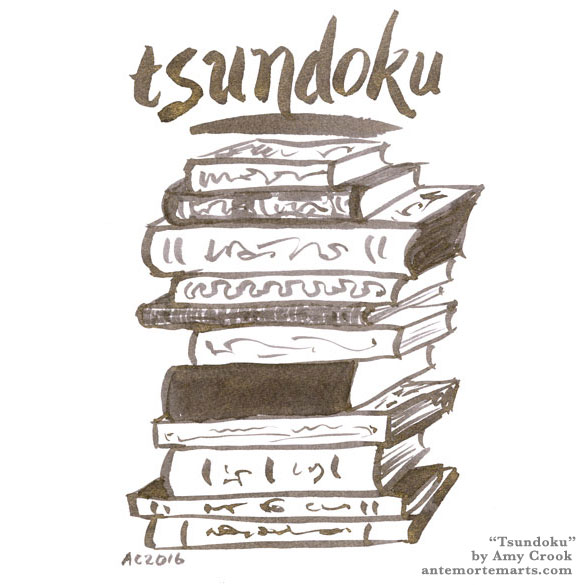
Tsundoku. The word literally means ‘reading pile’. It derives from a combination of tsunde-oku (to let things pile up) and dokusho (to read books). It generally refers to the tendency to buy books and let them pile up around the house unread. It can also refer to the stacks themselves. The word carries no pejorative sense in Japanese. Rather it connotes a cheerful whimsy: wobbly towers of unread books, each containing an unknown world. I am happy that now my stash of books “saved for a rainy day” has a respectable name!

Aspaldiko. Besides the joy and comfort of books, it is friends that make life worth living. While there are some that we meet regularly, there are some who one cannot meet as often. Meeting an old friend after a long time has a special excitement and delight. Well the Basque people have a word exactly for that feeling. Aspaldiko. It refers to the joy of catching up with someone you haven’t seen in a long time. A perfect word to the next time one reconnects with an old friend!

Tartle. There is the aspaldiko of meeting up with that special friend. But another way of meeting up is the organized ‘class reunion’. Meeting with literally ‘old’ faces, decades after one last saw each other, has its moments of embarrassment. The face is sort of familiar but the name that matches the face eludes, at the precise moment when you meet face-to-face. More red faces when you don’t know how to introduce the same to your spouse or children. Well the Scots have just the word for this—Tartle! This sums up the embarrassment and panic you feel when you forget someone’s name before introducing them. The word even comes handy to excuse your apparent rudeness. All you need to say is “Sorry for my tartle!”

Shemomedjamo. Reunions are also an occasion to eat, drink and be merry. As the feasting continues, you know when you’re really full, but your meal is just so delicious, you can’t stop eating it. The Georgians have a word for this mixture of gluttony and gastronomic distress. Shemomedjamo. This word means, “I accidentally ate the whole thing.”

Pelinti. In the process of getting to the stage of Shemomedjamo, you reach out for that slice of freshly arrived pizza. The melted cheese is irresistible. You bite into the piece and that tanatalizing cheese immediately sticks to your palate causing sheer agony. You frantically move the piece in your mouth hoping for some relief. While this may render you temporarily speechless, in Ghana they have a word for just this moment. Pelinti! You can scream Pelinti as you move the hot food around in your mouth in a desperate attempt to cool it before swallowing.

Abbiocco. You have feasted to the point of overeating, and perhaps had occasion to scream “pelinti”. The belly is happy and the senses replete. Conversation slowly ebbs, and it’s time for the next scene in the play. Most of us know that this calls for a siesta! Well the Italians also have a perfect word for this–abbiocco, literally meaning to collapse with exhaustion, but more effectively used to denote the slothful feeling of the need to lie down after heavy eating and drinking.

Lagom. While many cultures celebrate the joys of indulgences and their languages have appropriate words to define these excesses, the Swedes are more restrained, with a more functional approach to living. And reflecting the same approach is a single word Lagom. The word describes a general contentment with the “enoughness” of what’s presented to you in the moment. Lagom means not too much and not too little. It asks us to create balance in our lives by taking everything in moderation, avoiding both excess and deprivation.

Well it’s each to their own formula of a good life! Provided that one can have brief moments of Gigil. This giggly-sounding word comes from the Tagalog language of the Philippines. Gigil as defined is more than joy, and not quite pure excitement, but somewhere in the middle of joy, excitement, and a giddy heart-warming feeling. It is such moments that keep us alive.

Have a good life!

–Mamata
A House for Mr. Narayan

Generations of Indians have grown up on RK Narayan’s writings. If you have not read his novels, maybe you have seen ‘Guide’, starring Dev Anand and Waheeda Rehman? Or the charming TV series ‘Malgudi Days’? Well, suggest you visit or re-visit all of the above!

RK Narayan was one of the first Indian authors to gain international recognition. His first novel, Swami and Friends, which he wrote in 1930 did not find a publisher for many years. But sometime in 1933, his friends in Oxford to whom he had sent the manuscript, showed it to the famous author Graham Greene. The senior author liked it so much that he recommended it to his publishers and the book saw the light of day in 1935. It got good reviews across the world. RKN followed this up with The English Teacher and The Dark Room, which also won appreciation. From then, it was a steady stream of novels, short stories and articles.

Narayan created the fictional town of Malgudi as the setting for his novels. So authentic was it to his readers that many even today believe it is a real place.

But why the sudden piece on RK Narayan, one might ask.

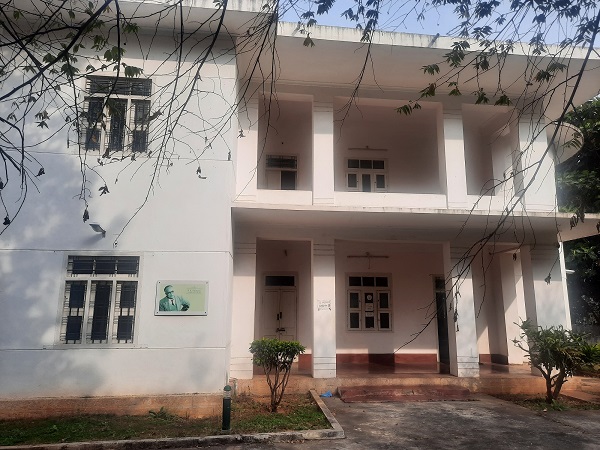
Well, it has been triggered by a visit to his house in Mysuru. Just last week, when I was there, I was lucky to get to visit this house. RKN spent many years in Mysore (as it was spelt then)—some of his growing up years, as well as his adult life when he accepted a commission in the State of Mysore.

It was in the second stint that he built a house which I visited. Set in the quiet area of Yadavagiri, it is a beautiful house typical of the 1950s, full of light and air, with red oxide floors and a beautiful balcony.

It was indeed gratifying to see the house so well preserved. Especially after we heard the story of how it was almost demolished. The author passed away in 2001. All of his family had left Mysuru by then. The house was falling to rack and ruin, when a builder wanted to pick it up and re-develop it. It was at this time that Mysuru woke up to this legacy. Led by a journalist, the people of the city protested. Finally in 2011, the city corporation bought the house and restored it.  

And we must be thankful for this! For not only is the house in good shape, it seems to have been restored fairly faithfully. There is also an exhibition of several artifacts, including his awards, personal items etc., many photographs, as well panels of text for those who have the patience to read them.

But…

And it is a very big BUT!

When one thinks of the potential that the house has for the students, literature lovers and citizens of Mysuru, not to mention the thousands of tourists the city attracts, it is a tragedy to leave it to routine care-taking and not very imaginative management.

As we reflected on our visit, we could come up with more than 10 ideas in less than 5 minutes:

  • Have a lively permanent exhibition, along with special temporary exhibitions to explore specific themes: maybe selected books; his relationship and collaboration with his brother, the famous RK Laxman, who illustrated so many of his books; maybe the process of turning his books into movies or TV (he is said to have hated the movie Guide), RK Narayan compared to comtempory Indian writers, etc., etc.
  • Sell RKN’s books (no, unbelievably, they don’t!)
  • Make it the hub for meetings of book-clubs
  • Make it a venue for book-launches
  • Host lit fests
  • Have literary events for children
  • Have screenings and discussions of movie and TV shows based on his books
  • Have an author-in-residence programme
  • Develop an archive related to his life and work
  • Create and sell souvenirs based on Malgudi
  • Start a café in the lovely little garden space around the house, and serve his favourite dishes
  • Make it a wifi café, so young people hang out
  • And charge a small fee for entrance (the Corporation has kept entry free..generous but it would be more sustainable to charge something).

Ideas are of course easy. Execution is difficult. But do this for RK Narayan’s house we must. He is a very important part of Indian writing in English.

While India does not have a great tradition of making author’s houses into educational and enjoyable experiences, there are more than enough international experiences to learn from: Shakespeare’s birthplace; Mark Twain’s house; Emily Dickenson’s House; Jane Austen’s House; Milton’s House are among the many which are successfully keeping the legacy of these authors alive.

Maybe RK Narayan House can set the example for homes of other Indian authors?

–Meena

Fruity Names

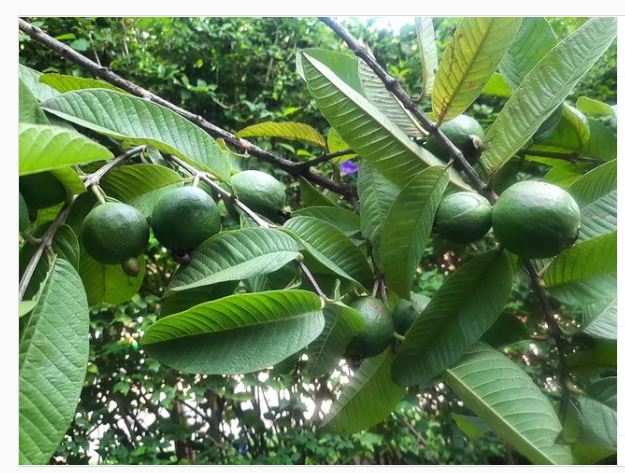
I have a guava tree which has just started fruiting this year. And with the enthusiasm of a newbie, it is overdoing the act. But I must marvel at its boldness—a thin, weak tree, it has literally 10s of fruits on each branch and is completely bowed down with the weight. Even after the birds and squirrels have done feasting on them, we are left with about 5-6 fruits every day. Which is a lot more than we can eat.

So I decided to check out some guava-based recipes. A visit to cooking sites threw up a few promising ones. But I got side-tracked. Browsing through the pages, I was reminded that guavas, apart from being called amrood, are also called peru. I was intrigued. Where did that name come from? A fairly straight forward explanation: Guava is believed to be a native of Peru in South America. Guavas came to India only around the 16th century, and probably because consignments were received from Peru, people in and around the port of Bombay started calling it that.  The fruit took well to Indian growing conditions and became popular here. Today peru or guava is the fifth-most widely grown fruit crop of India!

Guava
Guava, also called Peru

That got me thinking of the names of other fruits and vegetables which take their names from the names of places. Obviously, they are not called that in their place of origin, but when they travel, they take along the name. I doubt if anyone in the country of origin knows that the fruits are carrying the names of their countries far and wide, albeit in a strange context (how confusing it would be if people in Peru called a fruit ‘peru’!). And for sure, most people in the destination country after a passage of time, don’t link the name of the fruit to anything–a name is a name is a name and just is.

Here is a look at some more such fruit names

Peaches were called persicum—‘Persian apples’–by the Romans because they were traded by Persians. And a variation of the name stuck in English.

The name ‘currant’ is derived from the ancient Greek city of Corinth, which was known for its production of small dried grapes now known as currants.

Musk melons are sometimes called Cantaloupe. Though the fruit is not native to Italy, it was brought to the Cantus region of that country from Armenia and gained popularity there. As it slowly spread from there to other parts of the world, it carried the name of the Cantus region with it.

Oranges are indigenous to India and the origin of the name is from the Sanskrit naranaga. Most languages call oranges by some variation of this name. But in Greek, it is called portokali  because Portugese merchants traded in them.

Oranges spread far and wide, and variations developed. A type of blood orange which originated in the Mediterranean islands of Malta circled back to India and we call it the ‘Malta’. It is widely grown in Uttarakhand today. Tangerines are a variant which come from Tangier, Morocco.

Though the tamarind probably has its origins in tropical Africa, it has been cultivated in the Indian subcontinent for so long that it is universally known as Tamarind—the date of India!

Even apart from being named for the place of their origin, fruit and vegetable names are often prefixed with place names. The Devenahalli Pomelo for instance, is a special variety of the fruit which grows only in the Devenahalli area around Bangalore airport, and is tagged with Geographical Indicator (GI) status.  Another example is the Shimla Mirch. When the British brought capsicum to India, they first cultivated it in Shimla, so the name of the district is still used to refer to the now-ubiquitous vegetable.

The Nagpur orange, Lima beans, Brussels sprouts, are all named for places where they originated or where they grew abundantly. Ponni rice, so popular in the South, derives its name from the Cauvery, also called Ponni (meaning gold), since it grows in the deltas of this river.

Interestingly, the origin of the word ‘fruit’ itself can be traced back to the Latin word fructus, which comes from frui meaning ‘to enjoy’.

What could be more appropriate!

–Meena

PS: I found a few recipies for peru subzi and chutney, which shall be tried out in due course.

Paper Tigers

29 July is International Tiger Day. The day was first launched at the Saint Petersburg Tiger Summit in Russia in 2010 and is observed annually to remind the world about the decline of the global tiger population, and to encourage efforts for tiger conservation. On this day we will see many reports and statistics about tigers and their falling/growing population, and many conferences and seminars will be held on research and studies on tigers.

This is perhaps a good time to look at the tigers that roam not the forests, but that have also populated the pages of language and literature. The tiger has been a dominant character in folklore and mythology in many cultures.  

Perhaps China is the richest country in myths, representations, traditions, and legends related to tigers. Tigers have been a Chinese cultural symbol which has inspired story tellers, singers, poets, artists, and craftspeople for over 7000 years. In Chinese folklore, tigers are believed to be such powerful creatures that they are endowed with the ability to ward off the three main household disasters: fire, thieves and evil spirits. A painting of a tiger is often hung on a wall inside a building, facing the entrance, to ensure that demons would be too afraid to enter. Even in modern- day China, children wear tiger-headed caps, and shoes embroidered with tiger heads to ward off evil spirits; they are given tiger-shaped pillows to sleep on to make them robust. During the year of the Tiger, children have the character Wang painted on their foreheads in wine and mercury to promote vigour and health.

The tiger has equally captivated the people of the Indian subcontinent since time immemorial – feared and revered at the same time. These majestic beats and the lives of the people, especially those that live in close proximity to the tiger and its habitat, have long been intertwined, giving rise to several myths and legends surrounding them. Tiger lore has been interwoven with gods and legends, giving it a mythical status.

According to stories from Indian mythology, the tiger is believed to have powers to do everything from fighting demons, to creating rain, keeping children safe from nightmares, and healing. Humans are often attributed as having tiger characteristics. The consecration ceremony of a king in ancient times required the king to tread upon a tiger skin, signifying the King’s strength.

Songs, proverbs, and sayings in most Indian languages feature tigers as part of their treasury of folk lore and literature. Tigers appear in many stories in the Panchatantra.

A popular belief among many tribes in the Northeast of India is that the cosmic spirit, humans, and tigers are brothers. There are many folk tales based on this theme, with local variations. The belief that the tiger is a human’s brother has meant that the people of these tribes would rarely kill a tiger. There are traditional rituals performed even today to honour and worship the tiger.  

In more recent times, tigers were introduced to non-Asian audiences through the writings of Englishmen who had lived in colonial India by authors such as the famous hunter-turned-conservationist Jim Corbett. His books like The Man Eaters of Kumaon were perhaps some of the early depictions of human-tiger conflict.

In the culture of the West, where they are not found in the wild, tigers have nevertheless sparked the imaginations of writers, and have become popular fictional characters in stories, films, cartoons, songs, and even advertisements. Perhaps the best recreation of the fearsome tiger is Shere Khan of the Jungle Book fame.

Anthropomorphized tiger characters in children’s books have won their place in millions of hearts. There is boisterous and exuberant, Tigger, who is a one-of-a-kind friend in the world of Winnie the Pooh. He eagerly shares his enthusiasm with others—whether they want him to or not, and steals our heart.

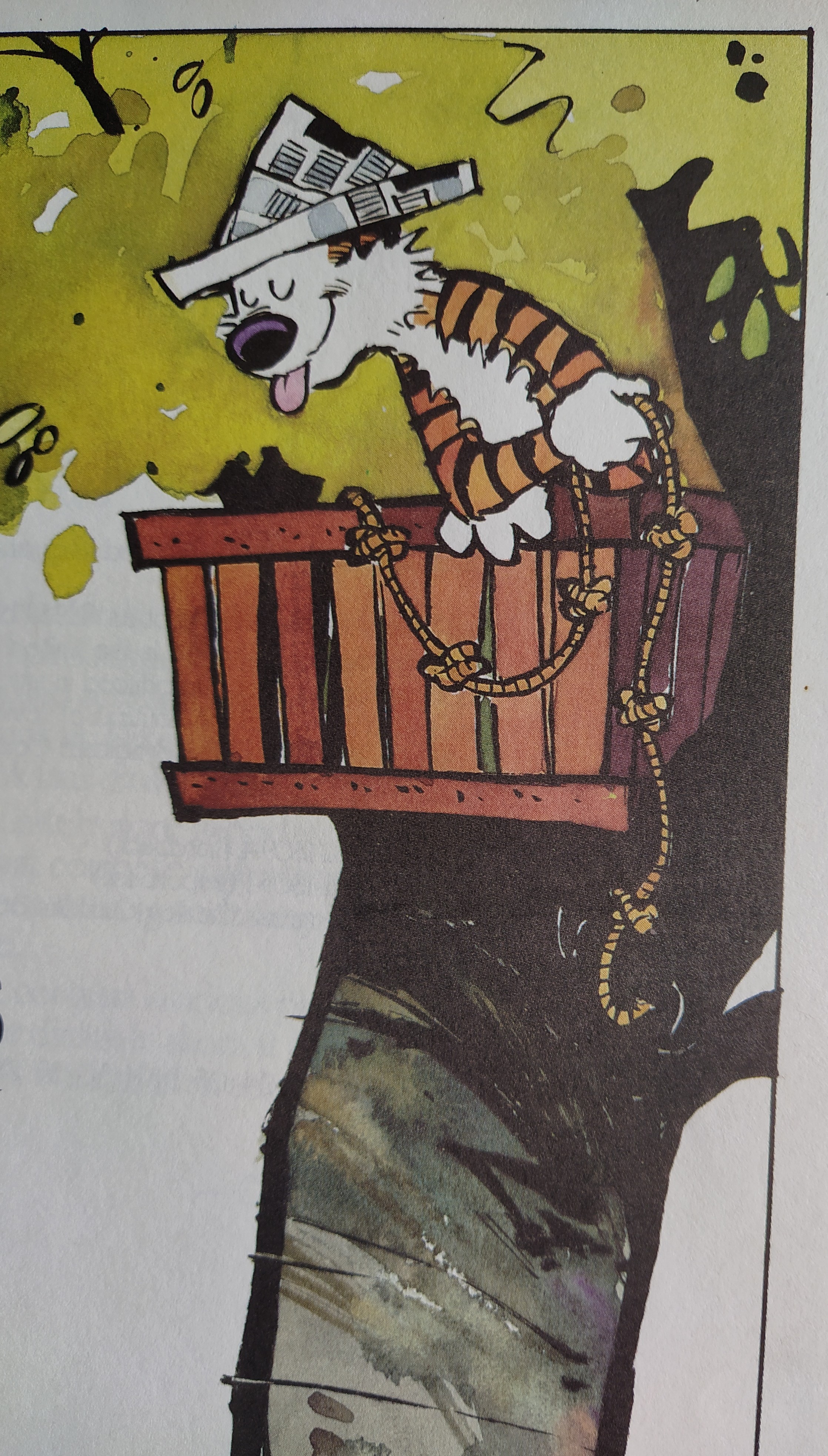
Calvin and Hobbes

And we have the imaginary stuffed tiger Hobbes in the cartoon strip Calvin and Hobbes, who is very real to the irrepressible six-year-old Calvin—a faithful companion in all the capers, sometimes a comforting friend, sometimes a savage beast. The two friends have deep philosophical conversations, ruminating on how best to find meaning in their lives, the essence of which is what all of us are seeking.

Other than literature, tigers have permeated our language through numerous aphorisms, proverbs and sayings. Here are a few ‘tigerisms’.

Paper tiger: Someone who at first glance seems to be in charge but who, on closer examination, is completely powerless.

Tiger economy: A dynamic economy usually referring to of one of the smaller East Asian countries, especially that of Singapore, Taiwan, or South Korea.

Tiger mom: A particularly strict mother who makes her children work very hard in school to achieve success.

Catch a tiger by the tail: Try to control something that is very powerful; have a difficult problem to solve.

A tiger cannot change its stripes: You can’t change your true nature, even if you pretend or claim otherwise.

Eye of the tiger: Determined and focused

A new-born calf has no fear of tigers: A Chinese saying that means that the young are brave, but often due to inexperience.

As tigers in the wild continue to be threatened and pushed towards extinction, International Tiger Day is also an occasion to celebrate the power of words that keep the tiger alive and vibrant in the pages that they also inhabit.

Some beautiful words by Ruskin Bond capture this spirit.

Tigers Forever

May there always be tigers

In the jungles and tall grass

May the tiger’s roar be heard.

May his thunder

Be known in the land.

At the forest pool by moonlight

May he drink and raise his head

Scenting the night wind.

May he crouch low in the grass

When herdsmen pass.

And slumber in dark caverns

When the sun is high.

May there always be tigers

But not so many that one of them

Might be tempted to come into my room

In search of a meal!

Ruskin Bond

–Mamata

Purposefully Unparliamentary

Over the last week, media has been full of news, editorials, funny pieces and trying-to-be-funny pieces about the list of banned words issued by the Parliament Secretariat in India—apparently a standard practice before the start of a session.

banned words

The use of language and words is a zone of contention in most parliaments across the world. Nor is this a phenomenon of recent times. The earliest recorded instances are from 991 AD, when incidents of ritual cursing and boasting (called flyting) were reported between Germanic chieftains.

The discretion to rule what is acceptable and what is not, is generally left to the Speaker of the house, but there are often lists and books and rules to guide them. While some Speakers revel in the power to cut down the words of their House colleagues, others feel constrained to do so by the duty imposed on them. For instance, ‘Un-parliamentary language is one of the things for which a Speaker must be on guard. Since the beginning of Confederation, a list has been drawn up of words, expressions and sentences that are not to be used by Members in the House. To employ them is to incur the wrath of the presiding officer of the day, and the penalties can be swift and harsh.. Now, as a humane, civilized man, it is not a task I relish, but there must be discipline in the Chamber, and I will take whatever measures, no matter how repressive they may seem, to quell unrest.’ said the Speaker of the Canadian House in 2001.

But obviously the members test the limits. For instance, the Scottish Parliament objected to the First Minister being called a liar. So the member who used that word substituted it with ‘dishonest’ and ‘perpetuating a con trick’, which had the precedent of having been used in the same debate but not objected to.

Or they use the word and then apologize: Irish MP Paul Gogarty of the Green Party used the F-word after being heckled by the opposition. He immediately apologized for the rant, which he admitted was “the most unparliamentary language”. Justin Trudeau, before he became PM of Canada, called an MP a ‘piece of shit’ and then quickly apologized.

On the other hand, some don’t apologize or withdraw their words, and are ready to face the consequences. Plaid Cymru AM calling the Queen “Mrs. Windsor” and became the first MP to be ordered out of the Welsh assembly chamber  because she refused to withdraw her words. In the UK, Dennis Skinner called the then-PM David Cameroon “Dodgy Dave”, and was kicked out from the Commons.

There is actually a lot academic research and theorizing on why parliamentarians are so unparliamentary in their speech! Here are some insights from ‘Language and Ideology’ a book edited by Rene Dirven, Roslyn Frank and Cornelia Ilie, which has a whole chapter devoted to this: ‘In a hierarchically-based and rule-regulating setting like parliament, insults are powerful because they challenge the ‘status quo’.’

Our parliamentarians will surely agree with the following finding: ‘Language users have noticed that abusive and derogatory words tend to have a detrimental effect on the target of the insult, while at the same time, they may strengthen the position of the insult initiator.’ The researches aver that ‘By offering the insults publicly, insult initiators intend to reach a wider audience.’

The book explains the three major objectives of parliamentary insults:

  1. To score points by silencing, embarrassing, and/or humiliating political adversaries
  2. To challenge the authority and institutional role of political adversaries
  3. To redress the political imbalance and to strengthen group cohesion.

So next time we hear some unparliamentary language, more than worrying about the words, maybe we should try to fathom the motive!

–Meena

A Wordy Adventure

 “I’m bored!” How many little boys and girls, across the world, echo the same words. More than ever before, the last two years when the pandemic confined families within four walls, this was the refrain. But this is nothing new.

There once was a boy named Milo who didn’t know what to do with himself not just sometimes but always.

That is the opening line of The Phantom Tollbooth, first published in 1961, which went on to become a classic of children’s literature.

The Phantom Tollbooth is the story of Milo, a 10 year-old boy who is utterly bored with everything around him. One day he comes home to finds a mysterious package with a bright blue envelope which reads “For Milo. Who has plenty of time.”

When unpacked it reveals a magical toy tollbooth which he sets up in his room. Having nothing better to do, he drives his toy car through it and there begins his whacky journey through the different realms of language. He is accompanied on his travels by a “watchdog” named Tock—a large dog with an alarm clock for a body. 

Crossing Expectations and going through the Doldrums, Milo heads for Dictionopolis, ruled by King Azaz the Unabridged–Monarch of Letters, Emperor of Phrases, Sentences and Miscellaneous Figures of Speech. He is welcomed by five tall thin gentlemen who introduce themselves as The Duke of Definition, The Minister of Meaning, the Earl of Essence, the Count of Connotation, and The Undersecretary of Understanding.

We offer you the hospitality of our country, nation, state, commonwealth, realm, empire, palatinate, principality.

Do all those words mean the same thing? asked Milo.

Of course, certainly, precisely, exactly, yes, they replied in order. They also explain: Dictionopolis is the place where all the words in the world come from. They’re grown right here in our orchards.

Milo wanders around the marketplace of words where there are thousands of words on sale, with the vendors trying their best to sell theirs. It is here that he meets the giant Spelling Bee, that can spell any word, and who joins him on his travels.

Finally he meets the king who asks him what he can do. Milo has no answer. The King thinks:”What an ordinary little boy. Why my cabinet members can do all sorts of things. The duke here can make mountains out of molehills. The minister splits hairs. The count makes hay while sun shines. The earl leaves no stone unturned. And the undersecretary hangs by a thread.”

And thus Milo embarks on a wordy adventure where the characters indulge in a riot of word play that initially throws Milo into deep confusion, but gradually his curiosity leads him not only to learn new things, but eventually to join in the pun-fun as it were. 

From Dictionopolis to Digitapolis, from the Foothills of Confusion, and over Mountains of Ignorance; through the Valley of Sound and the Forest of Sight; the Sea of Knowledge and Island of Conclusions (he had to jump to get there!), and the Kingdom of Wisdom, Milo encounters an army of new words as he is roped in to rescue the captured princesses of Rhyme and Reason imprisoned in the Castle in the Air, while fighting the fearsome Hate and Malice.

The Phantom Tollbooth is an absolute delight for word lovers such as me. The word play is clever and stimulating, reminding one of the adventures of Alice in Wonderland. When the book was published, several reviewers wondered whether children would even understand so many new and unfamiliar words, and whether they had the ability to really enjoy the play on words. These apprehensions were vindicated when the book sold millions of copies; and continues to remain a favourite even 60 years after it was first published in 1961.

Years later the author Norton Juster explained his approach: My feeling was that there is no such thing as a difficult word. There are only words you don’t know yet, the kind of liberating words that Milo encounters on his adventure. Today’s world of texting and tweeting is quite a different place, but children are still the same as they’ve always been.

The story of how the book came about is equally interesting. Norton Juster was a young architect working in New York. He had received a Ford Foundation grant for a book on cities for children, and spent months researching it. One day, in a restaurant, he overheard a boy asking the question   “What’s the biggest number there is?” That put him on a totally different path.

I started to compose what I thought would be about a child’s confrontation with numbers and words and meanings and other strange concepts that are imposed on children,” he wrote. “I loved the opportunity to turns things upside down and inside out and indulge in all the bad jokes and puns and wordplay that my father had introduced me to when I was growing up.

The grant never fructified into the intended book, but there began the story of The Phantom Tollbooth. Norton recalled: When I wrote the book I really didn’t write it with any sense of mission. I wrote it for my own enjoyment. The book in no way was written to any sense of what it was that children needed or liked.

However, under all the word play is just what children need–a feeling that navigating the world can be an exciting adventure in itself. As Norton puts it: And I think what kids do — it’s a fairly universal kind of thing – I think the general sense of the book – the feeling of it is something most kids experience one way or another. They’re at times disconnected, or they don’t know what to do with themselves. They don’t know why anything is happening. All the things that they’re learning don’t connect to other things. One of the things that happens in your life is you start out learning a million facts and none of them connect to any other facts. As you get older you gradually realize that something you learned over here connects to something you experienced over there. And you start drawing sort of mental lines, and after a while, like when you get to my age, there’s almost nothing that you learned that doesn’t connect with 80,000 other things. So it all has some kind of a meaning and context to it, and I think kids slowly begin to feel that too.

In an age when children have so many distractions, and yet are always “bored” this book encourages them to look anew at the world around them. You have to constantly look at things as if you’ve never seen them before. Or look at them in a way that nobody has ever seen them before. Or turn them over and look at the other side of everything. That is the magic formula.

Serendipitously, at the time Norton was writing the book, his illustrator friend Jules Feiffer, who was also his upstairs neighbour, read some of it and spontaneously produced a bunch of perfectly-suited drawings that brought the characters to life. And The Phantom Tollbooth continues to be loved by children even six decades later.  

I seem to have missed reading this book in my childhood, but I am delighted to have discovered it in the sixth decade of my life. Thank you Evan for sharing this, a favourite childhood read of yours, with me!

–Mamata

Eponyms: When People Become Things

As I wrote last week the evolution of language involves multiple inputs and processes. ‘Clipped’ words often overtake their original abbreviations to take on their own identities. At times, the process goes the other way and words become elongated by being ‘topped’ and ‘tailed’ by other words to gain new meaning and identity.

Place names become words. So when you laugh at a ‘limerick’, drive a ‘limousine’, have a pet ‘alsatian’ or ‘labrador’, play ‘badminton’ or ‘rugby’ or run a ‘marathon’, you are in fact invoking the name of a place that has become synonymous with the object or activity.

Place names may also become easily identifiable product names; as in drinks—Martini, Cognac, Bourbon; or food as in Hamburgers and Frankfurters. 

It is not just names of places but also names of people that have become words in their own right. Today when we use the words, we immediately visualize the object, without having the faintest idea that there was a person that originally gave his or her  name to the thing.

For example the cardigan was named after James Brudenell, 7th Earl of Cardigan, a British Army major general who led the Charge of the Light Brigade at the Battle of Balaclava during the Crimean War. The woollen garment is modelled after the close-fitting knitted wool waistcoat that British officers supposedly wore during the war. The macintosh (or the Englishman’s ubiquitous waterproof coat) was named for Charles Macintosh who invented the waterproofing process that was used in the material for these raincoats. The sandwich is named for an 18th century English aristocrat, the 4th Earl of Sandwich who, as the story goes, ordered his valet to bring him a piece of meat tucked between two slices of bread, so that he would not have to get up from the gambling table for a formal meal.

Perhaps the more commonly known eponyms are the botanical names of plants, many being named after their discoverers. An interesting double link is to be found in the word Nicotine which is named after the tobacco plant Nicotiana tabacum. The botanical name of the plant is derived from the name of the French ambassador Jean Nicot de Villemain, who when visiting Portugal, sent tobacco and seeds to Paris in 1560, presented it to the French King, as something that had medicinal value and protected against illness.

We may not be aware that many other terms in science and technology also reflect the names of their inventors. .

The diesel that powers our vehicles and machines is named after its German inventor-engineer Rudolph Diesel. The ampere is named for French physicist and mathematician André-Marie Ampère (1775–1836), who studied electromagnetism and laid the foundation of electrodynamics. Celsius is named after Swedish astronomer Anders Celsius who first proposed the centigrade scale in 1742, and Fahrenheit is named for the physicist Gabriel Daniel Fahrenheit. The ohm (symbol: Ω) is the SI derived unit of electrical resistance, is named after its discoverer German physicist Georg Ohm. And the more familiar term watt, a unit of electrical power, is named after the Scottish engineer and inventor James Watt.

Similarly in medicine a condition originally named after the doctor who first described it, becomes over time, a noun for the condition. Alzheimer’s disease is named after Dr Alois Alzheimer a German psychiatrist and neurologist who first analysed the brain of a woman who had an unusual mental condition and studied the changes in the brain that caused the issues. Similarly Parkinson’s disease is named after Dr James Parkinson who described the condition in 1817. Today it is commonplace to describe a patient suffering from these diseases as simply having Alzheimers or Parkinsons.

All these are examples of eponyms. An eponym is a person, place, or thing after whom or which someone or something is, or is believed to be, named.

There is one other form of eponym. These are words that were initially the name of a particular brand but now are used to reference entire categories of things. One of the most popular eponyms is a band-aid. While band-aid is the name of the brand that makes adhesive bandages, most people use the term to refer to any adhesive bandage, regardless of who makes it. In India at one time Cadbury was the eponym for any chocolate!

And then there is the world of high fashion where people wear Dior, spray Chanel, carry Prada, and travel with Louis Vuitton! Bata is eponymous in India with sturdy, reasonably priced footwear, and generally thought of as a truly India brand. It is interesting that, in fact, the brand was named after Tomas Bat’a who along with his brothers started a family owned business in Czechoslovakia in 1894 to produce sturdy and affordable shoes.. However, I have not met anyone who proudly says “I am the proud owner of a Bata!”

–Mamata

Winning Words

Language is always evolving. While some words have a history that can be traced back over centuries, new terms and new uses for terms also continue to emerge, and over time find their place in dictionaries. Much of the new vocabulary in 21st century English reflects major social changes and events that have taken place in the real world. New editions of dictionaries have included expressions such as social media, congestion charge, designer baby, flash mob, toxic debt, WMDs (weapons of mass destruction) and wardrobe malfunction.

The major English language dictionaries have an elaborate process of keeping track of new words and their usage, and based on the studies and statistics, announce the winning word or words of the year.

This is the time of the year when Words of the Year are declared by the leading dictionaries. This is the outcome of a process that reviews the ‘usage evidence’ of certain words during the year. The selection of the word/words reflect, as the Oxford English Dictionary explains “the ethos, mood or preoccupations” of the preceding year, while also having “potential as a term of lasting cultural significance.”

It was thus no surprise that the words of the year 2020 were those that dominated the lives and pre-occupations of people around the world. These included Pandemic, Quarantine and Lockdown. These words moved beyond the English language and became part of a universal vocabulary.

A natural progression from these led to the word that has been declared as the Word of the Year 2021 by the Oxford English Dictionary. The winning word is Vax.

The word first appeared as a noun in the 1980s to mean either vaccine or vaccination. But it in this year, that the small but pithy word has been used in so many ways: to denote status—‘vaxed’ ‘double vaxed’ or not ‘vaxed’; attitude—‘vaxers’ vs ‘anti vaxers’, and events—vaxathons, and vaxxies (vaccination selfies!)

In keeping with the trend of abbreviations which pack a punch of meaning, the Merrian Webster dictionary has released its list of new words added to the dictionary in 2021 that reflects the use of language in the age of online communication. Among the words in this category are:

TBH: an abbreviation for “to be honest.” 

Amirite: slang used in writing for “am I right” to represent or imitate the use of this phrase as a tag question in informal speech. An example: “English spelling is consistently inconsistent, amirite?”

FTW: an abbreviation for “for the win” used especially to express approval or support. In social media, FTW is often used to acknowledge a clever or funny response to a question or meme.

And of course these words are the staple of the vocabulary of  the Digital Nomads—a term used to describe persons who perform their occupation entirely over the Internet while traveling; especially if such a person has no permanent fixed home address.

The acceptance of abbreviations as official words that find their place in dictionaries is not a new trend in the English language. In the late 1600s it was linguistically fashionable to shorten words. For example people said ‘pos’ or ‘pozz’ for positive, meaning ‘that’s certain’ or ‘incog’ for incognito in casual speech. Words which were reduced in size in this way were called ‘clippings’. Common examples of words where the ends were ‘clipped’ were ad, doc and prof. Among the words where the beginning was clipped were phone and burger; and words where both the beginning and the end were clipped included flu and fridge. What started as informal usage became the acceptable use, and the full forms were almost forgotten over time; think of fax, memo, exam, vet, pub and bus! And not to forget the Bots whose mechanical messages have all but replaced human voices.

Perhaps the ‘clipped’ word that has dominated the past few decades as much as the word ‘vax’ may do in this decade is ‘app’.

The idea of an ‘application’, a computer function designed to meet specific user requirement had been around since the 1960s. But it was in 1985 that a writer in a trade magazine used the abbreviation ‘apps’ to denote ‘for applications’. The short form immediately caught on. It was ‘phonetically appealing, a short, perky syllable, that seemed to suit the exciting quick fire developments in digital communication of the time.’

Following this came the idea of a ‘killer app’—a function which in the dreams of the multimedia industry, would be so appealing that people would not be able to do without it.

I am not sure if ‘app’ was ever voted the word of the year, but this is one word that has surpassed the boundaries of the English language; it continues to be on everyone’s lips, and fingertips! 

–Mamata

Poet with the Piercing Gaze: Subramania Bharathi

The image of Che Guevera, his hair flowing to the shoulders, eyes looking off-camera and a beret on his head, is the international image of revolution, of the oppressed fighting against the powerful, of idealism, of nobility.

No less iconic for Tamilians is the image of Subramania Bharathi, turban on the head with the end wound around his throat, a mustache, and eyes that seem to pierce into the soul. It stands for all of the above, and in addition, for sublime poetry and an idealistic vision for India.

Poet Subramania Bharathi
Mahakavi Bharathi

We mark a century of Mahakavi Subramania Bharathi’s passing this month. He died at the age of 39, tragically trampled to death by the elephant at the Parthasarathy Temple, Triplicane, Chennai. He used to feed the elephant regularly, and they were friends. But on that particular day, something went drastically wrong. His death, as his life, was completely out of the ordinary.

But he is very much alive today, a living tradition. The versatility of Bharathi’s composition is one reason—his songs of national pride, his songs of revolution and social change, of romance, of bhakti—there is something for every occasion.

There is no schoolchild in Tamilnadu who does not know his poems and writings. Not a musician—classical or light-classical or filmi or pop–who does not have a repertoire of Bharathi songs. Not a film-maker who has not used a song or at least a verse from one of his compositions at one time or the other. Not a Tamilian who has not been touched, moved, affected by his poems.

He was something of a child prodigy, being conferred the title of ‘Bharathi’—one who was blessed by the Goddess Saraswathi—at the age of 12, by the Raja of Ettayapuram, for his poetic genius.

He knew 14 languages, but chose to write in Tamil. He was a teacher, a journalist, a poet, a writer, a freedom fighter. He was deeply spiritual, delving deep into Hinduism. It is said that he adopted his trademark turban in admiration of the Sikhs.

The British Empire feared his pen so much that there was an arrest warrant out for him. He spent almost 10 years in exile in Pondicherry (a French territory), so escape imprisonment.

He was an ardent proponent of the emancipation of women, and advocated that they take their place shoulder to shoulder in the freedom struggle and in the development of the nation. In fact, traditional Madras of over a century ago was shocked and agog when he insisted on walking in public, holding hands with his wife!

Poetry in translation seldom works anywhere as well as the original. But even with that, a poet’s words speak louder than anyone else can, of his thoughts, ideas and ideals. So here is an excerpt from one of his most stirring songs:

‘With the name of Bharat Desh on our lips

Let us shake off our fears and poverty

And overcome our sorrows and enemies.

We shall stroll on the snow-clad silver heights of the Himalayas

Our ships shall sail across the high seas

We shall set up schools—scared temples for us.

We shall span the sea to reach Sri Lanka

And raise the level of the Sethu and pave a road on it

We shall water Central India with the bounteous rivers of Bengal.

We shall have such devices that sitting at Kanchi

We will listen to the discourses of scholars in Varanasi.

We shall make tools and weapons

We shall produce paper

We shall open factories and schools

We shall never be lazy or weary

We shall ever be generous

We shall always speak the truth.

Both scriptures and sciences we shall learn

The heavens and oceans we will explore

The mysteries of the moon we shall unravel

The art of street-sweeping too, we shall learn.’

Be inspired, be elevated. Listen to renditions of Bharathi even if you don’t understand the words. And do look out for translations of his work. This translation is from a 1984 publication brought out by NCERT, which also has a well put-together summary of his life. Proving once again that NCERT has done some wonderful work!

https://archive.org/stream/in.ernet.dli.2015.231768/2015.231768.Poems-Subramania_djvu.txt)

–Meena

From Colour to Color

Last week I wrote about the Spelling Bee in America and how the Merriam-Webster Dictionary is the official reference for spellings for this prestigious competition. The challenge for participants in the competition is to know the spellings and meanings of the 7000+ words in the dictionary. But how many know the story about the man behind those words—Noah Webster?

This story begins on a farm in West Hartford, Connecticut where Noah Webster was born on October 16 1758, a time when America still belonged to England. His father farmed the land, and from the time Noah was a young boy, he helped out with agricultural chores; but his mind was restless and he was eager to use it in different ways. Having taken in all that the local school had to offer, and encouraged by his teachers, Noah, aged 16, entered Yale, one of the best colleges in the country then. His father took a loan on the farm to support his education. But when he graduated, his father gave Noah eight dollars and told him that henceforth he was on his own.

The 19 year-old graduate, with a farm loan to pay back, needed to start earning immediately; so he started teaching in a school. The conditions were pathetic.  . Children of all ages were crammed into one-room schoolhouses with no desks or basic supplies, untrained teachers, and a few old school books from England which pledged allegiance to King George. This was also a time when the east coast of America was in the throes of the Revolutionary War against the British. Noah strongly felt that his students should be learning about their own country from American textbooks, in a vocabulary that they identified better with.

In October 1781 after King George’s soldiers were defeated, Americans effectively won their independence. And Noah Webster decided that “I will write the second Declaration of Independence. An American spelling book.”

Noah felt that there was no reason why the newly independent people should continue to spell the way they did in England, where words were often spelt very differently from the way they sounded phonetically. Also within America itself the same word was often spelt in different ways (mosquito, moskito, miscitoe, misqutor, muskeetor…). Noah felt that Americans should spell every word in the same way, every time, everywhere. He felt that this would lead to creating a true United States of America.   

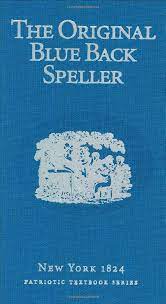
For two years, Noah taught school all day and worked at night on this dream textbook. In 1783 he published this under the title A Grammatical Institute of the English Language. He wanted that his “speller” should look different from other books on the shelves and told his printers to put a blue cover on it. And that is what the book became popularly known as–The Blue-Back Speller. The book not only taught spelling, but also listed important American dates, towns and states. Noah Webster had created the first American textbook! For over 100 years, Webster’s book taught children in America to read, spell and pronounce words. It was the most popular American book of its time, selling nearly 100 million copies. But Noah did not mint money from its sales—while originally the book cost 14 cents, he received one penny for each copy sold, the rest went to the printer.

At the time Samuel Johnson’s 1775 Dictionary of the English Language, introduced by the British, was considered the authoritative English language resource by most Americans. But there was a section of the population that wanted its own national dictionary for the newly declared free states of America. In 1806 Noah Webster took the first step towards this when he published A Compendious Dictionary of the American Language which had 40,600 words.

But he was not satisfied; he continued to work on this project with the aim of creating a reference that would overthrow Samuel Johnson’s dictionary. To accomplish this, Webster learned to read and understand more than 20 languages including Arabic, Sanskrit, and Welsh; and he travelled to France and England to research early dictionaries and books on the origins of words and language.

Noah Webster embarked on this project in 1807, and was still working on it 17 years later. At that point he felt he needed to refer still more books and visit more libraries, so in 1824 he set sail for Europe. He completed his magnum opus by penning the last word Zygomatic, in a shaky hand, in 1825. He then meticulously proof read the two thousand pages that he had complied over 20 years.

Noah was 70 years old when the first edition was printed in 1828 under the title An American Dictionary of the English Language.  It included 70,000 words, definitions, and explanations of words’ origins. In doing so, Noah Webster also created a lexicon of “American” words and spellings.

The idea of reforming spelling had taken hold of him as early as 1789 when he had written in an essay: The omission of all superfluous or silent letters; as in bread. Thus bread, head, give, breast, built, meant, realm, friend, would be spelt, bred, hed, giv, brest, bilt, ment, relm, frend. Would this alteration produce any inconvenience, any embarrassment or expense? By no means. On the other hand, it would lessen the trouble of writing, and much more, of learning the language; it would reduce the true pronunciation to a certainty; and while it would assist foreigners and our own children in acquiring the language, it would render the pronunciation uniform, in different parts of the country, and almost prevent the possibility of changes.”

It took several decades for these early ideas to fructify. In his dictionary Noah Webster did simplify the original English spellings, he took out excess letters, like the ‘u’ in colour and honour, the extra ‘l’ in traveler, the ‘e’ on ax and the ‘ough’ in plow. He also reversed the ‘re’ in theater and center and the ‘k’ in musick. He introduced new words from different sources. From Native Americans came words like wampum, moccasin, canoe, moose, toboggan and maize; from Mexico came hoosegow, stampede and cafeteria; from the French came prairie and dime, while cookie and landscape came from the Dutch. Existing words were combined to make new ones, for example, rattlesnake, eggplant and bullfrog. He also added American words that weren’t in English dictionaries like skunk and squash. Only some of the changes that he wanted didn’t make it, like bred for bread, wimmen for women, dawter for daughter and tung for tongue!

Noah Webster accomplished much more than compiling and creating words. Not only did he fight for an American language, he also fought for copyright laws, a strong federal government, universal education, and the abolition of slavery. In the 1780s he pioneered one of the first workmen’s compensation insurance programmes and helped found the antislavery group the Connecticut Society for the Promotion of Freedom. In between fighting for these causes, he wrote textbooks, edited magazines and worked to advance copyright laws. He went on a national lecture tour and wrote numerous essays promoting education reform and other cultural concerns. He helped found Amherst college, and helped to establish the Federalist newspaper The American Minerva.

Webster had his idiosyncrasies. He counted houses and churches when he travelled through towns, recording his findings in his diary. While travelling across the American territories in 1785 and 1786, he tallied 20,380 houses in 22 cities.  He kept records of practically everything he did and made copious notes in the margins of anything he read. He assumed that every word he wrote would be interesting to someone in the future. He kept copies of letters he wrote to public figures and even kept their replies. By the time he was in his 70s, he had volumes of notes, letters, essays, and diaries that he stored and saved. These he willed to his son-in-law!

When Noah Webster died in 1843, he was an American hero.

In 1847 (four years after his death), George and Charles Merriam gained the rights to Webster’s work and published their first edition of the Merriam-Webster dictionary. Noah Webster’s was a pioneer in many fields, but his name will always be synonymous with the Webster’s Dictionary.

–Mamata