Fabrics for Freedom: Khadi and Beyond

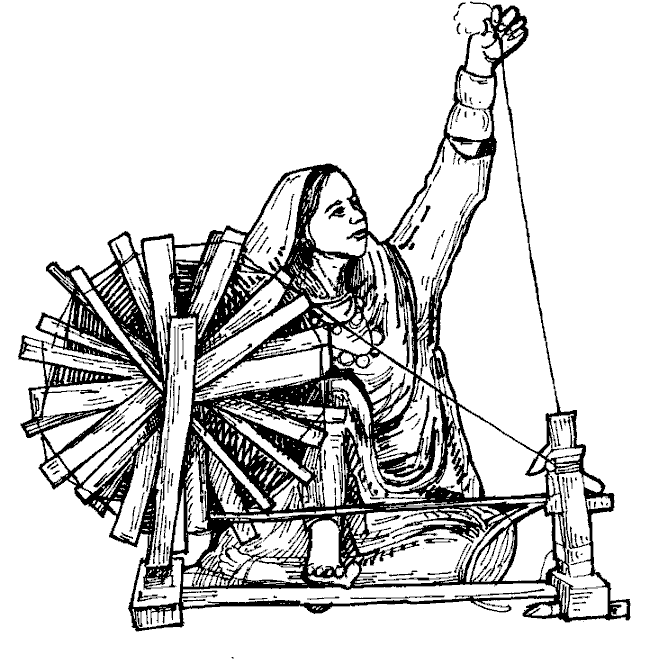
We are all aware of how central khadi was to our struggle for independence. It was not only about defying the British and refusing to buy their imported cloth, but a potent symbol that it was not mere freedom from colonial rule that was critical, but also economic independence—a means of livelihood for millions of people of the country. In the words of Divya Joshi: ‘Gandhiji presented khadi as a symbol of nationalism, equality and self-reliance. It was his belief that reconstruction of the society and effective Satyagraha against the foreign rule can be possible only through khadi….The spinning wheel was at one time the symbol of India’s poverty and backwardness. Gandhiji turned it into a symbol of self-reliance and non-violence.’

Khadi

But India is not the only country where spinning and weaving of textiles were a core part of a movement for independence. Another large British colony also used this as a weapon. This was the USA!

Britain saw its colonies including the American territories, as suppliers of raw material, insisted that they export all cotton to it, and buy all finished cloth from it. And of course it imposed huge taxes on all these products including fabric.

In defiance, the people in the American colonies started spinning their own cloth, and the spinning wheel because as important a symbol of patriotism in Americanin the 1760s and 1770s as the charkha was to the become in the 20th century in India.

Women were at the forefront of the spinning movement in the American War of Independence, and created their own homespun cloth to disrupt the British monopoly.  Fabric made this way was called “homespun.” Wearing homespun was a symbol of patriotism.  

In certain areas like New England, women showed their protest by going to ‘spinning bees’ where they would set up spinning wheels and keep each other company while they spun yarn. And these were not isolated events—for instance, in a single area, from Harpswell, Maine to Huntington, Long Island, over 60 spinning meetings were held over 32 months starting in March 1768.

The Daughters of Liberty, a group of political dissidents who got together to fight for liberty, were at the forefront of these spinning bees. They organized boycotts of British goods, especially tea, and they manufactured replacement products, especially cloth.

As in India, spinning was at the centre of a lot of publicity and was a rallying point for the freedom fighters. Newspapers reported elaborately on the smallest cloth-making development to amplify the message. Spinning schools were set up and awards were offered for the person who wove the most cloth. Old and young learnt to spin—it is reported that a 70-year-old woman in Newport, R.I., learnt to spin for the first time during the movement. Competitions were held—‘in 1769, two Connecticut women held an all-day spinning contest in which the winner spun seven skeins and two knots of fine linen yarn, just a little more than her competitor’.

The boycott of imported fabric and other goods from tea to molasses, worked, and it is estimated by some sources that the value of imported goods from Great Britain to the US fell by half in 1769 over the previous year, from 420,000 to 208,000 pounds.

So ‘swadeshi’ proved a potent war cry against imperial colonizers halfway across the world!

As it did in India almost 150 years later–rallying self-confidence, morale, giving a sense of identify.

Happy Independence Day!

Buying one pair of Khadi clothes a year can contribute to livelihoods for our millions of weavers. And they need it more than ever now, as the spinning of the national flag, which was their monopoly, has been taken away.

–Meena

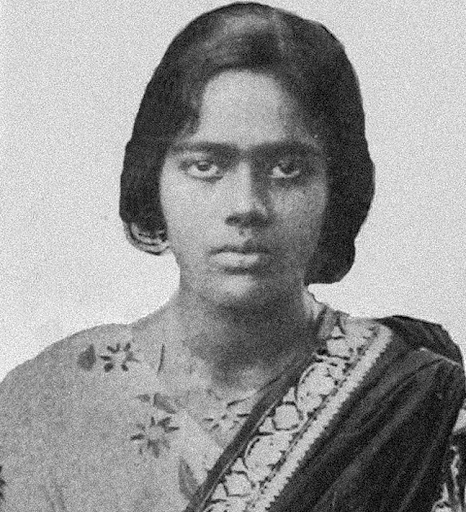
‘Birbala’ Kanaklata: Teenage Martyr for the Tricolour

Here is a mantra, a short one that I give to you. You may imprint it on your hearts and let every breath of yours give expression to it. The mantra is ‘Do or Die.’ We shall either free India or die in the attempt; we shall not live to see the perpetuation of our slavery. Every true Congressman or woman will join the struggle with inflexible determination not to remain alive to see the country in bondage and slavery.

These words spoken by Gandhi on 8 August 1942 launched the Quit India movement. Although Gandhi and many other leaders were arrested within hours of his speech, with the expectation that without their leadership the resistance movement would be rudderless, the effect was the opposite. Thousands of Indians, young and old, heeded this call and plunged into the movement, each contributing in their own way.

This mantra shared by Gandhiji at the Gowalia Tank Maidan Park in Bombay echoed across the country. Its reverberations reached the eastern corner of India, to Assam, and lit a spark in the heart and mind of a young girl named Kanaklata.

Kanaklata Barua was born on 22 December 1924 in Barangabari village of Gohpur, now in the Sonitpur district in Assam. Her mother died when Kanaklata was only five years old, and the young child developed a sense of responsibility much beyond her tender age. Her father remarried but he also died when she was thirteen. With added household responsibilities, and caring for her siblings, Kanaklata had to drop out of school and could not continue her studies after third standard.

Even as she was growing up in her village in Assam, the sparks of the nationwide freedom movement were spreading across the length and breadth of the country. The non-cooperation movement was gaining strength. The movement reached a climax with Gandhi’s call for “Do or Die”, and the wave of the Quit India Movement surged to new heights.

In Assam too there were widespread protests against British rule, and young and old joined in. Initially the protests were peaceful, but the British arrested all the Congress leaders of the state, and stepped up their brutal repression of the people. This only strengthened the opposition, and engendered underground conspiracies to fight the British. Among these was the setting up of a suicide squad which engaged in subversive activities like derailing and burning trains, attacking army outposts and snapping communication channels.

Seventeen-year-old Kanaklata was inspired and fired by the cause, and eager to contribute. Her dream was to join the Azad Hind Fauj, but as she was still a minor, she was not permitted to do so. Undeterred, she volunteered to join Mrityu Bahini–a suicide squad. For this too she was technically underage, but her determination and passion for the freedom movement was considered suitable for granting her membership. Subsequently she became the leader of the women’s cadre of the Mrityu Bahini.

The then president of the local Congress committee, Kushal Konwar was an ardent believer of non-violence proposed by Gandhi. He was falsely accused by the British for derailing a train which killed many British soldiers, and he was hanged. After the martyrdom of Kushal Konwar, the revolutionary camp of Gohpur division, under the leadership of Jyoti Prasad Agarwala, decided to mark their protest by removing the British flag and unfurling the National Flag at the local police station.

On 20 September 1942, Kanaklata led the procession of members of the Mrityu Bahini, walking proudly with the national flag in her hand, and with cries of Vande Mataram. The officer-in-charge of the police station was anticipating this. He warned the procession not to proceed further. He threatened that the police were duty-bound to start firing if the protesters advanced. Kanaklata responded by saying that he could do his duty while she carried on with her duty.

The procession carried on towards the police station; Kanaklata was leading, with the tricolour held aloft in her hands. As they neared, the police fired. Kanaklata fell to the bullet, with the flag still firmly held up. Before the flag could touch the ground it was taken by Mukunda Kakoti, another member from the group. He too was felled by a police bullet. Two young lives, snuffed out even before they attained adulthood. Kanaklata was not yet eighteen years old, and did not live to see the independent India of her dreams.

Their martyrdom did not go in vain. Even as their comrades were breathing their last, the others in the group did not let the tricolour down. They picked it up and with cries of Vande Mataram, the flag was eventually unfurled at the police station. One of the millions of small but significant gestures that added nail after nail to the coffin of the end of British rule in India.

While Kanaklata’s tale is not well known, it has at least been told. This month as we remember the many struggles and sacrifices that contributed to the unique non-violent movement that led India to become Independent, let us also pay tribute to the many unsung heroes and heroines who gave their all, even their life, for this cause.  

And as we swell with pride to see the Indian tricolour fly freely and fearlessly, let us not forget the brave young woman “Birbala” Kanaklata Barua who gave her life for it.

–Mamata

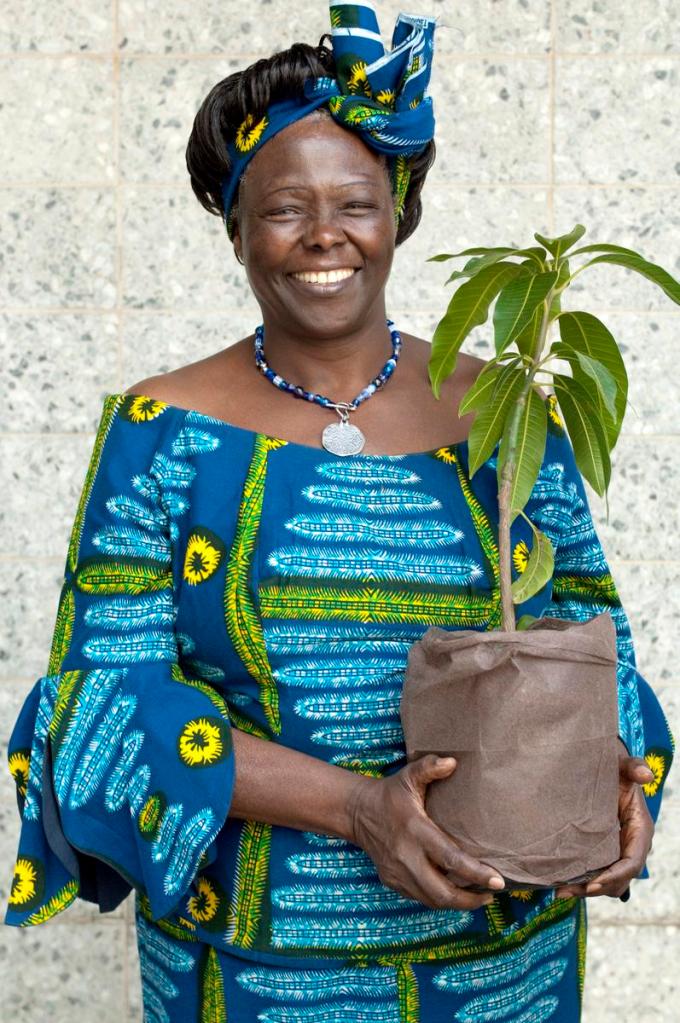
Mama Miti Wangari Maathai: Mother of Trees

The first week of July is celebrated in India as Van Mahotsav or Forest Festival. It is marked by the planting of thousands of trees, through community events. It is a reminder of the critical role that vegetation plays in the conservation of water and soil, and thus of life itself. This week brings to mind the story of another greening movement that was the brainchild, and life-long passion, of an incredible woman named Wangari Maathai.

Wangari Muta Maathai was born in Nyeri, a rural area in the central highlands of Kenya in 1940. Her parents were farmers, and she was the third of six children. Wangari’s childhood was spent in the outdoors, playing in the fig trees and the stream around her home, and helping her mother collect firewood for the household. She always saw herself as “a child of the soil”, growing up with her mother’s belief that trees were ‘God’ and should be respected accordingly, something she made the foundation of her life’s work.

Wangari started her education at St. Cecilia Intermediary, a local mission school. She was always a star student; she won a scholarship to study biology at Mount St. Scholastica College in the United States, and graduated in 1964. She went on to earn a Master of Science degree from the University of Pittsburgh. But as she wrote in her memoir Unbowed: The spirit of freedom and possibility that America nurtured in me made me want to foster the same in Kenya, and it was in this spirit that I returned home.

After she returned to Kenya, Wangari continued her studies and obtained a doctorate in veterinary anatomy at the University of Nairobi, becoming the first African woman in East or Central Africa to hold such a degree. She then joined the university as an associate professor, and went on to become chairwoman of its veterinary anatomy department in the 1970s.

Wangari was however more than just an academic. She was very aware of the changes in her native country’s landscape stemming from the legacy of the British rule—massive deforestation and overexploitation of resources. As a member of the National Council of Women of Kenya (NCWK), she was also becoming engaged with women’s issues. She heard, and saw, rural women who were facing immense hardship due to water sources drying up, and degradation of the soil; women who had to walk miles each day in search of firewood to cook their meals.

By then I understood the connection between the tree and water, so it did not surprise me that when the fig tree was cut down, the stream where I had played with the tadpoles had dried up. I profoundly appreciated the wisdom of my people, and how generations of women had passed on to their daughters the cultural tradition of leaving the fig trees in place. I was expected to pass it on to my children, too.

Wangari remembered her mother’s words about trees. She realised that the only way to prevent the further deterioration of the land was to plant trees. Now, it is one thing to understand the issues. It is quite another to do something about them. But I have always been interested in finding solutions….It just came to me: ‘Why not plant trees’? She first approached foresters to urge for more intense and extensive tree planting. But they derided her by saying what could a veterinary scientist know about plants and plantation? Wangari was undeterred. She decided to go directly to the local women and started explaining to them about the links between tree cover, soil and water conservation, and availability of firewood to cook nutritious meals for the family. She urged that women themselves should take on the mission of planting trees.

Wangari set the example by starting a small tree nursery in her backyard and giving women saplings to plant. As I told the foresters, and the women, you don’t need a diploma to plant a tree. After the women had planted seedlings on their farms, I suggested that they go to surrounding areas and convince others to plant trees. This was a breakthrough, because it was now communities empowering one another for their own needs and benefit.

This simple formula was to snowball into one of the largest grassroots tree planting movement—Kenya’s Green Belt Movement. Wangari’s approach was practical, holistic and deeply ecological—the tree roots helped bind the soil, halting erosion and retaining ground water when it rained. This water replenished the streams needed for cultivation of food crops. The trees also provided food, fodder, and fuel which were the mainstay of the communities.  Initially the government did not pay much attention to these nurseries, but as thousands of nurseries began to be created the Government began to see the potential threat that such mobilization could pose to the status quo and vested interests, and it began to harass the Green Belters. By then the movement had attained its own momentum and mobilized thousands of women and men to plant tens of millions of trees across the country. The movement also did more than get women to plant trees; it empowered them to stand up for themselves even in the face of domineering husbands and village chiefs, as well as political and social pressures.

As the movement grew, Wangari Maathai was also becoming more convinced in her understanding that environmental changes alone were not sustainable unless they were linked to issues of governance, peace, and human rights. She used the movement to also address abuse of power like land-grabbing, and human rights issues like illegal detention of political opponents. This led the Green Belt Movement to be labelled as ‘subversive’ during the 1980s.

Wangari felt that these issues could not be fought only through activism. She herself entered the political fray. She was elected as an MP in 2002, and also served as an assistant minister in the Ministry of Environment and Natural Resources. She used her position to fight for women’s rights, democratic processes, and questioned corruption and abuse of power. This also led her to be seen as a threat to the powers that be; she was threatened, harassed, beaten and even jailed. In 2008 she was pushed out of government.

In the meanwhile Wangari Maathai and her Green Belt Movement were attracting international attention. She travelled across the world campaigning for change; urging action to be taken on environmental justice, climate change, and championing the cause of participatory democracy, good governance and women’s rights. Her key message was: It is the people who must save the environment. It is the people who must make their leaders change. And we cannot be intimidated. So we must stand up for what we believe in. Meanwhile in Kenya, the Green Belt Movement continued to grow and spread with over 6000 grassroots nurseries and tens of millions of trees planted across Kenya.

In 2004, Wangari Maathai was awarded the Nobel Peace Prize, becoming the first African woman to be awarded the Prize.

In presenting her with the Peace Prize, the Nobel committee hailed her for taking “a holistic approach to sustainable development that embraces democracy, human rights and women’s rights in particular” and for serving “as inspiration for many in the fight for democratic rights.”

Wangari Maathai passed away in 2011. Even her last wish to be buried in a casket made of hyacinth, papyrus, and bamboo, echoed her life’s mission to save trees. Mama Miti or ‘ mother of trees’ as she was fondly called in Swahili left behind an inspiring legacy of millions of trees that sustain their land, planted and nurtured by the thousands of women whose lives she touched, and changed in many ways. She exemplifies how one woman can be a powerful force for change.

–Mamata

 .

Gandhi and the Environment: A Tribute for World Environment Day

Mrs. Indira Gandhi was the only Head of State at the United Nations Conference on the Human Environment held at Stockholm in 1972, apart from the host Prime Minister Olaf Palme, who was the host. The speech she gave at the Conference, linking human development, poverty and peace to environmental conservation is definitely one of the first steps towards the articulation of sustainable development. i.e., ‘meeting the needs of present generations without compromising the ability of future generations to meet their own needs’.

But long before this Gandhi, there was another Gandhi who was calling the world’s attention to these issues. Who else but Mahatma Gandhi!

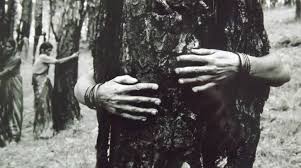
chipko
Hug the Trees!

Gandhiji may not have articulated his thoughts on the environment in terms that we use today. But his whole philosophy was deeply rooted in concepts of what we now call sustainability: taking only what one needs from the environment, simplifying wants, equity, non-violence towards all life forms, and a caution against mindless pursuit of ‘development’. Many environmental movements like Chipko or Narmada Bachao Andolan are in fact inspired by Gandhiji.

On the occasion of Stockholm+50 and WED, here are some quotations from the Mahatma, which mark him as a very early spokesperson for environment and sustainable development.

‘I suggest that we are thieves in a way. If I take anything that I do not need for my immediate use, and keep it, I thieve it from someone else. I venture to suggest that it is the fundamental law of Nature, without exception, that Nature produces enough for our wants from day-to-day, and if only everybody took enough for himself and nothing more, there would be no pauperism in the world, there would be no man dying of starvation in the world.’

Speech on ‘Ashram Vows’ at YMCA, Madras. 16 Feb, 1916. CWMG Vol 13, 230-231.

‘Earth provides enough to satisfy every man’s need, but not every man’s greed.’

Quotation popularized by Gandhi.

‘We cannot have ecological movement unless the principle of non-violence becomes central to the ethics of human nature.’

Mohan-mala. A Gandhian Rosary. Ahmedabad. Navajivan Publishing House. 1997. 93-94.

‘God forbid that India should ever take to industrialization after the manner of the West. The economic imperialism of a single island kingdom (England) is today keeping the world in chains. If an entire nation of 300 million took to similar economic exploitation, it would strip the world bare like locusts.’

Young India. 12 Dec 1928. CWMG Vol. 38. 243.

If it is man’s privilege to be independent, it is equally his duty to be inter-dependent.

http://www.selfimprovementpath.com.mahatmagandhi.

‘In the modern rush, the chief use we have for our rivers is to empty our gutters in them and navigate our cargo vessels, and in the process make them dirtier still.’

Young India, 23 December, 1926.

‘Civilization, in the real sense of the term, consists not in the multiplication, but in the deliberate and voluntary reduction of wants.’

Yeravada Mandir. Navjivan Publishing House, Ahmedabad.  

‘We cannot have ecological movement unless the principle of non-violences becomes central to the ethics of human nature.’

Mohan-mala. A Gandhian Rosary. Navjivan Publishing House.

–Meena

Credit: Centre for Environment Education put together a collection of Gandhiji’s thoughts to mark the 10th anniversary of the Earth Charter, in a publication called ‘Earth Charter & Gandhi: Towards a Sustainable World.’ Compiled by Karikeya Sarabhai, Meena Raghunathan, Amishal Modi. These quotations are taken from there.

The Whispered Wisdom of Podcasts

I am slow to adopt most things new. And so it was with podcasts. I was pretty skeptical of the audio medium as a means of learning. Being fully old school, for me, the ‘read word’ was the major source of both learning and recreation.

My conversion to podcasts is fairly recent. The audio system that I was using during my walks to listen to music on broke down, and that was when I decided to explore podcasts. And what a world it has opened up to me! Not just walks, but also car-rides and flights have become much more enriching. But I have to admit, while my default state is to sit around the house with a book in my hands, I am not as yet able to sit around with a podcast plugged into my ears. I feel kind of guilty and unemployed. But I am sure the day will come…

While the raw beginnings of podcasting are traced back to the ‘90s, the medium really came into its own in the mid-2000s. The first steps were laid in 2004, by Adam Curry  a former MTV video jockey, along with a software developer Dave Winer, when they coded a program known as iPodder. This made it possible to download internet radio broadcasts to iPods. Within a year, commercial companies realized the potential and with Apple as the first mover with iTunes 4.9, started to offer support for podcasts. Politicians were not far behind—George Bush became the first President to have a weekly podcast as early as 2005. The speed with which the innovation caught on can be gauged by the fact that   “Podcast” was declared “Word of the Year” by the New Oxford American Dictionary.

Today tech-savvy India has the third-largest podcast listenership in the world. At  57.6 million listeners, it is behind only China and the US, and growing at a rapid 30+%.

I listen of course to the usual suspects, from Stuff You Should Know, to Ted Talks Daily, to BIC Talks, to The History of India Podcasts, to No Stupid Questions, and 99% Invisible.

Aryabhatta, India’s first Satellite

But the podcast that moved me most, which inspired and fired me was MISSION ISRO. This series traces the history of India’s space programme, essentially through the work of Dr.Homi Bhabha and Dr.Vikram Sarabhai. These two men had not only the vision, but the scientific stature, the international standing and the conviction to overcome all barriers to make this dream a reality. How they convinced the decision-makers in the country that a newly-independent country like India, which was struggling to even feed its people, needed to invest in space, and how they convinced the world that India had the capacity to make this work, is a fascinating tale.  And the vision of the then-PM, Shri Jawaharlal Nehru, who believed in the use of science and technology for national development is what made this possible. The clarity of the philosophy of the Indian space programme set by the founding fathers—that it was not for warfare and aggression, but rather, to bring development to the remotest corners of India and to the poorest—is what sets our space programme apart even today.

The refusal of Dr. Sarabhai and Dr. Bhabha and their teams to be deterred by any obstacles– whether lack of equipment, permissions, know-how—is awe-inspiring. The innovative ways they found to get around challenges, to make do with the resources they had, to find supporters and partners, in order to accomplish Mission Impossible brings home the lesson that a clarity of purpose and the belief that it can be achieved will move mountains.

Researched and scripted by Archana Nathan, produced by Gaurav Vaz, Harsha Bogle’s voice brings the podcast to life. The enormous effort in getting interviews with key people who were involved in the space programme and hearing them relate the stories of those times is amazing. And hearing Dr. Vikram Sarabhai’s voice sent goose bumps down my spine!

Don’t miss it. It gives us an understanding of our history and achievements from times which today are dismissed so easily. It gives us an understanding of what visionary nation-building is and the mettle that visionary nation-builders are made of.

–Meena

Of Textbooks and More

Exactly 80 years ago this April, ‘Academies and Societies’ which I suppose was a catalogue of learned scientific publications, listed ‘Modern Inorganic Chemistry’ (Tamil) by N. Ananthavaidyanathan, published by Annamalai University and priced modestly at Rs. 2-8.

The Reference!

A lot of family history behind this entry, as the afore-mentioned Ananthavaidyanathan was my grandfather. He was a Professor of Chemistry at Annamalai University having joined it in the mid-1920s, when it was still Sri Minakshi College, and he saw the growth of the College and its sister institutions into Annamalai University in 1929 .

The book was written in response to a competition organized by the University, to come out with the first Tamil under-graduate science textbooks in the country. My grandfather’s ‘Modern Inorganic Chemistry’ won the prize.

My grandmother told us tales of the days and nights and weeks and months of work that went into the book. With no precedents of modern scientific writing or references in regional languages, my grandfather had to coin several names for chemicals, for processes, for phenomena. Being the conscientious, old-school scholar he was, that involved a lot of research and consultation. With Tamil type-writing skills not easy to find, and moreover, the problems of typing chemical formulae in the typewriters of those days, it was a physical challenge as well as an intellectual one! My grandmother helped him proof-read draft after draft.

The hard work paid off, and his was the first college-level chemistry textbook in Tamil.

Annamalai University is an institution with a hoary past. Rajah Sir S. R. M. Annamalai Chettiar, In the early 1920s, set up three educational institutions– Sri Minakshi College, Sri Minakshi Tamil College and Sri Minakshi Sanskrit College—in the temple-town of Chidambaram, and these soon became intellectual centres. The purpose of setting up the educational institutions was to educate the poor, and to give a fillip to literature in Tamil. And I suppose it was in pursuit of the second aim that the competition was organized.

Sir Chettiar was an enlightened industrialist and banker with a deep interest in education. He contributed generously to philanthropic causes and set up institutions. He was one of the founders of Indian Bank. He counts Shri AC Muthaih (who served as the Chairman of SPIC and the President of Board of Cricket Control of India), and Shri PC Chidambaram (former Finance Minister of India) among his grandsons.

In 1928, Sir Annamalai agreed to hand over the group of educational institutions he had set up, to the local government to establish a University. On 1 Jan, 1929, Annamalai University was established under a State Act–India’s first private University.

In its time, the University has been the centre of Tamil, of intellectual debate, of students who questioned the status quo of their day, of strikes, of agitations and of academic excellence. Today it is one of the largest public residential universities in Asia

We are an ‘Annamalai University family’, with my grandfather having taught there for several decades. My father studied Physics there—he had to choose between studying Physics and Chemistry, but my grandfather would not let him join the Chemistry faculty because he was the Head of the Dept., and did not want any controversy about his son being a student in the same department. My brother studied Engineering there. My father and brother both served the Defence Research and Development Organization all their lives, and my brother was honoured with the Padma Shri for his contribution to Agni and Prithvi Missiles. So I suppose I have much to thank Annamalai University for!

–Meena

Doctor Without Borders: Jonathan Kaplan

Last week I wrote about a young doctor who chose to use his medical training to serve people in war situations. This was Dr Kotnis who worked with passion and dedication on the war front in China, almost a century ago. Every generation and every period of history has examples of such professionals who voluntarily choose to serve in some of the most difficult and dangerous situations.

Doctors without Borders

I recently read a fascinating account by such a doctor in our own times. This is Dr Jonathan Kaplan who began his medical career, as do all doctors, after long and intensive years of study. Dr Kaplan graduated from medical school in South Africa and spent the next ten years acquiring specialist qualifications and training as a general surgeon, and super-specialization in vascular surgery in hospitals in the UK and USA. This equipped him to move on to become a “consultant” with a comfortable and prosperous practice. In his own words:

Master of Surgery. The title had a ring of Zen about it, as though I was now a sage of some martial art, a mystic bladesman. I had trodden the path of professional dedication, served the necessary years at the required levels of experience and responsibility, paid all my dues to date. A consultant post—the reward for all this industry—lay ahead, with attendant success and security. But I found myself beset by an odd emptiness…

This sense of emptiness led Jonathan to choose otherwise. He became a “medical vagabond” as he describes himself. He spent many years as a volunteer surgeon in some of the world’s most dangerous war zones in the 1990s. He attended to the casualties of apartheid in Cape Town; worked on the front line treating Kurdish fighters during the uprising at the end of the Gulf War, and in a part of Burma’s Shan state under attack by the Burmese army; in Mozambique during the civil war, and in Eritrea at the time of the Ethiopian offensive in 2000.

Besides the blood, sweat and tears of the battlefield, the adventurous Jonathan Kaplan was always looking for new challenges. In his own words Working as a doctor in war zones was voluntary and unpaid. My hospital career looked increasingly uncertain—my curriculum vitae was a curious patchwork of jobs that shocked the sensibilities of staid consultants—and I was considering a full-time post in accident and emergency medicine where I hoped a varied resume might be less provocative to the interview committees.

But that was not to be. A variety of chance offers led to interesting stints where Dr Kaplan saw different sides to the realities of illness and emergency care. Among these was being an air ambulance doctor, and a resident doctor on a cruise liner. He also became deeply engaged in an investigation on the impacts of mercury poisoning in a part of Brazil.  

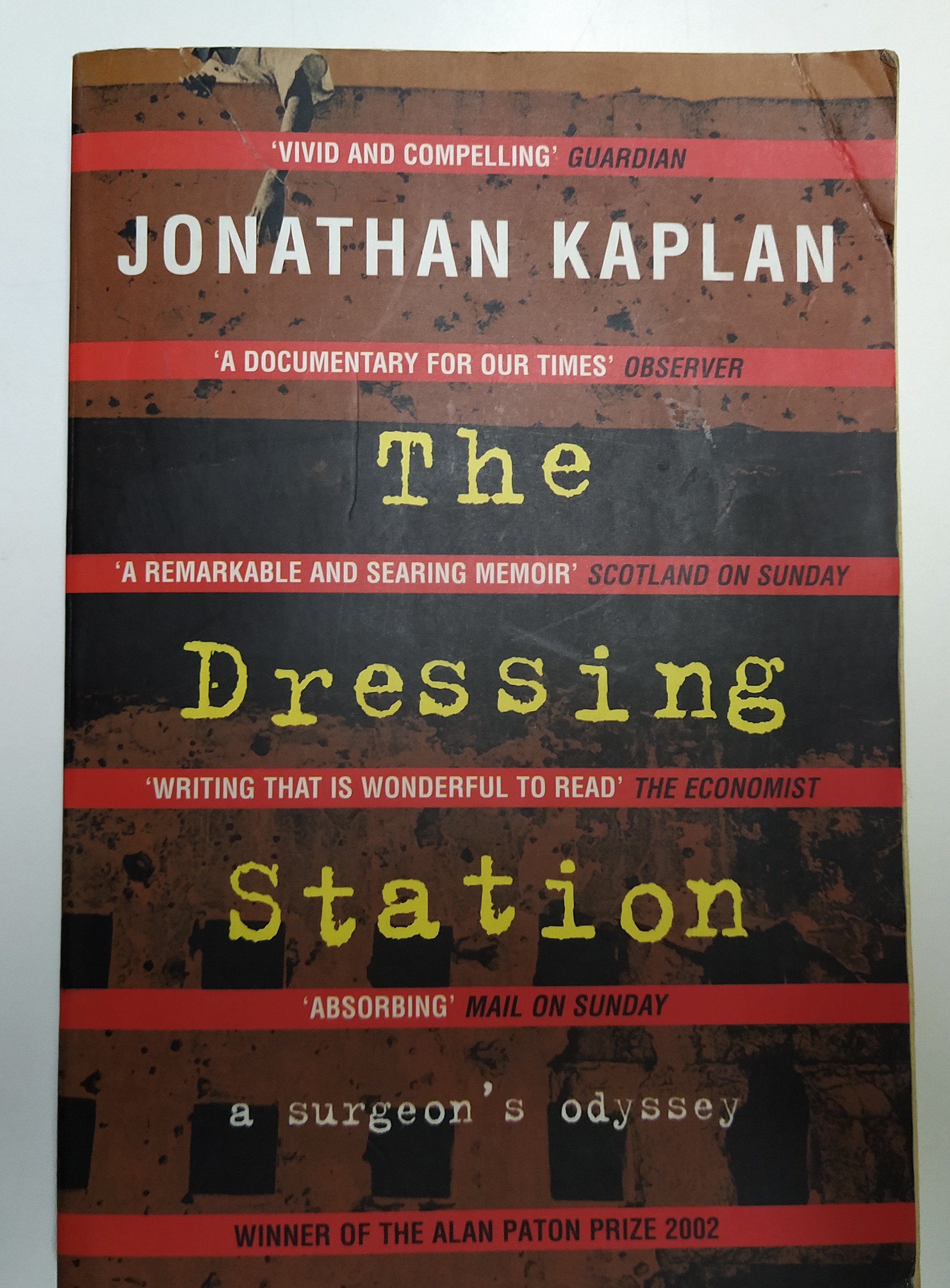
For most of his life Jonathan Kaplan worked tirelessly, and with minimal resources, amidst the most challenging conditions and heart-rending human tragedy, using every skill at his disposal to treat the wounded, and save lives. At the same time he also meticulously documented the politics, struggles, and universal human dilemmas. These have been published in a book titled The Dressing Station.

The book is a fascinating read, that vividly describes some of the most tragic and devastating impacts of war on human beings, alongside some highly technical details of surgery, and the contradictions of war-zone realities. But Jonathan is much more than a reporter. He also shares his angst and his internal struggles to maintain his humanity even under the most inhuman circumstances. He wonders about human life, and the role that doctors have to play in the human drama between birth and death. That is what makes his writing both eye-opening, as well as thought-provoking, not just for medical practitioners, but for every one of us who are on the other side of the ‘consulting table’.

As he shares: I have practised medicine in diverse fields: as a hospital surgeon, a flying doctor, a ship’s medical officer. I have operated on wounded straight off the battlefield, treated people with rich stains of tropical disease raging in their bloodstreams, and tried to help those affected by occupational illness from industrial toxins or work place stress. I have run research programmes funded by corporate finance—that met the needs of the shareholders before they benefitted any patients—and I’ve cared for children wasted by diseases of famine and war. Like most doctors I have seen my craft used and abused; been part of its successes and witnessed its failings. It is by the means of this unforgiving arena that we struggle to define ourselves.

He further ponders on his work and on life: No clinician can give an objective account of that work: the intersection between doctor and patient is mutual and intimate, and in the end comes down to something between us that is a fragile thing, as fragile as life. All we can do is the best we can in the war against death and against despair, including our own. For at its extreme the practice of medicine is a succession of front line, and each victory is only a temporary respite.

Dr Kaplan continues to take periodic assignments as a volunteer surgeon in conflict zones amidst UK hospital surgery, film-making, academic teaching, and working as a photographer, and as an advisor on medical TV dramas. He has also proposed, investigated, researched, produced and directed documentaries on health, development and environmental issues for several TV channels.

I picked up The Dressing Station by chance, not having earlier heard of Jonathan Kaplan. It was a gripping read. I look forward to reading his second book Contact Wounds.

–Mamata

A Doctor Abroad: Dr Kotnis

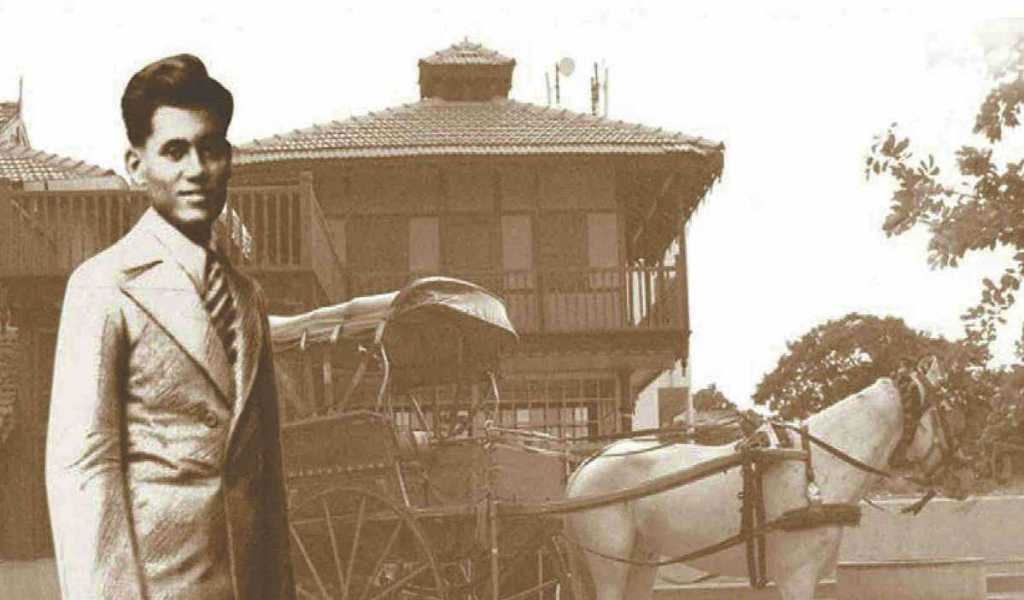
Much has been written in the past month about Indian medical students going to distant and relatively unfamiliar countries to pursue medical studies. Many of these young students have ambitions of making a successful and prosperous career after they obtain their degrees. Here is an unusual story about an Indian doctor who went abroad, over a century ago, not in the pursuit of name and money, but to use his education and skills in the service of those who needed them the most.  

Dwarakanath Shantaram Kotnis was born on 1 October 1910 in a middle-class family in Sholapur, Maharashtra. He grew up as one of seven children in the family, and his father had to take loans to support his children’s education. Dwarakanath moved to Bombay to pursue medical studies at the Seth GS Medical College. Possibly unlike his fellow students at that time, the young Dwarakanath’s ambition was to practise medicine in a different part of the world. And as destiny would have it, his dream took on an unexpected form.

Dwarakanath acquired his medical degree in 1938. The world was already in the throes of conflicts that would escalate into World War II. China had been invaded by in the early 1930s by the Japanese who were seeking raw materials for their growing industries. By 1937 Japan controlled large sections of China, and war crimes against the Chinese became commonplace. There were large scale massacres of civilians, and the Chinese resistance army suffered heavy casualties. At the same time there was an acute shortage of doctors who could attend to the injured and the dying.

It was at this time that General Zhu De, a Chinese revolutionary had written to Jawaharlal Nehru with a plea to send doctors to save the lives of the soldiers. India was in the midst of its own movement of freedom from British rule. The Indian National Congress under the leadership of Netaji Subhash Chandra Bose decided to send a team of five doctors to China to show the solidarity of the people of India with the Chinese in their fight against the Japanese aggression.

There was a call for doctors to volunteer for this mission. Dwarakanath was one of those who volunteered. He was 28 years old; neither he nor his family knew much about China, but he felt an inner urge to venture beyond familiar territory to practice the subjects that he had studied, in challenging circumstances. This decision would prove to be a life-changing one.

Thus young Dr Kotnis joined the team of five Indian doctors headed for China. The other four members of the team were M Cholkar from Nagpur, BK Basu and Debesh Mukherjee from Calcutta, and M Atal from Allahabad.

Dr Kotnis in China Source: https://www.chinadaily.com

The young doctors, the first medical team from another Asian country who had volunteered help, were personally received by Mao Zedong and General Zhu De. They were plunged straight into the war zone in Northern China where mobile medical units were treating wounded soldiers. The situation was very stressful, physically and mentally. About 800 injured soldiers had to be attended to every day which meant that the doctors often worked round the clock without rest or sleep. The young doctors stood up to the challenge, saving hundreds of lives and treating thousands of wounded.

As the battle in the North subsided, the Indian team was free to return home, and four members did so. But Dr Kotnis was reluctant to return. He wanted to spend more time in a country that he was beginning to know and love, and continue to contribute to the war effort. He joined Mao-led Eighth Route Army in 1939. He continued to work tirelessly, performing operations for up to 72 hours without a break, and treating hundreds of patients, day and night. He did not return home even when he heard about his father’s death.

Years later he was remembered by the ordinary people as a kind doctor who not only helped ease their pain and suffering, but was also concerned about their basic needs. He learned to read and write Mandarin Chinese and was able to communicate with the people in their language. He became one of them. They in turn adopted him and called him Kedihua dai fu (Kedihua was Kotnis’ Chinese name and dai fu meaning doctor).  He was also nicknamed “Dr Thoughtful” and “Old Ke”.

Around this time he also met Guo Qinglan who had volunteered as a nurse in the Eighth Route Army. The couple got married in December 1941.They had a son who they aptly named Yinhua; the Chinese character for Yin meant India and Hua meant China.

In 1941 Dr Kotnis was appointed as director of the Bethune International Peace Hospital in Shijiazhuang named after the famous Canadian surgeon Norman Bethune. Bethune was a Canadian physician and social activist who had also moved to China in 1938-39 during the Second Sino-Japanese and volunteered as a medical advisor to the 8th Route Army. He was a brilliant surgeon who not only worked on battlefields, but also helped in training medical personnel, and setting up medical programmes and hospitals to reform the health care system in China. He was deeply committed to the welfare of the poor. Dr Bethune died on the frontline, of blood poisoning in 1939, and became a national hero.

Dr Kotnis was a fit choice to carry forward the legacy of the revered Dr Bethune, who had had a similar professional path. Dr Kotnis continued to work with the same intensity and passion as he had done on the battlefield. He was also teaching medical students. As there were no textbooks he started compiling them himself. But the unrelenting stress had taken a toll on the young doctor’s health. Only three months after the birth of his son, Dr Kotnis was struck by a series of epileptic seizures that cut short his life. Even as he was writing his second surgery textbook, he collapsed, and following a seizure, died on 9 December 1942. He was just 32 years old.  He was buried in the Heroes Courtyard in Nanquan village in China among the people he made his own.

While the work of Dr Kotnis is not as well documented or known in India, the name and legacy of Ke Dihua as he was fondly called, are still remembered and revered in China. The Shijiazhuang Ke Dihua Medical Science Secondary Specialized School been named after him; from which over 45000 medical professionals have graduated. There are memorials and statues of him in several towns in China.

7 April is marked as World Health Day. A good time to remember a doctor who lived his short life with complete commitment and passion for the health of all people.

–Mamata

Weather Woman Anna Mani

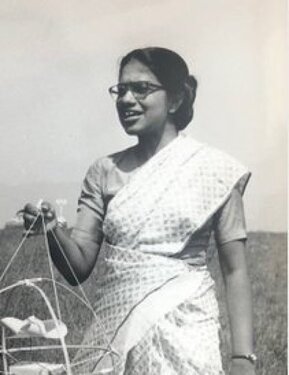
When she turned eight, Anna Modayil Mani was to be gifted a pair of diamond earrings, as per her family tradition. Young Anna requested instead a gift of Encyclopaedia Britannica! This was a bit of a shock for the Mani family in Travancore in Kerala. Anna, the seventh of eight siblings, grew up in a well-to-do but traditional family where sons were groomed for high level careers and daughters were trained to be mothers and housemakers in preparation for an early marriage. Anna however showed signs of breaking the mould from an early age when she spent her time devouring all the books in the house. Her lifelong love for nature was planted and nurtured by long walks in the forests around her father’s cardamom estates, and swimming in the backwaters and rivers. And her scientific mind was imprinted with her father’s teaching not to accept any statement unless it could be tested and verified.

Born in 1918, Anna was only seven years old when Mahatma Gandhi visited Travancore which was the epicentre of the Vaikom Satyagraha. Gandhi’s visit made such a deep impression on the young girl that she decided to wear only khadi. The spirit of nationalism that pervaded the period also instilled in young Anna the fierce spirit of freedom, including the freedom to make her own decisions. Thus, she chose to pursue higher education rather than marriage which her sisters had easily opted for.

Anna joined Presidency College in Madras from where she graduated with an honours degree in Physics in 1939. A year later she got a scholarship to undertake research at the Indian Institute of Science in Bangalore where she was accepted as a research scholar in CV Raman’s laboratory to work on the spectroscopy of diamonds and rubies. Thus Anna began to research the very stone that she had turned down in her childhood.

The experiments were challenging and laborious; Anna worked for long hours, often through the night. Between 1942 and 1945, she published five single-authored papers on luminescence of diamonds and ruby. In August 1945 she submitted her PhD dissertation to Madras University. The University, with a blend of bureaucracy and gender bias, denied granting her the degree on the basis that she did not have an MSc degree. This, despite the fact that she had won a scholarship for research at the Indian Institute of Science, and had worked with CV Raman.

Anna was not daunted by this. Around the same time, the Indian government had announced scholarships for internships abroad in various fields, and Anna applied. In 1945, just as WWII was ending, she boarded a troopship to England with the government scholarship to take up an internship in in meteorological instrumentation at the Imperial College in London. Although she had wanted to pursue further research in physics, this was the only internship available. And it is meteorology that was to become her life’s metier.

Anna Mani returned to an independent India in 1948, and joined the Indian Meteorological Department at Pune where a programme to design weather instruments was taking shape. Anna was put in charge of construction of radiation instrumentation. Despite a paucity of resources, she would not compromise on research or quality; she inspired the scientists under her to “Find a better way to do it!”

Anna Mani standardised the drawings for nearly 100 different weather instruments and started their production. She worked with members of the World Meteorological Organisation to rigorously compare measurements to verify the accuracy of Indian instruments, as she fiercely believed that “Wrong measurements are worse than no measurements at all.” She continued her link with academic research and published a number of papers on subjects ranging from atmospheric ozone, to the need for international instrument comparisons and national standardisation

During the International Geophysical Year (1957-58), she set up a network of stations in India to measure solar radiation. Her focus was on the instrumentation meant to measure solar radiation, taking into account its seasonal and regional variation across India.

By 1964, Anna Mani became involved in the ozone-monitoring efforts in India; this was well before the Ozone Hole became an international issue. India had stations to measure ozone since the 1940s, but it was Mani’s team that in 1967, developed the Indian ozonesonde, a balloon-borne instrument to measure ozone levels. They also updated ground-based equipment so that Indian scientists had a lot of data to work with. The scientist also published a number of papers on subjects ranging from atmospheric ozone to the need for international instrument comparisons and national standardisation. Anna Mani received a citation from the International Ozone Commission for her work on ozone-level measurements from 1960 to 1990.

In 1963, at the request of Vikram Sarabhai of she successfully set up a meteorological observatory and an instrumentation tower at the Thumba rocket launching facility.

Anna Mani’s work of three decades made a valuable contribution to Indian meteorological sciences, indigenously manufactured instruments, reliable data, scientific rigour and up-to-date methodology. It was Mani who spearheaded India’s efforts to manufacture its own weather observation equipment, such as barometers and wind gauges, dramatically bringing down their cost – at the same time, she ensured their reliability and precision.

Anna Mani retired as deputy director general of the Indian Meteorological Department in 1976. She returned to the Raman Research Institute as a visiting professor for three years. Later she set up a millimetre-wave telescope at Nandi Hills, Bangalore. She published two books, The Handbook for Solar Radiation Data for India (1980) and Solar Radiation over India (1981), which have become standard reference guides for solar tech engineers.

Mani did not marry, she spent her life in the pursuit of science, In 1994 she suffered a stroke which affected her mobility; and died in 2001.

Anna Mani was steeped in, and driven by her passion for work. As she once said “I should be most unhappy to wake up without the prospect of some work to do.” But she went on to say that when the work was done, she enjoyed listening to music, reading and enjoying nature, her childhood passions.

Her advice to young meteorologists was, “We have only one life. First equip yourself for the job, make full use of your talents and then love and enjoy the work, making the most of being out of doors and in contact with nature.”

23 March is marked as World Meteorological Day. This is a good time to celebrate Anna Mani and her significant contributions that made independent India self-reliant in measuring aspects of the weather, and helped lay the ground for harnessing solar and wind power as alternative sources of energy.

–Mamata

Two Faces of War

As the world watches in despair at another meaningless war, amidst the dark and dismal narratives, it is the stories of hope and resilience that resonate the loudest. And unknown or forgotten connections are remembered anew.

For many of us, Ukraine was just another name on the map, and we imagined that it was far away geographically and personally. Until we read about the many many Indians who have been living, studying and working there. It got even closer with the media in Gujarat full of stories not only of the Gujarati students who were stranded there, but equally of the way other Gujaratis in neighbouring countries were offering overwhelming help and support to fellow countrymen in need. In Poland especially food and shelter is being given with open hearts and homes—helping to create a little India in a distant land.  

This link with Poland goes back many years, back to another war—World War II, and a reverse flow of displaced people. One of the heart-warming stories is about how the Maharaja of Jamnagar created a Little Poland in Gujarat.

In 1939 Poland was invaded by both Germany and Russia. There were mass arrests, massacres, grabbing of land and businesses, and large-scale deportations. Over two million Polish civilians were sent to camps in Siberia, and thousands died, even before they got there. Hundreds of Polish children were left orphaned or abandoned. In 1941 there was an international amnesty that allowed the destitute refugees to leave the Soviet Union. They undertook arduous and long journeys to distant lands that were offering them refuge.

India was at the time, still under British rule and the British government was not keen on accepting refugees. In the face of severe opposition by the British, Digvijaysinhji Ranjitsinhji Jadeja or “Jam Saheb” as he was called, the Maharaja of Nawanagar, a princely state in Gujarat was the first to offer the orphaned children from Poland refuge. The 46 year old king had developed a special interest in Polish culture ever since his meeting with Ignacy Padrewski, a Polish pianist that he had met in Switzerland. He was moved by the plight of the Polish orphans. Despite the official British refusal to accept these refugees, as the head of a princely state the Maharaja had some level of autonomy. He was determined to use it and take in the homeless children. 

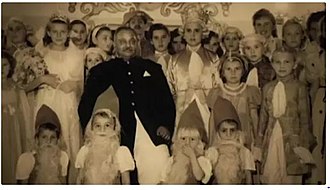
In early 1942 the first group of 170 children who reached Bombay, and travelled on to Balachadi a small seashore town close to the maharaja’s capital Jamnagar. The maharaja welcomed them with the words “You are no longer orphans. From now on you are Nawanagarians and I am Bapu, father of all Nawanagarians, so I’m your father as well”.

Bapu Jam Saheb and his Polish children at a Xmas show

Jam Saheb was true to his word. The children were initially put up in tented accommodation while the Balachadi camp was being built. The maharaja went to great lengths to ensure that Balachadi became a home away from home for these children who, at a young age, had experienced dislocation, loss of family and home, and the horrors of war. He built dormitories in which each child had a separate bed, and generously provided food, clothes and medical care. He converted the guest house of his Balachadi palace into a school, and even set up a special library with Polish books so that the children would not forget their mother tongue. He was concerned that they should not forget their own culture; he encouraged the children to put up shows including their songs and dances, and continued the country’s strong traditions of Scouts and the church. He encouraged children to play sports, and they were free to use his gardens, squash courts, and pool. He was concerned about their choice of food and would host special meals for the children. One of the children recalled, many years later, how the children did not like the way spinach was cooked and went on a ’spinach strike’. When the Jam Saheb heard about this he immediately ordered the cooks not to include spinach in the meals. 

Between 1942 and 1946 over 600 Polish children found a home in Little Poland thanks to the maharaja. When the war ended and the orphans had to return to Europe, both the children and the maharaja were heart-broken. The unusual bond that was formed remained strong, and played a crucial role in giving stability and hope to children who had lost everything.

The Maharaja died in 1966. His Polish “children” had spread across the world in countries where they started new lives after the end of the war. 76 years later, as a testimony to the enduring bonds, and to mark 100 years of Poland’s independence, in 2018, six of these “children” (now in their nineties) returned to Balachadi. They walked down memory lane, remembering the Bapu who not only gave them a home, but also their childhood.

Jam Saheb is remembered not only by his children, but is also considered a hero by the country that honours his generosity. He was posthumously awarded the Commander’s Cross of the Order of Merit. A city square in the heart of Warsaw is named Skwer Dobrego Maharadzy (The Square of the Good Maharaja). When he was alive the Maharaja had been asked how the Polish people could thank him for his generosity and he had replied that they could name a school after him. One of the city’s foremost private schools is named the Maharaja Jam Saheb Digvijaysinhji High School. A fitting tribute indeed.

Today, as another war rages, Poland is welcoming thousands of displaced women and children. Perhaps some of them will find refuge in the Square of the Good Maharaja, and history would have come full circle.

–Mamata.