Carved in Stone, Carved in Our Memories

Khajuraho. Memories of history textbooks. Also of sniggers and side glances among us as school girls.

When our friends and we decided to visit, it was on a whim. We wanted to see the monuments which are counted among the best in terms of the flowering of Indian art, architecture and creative expression. But we half-feared we would see badly maintained ruins.

What an amazing surprise! We were awe-struck with the boldness of imagination and design of the 25 out of 85 temple structures still standing. We marvelled at how, more than a 1000 years ago, buildings of such complexity and technical perfection could have been built. Even in terms of just moving material and creating such huge structures—how did they manage it? Truly a civilization at the height of its cultural powers.

We were equally impressed with how well the structures have been restored and how well they are being maintained. No ugly and inappropriate renovation. No vandalism. No graffiti. No unpleasant solicitation by guides or vendors. No garbage. No muck.

The cluster of temples (85 at the peak), were built between about 950 and 1050 AD, by kings of the Chandela dynasty. And the eclectic collection of Gods to whom they were dedicated is interesting—Shiva, Vishnu and even Jain temples (Devi temples being conspicuous by their absence).  The erotic nature of the carvings in Khajuraho is much talked about, but it constitutes only 10 per cent of the total. And done in a completely matter of fact way, juxtaposed with everyday scenes of life and times.

varahaWhat I found most fascinating was the Varaha temple. A temple dedicated to the 3rd avatar of Vishnu–Varaha or Boar. I don’t recall any other temple devoted to this avatar. The sculpture is a humungous sandstone monolith—2.6 metres long and 1.7 metres tall.  It boggles the mind how they got the stone up there and carved it. Because carve they did—every inch of the boar’s body is covered with numerous figures. Between the nose and mouth is a carving of Goddess Saraswathi, with the Veena in her hands—a tribute to knowledge. In the Varaha avatar, the demon Hiranyaksha kidnapped Goddess Earth and hid her under the cosmic ocean. Varaha battled the demon for a 1000 years and brought back the Goddess. Well, the Varaha statue has battled the elements for over a 1000 years, and stands testimony even today, to the skill of its creators. It looks fresh, exudes power, and is almost shiny metallic looking.

14F60E49-C3F9-4317-9D1F-FD07ED2A5575

telescope


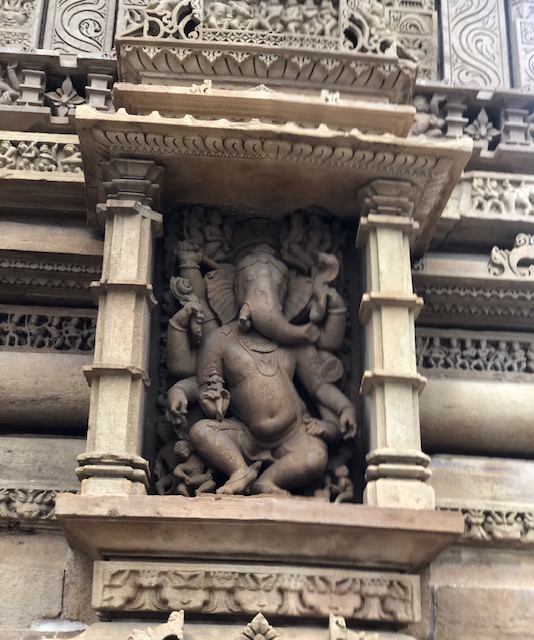
Other sculptures that stand out are a dancing Ganesha. You can see his paunch swaying as he dances! An elephant with a sense of humour, who looks with a twinkle in his eyes, at an amorous couple.

And most interesting of all, a man who is ‘upskirting’ a voluptuous beauty with the help of a device that looks like a telescope. But the telescope was invented only in about 1608!! So what could this device be?


While Khajuraho was an amazing experience, getting there was not! There is an airport, but flights seem seasonal, and only connect to Delhi, Agra and Varanasi. There is a station there, but only serviced by a few trains. We got there by road from Jabalpur. A distance of about 250 kms which took about 6 hours, thanks to 30 kms of potholed roads, and 20 kms of no road at all!

So while I bow to those who conceived and created Khajuraho, and bow to those who have restored and are maintaining it, I definitely do have a bone to pick with those who are doing their best to make getting there such a pain. A real disservice to anyone who wants to see India’s heritage in its glory, a disservice to the world in making access to a World Heritage site so difficult.

–Meena

A Gandhi for Every Poet

Among the thousands of events to mark Gandhiji’s 150th anniversary, the one I was privileged to attend was indeed special. A evening of ‘Gandhi music’ by the renowned Shubha Mudgal, at the Bangalore International  Center.

What made it special was that it was not the usual ‘Ashram bhajans’.  It was a bit disorienting to not have the performance begin with ‘Vaishnava Jan’ or ‘Raghupati Raghav’ or even ‘Ekla chalo’. But one was soon in the flow…not only of Shubhaji’s voice, but also the unknown…at least to me…songs.

This was a collection of poems on Gandhi and about his leadership of the freedom movement which the artist had researched, curated and set to music. Nothing else could have brought home more powerfully how wide and deep the Mahatma’ s influence was. There were pieces written by literary figures. A Bhojpuri folk song which talked about the charkha. A Holi song from Uttaranchal urging people to get immersed in Gandhi’s colours. A poem by someone who had lived in Gandhi’s ashram for 30 years and had written 500 poems reflecting on his experiences. A contemporary poem written a few years ago by an educational administrator from the Delhi government.

But the one that left a special mark was a song by a courtesan. In a characteristically out of the box move, Gandhiji had apparently addressed a ‘Tawaif Sabha’ in Benaras to urge them to do their bit for the freedom movement. His request was they should include  at least one protest song in their performances. In response, one well-known artist, Vidyadharibai, wrote and presumably performed a very powerful song castigating the British.

And the evening was limited to Hindi songs. It is mind-boggling to think what wealth of poetry there must be in all our languages! How did Gandhiji touch so many people, so many different kinds of people, people in so many places? How did he relate to all of them and all of them to him? Businessmen, farmers, rich, poor, professionals, weavers…..How did he inspire them and change them all?

The memory persists down generations. But the change?

—Meena

Environmental Scolder-in-Chief

E_SDG goals_icons-individual-rgb-13“You have stolen my dreams and my childhood with your empty words. And yet I’m one of the lucky ones. People are suffering. People are dying. Entire ecosystems are collapsing. We are in the beginning of a mass extinction, and all you can talk about is money and fairy tales of eternal economic growth. How dare you!’ said Greta Thunberg to world leaders at the UN.

And that is a scolding they will not forget in a long time!

Greta, the girl, who in her teens is shaking up the world! Deeply concerned about the climate crisis, and even more concerned that world leaders were not taking it seriously, a few years ago, Greta took off from school to protest outside Sweden’s Parliament, calling for action on climate. She tried to get some of her school mates to join her, but no one was interested. So she took time off from school every Friday, and sat alone outside Parliament for three weeks, holding signs which said ‘School Strike for the Climate’, and handing out pamphlets. Her strikes found their way to social media and started attracting worldwide attention.

As time went on, inspired by her, more school children joined in, and organized protests in their own communities. This developed into the School Climate Strike movement, or ‘Fridays for the Future’. And there have been strikes involving tens of thousands of school children in major cities of the world.

So strong were these voices of the youth that Greta was invited to address the United Nations Climate Change Conference in 2018. Her advocacy is forcing governments to acknowledge that they need to do more for the future generations by taking climate action.

Greta is not just about advocacy and telling other people what to do. She challenged her family to adopt more a more environment friendly life style and reduce their carbon footprint. And she succeeded! Her family is vegan now, and her mother has even given up her career as an international opera singer—which involved a lot of air travel– in order to reduce her carbon footprint!

Greta herself made the headlines once again when in August 2019, she sailed across the Atlantic Ocean from Plymouth, UK to New York, US in a 60ft racing yacht equipped with solar panels and underwater turbines to participate in some key meetings. The 15-day voyage demonstrated that it was possible to reduce emissions and do a carbon neutral transatlantic crossing serving. Greta attended the UN Climate Action Summit in New York City and COP 25 (Conference of Parties) Climate Change Conference in Santiago, Chile.

Greta has told the world what young people expect. Will world leaders and adults like us be able to step and do what it takes?

–Meena

The Moon Is Not Going Anywhere

full-moon-moon-bright-sky-47367If there were no failures associated with space forays, what would Hollywood do, considering that so many of its blockbusters are centered around this theme!

We lost contact with Vikram Lander. But we will still be getting information from Chandrayaan, which will be useful to the world’s scientific community. And if not this time, next time around, we are going to make it to the moon and other frontiers.

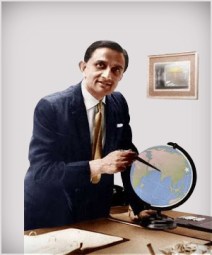
Dr.Vikram Sarabhai, father of India’s space program and the person for whom the Lander was named, would laud the spirit of ISRO which has dusted itself after the setback and is all gung-ho to carry on. This was the spirit he tried to imbue his institutions with, as testified by a quote from a paper on him:

“He has come. Tell him.”

“I didn’t do it. You tell him.”

“No, you tell. I feel scared.”

“What is it ?’

“The meter is burnt, sir. We passed too much current.”

“Oh, I see. Well, don’t worry. How else would one learn? Next time you will be more careful.”

That, in a nutshell, was Professor Vikram Sarabhai. Meters were scarce those days. In fact, we did not get a new one for almost two months and the work was held up. But the human qualities of this great man were evident even before he took courage in both hands and shaped the destiny of the scientific institution that was to be PRL, and brought it national and international repute. Visionaries there are many and finally nothing succeeds like success; but in the case of Vikrambhai one could see straightaway that he had to succeed; there was just no other alternative!”

The world’s scientific community is with ISRO. India is with ISRO.

It is a universal human quest—to explore the frontiers and expand our knowledge. This is, in the ultimate analysis, beyond boundaries. It is about the human spirit.

–Meena

Vikram Sarabhai Centenary

header_leftA remarkable man was born a hundred years ago in our country. He dared to dream impossible things and proceeded to make them possible. I would have thought the country would have been abuzz this year, with multitudes of events to remind the younger generation of his achievements in myriad fields from space science, to management, to atomic energy, to textile research, to education. That the institutions he had set up would not just celebrate the moment but also introspect and re-dedicate themselves to his principles.

ISRO is the only one which seems to be doing it at any scale. Chandrayaan went up, and all those associated with ISRO did remember and thank him. The mission’s lander is appropriately called Vikram. They are also launching a year-long calendar of programs for schools; awards for journalists in space science, technology and research; releasing a commemorative coin, a coffee table book, a space education van, etc.

But what is really disappointing for me is that his contribution to management and institution building is not being celebrated. Everyone acknowledges that his greatest achievements were probably in institution building. ISRO, IIM, PRL are just some of the prominent institutions which stand testimony to this in the public eye, but ‘Sarabhai was a prolific institution builder. He set up an institution every year beginning from 1947 till his death in 1971. He left his imprint in fields as diverse as space technology and performing arts.’

That makes it about 2 dozen institutions!!

There are a few old papers on his approach to institution-building. But I would have thought it should be seriously taught in management schools; there should be training programs for all levels of managers based on his thinking; that academics would delve into it and write papers by the dozens; that seminars and workshops would be held. In this year at least! But I haven’t heard of any such.

Indian organizations wither and die (if not physically, in spirit and achievements), within decades of their birth. Is it not important for managers in both the public and private sectors to understand how institutions that Dr.Sarabhai built have been able to retain the spirit and reaching the heights—literally the moon—close to five decades after his passing away? Dr.Sarabhai straddled the worlds of industry, government, academia and research, and used the same approach to all. So his approach to institution building should have messages for every manager.

Well, I owe a lot to his approach to institution building. So I thought to put together something as my tiny tribute. (The following are quotes majorly from two sources, one whose authorship it has not been possible to find. Since this is not an academic paper, I have taken liberty to quote from it.).

On Institutional Culture:

‘Trust was an important element of both personal and organizational relationship’.

‘The operating culture of (his) institutions were such that administration played a supportive role and helped the institutional growth through implementation of research programmes. This is unlike many organizations, especially educational, research, governmental, and public sector organizations, where the tail wags the dog.

He believed that an institution based on caring for people gave assurance to individuals to innovate and to respond to situations creatively.

Sarabhai was opposed to rigid controls and often wrote and spoke against controls which, he believed, “damaged innovative behaviour and consequently the growth of new institutions.”

On Building People to Build Institutions:

‘Sarabhai’s institution building philosophy was centered around development of individuals. For him people were more important than buildings. He created and nurtured various institutions through developing and nurturing young individuals. He gave trust, freedom of work and autonomy and showed care and concern to them in return he received creativity and commitment, which ultimately strengthened the institutional goals’.

On Institutional Leadership:

‘Vikram Sarabhai was very particular in selecting the head of an institution. The chief executive can make or mar the institutional fabric.’

In selecting a head of institution, it was very important to Dr. Sarabhai to see ‘how suitable he is as a human being’.

‘According to Sarabhai, a basic requirement of an institutional leader is the ability to provide the appropriate operating culture which would be created by the attitudes and assumptions of its people rather than by the formal organizational structure’.

On Staffing A New Institution:

‘In selecting researchers for ATIRA, Sarabhai insisted on recruiting fresh candidates with knowledge of scientific methodology and preferred those without previous experience. This was a deliberate move, for he believed that taking away experienced and trained people from universities and research institutions would create a vacuum which would weaken them.’

Respect for Individuals:

He showed tremendous respect to each individual he, met. Parikh (1972, p44) described this “Many times I have seen Dr, Sarabhai patiently listening to people who would go on with long incoherent monologues which seemed to convey nothing. Yet, In the end, Dr. Sarabhai would summarise the monologue, giving it a very constructive interpretation and meaning. I am told that when asked why he suffered fools so lightly, Dr. Sarabhai had replied that in a vast country like India where people come from diverse backgrounds not everyone has had a privileged upbringing. One should, therefore, allow for this in listening to people and try to see behind the words what they are trying to say.”

Summing up the Spirit:

And finally, in his own words: ‘There is no leader and there is no led. A leader, if one chooses to identify one, has to be a cultivator rather than a manufacturer. He has to provide the soil and the overall climate and the environment in which the seed can grow. One wants permissive individuals who do not have a compelling need to reassure themselves that they are leaders through issuing instructions to others; rather they set an example through their own creativity, Love of nature and dedication to what one may call the ‘scientific method.’ These are the leaders we need in the field of education and research’.

References:

Institution building: Ganesh S.R., Joshi P. (1985) Lessons from Dr. Vikram Sarabhai’s leadership. Vikalpa. Vol. 10, No 4.

Click to access 09_chapter%204.pdf

–Meena


Gentle Birdman Leaves Us

Many mornings, sitting in our little garden with our cups of tea, as we watch the birds already busy going about their day’s business, we may spot one that we had not seen before. And before it disappears we say, “Bring Lalsinhbhai’s book and let’s find out what this is.” Lalsinhbhai’s handy bird book is always close at hand. With the help of the beautiful life-like illustrations we open to the description, and always learn so much more than the name of the bird. Written in simple conversational Gujarati, Lalsinhbhai’s bird books are over and above the traditional description of birds. They capture nuances of birds that make them truly our Lifelong Companions, as one of his books is titled.

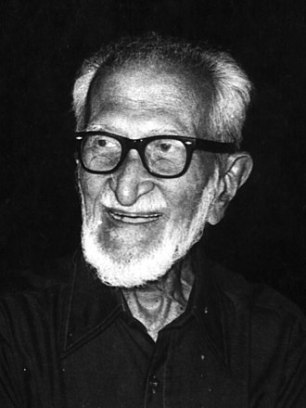
Lalsinhbhai Raol, passionate nature lover, the birdman of Gujarat, and an inspiration to countless nature lovers, passed away recently. For the Matriarchs, who both stepped into the charmed campus of CEE with relatively little prior exposure to the natural world, he was one of the wonderful guides that gently led us to explore and discover the world of birds.

Lalsinhbhai was then working with CEE on a book series called Introduction to Nature. For many generations, Salim Ali’s book had been the Bible for all birdwatchers. Lalsinhbhai’s series, in Gujarati, not only opened up the fascinating world of birds to non-English speaking audiences, but also opened windows to the birds of Gujarat—starting with the most commonly found birds, to birds of wetlands, of grasslands, and of the forest and its environs. Lalsinhbhai not only translated his long years of bird observation into succinct, interesting descriptions, but also coined appropriate Gujarati names for several of these.

His was a quiet, unobtrusive presence on CEE campus, but whenever you met him, he would always have a gentle word of concern and encouragement, and an exciting bird fact to share.IMG_20190801_110849.jpg

I had the privilege of sharing his great knowledge and passion when he kindly agreed to be the author of NatureScope Birds, one of a series of Teachers’ Manuals that I was editor of. This involved not only putting together a compendium of information about Indian birds in a teacher and student-friendly style, and also linking this with relevant and exciting activities that could be easily done. For me this was a greatly enriching and inspiring collaboration. Even today, I often dip into the book for facts, ideas, and activities with the confidence that every word is accurate and vetted by an expert ornithologist.

Meena has her own special memories of learning from Lalsinhbhai. I had the privilege to work with Lalsinhbhai on developing a proposal for a project of Bird Study for the Visually Challenged almost 30 years ago. It was a unique project, in that its purpose was to make ‘bird watching’ possible without the ‘watching’. Recorded bird sounds were of course an important part; but we also proposed providing tactile experiences such as touch-and-feel albums of feathers; collection of birds’ nests; true-size models of birds, birds’ feet, beaks, eggs; and trips to bird areas to experience the environment, sounds, etc. As always, Lalsinhbhai could empathise with the needs, and gave wonderful insights and ideas. The Ministry of Human Resources accepted the proposal and the team carried out a very successful project in Ahmedabad.

We feel fortunate for having known, and learnt from this gentle soul. May his spirit always soar high with the birds that he so loved.

–Mamata and Meena


Hidden Figures, No Longer

This is the week of moon missions—past, present and future. Fifty years since the first man walked on the moon, and very soon, India’s own Chandrayaan-2  will become the first space mission to make a soft landing on the South Pole of the moon. Another ‘first’ worth celebrating is the fact that this moon mission is being led by two women, along with a team that comprised 30 per cent women. While programme director Muthayya Vanitha has nurtured Chandrayaan-2 over the years, the journey will be navigated by mission director Ritu Karidhal. Much to be proud of indeed!

Interestingly, while today women are rightfully making the headlines in science and technology, the scene was very different just 60 years ago. The booIMG_20190718_102016.jpgk titled Hidden Figures: The American Dream and the Untold Story of Black Women Mathematicians Who Helped Win the Space Race traces the true story of black female mathematicians who worked as ‘computers’ (then a job description of those who did calculations by hand) at NASA, during the space race. The book describes how the three mathematicians Katherine Johnson, Dorothy Vaughan, and Mary Jackson, overcame discrimination and racial segregation, with determination and hard work, to use their brilliant mathematical minds to contribute substantially to some of America’s greatest achievements in space.

The book traces the period from the 1930s through the 1960s in America, when women were still expected to be at home, and faced social, racial and gender discrimination.  Through sheer tenacity, force of will, courage and intellect, these women scientists ensured their stamp on history.

Written by Margot Lee Shetterly, herself an African-American, whose father was a research scientist at NASA during that period. His accounts of the work, and of his co-workers inspired her to research and tell the story of some of these women whose contributions were hardly known, let alone recognised. Shetterly is the founder of The Human Computer Project which is an endeavour to recover the names and accomplishments of all of the women who worked as computers, mathematicians, scientists and engineers at the NACA and NASA from the 1930s through the 1980s.

Just this year, the street outside NASA’s headquarters has been named “Hidden Figures Way”, in belated honour of these three African-American women whose work helped pave the way for future generations at the space agency.

The book Hidden Figures has also been adapted as a film by the same name, which captures the spirit of the book, although not the details of the work environment at the NASA Langley Research Centre, and the lives and experiences of these women.

In the meanwhile we are proud to honour all the women who are, rightfully, no longer simply hidden figures. What all the women (hidden and otherwise) do have in common is the passion that drove them to achieve their dreams.

As Ritu Karidhal has said “Since my childhood, I realised that science was not just a subject for me, it was a passion. When you are passionate about something, it just keeps you going, it doesn’t matter who is in front of you or what obstacles comes.”

Yes, even the sky is not the limit for those who not just dream, and but also dare!

–Mamata


Calico Dome: My Introduction to the Genius of Buckminster Fuller

Born July 12, 1895. A tribute on his birth anniversary.

When I moved to Ahmedabad in 1984, one of the ‘must see’ places was the Calico Dome. So dutifully, I went there as part of the Old City sightseeing and shopping experience.

It took me quite a while to figure out what the big deal about the dome was.

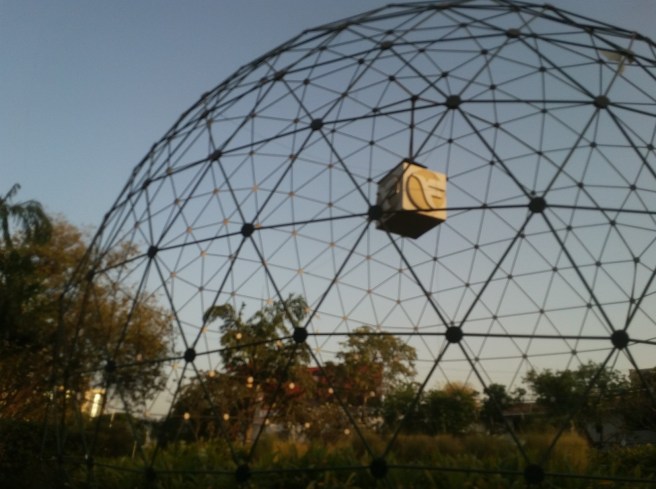
….That the dome was more than a showroom for the Calico Mills. That it was more than a venue for a fashion show that Parveen Babi had once taken part in as a student. That it was a historic structure, the first space frame structure in India (today so common in airports, for instance). That it was a design inspired by Buckminster Fuller‘s geodesic domes, and designed by Gautam and Gira Sarabhai and inaugurated in 1962.

Well, so what? Nothing, except the geodesic dome is ‘recognized as the strongest, lightest, and most efficient means of enclosing space yet devised by man’.

A geodesic dome is composed of a complex network of triangles. These structures are extremely strong. They can withstand high winds, earthquakes and heavy snow, making them ideal structures for any type of environment. They are also efficient and sustainable. Due to their spherical nature, dome homes provide a large amount of living space, while taking up very little surface area. And due to their lower area-to-volume ratio, they require less energy for heating and cooling.
geodesic.jpg

The geodesic dome embodies all that Buckminster Fuller stood for— ‘Less is More’, and a constant effort towards sustainability through design. Dedicating his life ‘to making the world work for all of humanity’, his designs have continued to influence generations of designers, architects, scientists and artists working to create a more sustainable planet. He was the first person to use the term ‘Spaceship Earth’.

He was a practical philosopher who contributed to many facets of life and has been called a ‘comprehensive, anticipatory design scientist.’. Just a few examples of how his work has contributed beyond architecture and design: Molecular biologists have now established that his mathematical formula for the design of the geodesic dome applies perfectly to the structure of the protein shell that surrounds every known virus. Several leading nuclear physicists are convinced that the same formula explains the fundamental structure of the atomic nucleus, and is thus the basis of all matter.

Other paradigm shifting designs include the Dymaxion houses, cars and map.

He visited India several time, giving the Nehru Memorial lecture in 1969. During one of his visits to India, he helped build a geodesic structure on the campus of Bengal Engineering College (now, Indian Institute of Engineering Science and Technology, Shibpur, West Bengal)

Happy that geodesic domes were something I encountered, including on drives to the airport at Ahmedabad for 20 years, at one of the garden-chowks!

—Meena


The mills and shops closed in the 1990s and the dome went into disrepair. In the 2001 earthquake, the centre of the dome collapsed and heavy rains damaged the interior of the underground shop. Later the dome collapsed completely.[3] [4]

On liquidation of Calico Mills, Ahmedabad Municipal Corporation (AMC) bought it as a heritage property in 2006.



Putting their novelty aside, dome homes have the potential to solve many of our most pressing environmental and societal challenges. R. Buckminster Fuller’s ultimate goal in designing geodesic dome structures was to solve the housing challenges of an ever-increasing population. He set out to design human shelters that were strong, sustainable and affordable.

The geodesic design is a perfect marriage of the sturdy arch and the rigid triangle, which enables dome homes to be extremely strong. They can withstand high winds, earthquakes and heavy snow, making them ideal structures for any type of environment, especially in an increasingly volatile climate.

Along with their strength, dome homes are incredibly efficient and sustainable. Due to their spherical nature, dome homes provide a large amount of living space, while taking up very little surface area. And due to their lower area-to-volume ratio, they require less energy for heating and cooling.

Additionally, dome homes require far less building materials than traditional homes do, and can be made out of a variety of eco-friendly building materials. They’re also typically less expensive to make than traditional homes, and the fact that they are much smaller than traditional single-family homes also helps keep the costs down. These factors make them ideal for people looking to build an environmentally friendly home on a budget.

While the residential application of the geodesic dome is most heralded in American culture, the original Fuller domes—as well as many since—were actually constructed for commercial use.

In fact, the first dome that was constructed after Fuller filed his patent for the structure was part of the Ford Motor Company headquarters in Dearborn, Mich., in 1953. The Ford Rotunda was originally an open-air pavilion, which the company then retrofitted with a roof to create an indoor space. However, the building could not sustain a traditional roof, which would weigh more than 160 tons. Ford turned to Fuller to design a geodesic dome that weighed just 8 tons. Although the Rotunda was destroyed in a fire in 1962, it was proof of concept for many commercial buildings to come.

After the success of the dome used for the Rotunda, other clients came calling, including the U.S. military. The government looked to the Fuller domes for two reasons. First was for how impervious they were to wind and weather, as the military needed shelter for their radar equipment that could withstand the harsh conditions at the Arctic Circle. The dome shape proved to be ideal to withstand high winds with minimal maintenance.

And second, the U.S. government explored using geodesic domes for their light weight and ease of construction. The domes were used to create “speedy but strong” housing for soldiers overseas in the 1950s, according to the Buckminster Fuller Institute. In fact, the Marines went as far as creating a 30-foot dome that could be delivered by helicopter and assembled in just over two hours—and that could withstand a day-long barrage of 120-mile-per-hour wind gusts.

MODERN DOMES AND POTENTIAL IMPACT

Since the early days of experimentation with geodesic structures, many have been built, including Epcot Center’s Spaceship Earth (although it’s technically a geodesic sphere, not a dome), the Tacoma Dome in Tacoma, Wash., the original hangar used to house the Spruce Goose, and the Amundsen–Scott South Pole Station (from 1975–2003). As architecturally impressive as they are utilitarian, these domes allow their proprietors to do more with less.

This do-more-with-less mentality has also led optimistic individuals to use the geodesic dome shape to solve urban problems such as creating transitional housing in Silicon Valley. A recent proposal by the entrepreneur Greg Gopman aims to provide a small village of dome homes available to rent for just $250 per month.

After all, what the geodesic dome—and its potential—shows us is the impact that architects and builders can have when they truly think outside the box.

https://blueprint.cbre.com/the-impact-and-importance-of-the-geodesic-dome/


  1. Buckminster Fuller was a renowned 20th century inventor and visionary born in Milton, Massachusetts on July 12, 1895. Dedicating his life to making the world work for all of humanity, Fuller operated as a practical philosopher who demonstrated his ideas as inventions that he called “artifacts.” Fuller did not limit himself to one field but worked as a ‘comprehensive anticipatory design scientist’ to solve global problems surrounding housing, shelter, transportation, education, energy, ecological destruction, and poverty. Throughout the course of his life Fuller held 28 patents, authored 28 books, received 47 honorary degrees. And while his most well know artifact, the geodesic dome, has been produced over 300,000 times worldwide, Fuller’s true impact on the world today can be found in his continued influence upon generations of designers, architects, scientists and artists working to create a more sustainable planet.


The Dymaxion Map, 1943

Not limiting himself to any one discipline, Fuller took on cartography with this invention – credited as the first two-dimensional map of the entire Earth’s surface that shows it without distortions.

To create the piece, Fuller projected the world map onto the surface of a three-dimensional icosahedron, which was then unfolded and laid flat.

https://www.dezeen.com/2018/08/27/eight-forward-thinking-ideas-buckminster-fuller-exhibition-los-angeles/

he Dymaxion map or Fuller map is a projection of a world map onto the surface of an icosahedron, which can be unfolded and flattened to two dimensions. The flat map is heavily interrupted in order to preserve shapes and sizes.

The projection was invented by Buckminster Fuller. The March 1, 1943 edition of Life magazine included a photographic essay titled “Life Presents R. Buckminster Fuller’s Dymaxion World”. The article included several examples of its use together with a pull-out section that could be assembled as a “three-dimensional approximation of a globe or laid out as a flat map, with which the world may be fitted together and rearranged to illuminate special aspects of its geography.”[1] Fuller applied for a patent in the United States in February 1944, the patent application showing a projection onto a cuboctahedron. The patent was issued in January 1946.[2]

—————————————————————————————————————-

geodesic dome, which has been recognized as the strongest, lightest, and most efficient means of enclosing space yet devised by man.


Molecular biologists have now established that his mathematical formula for the design of the geodesic dome applies perfectly to the structure of the protein shell that surrounds every known virus. Several leading nuclear physicists are convinced that the same Fuller formula explains the fundamental structure of the atomic nucleus, and is thus the basis of all matter.


Gira and Gautam Sarabhai and his team designed the Calico Dome, inspired by Buckminster Fuller‘s geodesic domes. The dome housed the showroom and shop for Calico Mills, which opened in 1962. The first fashion show in Ahmedabad was organised in the Dome.[2] Indian actress Parveen Babi took part in shows in the 1970s when she was a student.[2]

Inaugurated in 1962, the 12-meter wide structure

It was the first space frame structure in India

The mills and shops closed in the 1990s and the dome went into disrepair. In the 2001 earthquake, the centre of the dome collapsed and heavy rains damaged the interior of the underground shop. Later the dome collapsed completely.[3] [4]

On liquidation of Calico Mills, Ahmedabad Municipal Corporation (AMC) bought it as a heritage property in 2006.
 

The Danseuse and the Turtles

May 23 is World Turtle Day. And this is my turtle tale!IMG_20190523_095146.jpg

It was an unlikely subject–not one that I would have volunteered for! Among the diverse subjects that I had an opportunity to learn about when I was developing a series called NatureScope India, Turtles happened to be the subject of the next issue. That was going to take some research on my part! As it turned out, I found out a lot about turtles, but also had the wonderful opportunity to meet someone extraordinary–Dr Priyambada Mohanty-Hejmadi.

Dr Priyambada was a member of our Governing Council in the early 2000s. Sarees being a greater passion for me than turtles, I always admired this elegant lady who used to wear the most beautiful handwoven sarees from Odisha. Then I found out that she was one of India’s foremost authorities on turtles! And that she was also one of the earliest and well-known proponents of the Odissi dance form. What an awesome combination!

Over 60 years ago, Priyambada was already learning Odissi, when as a student she represented Odisha at an Inter-University Youth Festival in New Delhi and gave a performance of Odissi. This was perhaps the first time that the dance was performed outside of Odisha. The audience was rapturous, and a review by a Hungarian dance critic, put Odissi on the pan-Indian map. Today this dance form has found a niche in the international arena.

Priyambada continued to dance, but also to pursue her studies in Zoology. She moved to the United States on a fellowship to pursue higher studies in Zoology. Though her dance workshops and learning continued, her academic work took precedence. Her research on marine turtles has been globally recognised.

Of the seven species of turtles in the world, five species are known to occur in Indian coastal waters—the Olive Ridley (the smallest), Hawksbill, Loggerhead, Green, and Leatherback (the largest). Sea turtle females come ashore to lay their eggs. Orissa is the only state in India which has three large rookeries or turtle nesting sites of which Gahirmatha is the world’s largest known sea turtle rookery.

Priyambadaji has been at the forefront of the efforts to protect the Olive Ridley Turtle. Not so long ago these turtles were endangered due to the disturbances in the areas where they nested.  With the active campaigns and efforts of a number of groups, and with inspiration and support from people like Priyambadaji, there is now a resurgence of nesting turtles. This February-March it is estimated that nearly four lakh turtles came ashore for Arribada—a Spanish term for mass nesting, to lay their eggs on beach at Gahirmatha that was declared a marine sanctuary in 1997 by the Odisha government.

Advocating policy changes, supporting local NGOs to create awareness, and guiding plans for protection, while also pursuing academic research and writing, Dr Priyambada has been an inspiring supporter of the Turtles.

Dr Priyambada’s work in science earned her a Padma Shri. Her academic excellence saw her as the Vice Chancellor of Sambalpur University. Her passion for, and life-long immersion in dance has led her to write a number of books and articles on Odissi and related subjects.

I feel honoured to have had the opportunity to have interacted with this inspiring lady, who so graciously took the time to give her comments and guidance on the draft of the NatureScope book on Turtles. Priyambadaji truly demonstrates an interweaving of Science and Art, as beautiful as the sarees she wears!

–Mamata


Wordsmithery

A crossword clue led me to this by chance. The clue was ‘word was first coined in the book If I Ran a Zoo by Dr Seuss’. The answer was Nerd! This immediately caught If-i-ran-the-zoo-cover (1).jpgmy attention because Dr Seuss is one of my all-time favourite children’s writers. I adored his books when I was young and tried to pass on the love to my children by reading out his quirky verses night after night, twisting our tongues over his wonderful, wacky invented words.

But it is only now I discovered that the word Nerd is thought to have been coined by none other than Dr Seuss in his book If I Ran a Zoo published in 1950! The book is about a boy named Gerald McGrew who, when visiting a zoo, finds that the exotic animals are “not good enough”. He says that if he ran the zoo, he would let all of the current animals free and find new, more bizarre and exotic ones. Among these fantastical animals is a critter called a Nerd! To quote directly: “And then, just to show them, I’ll sail to Ka-Troo/And bring back an It-Kutch, a Preep and a Proo/ A Nerkle, a Nerd, and a Seersucker too!”

One year later, in 1951, Newsweek magazine included the word in an article using it to define someone who is a “drip” or a “square”. Today the word ‘nerdy’ is used to describe someone who is not attractive, and awkward or socially embarrassing; or someone who is extremely interested in one subject, especially computers, and knowing a lot of facts.

A ‘word-nerd’ would tell you that when we use Twitter, and Tweet away today, it would be worth remembering that the word was coined by Geoffrey Chaucer, known as the father of English poetry, who died 620 years ago, to describe the continuous chirping of a bird.

And that, well before a search engine was named Yahoo, the Yahoos appeared as legendary creatures in Gulliver’s Travels published in 1726.

Surprisingly a number of words that we tend to believe are so ‘trending’ and ‘21st century’ were coined well over a hundred years ago. These can be attributed to 19th century authors, many of whom were creative wordsmiths–inventing, importing, adapting, and generally messing about with language!

The revered Bard, Shakespeare was one of the first to print words like Obscene and Eventful, as well as much-used phrases such as Bated Breath and Love is Blind.

And for those of us who plodded through Charles Dickens it is he, himself who coined the word Boredom! Writing in the early 1800s Dickens also coined very not-boring words like Abuzz, Flummox, and Devil-May-Care!

And to think that bureaucratic red tape is an affliction of modern times, Wait! The word Red Tape comes from the English practice of using red or pink tape to tie official documents and,  as early as 1851 Dickens coined the apt term ‘red tape’ as slang for “the collection or sequence of forms and procedures required to gain bureaucratic approval for something, especially when oppressively complex and time-consuming.” Thus according to the OED, a Red Tape-worm’ is “a person who adheres excessively to official rules and formalities.” Sounds like a breed we all know too well!?

For those of us who describe our calling as ‘Freelance’ writers, we may be interested to learn that in 1820 author Sir Walter Scott used the term free-lance to describe a mercenary soldier, one whose lance (a long spear) was not exclusively in the service of a single master, but was hired out along with its owner to those to needed, and paid for, the service.

Today the lance has replaced by the pen (or its electronic version) but the nature of service remains the same!

–Mamata