The Artful Microbes

2020 has been a year dominated by a microbe. In our imaginations and our nightmares, microbes are demonic creatures which have brought the world to its knees, and are out to destroy us. The year has served to reinforce a general belief that bacteria and viruses are villainous creatures behind disease and death.

However, as all of us who have gone through middle-school biology know, on the balance, microbes as a class do more good than harm.  To recall, microbes are microscopic living organisms, too small to see with the naked eye, There are five main groups of microbes: bacteria, viruses, fungi, algae and protozoa. While some of them do cause disease, many microbes are beneficial, and many, many others do neither active harm nor good but are an intrinsic part of the ecosystem. Bacteria and fungi in the soil are essential for decomposing organic matter and recycling old plant material. Some soil microbes form relationships with plant roots and help provide the plant with important nutrients like nitrogen or phosphorus. In fact, we could not digest food without gut bacteria. They protect against infection and even maintain reproductive health. We would not have bread or yogurt without microbes. Scientists say that nearly fifty percent of the oxygen that is present in the atmosphere is produced by bacteria.

But listings are boring and a picture is worth a 1000 words! And that is what the work of the American Society for Microbiology does for microbes through its annual ASM Agar ArtContest. The results of the 2020 edition were just announced. And they help us appreciate microbes–not through a recital of benefits, but by creating art with them!
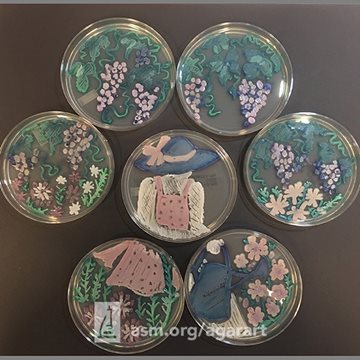
First Prize: “Strands of Antisense” by Riley Cutler, Mississippi State University Starkville.

This annual contest is for ‘art created in a petri dish using living, growing microorganisms. Creators use either naturally colorful microbes, like the red bacteria Serratia marcescens, or genetically modified microbes, like the yeast Saccharomyces cerevisiae transformed with violacein genes, as ‘paint’ and various types, shapes and sizes of agar as a ‘canvas.’

The contest has been gaining popularity and this year’s edition had close to 200 countries entries from 29 countries across the world. It vindicates Fleming (yes indeed, the discoverer of penicillin) who was probably the first agar artist but whose art form was not appreciated in his time. He would fill Petri dishes with agar (a medium used to grow microbes), and then use a lab instrument called a loop to introduce different types of bacteria on different parts of the agar. He created many ‘paintings’ by culturing microbes of different natural colours—brown, violet, pink, yellow, orange etc., in Petri dishes, planned in way to create colourful patterns. It is not that simple either. Because he had to find the right colour of bacteria and dexterously introduce it on the exact spot on the dish. Further, different bacteria grow as different speeds, and hence have to be introduced at different times, with the end result in mind. And the art is ephemeral, because soon one bacteria will grow into another’s space and blur things out.
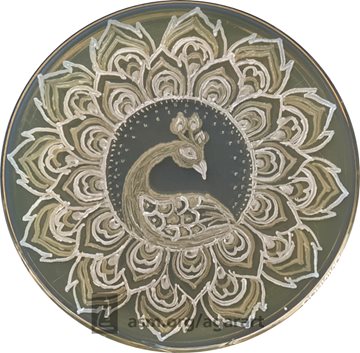
Second Prize: “Microbial Peacock: Balaram Khamari. Sri Sathya Sai Institute of Higher Learning, Puttaparthi, India

Agar art thus is not just about creating beautiful things where they are least expected. But today, is also being recognized as a part of the art curriculum in some countries, and incorporated into biology curricula in some, since it has the potential to help students learn so much about microbes in such a hands-on way.

Thank you ASM, for showing us beauty where we least expect it, for helping us to put things in perspective, and for providing a platform for art to take wings! In 2021, may we too be able to do this in our everyday lives! May the year bring victory over the ‘bad’ microbes!

–Meena

Though these words did not make it to any listings, here are two words without which it is impossible to study microbes:

agar

agar (noun) · agar-agar (noun)a gelatinous substance obtained from certain red seaweeds and used in biological culture media and as a thickener in foods.

Petri dish

A Petri dish is a shallow transparent lidded dish that biologists use to hold growth medium in which cells can be cultured, originally, cells of bacteria, fungi and small mosses. The container is named after its inventor, German bacteriologist Julius Richard Petri. It is the most common type of culture plate. The Petri dish is one of the most common items in biology laboratories.

Pics from: https://asm.org/Events/ASM-Agar-Art-Contest/2020-Winners
The Mathematician Priest

This week as we celebrated Dr AR Rao, a great teacher of mathematics, it is the right time to make it a double celebration. Coincidentally this teacher of mathematics was not only a contemporary of Dr AR Rao, but also made Ahmedabad his karmabhoomi, and the teaching of math his life’s mission.

He was Father Carlos Valles, a Spanish Jesuit priest whose contribution to mathematics education, as well as to the Gujarati language and literature left a significant mark in both fields. The life and work of Father Valles are inspiring, as well as humbling.

Carlos Valles was born in Spain on 4 September 1925. His father, a respected engineer died when Carlos was only 10. But he left a very strong impression on his young son, who through his life reiterated “My father trusted me. I would never let him down.” Soon after his father died, Carlos’ family lost everything in the civil war that broke out in Spain. His mother took refuge with a sister of hers in a city where the Jesuits had just opened a school, and Carlos and his brother got scholarships to study and board in the school. When he was 15 Carlos joined the Jesuit religious order as a novitiate. This was also when he wrote his first book The Art of Choosing, where he reflected on this turning point in his life—detaching from the family for Christ and a lifetime of service. His next ‘detachment’ was leaving the country of his birth. On his own request that he be “sent East”, he was asked to go to India. As it happened, his Jesuit order was planning to start a new St Xavier’s college in Ahmedabad, and the young priest was given the task of helping to set this up. And so, in 1949, Carlos Valles left his mother country for India, which became his home for the next many decades. As he later wrote “There I went in the fullness of my youth. My father had taught me never to do things by halves”.

He also wrote that right from the moment he arrived, he felt so at home in India, that his Indian friends were convinced that he had been an Indian in his previous reincarnation. It was here that he completed his education with a Mathematics honours degree from Madras University in 1953. For someone who knew only Spanish, the course led him to become proficient not only in math but also in English, the medium in which the course was taught.

Around the same time he was also became convinced that if he were to work and teach in Gujarat, then his teaching would need to be in the local language. As he wrote “English was enough to teach mathematics, but not to reach the heart. The heart is reached through the mother tongue”. He had already studied basic Gujarati but he realised that this was not enough. So he went on to hone his language skills at Vallabh Vidyanagar University in Gujarat, living in the hostel for one year with fellow Gujarati students, immersing himself in the language and culture, until he gained mastery over Gujarati.  This was followed by four years of theological studies in Pune, where he continued to practice writing in Gujarati for two hours every day. Carlos Valles was ordained to priesthood in 1958, in the presence of his mother who came to India for the first time.  

Finally it was in 1960, the year that Gujarat separated from Bombay and became a new state, that Father Valles started his mathematics teaching at St Xavier’s College in Ahmedabad. The story goes that on the train from Bombay, he could not get a seat, and so stood all the way, and when in the melee one of his slippers fell off the train, he also threw the other one out, saying that now there is a complete pair that someone can use.

And there started the transformation from being a student to a teacher who was eager to give his body and soul to his teaching. And Father Valles was not one to take the easy path with tried and tested teaching techniques. He not only devised innovative ways of communicating math concepts, but also took upon himself to coin appropriate Gujarati terms for the concepts. He was also convinced that it was his duty not only to reach the minds, but also the hearts of his students; through dialoguing with them on all aspects that affected their life beyond the classroom. He started by writing a small book in Gujarati. Many publishers rejected the manuscript as they felt that no one would read such a book. Eventually Father Valles published it himself with some money that his mother sent him. The book titled Sadachar went onto see twenty editions in three languages.

Thus began the double life of Father Valles—as a Mathematics teacher and as a writer—both in Gujarati. Father Valles soon became a regular columnist for Gujarati periodicals and newspapers. In his original Sunday column in Gujarat Samachar titled To the New Generation he wrote about a wide range of topics– youth, family, society, religion, psychology, morals and contemporary issues. He secretly hoped, as he wrote, that the old generation would read it first. His writings became hugely popular over the years and were compiled and published as books. He did not ignore his first subject either, and with his colleagues, he wrote a whole series of mathematical textbooks in Gujarati which were used and remembered by generations of students in Gujarat.

But it is not only through newspaper pages that Father Valles entered the hearts of Gujaratis. He was a familiar sight riding on his bicycle across the city with his cloth sling bag. To learn from close quarters about the lives, mentalities, attitudes to life, beliefs and traditions of the people of the city, he lived with families in the narrow pols of the old city. As he wrote, “…so I lived the whole day with them, sharing their two daily vegetarian meals, their floor space on a mat at night, and their family life in all its richness, blessings and problems for a few days till I knocked at the door of another family in a continuous pilgrimage. I cycled daily to and from the college for my classes, but for the rest I lived fully as a member of the family I lodged with for the time. I spent ten years in that happy way. Perhaps that is possible only in India”.

For 22 years, Father Valles carried out his mission with heart and soul, in a city that he thought would be his home for life. However as he wrote, “circumstances shaped new and unexpected paths for me.” His mother turned 90 and expressed a wish for her son’s company. Without a second thought, Father Valles moved to Madrid to be with her until she died at the age of 101. He continued to write, now in three languages—English, Gujarati and Spanish, and travel. In 1999, at the age of 74, with his undiminished passion for reaching out, he bought a computer and started a website in Spanish.

Father Valles continued to live in Madrid, but he could make a trip back to his beloved Ahmedabad in 2015. Ahmedabad had changed much since he had left, but his gentle presence reminded its citizens once again about his life’s mission of bringing harmony. As he once said “I would like the word Harmony to be the summary of my life.”

Father Valles passed away in Madrid on 9 November this year, 5 days after his 95th birthday.

Sadly I was not living in Ahmedabad in the years when he was here, but the heartfelt reception he got on this last visit, made me wish that I could have had the privilege of having met this innovative teacher, prolific multi-lingual writer, and above all, an incredible human being.

–Mamata

Go Figure: National Mathematics Day

December 22, the birthday of the mathematical genius Shri Srinivasa Ramanujam, has been observed as National Mathematics Day in India since 2012, the start of the celebration of his 125th birth anniversary. The Day has, since then, been marked in schools and colleges by special events like maths quizzes, competitions etc. Hopefully, the enthusiasm will be carried over to the digital medium this year.

Those of us who fear math will also recall they feared their math teachers. In fact, the fear of math stems in most of us because we just did not understand what was happening in the class. And math teachers seldom felt the need to do anything differently to help students understand the abstract concepts better.

It is in this light that Mathematics Educators like Shri AR Rao stand out. He dedicated his life to math education and inspired generations.

Born in the small village of Jakka Samudram of Salem district, Tamilnadu, he had his initial schooling at Tanjore—not far from Kumbakonam, where Ramanujam and studied lived when he was young.  He studied chemistry, not mathematics at graduate level, and then took a post graduate degree from Chennai. But his karmabhumi was Gujarat. He joined Bahauddin College, Junagadh in 1933, as a Professor of Mathematics and spent 27 years there. After that he taught in various other colleges in the state.

After ‘retirement’ in 1974, he started his second innings. He became a mathematician at VASCSC (Vikram Sarabhai Community Science Centre), a pioneering science education facility in the county. The teacher of formal mathematics became the flag-bearer of non-formal mathematics as a means to popularize mathematics. His mission was to make mathematics enjoyable for students and everyone else.

His innovative mind came up with dozens of puzzles, games, models and teaching aids towards this.

He set up India’s first Mathematics Laboratory at VASCSC. He traveled, attended workshops and seminars, and spoke all over the country to popularize these ideas.

I had the great good fortune of having interacted with Shri AR Rao to some extent. When I was helping at VASCSC, his 90th birthday came up. It was decided to throw a surprise party at the Centre. Just to ensure that he did come in that day, a message was sent to him that the Trustees wanted to meet him.

I still remember the joy and the excitement of the many students and bhakts who came for the party. And at last the guest of honour, Shri AR Rao, walked in. He was truly surprised and thrilled. He almost broke down when it was his turn to speak. He said that he had come in very nervously, thinking that the Trustees had wanted to meet him to ask him to retire now that he was 90! Such was his love and passion for spreading the word on mathematics education that he wanted to come in to work at this age. And indeed he did, till the age of 100. He passed away on 4th April, 2011.

If today the teaching of mathematics in India has become more comprehensible to the average student, if students appreciate and enjoy the beauty of mathematics, and if teachers have begun to employ innovative methods to teach the subject, Prof. AR Rao had a lot to do with it.

It would be appropriate to end with a quote from him:

“Although everyone concedes that without mathematics, modern science and technology can hardly make any progress, it is common knowledge that the students everywhere consider mathematics as a very difficult subject. Of the many reasons that can be found for this, perhaps, the most important are, some defective methods of teaching, over emphasis on exams and indiscriminate cramming of materials from the text books and the so-called guides. So what is really needed is inculcation of a power of understanding and a capacity of creative thinking.” AR Rao.

Blessed indeed to have met such people!

–Meena

Much of the material has been drawn from http://www.vascsc.org/images/pdfs/Glorious-Innings-of-Prof.A-R-Rao.pdf.

When Social Responsibility was Risky Business!

Philanthropy has been garnering headlines in the world media for some years now, with the most successful entrepreneurs speaking more about their giving initiatives than their businesses. And it has indeed set off a virtuous cycle.  

But lest we think giving by industrialists is a new phenomenon …

In continuation of last week’s blog which marked 13 November (designated as World Kindness Day), and November 16 (International Day for Tolerance and Peace), here is a look at a few examples of Indian industrialists whose philanthropy exhibited a sense of enlightenment and responsibility that was path-breaking . The critical thing to remember is that most industrialists of the late 18th and the early 19th centuries saw building up India’s industry and infrastructure and supporting the freedom movement as their most critical social responsibilities. They were flying in the face of the Raj in doing this, and the Raj had the power to destroy them! But that did not stop them.

The Vision of Jamsetji Tata

Shri Jamsetji Tata was a pioneer in setting India on the path to industrial self-reliance. But it was not just about technology. His vision for the well-being of his workers was truly enlightened. Way back in the 1880s, he offered facilities like crèches for workers in his mills, as well as short working hours, properly ventilated workspaces, fire safety, etc. In 1886 he instituted a Pension Fund, and in 1895, began to pay accident compensation.

The story of Jamshedpur is another testimony to his vision. The work on this township for housing the workers of the Steel Mills was commenced in 1908. Shri Jamsetji dreamt of more than basic housing for his workers. He wanted to build a proper modern planned city. His instructions regarding the city were:  “Be sure to lay wide streets planted with shady trees, every other of a quick-growing variety. Be sure that there is plenty of space for lawns and gardens; reserve large areas for football, hockey and parks; earmark areas for Hindu temples, Muslim mosques and Christian churches.”

It was private philanthropy that led to the creation of institutions like the Indian Institute of Science (IISc), Bangalore and Tata Institute for Fundamental Research, Mumbai. It is said that Jamsetji mooted the idea of contributing to an institute like IISC as early as 1898, long before Carnegie’s endowment to set up a Technical School (today Carnegie Mellon University).

From Temples to Gods, to Temples of Education

Shri G.D. Birla was a strong supporter of Gandhiji and gave considerable resources to the freedom struggle. Many of us would have at some time or other visited a Birla Mandir–many a large town in India boasts one. Apart from this charitable activity of temple-building, a landmark contribution of Shri Birla is the creation of one of India’s best higher educational institutions—the Birla Institute of Technology. This was started as a school for G.D. Birla and R.D. Birla by their grandfather in 1901. It grew into a high school  in the 1920s. In the forties, the Birla Education Trust was founded and the institution went from strength to strength, adding degree and post-graduate courses in a variety of disciplines.  In 1964, taking advantage of a Ford Foundation grant, the institute formed a partnership with Massachusetts Institute of Technology (MIT), USA, and was well on the path to leading India’s achievements in technical education.

Gandhi Ashram is Saved!

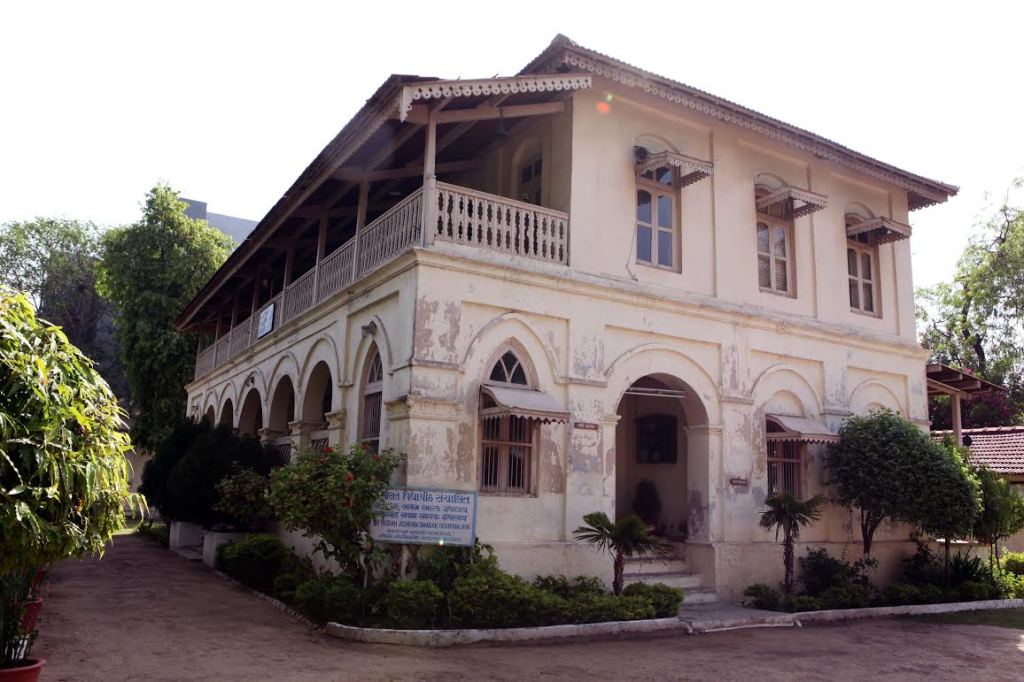
When Gandhiji  first came to Ahmedabad, he set up his Ashram at Kochrab. He invited a Dalit family– Dudabhai and Danibehn–to come and live at the Ashram. This led to considerable agitation among the Ashram’s neighbours as well as many funders, leading to a financial crisis, which forced Gandhiji to think of shifting the Ashram.

Kochrab Ashram

And then one day, in Gandhiji’s words: “A car drew up near our quarters and the horn was blown. The children came with the news. The sheth did not come in. I went out to see him. He placed in my hands currency notes to the value of Rs 13,000 and drove away. I had never expected this help, and what a novel way of rendering it!”

This gift saved the Ashram. It is well-known that the ‘Sheth’ was Shri Ambalal Sarabhai, one of the foremost industrialists of the time. However, neither he nor Gandhiji ever admitted this!

Jamnalal Bajaj: Exemplary Patriotism

Jamnalal Bajaj was considered Gandhiji’s fifth son, and adopted all his values—from Ahimsa to his dedication to the poor to his commitment to locally made goods and his patriotic spirit. He fought for admission of Harijans into temples, and in the face of strong objections, opened up his own family temple in Wardha—the first temple in the country to do this.

Shri Bajaj was an active member of the Congress Party, and gave up the Rai Bahadur title conferred on him by the British Government and joined the non-cooperation movement.


Importantly, Jamnalalji, in line with the trusteeship concept propounded by Gandhiji, felt that inherited wealth was a sacred trust to be used for the benefit of the people, and dedicated most of his wealth for the poor and under-privileged.

On the shoulders of giants….

–Meena

 www.tata.com

https://jamnalalbajajfoundation.org/jamnalal-bajaj/about

Mr Kindness

Last week I wrote about Children’s Day. Earlier this month two other important international days passed almost unnoticed. 13 November which is designated as World Kindness Day, and November 16 which is marked as International Day for Tolerance and Peace.

For its fiftieth anniversary on 16 November 1995, UNESCO’s Member States adopted a Declaration of Principles on Tolerance. Among other things, the Declaration affirms that tolerance is respect and appreciation of the rich variety of our world’s cultures, our forms of expression and ways of being human. While this is a universal ideal and aspiration, it is at the level of the individual that the foundation of tolerance and respect is laid.

And this is what the World Kindness Day seeks to do–reinforce the understanding that compassion for others is what binds us all together. It is this that has the power to bridge the gap between people, communities and nations. This global day promotes the importance of being kind to each other, to oneself, and to the world.

The idea of this day was promoted by an international non-profit organisation called the World Kindness Movement which works to inspire individuals towards greater kindness to create a kinder world; and their guiding tenet: The world is full of kind people. If you can’t find one, be one.

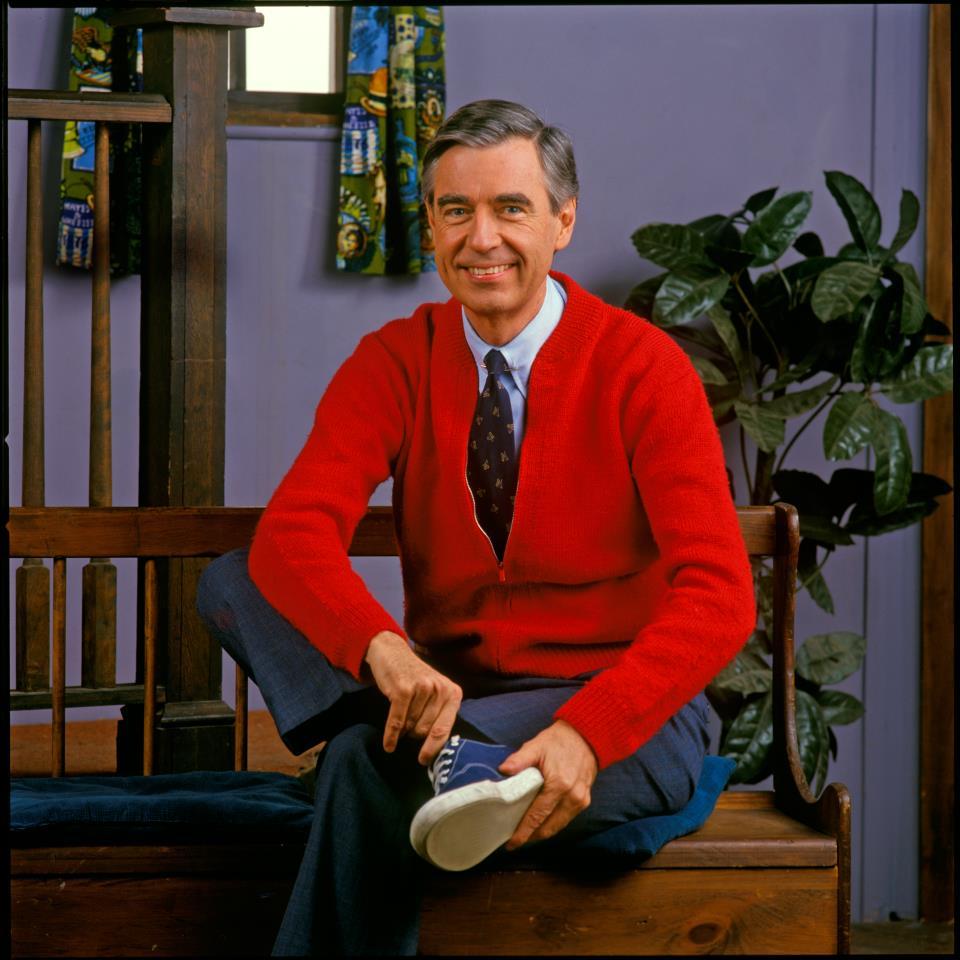
Nothing, and no one, exemplifies the spirit and practice of all the three days better than the beloved Mr Rogers whose TV show celebrated kindness, and helped millions of children to develop empathy.

I came upon the inspiring story of Mr Rogers via Tom Hanks when I saw the movie A Beautiful Day in the Neighbourhood. After seeing Tom Hank’s version I wanted to know about the real Mr Rogers!

Fred McFeely Rogers grew up in America in the 1930s as a shy, somewhat awkward, and sometimes bullied child. After getting his first degree in music, he returned home for the vacation before he prepared to enter the seminary and study to become a priest. It was then that he saw television for the first time at his parent’s home. He was appalled to see the kind of programmes where as he said ‘people were throwing pies in each other’s faces.’ While he found this disgusting, he also saw the enormous potential that TV had for connection and enrichment. That eureka moment changed his life—and the lives of millions of Americans.

Fred Rogers went on to create a TV show called Mister Rogers’ Neighborhood, which first aired on 19 February 1968 and continued for over 30 years. The last episode of the 31 seasons was aired on 31 August 2001. Fred Rogers was the host of all 895 episodes, the composer of its more than 200 songs, and its puppeteer.

The set of simple hand puppets featuring 14 characters from his first show continued to be with the friendly Mr Rogers, clad in his trademark red cardigan and sneakers, for over 40 years. The puppets who inhabit the Neighbourhood of Make Believe, portray real-life feelings as they live and learn with the help of their neighbourhood human friends who represent a wide variety of interests and talents. The puppets and the humans live together, care about and learn from each other. As they often reminded viewers “We all have different gifts, so we all have different ways of saying to the world who we are. It’s our job to encourage each other to discover that uniqueness and to provide ways of developing its expression.”

Mr Rogers was far from preachy. He did not shy away from difficult topics like bullying, divorce, and death; he talked honestly and openly about subjects that adults are hesitant to discuss with children, but that children wonder and worry about silently. He reassured children and adults that it was ok if there were some things that they could not understand. He addressed children’s fears and insecurities, and instilled a sense of faith and trust. “When I was a boy and I would see scary things in the news, my mother would say to me, ‘Look for the helpers. You will always find people who are helping”.

Although Fred Rogers later acquired graduate degrees in child development as well as divinity, he always consulted with his close associate and child psychologist Dr Margaret Mcfarland, to ensure that his scripts would authentically reflect the real concerns and feelings of children.

His show also offered children the tools to be lifelong learners—a sense of wonder, a curiosity about the world around us, the willingness to ask questions. “Did you know, when you wonder you are learning?”

The concept of neighbour and neighbourhood in the leitmotif of Mr Rogers’ life and work. “Neighbours are people who live close to each other. Neighbours look at each other, they talk to each other; they listen to each other. That’s how they get to know each other.” In his neighbourhood everyone was welcomed and valued, and the characters taught how to appreciate and respect others.

Mr Rogers’ ‘neighbourhood’ in a sense becomes the symbol of community; it extends beyond a residential address to embrace the city, the country, the continent, and ultimately the planet that we all inhabit. It metaphorically embraces the universe. And it reminds us of the dire need for, and the gentle power of sharing and compassion. “All of us, at some time or other, need help. Whether we’re giving or receiving help, each one of us has something valuable to bring to this world. That’s one of the things that connects us as neighbours—in our own way, each one of us is a giver and a receiver.”

Today teaching and learning respect, tolerance, sharing, acceptance of differences, and celebration of diversity are highlighted in “values education” curricula. This is the kind of education proposed by UNESCO in its declaration of four pillars of education, i.e. learning to know, learning to do, learning to live together and learning to be.

Over 50 years ago Fred Rogers planted the seeds of basic human values in millions of children, who must themselves have grandchildren now! And for all this he offered only one mantra: “There are three ways to ultimate success: The first way is to be kind. The second way is to be kind. The third way is to be kind.”

–Mamata

Winter Is Coming….

Unlike the Starks, I don’t need to worry about endless nights and freezing cold; or White Walkers and scary creatures breaking through the Wall.

But I do have to worry about keeping my skin moisturized.

I am bewildered when I go into a shop these days, with the multiplicity of choices. When we were young, there was a default setting. It was cold cream—in fact, Ponds Cold Cream. It was used on face, on arms, legs or any other exposed parts of the body. For particularly recalcitrant dryness, there was Vaseline, also used on chapped lips. There was the weekly ‘oil bath’ in Tam households wherein til oil was mercilessness massaged into the skin till it saturated every pore, and then washed away with shikai powder or besan.

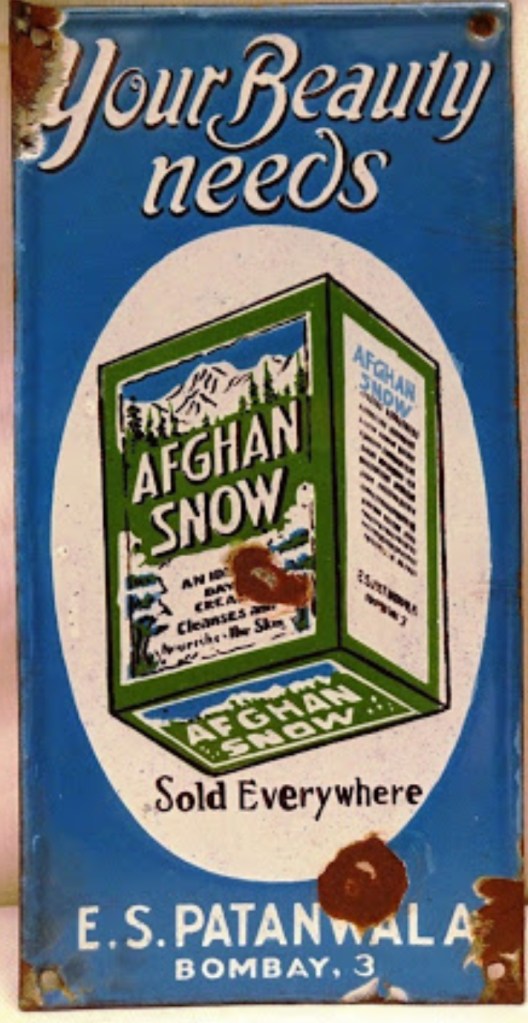
We were simple and naïve. We didn’t even know there were other types of creams and lotions and potions. There was one dream product though, that our hearts yearned for. But seldom did we get our hands on it. I am not sure why—was it very expensive? Or was it that it was a ‘frivolous’ beauty cream and not a ‘useful’ moisturizing cream? (I saw a recent article mentioning  Afghan Snow as a fairness cream, but I don’t have any memory of it being billed in those days as such). Whatever the reasons middle-class mothers of those days had, I do remember the longing of my young heart for Afghan Snow.

I am not sure if it is still available, but I do remember the light, sparkly, ethereal look of the cream. It came in a blue glass bottle and had a lovely gentle smell. It was the most exotic thing that we knew in terms of cosmetics.

Recently, trying to figure out a bit more about this, I unearthed the fascinating Atmanirbhar story behind this product.

Ebrahim Sultanali Patanwala, originally from Rajasthan, made his way to Mumbai in the early 20th century. He found work with a perfumer and quickly picked up the techniques of blending perfumes. Soon he branched out and set up as an entrepreneur. His first product was a hair oil called ’Otto Duniya’ which met with quite some success, enabling him to set up his own lab and offices.

Messrs. E.S.Patanwala was established in 1909. The company sold oils and perfumes—both those they made, and imported ones. He developed quite a clientele among the Britishers as well as Indian royalty. This did not content him and he took himself off to Europe to learn more. He knew little English, but his earnestness and desire to learn opened doors for him. He connected with Leon Givaudan of Switzerland, at that time the world’s biggest manufacturer of aromatic chemicals. With the training and mentorship he got in Europe, he developed the formula for what was to become one of India’s most popular cosmetics—a cream.

He came back to India and set up a factory in Byculla to make the cream itself, but imported the glass bottles from Germany and the labels from Japan. Around that time, King Zahir of Afghanistan was visiting India and wanted to meet some Indian entrepreneurs. Patanwala was one of them, and he presented the King a hamper of his products included the new, as-yet-unnamed cream. The King is supposed to have opened the bottle, been charmed by the look and perfume, and made the remark that it reminded him of the Snow of Afghanistan. The enterprising Patanwala immediately asked if he could name the cream as Afghan Snow, and the King agreed, and product was launched in 1919 (making it more than 100 years old!)

The product was extremely popular, but ran into some rough weather during the Swadeshi Movement. Because the bottle and labels looked (and were) imported, people thought it was an imported product and listed it as one of the items to be boycotted. Patanwala sent a letter to Mahatma Gandhi, telling him that the product was wholly indigenous and manufactured in Byculla. Mahatma Gandhi then wrote in his newspaper about Afghan Snow, saying that it was a mistake to boycott it, and that he was appreciative that such a good product was being made in India, and that he personally endorsed it.  

I yearn even more for the product now that I know the story! What I would not give for a dark blue glass bottle full of beautifully-perfumed, light frothy shiny white snow, promising to transport me into a fairy tale!

Even more, I yearn for biographies of these amazing people who broke so many barriers, who did so many pioneering things, and who made products whose name still evokes so many memories a hundred years down the road! How they succeeded and why they did or did not sustain.

–Meena

Mamitu and Emaye: Women Warriors

This year the term ‘frontline warriors’ has become deeply embedded in the vocabulary around the world.  As we show our respect and appreciation for these tenacious, dedicated health workers, here is a much older story of two remarkable women who saved and changed the lives of thousands of others. The story spans over 60 years, and starts from two different places.

It begins in 1959 when a young doctor couple in Australia, Reginald and Catherine Hamlin, saw an ad in The Lancet looking for gynaecologists in Ethiopia.  With the zeal to do something useful, the idealistic couple flew across the oceans and continents to land in a tiny airport in Addis Ababa. They had plans to stay for 3 years, but they never went back.

Among the many gynaecological and obstetrics cases that they treated, the most common and most horrendous was a childbearing injury known as obstetric fistula. The condition is caused when prolonged labour opens a hole in the birth canal, leaving many women incontinent. For Ethiopian women, the injury often led to their being rejected by their husbands and ostracized by their communities.

When the Drs. Hamlin arrived in Ethiopia, there was little or no treatment available for such patients anywhere in the country, causing of thousands of women to barely survive, with life-threatening and life-changing injuries. Poring through medical books, journals and drawings of operations by other experts, the young doctors developed innovative surgical techniques to repair the damage.

One day in 1963, a 16 year-old girl was brought to them from a distant village, carried for twelve hours through mountainous terrain, on a primitive stretcher made from eucalyptus branches, and then on a bus to Addis Ababa. She had been in labour for four days, and her baby had died. She was in excruciating pain, and close to dying.

Her name was Mamitu Gashe. She was illiterate and terrified. She had never left her village, nor seen white people before; in her delirium she thought that they were angels. The agony, and the trust of the girl immediately touched the hearts of the doctors. Her injuries were the worst they had handled. It took months of repairs and treatment to heal her ravaged body. By then the innocence and indomitable spirit of Mamitu had created a special bond between the patient and her saviours.

As she gradually started her road to recovery, the young girl did not know how to show her gratitude to her doctors. Even while she was still in hospital, she started helping with chores like sweeping and changing sheets. Then as she regained her strength and confidence, Mamitu started to greet and comfort new patients, remembering her own terror when she first came. She refused to go back to her husband and village, and declared that she would stay and help the doctors. They in turn treated her like a daughter. She started calling them Emaye (mother) and Abaye father).

Over the next ten years Mamitu worked shoulder to shoulder with the Hamlins, helping out in the operating theatre, and then assisting in their operations; initially sewing up at the end of the surgery but progressing to learn all the steps in an operation. She learned to operate on fistulas by placing her hands over the surgeon’s and tracing her intricate incisions as she worked to save the women. In 1987, at the age of 40, Mamitu began operating on her own. She still could not read nor write, or speak English, but she had the gift of dextrous fingers, and just the right touch. Under the training and guidance of the Hamlins, Mamitu went on to be recognised as one of the finest fistula surgeons in the world. In 1989 she won the Gold Medal for surgery from the Royal College of Surgeons in London.

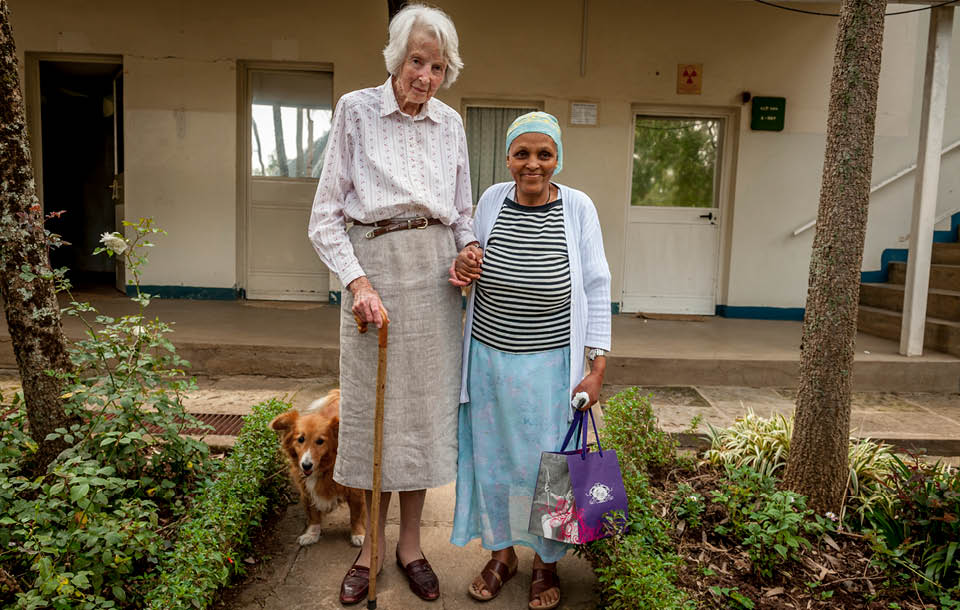
Emaye Catherine and Mamitu Source:https://hamlin.org.au/

In 1993 Reginald passed away, but Catherine continued with her life’s mission, with Mamitu by her side. In 1995 they built another new hospital, one of a series that had started with their first in 1975–Addis Ababa Fistula Hospital. Today an estimated 60,000 women have been treated, and cured, by the Hamlins’ hospital and clinics. 

Mamitu and her Emaye were inseparable companions for 57 years. In the later years, Mamitu became the caregiver of the one who once gave her a new life and purpose. The two were finally separated in March 2020, when Catherine Hamlin, passed away, aged 96. Seven months later, the still-grieving Mamitu has recently returned to the operating theatre. Now 74 years old Mamitu carries on her parents’ legacy, and continues to be a formidable frontline warrior.

–Mamata

Sankofa

A few days ago my niece asked if, in India, we had a concept or symbol similar to that of Sankofa. This was a new word for me, and as I love to do, I immediately wanted to find out more. What I discovered was beautiful and meaningful.

The concept of Sankofa is derived from King Adinkera of the Akan people of Ghana in West Africa. The word Sankofa is derived from three words in the Akan language: San (return), Ko (go), Fa (look, seek and take). Translated literally it would mean ‘go back or return, and look’. In the Akan dialect this concept is expressed as “se wo were fi na wosan kofa a yenki which means “it is not taboo to go back and fetch what you forgot.”

This reflects the strong belief of the Akan that the past serves as a guide for planning the future. While the Akan believe that there must be forward movement and new learning as time passes, they caution that as the march ahead proceeds, it is the wisdom in learning from the past which ensures a strong future.

Sankofa bird

Visually and symbolically, Sankofa is depicted as a mythical bird with its feet firmly planted forward, or sometimes flying forward (to represent looking or moving ahead), with its head turned backwards (looking to the past). The Sankofa bird is always shown with an egg in its mouth, or as turning back to take an egg off its back. The egg represents the ‘gems’ or knowledge of the past upon which wisdom is based; it also signifies the generation to come that would benefit from that wisdom. Thus, the bird graphically demonstrates the Akan belief that the past serves as a guide for planning the future.

The depiction of the bird as bending its neck with effort, to reach back for the abandoned but precious egg signifies the diligence and effort required to pay due reverence to the past, and give it its proper place in the current scheme of events.

Sankofa teaches us that in order to move forward we must go back to our roots. That does not mean that we remain in the past, but rather we use the lessons and wisdom from that knowledge, and use it to make the best of the present, and a better future. It is a way of looking to the past with the understanding that both the good and the bad have formed the present situation. The concept emphasises the value of learning not only from the good things, but also from the bad things and mistakes of the past so as not to repeat these in the future.

 Sankofa embodies the spirit and attitude of reverence for the past, reverence for one’s ancestors, reverence for one’s history, and reverence for one’s elders. All indigenous cultures across the world have traditionally acknowledged and revered their elders who are regarded as the fount of knowledge, based on experience and wisdom, who can help guide the way. Sadly, in this century there has been an increasing trend to shrug off their wisdom as ‘old wives tales’. Why go to the grandparents when Google Guru has all the answers you need? An interesting contemporary initiative reminds us of the value of this wisdom. 

In July 2007 Nelson Mandela marked his 89th birthday by forming a Council of Elders dedicated to finding new ways to resolve some of the world’s long-running crises, reduce conflict and despair, and foster peace. In his words “They will support courage where there is fear, foster agreement where there is conflict and inspire hope where there is despair.”

The Elders were visualised as individuals who had “earned international trust” and “a reputation for inclusive, progressive leadership”, but no longer held public office, and were independent of any national government or other vested interest.

The original Elders included India’s Ela Bhatt; Kofi Annan, the former UN secretary-general; Jimmy Carter, the former US president, and Desmond Tutu, the retired South African archbishop. Other members were former Norwegian prime minister Gro Harlem Brundtland; Mandela’s wife Graca Machel, a children’s rights campaigner; former Irish president Mary Robinson, and Muhammad Yunus, founder of Grameen bank, the pioneering micro-credit institution.

A inspiring initiative and much-needed recognition of the need for collective wisdom of the past experience to guide the future of a world besieged with conflict, chaos, and confusion.

Sadly today, across the world, there is a dangerous trend of going back to the past, not so much to learn from it but to choose selectively from it in order to perpetuate what seems convenient to suit the political agenda or religious climate. Alternately there is also the inclination to erase all traces of the past, and build the future on a brand-new slate.

Sankofa is a gentle reminder that if even in our arrogance we overlook the gems from the past, when we come to our senses we should be humble enough to retrace our steps and make amends. As the popular saying goes, those who do not know history are doomed to repeat it.

There is no shame in going back to our roots. That is Sankofa, simple yet profound.

Thank you Suparna, for introducing me to Sankofa.

You can’t connect the dots looking forward; you can only connect them looking backwards. So you have to trust that the dots will somehow connect in your future. Steve Jobs

–Mamata

Waiting for the Mahatma

This slim 1955 novel by R.K. Narayan is the best Gandhi Jayanti gift I could have given myself. It transported me to the days of the Independence struggle. The story itself is not really the crux of it, though it is a novel and there is a love story interwoven with the freedom movement.

So much time has passed since the time of the Mahatma that we cannot really fathom what it must have been to live in his time, to be inspired by him and be, even in the remotest way, a part of the freedom movement. And that is just what the book brought to me. That the most uneducated person in the remotest village in any corner of the country was somehow moved and fired by this figure called Gandhi. Whether the person fully understood what Gandhi stood for or what he wanted of them, still they were ready to believe in him, to dedicate themselves to his mission. In the tens of thousands they stood for hours in the sun for a glimpse of the Great Soul. In the thousands, they were ready to give up everything in life and go to jail for him. The book gives us a glimpse of the person behind the myth.

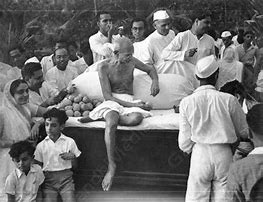
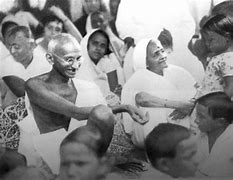
The incidents in the book obviously draw from many, many real happenings of those times. When I found the photograph of the Mahatma, children and fruits, it told me how authentic was the experience from which the book came. The book describes an incident when Gandhiji is taken to the house of the richest man in a town he is visiting, and all the elite are there, waiting for him to speak and to catch his attention. There are trays and trays piled with fruit. Not one of which he touches. Instead, he calls the children in the audience and distributes the fruit to them. While the adults are not thrilled, they still tolerate it. But they definitely are not happy when the Mahatma spots a little urchin in completely tattered clothes in the crowd, calls him up to the dais, seats him beside himself, plies him with fruit and has a full-fledged conversation.  And then decides to go and stay in the home of the urchin, who lives in the Cleaners’ Colony– the poorest, filthiest and unhealthiest part of town. In spite of the exhortations of all the bigwigs to stay in the house of the town’s wealthiest man where arrangements have been made, gently but uncompromisingly, Gandhi insists on going to the boy’s house, throwing the local elite and officials into a complete tizzy.

His uncompromising insistence on truth and ahimsa. His never sacrificing the means for the end. His belief in people, and at the same time, his being able to understand why they slip from the path. His interest in the minutest details of the lives of those around him. His prodigious correspondence—responding to each one of the letters he got. His sense of humour and unshakeable resolve. His sticking to his point without aggression. With this, he inspired a sub-continent and fought the mightiest empire of the time. With this he got us our freedom.

But we still make the Mahatma wait for us. Wait for us to live up to his ideals. Wait for us to be the nation he dreamt we would be.

How long will he have to wait?

–Meena

Gandhiji’s Wisdom on Education

As we approach Gandhi Jayanti with the New Education Policy (NEP) now a reality, it is an appropriate time to re-visit Gandhiji’s philosophy of education as encapsulated in his Nai Talim (New Education)—Basic Education for All.

The fundamental premise of Nai Talim is that basic education is a holistic process, where all aspects of the individual—intellectual, physical, social, and spiritual—are given opportunity for development.  The curriculum seeks to impart learning through hands-on skill-based work that prepares young people for the real world, rather than creating islands where education has nothing to do with the surrounding community. The centrality of skills aims to reinforce the dignity of labor, the value of self-sufficiency, and strengthen local culture. In this approach to education, craft-skill serves as the center of the holistic development of the student. Other skills such as literacy and mathematics are learned in the context of their craft, and subjects are taught in an interdisciplinary way and never separated from their practical application in the world.

Some other perspectives that under-pinned Gandhiji’s thinking on education were:

  • That education should include a “reverent study of all religions.”
  • Education meant lifelong learning
  • And a re-definition of the role of the teacher, which is summed up by him as : “A teacher who establishes rapport with the taught, becomes one with them, learns more from them than he teaches them. He who learns nothing from his disciples is, in my opinion, worthless. ..In this way, a true teacher regards himself as a student of his students.”

A national education conference held at Wardha on 22–23 October 1937 wherein Gandhiji shared his vision of education led to the setting up of two model schools at Wardha and nearby Segaon.  A few years ago, I was in Wardha and sadly, it did not seem that the school was doing too well, or that it was at the forefront of educational innovation. It would seem that it is not easy to implement the philosophy of Nai Talim in a way that is relevant to today’s world.

They say the NEP has some influences from Nai Talim. How far these elements are implementable or how seriously they will be implemented is yet to be seen. My feeling is that it will take very creative re-interpretation of the philosophy of Nai Talim, if we want the spirit of it to infuse our education system. And as of now, I am not aware of any exciting experiments in this direction.  

I often find myself returning to these two quotes from Gandhiji after discussions and debates on education. To me, they are the touchstone by which any educational initiative must be evaluated:

“By education I mean an all-round drawing out of the best in child and man–body, mind and spirit. Literacy is not the end of education nor even the beginning. It is only one of the means by which man and woman can be educated. Literacy in itself is no education.’

“The real difficulty is that people have no idea of what education truly is. We assess the value of education in the same manner as we assess the value of land or of shares in the stock-exchange market. We want to provide only such education as would enable the student to earn more. We hardly give any thought to the improvement of the character of the educated.’


–Meena