‘Flagman’ Pingali Venkaiah

A young boy, very far from home, was fighting an alien war, on foreign land as part of an imperialist army. His name was Pingali Venkaiah. He was a soldier in the British Indian Army fighting for the British in the Anglo Boer war in South Africa, at the end of the 19th century. Around the same time, another young man in South Africa was starting his experiments with what was to become a lifelong crusade for truth, justice and freedom. His name was Mohandas Karamchand Gandhi.

When the Boer War broke out in 1899, while Gandhi’s sympathies were with the indigenous Boers, but as a member of the British crown colony of Natal he felt that he needed to contribute to the British efforts. Gandhi set up an Ambulance Corps of 1100 volunteers, out of whom 300 were free Indians and the rest indentured labourers. Gandhi’s task was to instil in this motley group a spirit of service to those they regarded as their oppressors. Gandhi’s corps placed a significant role as stretcher bearers, carrying the wounded out from the battlefield.

At some time during this period, the 19-year-old Pingali met Gandhi, who had already become known for his mission for justice. He must have seen Gandhi as described by the Pretoria News: Gandhi was stoical in his bearing, cheerful and confident in his conversation and had a kindly eye. Pingali was deeply impressed and influenced, and a bond was formed between the two; a bond that would endure half a century.

Inspired by Gandhi, and the strong urge for freedom from colonial rule, Pingali, on his return from Africa, became a member of the secret revolutionary units fighting against the British Raj and spent time in Eluru. At the same time he began to seriously pursue his interest in agriculture, especially the farming of cotton. He spent a lot of time in experimenting with cotton cultivation. He imported Cambodian variety of cotton seeds from America and crossed them with Indian seeds to create an indigenous hybrid variety of cotton seeds. He acquired a piece of land in the nearby Chellapalli village and planted these seeds. The fine variety of cotton that grew from these, came to the notice of the local British officers during an agricultural exhibition in 1909. The Royal Agricultural Society of London offered him an honorary membership. He became locally famous as ‘Patti (cotton) Venkaiah’.

Along with agriculture Pingali continued to pursue his academic interests, especially in languages. This took him to Lahore to study Sanskrit, Urdu and Japanese in the Anglo Vedic School. He became fluent in all the languages, and in 1913, gave a full length speech in Japanese that earned him the moniker of ‘Japan Venkaiah’.

Pingali joined the railway services as a guard and was posted to Bangalore and Bellary. During those years, Madras was reeling under the plague epidemic. Seeing the plight of those suffering, he quit his job and went there to work for a short time as an inspector of the Plague Disease Eradication Organization.

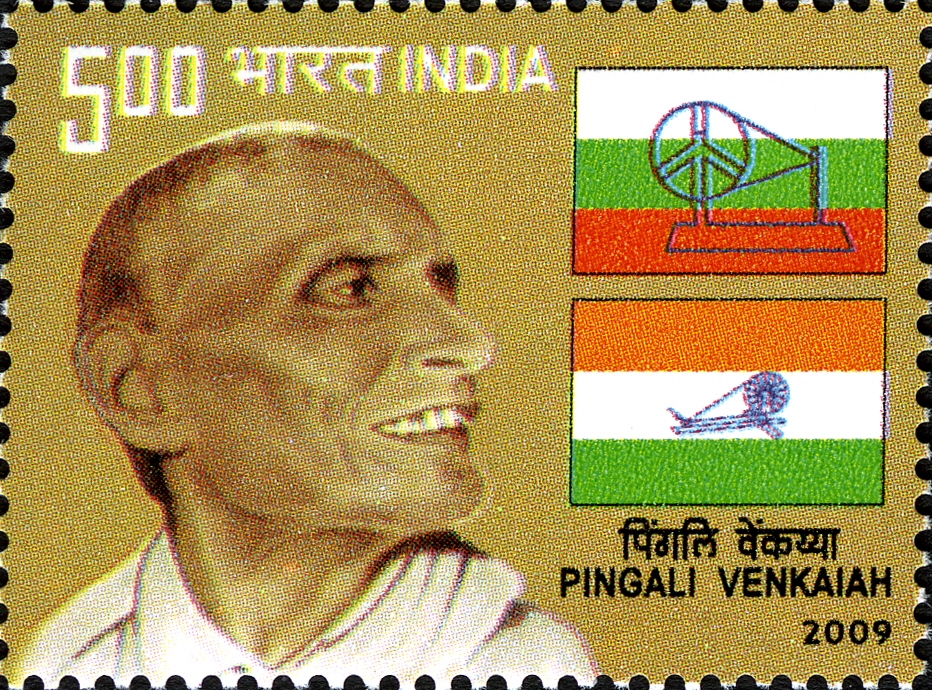
Pingali continued his commitment to the freedom movement. He attended the sessions of the Indian National Congress. At the Calcutta session in 1906, Pingali’s patriotic sentiments were deeply hurt at seeing the English Union Jack being hoisted. He returned from the session with a new passion—a national flag for India. He started by researching the flags of different countries, even while pursuing his numerous other interests and occupations. In 1916 he published a book titled A National Flag for India which included thirty designs for the flag. From 1916 to 1921, at every session of the Indian National Congress, Pingali raised the issue of the need for a national flag. Gandhi liked the concept, but his vision was that of a flag that would “stir the nation to its depth”, a flag that “represents and reconciles all religions”.

It was in 1921, at the meeting of the Congress at Vijaywada that Pingali showed Gandhi his book with designs of the flags. Gandhi appreciated Pingali’s hard work and persistence. In an article in Young India titled Our National Flag he wrote: “We should be prepared to sacrifice our lives for the sake of our National Flag. Pingali Venkaiah who is working in Andhra National College Machilipatnam, has published a book, describing the flags of the countries and has designed many models for our own National Flag. I appreciate his hard struggle during the sessions of Indian National Congress for the approval of Indian National Flag. When I visited Vijaywada, I asked Mr Venkaiah to prepare a two coloured flag with red and green colours along with a Chakra symbol and obtained it within three hours from him. Later we had decided to include the white colour, also the colour that reminds of truth and non violence”.

Source: en.wikipedia.org

Pingali worked overnight to make a fresh design that would reflect Gandhiji’s vision. The flag, as Pingali Venkaiah designed it, became the blueprint for what would, eventually, become the national tricolour of India. And earned its creator another title: ‘Jhanda Venkaiah’ or Flag Venkaiah.

In 1931, the flag was officially adopted by the Indian National Congress with some changes in design. Pingali Venkaiah’s nationalist mission was fulfilled, but he continued to be a part of Gandhiji’s mission for Swaraj until India gained her Independence on 15 August 1947, when India’s own flag was proudly hoisted, as the Union Jack came down.

After 1947, Pingali Vekaiah withdrew from active politics and settled down in Nellore. He had always had a keen interest in geology, and a sound knowledge of the precious and semi-precious stones in that region. He now seriously embarked on yet another area of study—gemology. He soon became an expert in the field, writing research articles, advising the Government of India and conducting field trips. Thereby adding another title to his repertoire—‘Diamond Venkaiah’.

A humble unassuming man of amazing versatile talents, Pingali Venkaiah lived his life following his inspiration Gandhiji’s motto of simple living, high thinking. So much so that his last days were spent in utter penury. While the young Republic proudly raised its tricolour as the symbol of its growing stature and strength, the man who had dreamed and designed this very symbol was increasingly forgotten.

But for Pingali Venkaiah this flag signified the highest fulfilment of his life. As he wrote in his will, his final wish was that his body be covered with the tricolour before he was put on the pyre, and then be removed and hung on a tree branch. Pingali Venkaiah died on 4 July 1963, and his wish was fulfilled.

This month all Indians have cheered as our tricolour was raised high by our young Olympians. This week we will hold our heads high as we salute our Nation. A good time to also remember the generation of Indians that fought and sacrificed so much to give us these proud moments. And to recall Gandhiji’s words: The national flag is the symbol of non-violence and national unity to be brought about by means strictly truthful and non-violent.

–Mamata

VASCSC: Dr. Vikram Sarabhai’s Vision for Science Education

As we approach Dr. Sarabhai’s birth anniversary (12 August), time to pay tribute to a great visionary, scientist and institution-builder.

His role in the nation’s space and atomic energy programmes, in creating institutions like ISRO, PRL, IIM-A, ATIRA is well known, as was his zeal for the planned use of science and technology in the development of a newly-independent India are known. His passion for science education however, needs to be more widely discussed.

Dr. Sarabhai was keenly aware that creating a scientific temper and promoting scientific thinking among the population was fundamental in our progress as a nation. He felt that science teaching needed to be innovative to achieve this, and also that the best scientists should engage with young minds, and inspire them towards science. His own background of being home-schooled in a very open learning environment, where exploring and innovating were the key, may have been the foundation of his conception of science education.  

Vikram Sarabhai as a boy, with his model train

It was in this background that in 1963, Vikrambhai got scientists of the Physical Research Laboratory (PRL) involved in a project called ‘Experiment for Improvement of Science Education’, to take science to citizens. These early efforts were institutionalized in 1966, with the creation of an institution called the Community Science Centre (CSC), whose foundation stone was laid by Dr. Sarabhai’s guru, the Nobel Laureate, Sir CV Raman.  The famous lecture ‘Why the Sky is Blue’ was delivered by Sir Raman at the Centre on this occasion.

CSC was the trailblazer in the country, and the country’s active Science Centre/ Science Museum movement owes a lot to the pioneering work of this institution. CSC was re-named Vikram A. Sarabhai Community Science Centre (VASCSC) after the passing away of Dr. Sarabhai.

To quote VASCSC’s website, ‘The core of the Centre’s philosophy is to take school and college students out of the rigid framework of textbooks and encourage them to think, explore and create. Over the years, the Centre has combined formal and non-formal techniques to formulate many innovative methods to give students a better understanding of Science and Mathematics, which not only make the process of learning enjoyable but also sustained and long-lasting.’  It aims to bring teachers, students, research workers, administrators and the community together for a better appreciation and understanding of science.

VASCSC has been the pioneer of several innovative science education programmes, including interactive science exhibitions, open laboratories, math-lab, science playgrounds. These are today the backbone of many a science education programme in the country.  The educational kits and materials developed by it are of a very high quality.

A landmark initiative of VASCSC was the Science Express, done for the Department of Science (DST), which ran for several years. This was an innovative science exhibition mounted on a 16-bogey train, specially designed by the Indian Railways. Launched in October 2007 by DST, Science Express covered over 1,22,000 km across the country, receiving more than 1.33 crore visitors at its 391 halts, over 1,404 days. It has thus become the largest, longest running and most visited mobile science exhibition, probably in the world and has created several records in its wake’ (DST). The exhibition has six entries in the Limca Book of Records.

Mrs. Mrinalini Sarabhai wrote of Dr. Sarabhai: ‘‘He often said that on retirement he would like to spend time with young children talking to them about science.’ Sadly Dr. Sarabhai died young, so he could not fulfill this dream. But the initiative he started at the CSC has indeed contributed to the vision of transforming science-education in India

–Meena

I am privileged to be a member of the Governing Council of VASCSC.

Vikram Sarabhai Centenary

A Life Too Short: A Tribute to Dr. Vikram Sarabhai

Vikram Sarabhai Centenary

A Life Too Short: A Tribute to Dr. Vikram Sarabhai

Vikram Sarabhai Centenary

A Life Too Short: A Tribute to Dr. Vikram Sarabhai

Lepidopt-artist

It is butterfly season again. After a few hot, dry months, it is a treat to see so many different kinds of butterflies fluttering and flitting among the flowers and leaves. Butterflies have inspired art and poetry; and they have also been the subject of the scientific study by lepidopterists. The distance between the art and the science has always been distinct, starting from primary school where children learn about the life cycle of butterflies in Science class and draw and paint these colourful creatures in the Art class.

It is amazing to know that nearly four centuries before there was a woman who successfully and brilliantly combined the art and the science to produce some of the most groundbreaking work on butterflies and other insects. This is her inspiring story.

Maria Sibylla Merian was born in 1647 in Frankfurt at a time when scientific study of life was still in its infancy. Her father was an engraver and publisher, who died when Maria was a baby. When she was three years old, Maria’s mother married Jacob Marrel who was a renowned still-life painter. He encouraged young Maria’s interest in collecting live insects and also taught her the art of flower painting. As she grew, so did her passion for both these hobbies—which became lifelong commitments.

Women of Maria’s class and era collected butterflies as a hobby. Their catches were displayed as pinned specimens. Maria was driven by a different approach. She was not interested in dead specimens. She was fascinated by live insects and wanted to understand not just the insects and their life stages; but also their habits and habitats, the plants that they associated with and fed on, and their interactions with other species.

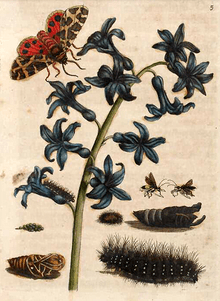
From the age of 13 she started collecting caterpillars and raising silkworms. She observed how they changed form at different stages, until they developed into butterflies or moths. She not only kept meticulous records and notes of her observations, but also detailed drawings of the process. She often painted by candlelight as she awaited the moment when the caterpillar made its cocoon, or a butterfly emerged from one. She painted caterpillars feeding on their host plants and being fed upon by their predators.

The metamorphosis of the garden tiger moth, its plant host, and parasitic wasp by Maria Merian. Source: https://en.wikipedia.org/

She publishing her first book of illustrations at age 28; this was followed by a two-volume set on caterpillars (published in 1679 and 1683) that showed the metamorphosis and host plants of 186 species.

Maria Merian was the first person to document the life cycle of butterflies. At that time it was widely believed that life originated spontaneously from inanimate matter. For example, that flies arose from rotting meat; other insects, including butterflies formed from mud, and that raindrops produced frogs. Maria’s observations and documentation opened up a new dimension.

This was also an era when most women did not have the opportunity of going to university. Maria was far from a being an academic scientist, nor did she have the freedom to devote all her time and energy to this pursuit. At the age of 18 she married her stepfather’s apprentice, and had two daughters. The marriage was not a happy one, and she left her husband, taking both her daughters, to live in a religious community; eventually getting a divorce. For many years she brought up her daughters as a single mother, supporting the family by teaching paining to daughters of wealthy families; and still making time for her art and scientific studies. By then she had moved to the Netherlands, where she spent the rest of her life.

For the first fifty years of her life, Maria observed and documented hundreds of  European insects, from caterpillars to spiders. She became well known for her work; collectors and art dealers would frequently come to her and show her insect dead specimens for her to observe.

But in 1699, at the age of 52, she embarked on one of the first purely scientific expeditions in history. She sold 255 of her paintings to finance the trip. Her goal was to illustrate new species of insects in Surinam, a South American country which had been recently colonised by the Dutch. After two months of dangerous travel, accompanied by her 20-year-old younger daughter, she reached Surinam.

For Maria Merian this was an entomologist’s paradise. She was itching to collect and paint everything she saw. But the Dutch planters of the island were not willing to accompany the two women into the forests to collect insects. So she forged relationships with enslaved Africans and indigenous people who agreed to bring her specimens and who shared with her the medicinal and culinary uses of many plants. Merian and daughter spent two years in Surinam before Maria’s failing health from frequent bouts of malaria, forced then to return to the Netherlands.

But the compilation of all her work in documenting and illustrating flora and fauna in Surinam resulted in a book titled Metamorphosis insectorum Surnamensium. It was written in Latin, the international language of science, with 60 stunning copperplate engravings that brought the exotic world of the rainforest to the damp drawing rooms of Europe. The book became well known in scientific and artistic circles.

Merian’s eldest daughter, Joanna, subsequently made the journey to Surinam and would send her mother new specimens and paintings until Merian’s death, at the age of almost 70, in 1717.

For a woman of her time, with no university education, Maria Merian’s meticulous scientific and artistic work earned her respect. Karl Linnaeus, famous for developing a system for classifying life, referred heavily to her illustrations in his species descriptions. The grandfather of Charles Darwin, Erasmus Darwin, cited Merian’s work in his book The Botanic Garden. 

Merian also published works in German and Dutch, which allowed lay readers unprecedented access to scientific discoveries, arguably making her one of the earliest science communicators.

Merian was also proved to be a successful businesswoman. She sold her drawings and engravings to finance the printing of her own books, which she would later sell. This financial security also allowed her the freedom her to pursue her interests and ideas.

In the 1800’s, by which time university-trained academics laid stake to “biological knowledge” there was a trend to discredit Maria Merian and her work. As she had no formal scientific training she was written off as a woman with a hobby who painted beautiful – but entirely unscientific – pictures of butterflies. Although her work continued to inspire and influence generations of artists, her contributions as a scientist were largely forgotten. It is only in more recent years that her scientific work has been revisited and revived.

Maria Sibylla Merian was a pioneering naturalist, who also managed a successful career as an artist, botanist, and entomologist. Merian studied the behaviour and interactions of living things at a time when taxonomy and systematics (naming and cataloguing) were still at a nascent stage. She laid the groundwork for the fields of entomology, animal behaviour and ecology. She was the first ever to show the interaction between species, food chains, and the struggle for survival in nature. And how environment affects development and behaviour. She captured the ecology of species, centuries before the term even existed.   

At a time when other scientists were trying to make sense of the natural world by classifying plants and animals into narrow categories, Merian looked at their place within the wider natural world. She searched for connections where others were looking for separation.

Today when there is so much talk of encouraging women in STEM, it is more than worthwhile to remind ourselves of this inspiring woman who not only successfully combined her artistic and scientific work, but also pioneered fields of study that we erroneously believe to have more recent origins.

–Mamata

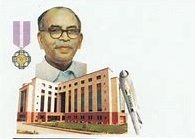
Defence Science: Remembering Dr. DS Kothari on his Birth Anniversary, 6 July

‘Dr Daulat Singh Kothari, a theoretical physicist and Dean of the Faculty of Science of Delhi University, was appointed the first Scientific Adviser in July 1948, at the age of 42. He formed Defence Science Organisation by hand-picking scientists from the various universities in India who were proficient in aeronautics, electronics, chemistry, mathematics, nutrition, physics, psychology to start research work in ballistics, electronics, chemistry related to explosives, paints and corrosion, food preservation and nutrition, psychological fitness profile for selection of Service personnel, battlefield stress and physical fatigue. He made the Services conscious of the role a scientist could play in the solution of defence problems. Dr Kothari aimed to build a boundaryless learning organisation stripped of hierarchical trappings and with two-way communication between him and his scientists. The basic science laboratory raised by Dr Kothari provided the nucleus for the formation of the Defence Research and Development Organisation.’

–DRDO Website

The first Boss is the most formative influence on one’s career, work ethics and leadership style. And if he/she is a good boss, then they are almost Gods to impressionable young minds.

Dr. DS Kothari was my father’s first Boss. And was God to him.

Each line in the DRDO (Defense Research and Development Organization) write-up resonates with what I have heard about Dr. Kothari from my father.

DRDO was officialy established in 1958, but many constituent labs came into being before that. My father applied and was interviewed for the junior-most position in the Defence Science hierarchy around 1953. And who should be the head of the panel but Dr. DS! He sat through days and days of interviews in the midst of all his responsibilities as Scientific Advisor to Raksha Mantri. He saw this as his most important responsibility—hand-picking young scientists of promise from across the country to build a unique institution and an ambitious one for a newly independent India.   

The first problem he set my father and a few of that cohort was to work out the ideal thickness of rotis for high-altitude troops. The parameters to be optimized for a given weight of atta were time for the cook to roll out the roti, cooking time, and fuel consumption. And of course the rotis had to be edible! I think the realization that science could be brought to bear on such everyday problems was a lesson that scientists of that generation imbibed and made a way of life.

In 1955, PM Pandit Nehru set the scientists the task of studying the consequences of nuclear, thermonuclear and other weapons of mass destruction. Dr. DS had the major responsibility of bringing out the report, along with Dr. Homi Bhabha and Dr. Khanolkar. A small group of young Defence scientists—my father among them–was tasked to assist these stalwarts. Due to various reasons, it was Dr. Kothari who took up most of the burden of the work.

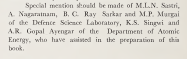
The 10-12 months were among the most hectic and most memorable ones of my father’s career. There was very little information on this subject in the public domain at that time, and India did not belong to any elite clubs which could get access to any classified information. Yet, in less than a year, the group brought out a data-rich 212-page report ‘Nuclear Explosions and Their Effects’ (subsequently published by the Publications Division). The book had a foreword by Pandit Nehru and was a seminal report at the time, not only in India but internationally.

The powers that be were also gracious in acknowledging the contribution not only of the leaders but also the young scientists.

But what is part of family history is something that captures Dr. Kothari’s essence. Apparently, at 4 pm on a Sunday afternoon, there was a knock on the door of my parents’ house. When they opened the door, there was Dr. DS himself! He had wanted to urgently discuss a point related to the book. In the days before home-telephones, he got his office to dig out my parents’ address, and rather than send someone to fetch my father, decided to come himself and save time.

My mother, till her last days, recalled this incident with not only awe, but also a feeling of being overwhelmed. A young girl newly arrived from Tamilnadu, with a very cranky baby on her hip. and no Hindi and only a smattering of English, she was confronted with having to entertain God himself! I think the sum total of furniture in the tiny house consisted of a few Godrej chairs, a study table and a cot. I don’t know if Dr. DS partook of anything, but I surely hope he asked for coffee rather than tea, because there would have been no tea leaves in a good South Indian household of that time. Nor would my mother have known how to brew a cup of tea. And steel tumblers and dawaras were the only serving utensils.

But Dr. DS, by family accounts was completely oblivious of all this. He came, made himself completely at home on the Godrej chair, stayed for almost an hour discussing what he had come to discuss, and then with blessings to my brother and a warm smile to my mother, was off.

All in a day’s work for him. But for us, family history for generations!

Dr DS Kothari: Scientist of international renown who worked with Dr. P Blackett in Cavendish Laboratory, Cambridge University, under the guidance of Lord Ernst Rutherford, the Father of Nuclear physics, and contributed immensely to the fields of statistical thermodynamics and Theory of White Dwarf Stars. Steering-hand of DRDO and the founder of many of the labs in the system. Played a key role in setting up UGC and NCERT, and was Chair of India’s first Education Commission.

–Meena

In memory of my father, Shri A. Nagaratnam, a physicist, who worked with DRDO for almost half a century. And my brother, Dr. N. Prabhakar, an aeronautical engineer, who also spent his entire career with the same organization, and was awarded a Padma Shri. They knew no other life, and were immensely proud to be a part of DRDO.

To School or Not to School?

Last week Meena wrote about the conundrum of schooling in the age of Corona lockdowns. While school-going children and teachers of all ages have been thrown overnight into an entirely alien pattern of e-teaching and learning, parents have been facing some of the biggest challenges in terms of new role and responsibilities. This period has also triggered numerous dilemmas and debates about how to provide the best possible education for children while schooling at home. Several parents have seriously started considering the merits of ‘home-schooling’.

Since the early days of formal educational systems as defined by the institution of the School, there have always been a cohort of parents who have chosen to experiment with alternative methods of teaching and learning for their children. The jury is still out on the strengths and weaknesses of this practise, but there are certainly interesting examples and experiences to peruse and ponder over. Here is a particularly inspiring one.

The story goes back to 1847; when 7-year-old Al, who had been in school for just three months, came home with a note from his teacher which stated that the young boy was “addled”, was not capable of keeping up with studies, and that he was advised to leave the school. Al’s mother Nancy refused to accept this harsh judgement about her child; she took this as a challenge and decided to teach him at home. She knew that though he was shy and retiring, but this was probably because he had a hearing difficulty that constrained his active participation in the classroom. Having once been a teacher herself Nancy diagnosed that the imaginative and inquisitive child was a ‘misfit’ because he was bored by conventional rote learning. Nancy encouraged her child’s curiosity, and love for books, and gave him the time and space to use his head and hands by exploring, experimenting and discovering for himself.

The young boy was fascinated by mechanical things and experiments. An elementary science book that she gave him when he was nine, explained how to do chemistry experiments at home. Al was hooked! He spent his pocket money on buying chemicals from the local pharmacy and collected basic equipment for experiments; when he was 10, he set up a simple lab in the basement of his house where he spent hours. Encouraged by his parents, he read voraciously, including literature and history. Thus began a lifelong passion for learning for a boy who never had more than three months of formal schooling.

Al grew up to be known as Thomas Alva Edison, one of the most prolific inventors of all times whose inventions changed the world in many ways–from the incandescent light bulb, the phonograph, and the motion picture camera, as well as improving the telegraph and telephone. In his 84 years, he acquired an astounding 1,093 patents. He invented both product but also systems to support the process of invention, a forerunner of the concept of R&D labs. Edison went beyond being an inventor to also become a successful manufacturer and businessman, marketing his inventions to the public and setting up what was one of the early forms of a successful corporation.

Thomas Alva Edison’s mother Nancy died when he was 24 years old but she remained his source of inspiration through his life and career. In later years, a grown and very successful Thomas always acknowledged that his mother’s discipline for a focused life was responsible for his great success. As he said, “My mother was the making of me. She was so true, so sure of me, and I felt I had someone to live for, someone I must not disappoint.”

Not all of us can be a Nancy Edison, and certainly not every home-schooled child may grow up to be a Thomas Alva Edison. What interested me more about the story was not so much the great inventor Edison about whom much has been written, but Edison’s deep thinking on education that was well ahead of his times, and clearly reflected the deep impact of his personal experiences.  

Edison was critical of the education system of his day. He felt that “The present system does not give elasticity to the mind. It casts the brain into a mould. It insists that the child must accept. It does not encourage original thought or reasoning and lays more stress on memory than observation. The result of accepting unrelated facts is the fostering of conservatism [in thinking]. It breeds fear, and from fear comes ignorance.”

Edison’s entire life was an intense and passionate quest for knowledge and understanding which came not by blindly following books but by learning-by-doing. All his life he adhered to a meticulous recording of innumerable experiments, thoughts, and observations in thousands of detailed laboratory notebooks. Even when he became a successful businessman, his intense love for information, communications, and learning led him to set up his corporate office in his beautiful and well-stocked library. He even considered his childhood deafness, which increased as he got older, as an asset rather than a liability. For someone who was an inventor, he was asked why he did not invent a hearing aid. He said that not being assailed by outside noise made it easier for him to concentrate on his experiments and research.

Even when he had his own labs and research staff, Edison continued to endorse his style of hands-on learning-by-doing. One of his early experiments, in the early 1890s, was to produce bricks that were porous, but which would not absorb moisture when exposed to rain or snow as they were transported in open train cars. Edison and his colleagues spent almost a year experimenting with different materials and solutions to come up with a suitable binding solution or “muck” as they called it. Edison started referring to his researchers as “muckers”, and then on, the name stuck for all researchers who worked in his labs, who later formed an organisation called Muckers of the Edison Laboratory” or “Edison’s Muckers”.

This is the core of Edison’s strong views on education Edison believed that most schools taught children to memorize facts, when they ought to have students observe nature and to make things with their hands; in other words ”be muckers”.

Later, as a parent himself, he set up small problem solving searches for his children. One of these was “team-based research”; he would tell them what he was interested in reading about, and they would have to go through the books in his vast library and search out not only the books, but also mark the relevant pages or sections with slips of paper. The family also played indoor games where the traditional rules were often changed.

It was natural that Edison’s own upbringing and his discomfort with the education system would lead him, in later years, to appreciate and support Montessori’s positive alternative   philosophy of education. As he wrote, I like the Montessori method. It teaches through play. It makes learning a pleasure. It follows the natural instincts of the human being.”

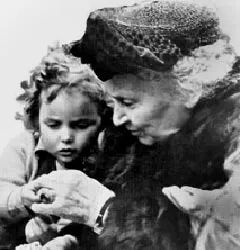
In 1913 when Maria Montessori made her first visit to the United States for a lecture tour she stayed at Edison’s home.  Edison helped found one of the very first Montessori schools in the United States thus helping to spread the message and mission of an alternative educational system.

Edison’s inventions transformed the world in many ways, and many of these were the pioneers of the tech revolution that has changed the way we think and operate today. But Edison also concerned himself equally with the true meaning of education and the processes of learning. His work and life was guided by four simple principles, taught to him by his mother:

Never get discouraged if you fail. Learn from it. Keep trying.

Learn with both your head and hands.

Not everything of value in life comes from books-experience the world.

Never stop learning. Read the entire panorama of literature.

If only every parent could internalize, and instil, with conviction, these principles that lay down the foundation of life-long learning.

A century later, the world is grappling anew with the same question: What should be the future of education? While re-imagining the transformation of education in the age of technology it would still be worthwhile to leave space for our children to be “muckers”, and for the unfettered joy of learning.

–Mamata

RIP Sundarlal Bahugunaji, Sentinel of the Slopes

The story of the Chipko Movement was one of the examples that was held up to the youth of the ‘70s and ‘80s, to inspire them towards caring for the environment, and to urge them towards peaceful activism.

Deeply rooted in the Gandhian philosophy and the Sarvodaya movement, Sundarlal Bahugunaji and Chandiprasad Bhatji were at the forefront of this, one of the first people’s movements in the country which saw the connection between the degradation of the environment and the well-being and livelihoods of people.

For decades, Bahugunaji had been working in the Tehri Garwhal area of what would become the state of Uttarakhand, organzing people along Sarovdaya lines, addressing issues of livelihoods, women empowerment and ecological protection.

These years of work prepared the ground for what would become the Chipko Movement.

The story begins in the monsoon of 1970. The Alaknanda, along with other Himalayan rivers was in flood and swept down the valley, leaving behind a wake of destruction. The people in the area could clearly see that the extent of the havoc was linked to the destruction of the thick forests that had once covered the mountain-sides. For many years now, trees were being cut by contractors, and the wood taken away to the cities. This left the slopes exposed, unstable and vulnerable to floods like this. Not only that, while the contractors were allowed to cut wood, the communities who had lived in and around the forest for generations and depended on them for food, fuel, medicine, timber  and other forest produce, were denied these. The forests were originally of oak, and the people knew these trees and used them in a number of ways. But now, contactors were not only destroying the oak forests, but they were also replacing them with chir pine which was not suited to the area, nor useful to the people, but whose wood was prized commercially. All this led to an increasing sense of frustration in the people.

The spark was lit on a March morning in 1973. A group of people from a sports-goods factory in Allahabad reached Gopeshwar village in Chamoli District. They had come to cut ash trees for the manufacture of cricket bats.

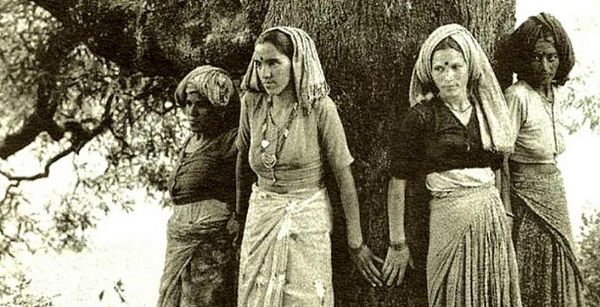
The villagers were in no mood to let these people cut their trees. They requested the axemen to go back, but they were under orders to cut the trees, and so refused. The villagers spontaneously decided that they were not going to let a single tree be touched even at the cost of their own lives, and rushed forward shouting ‘Chipko, chipko’ (roughly, ‘hug the trees’). They clung to the trees. The axemen, not knowing what to do, returned without cutting a single tree.

It was a battle won, but the war continued. Two months later, the contractors got permission from the local forest officer to cut the trees in a forest near the village of Rampur Phata, about 60 km away.

News of this reached Gopeshwar. The people were incensed. The entire village—men, women, old and young—set off in a procession to Phata. They carried drums and trumpets and banners with messages like ‘Chop me, not the tree’. The marched to Phata, singing and shouting slogans. People from other villages along the way joined them, and ‘Chipko’ was on everyone’s lips.

The huge procession reached Phata. The axemen were once again forced to flee by a peaceful crowd ready to give up their lives for the tree.

Confidence grew in the communities that they could protect their forests and environment.

But the contractors were worried. They were plotting and planning. Once, when they knew that the menfolk of Reni village would be away, they sent their men to the forests there. But the news of this reached the village, and a procession of women and children led by the fearless Gaura Devi walked towards the forests. At first the contractor’s men were not worried, as they thought here was not much the women could do. But they were wrong! Gaura Devi made it very clear that they would hug the trees and not let them touch a single one. ‘Shoot us first. Shoot us, only then can you cut this forest which is like a mother to us.’

Once again the axemen had to return empty-handed.

Not only did the women make the tree-cutters exit this once. They saw that the men had to cross a path to reach the forests. But this path on the steep mountain route had caved in during a landslide. A cement slab had been placed across it to allow people to cross from one side to the other. This was the only access to the forest. The women had a brainwave. With a strong stick and their combined strength, they managed to push the slab into the deep gorge below. The path could no longer be crossed!

And so the Chipko movement took root, impacting not only that area, but the environmental consciousness of the country and the world.

And this is the legacy left to us by Sundarlal Bahugunaji. The troubling question is whether we are living up to it.

–Meena

Srinivasa Ramanujan: A Book and A Movie

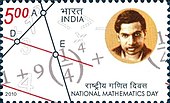
April 26th marked the 101st death anniversary of one of 20th century’s greatest mathematicians, Srinivasa Ramanujan. By coincidence, I was finishing ‘The Indian Clerk’ by David Leavitt at just about this time. And then went on to watch ‘The Man Who Knew Infinity’.

When it comes to the book, even with its various digressions, the mystic mathematical genius of Ramanujan comes through. The trials and tribulations of lower-middle class lad from the deep South of India, steeped in religious tradition, totally unprepared for the England of the 1910s, are heart-rending. The mathematical genius is an uncomfortable social being–moody, vulnerable, lonely, awkward, under-confident. Never mind food for the heart and soul in terms of companionship and friendship, he does not have enough food to keep in good health. First his strict vegetarian regime and various taboos make it imperative to cook for himself. But more seriously, as the First World War breaks out, he does not even get basic rations, vegetables and fruits. This, coupled with the cold, had lasting impacts on his health, which not only led to serious bouts of illness and hospital stays, but his tragically untimely death at the age of 32.

Away from anything familiar, longing for his wife, and with only a few Indian friends, how lonely life must have been!

But whatever the body, the heart and the soul missed, the mind just went on! And in Prof Hardy who was instrumental in bringing him to Cambridge, England, he had an intellectual companion, albeit they did not always agree on ‘ways and means’. Ramanujan’s refusal to provide systematic proof for his intuitive mathematical assertions led to many an argument. His insistence that his mathematical claims and insights were written on his tongue by the Goddess Namagiri irritated and baffled Hardy.

Ramanujan’s legacy was in the form of 37 published papers, as well as three notebooks and a ‘lost’ notebook (discovered only in 1976) with approximately 4,000 mathematical claims, most without proofs. Almost all of these have now been proved, in the century and more after his death. They continue to inspire modern-day mathematics and expand its boundaries.

I got a sense of all this from the book.

Coming to the movie, starring Dev Patel as Ramanujan, I found it sadly unsatisfying. To begin with, I could not reconcile the tall, debonair and poised Patel with my image of the short, stout, badly dressed and awkward Ramanujan. However good the actor, there have to be some physical similarities. It cannot be that the first Indian at hand is cast in a movie with an Indian protagonist. Ben Kingsley’s looks were as important as his acting, in bringing the Mahatma to life.

And then, small trivial details about life and mores in Tamilnadu of a century ago. Just a little fact-checking could have made it so much better.

Though both are for a general audience and cannot by definition get into too much math, of course a book can deal a little better with math than a movie can. So there is that too.

Both play up the ‘saas-bahu’ drama between Ramanujan’s mother and wife to the hilt, the movie a little more sympathetic to the MIL than the book.

All in all, worth it for anyone to spend some time on. It will surely awaken a sense of wonder about the unimaginable achievements of a short life—not only blazing paths that no Indian had trod, but impacting the course of mathematics for times to come. And give a sense of genius which is beyond rational explanation.

‘Man Who Knew Infinity’ by Robert Kanigal, is a more serious, and hence somewhat heavier read. There is also a movie titled ‘Ramanujan’, which I have yet to see.

–Meena

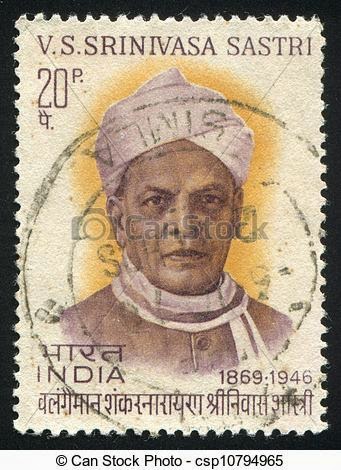
Silver-tongued Orator of the British Empire

As a student, he corrected passages in JC Nesfield’s “English Grammar” (the standard grammar textbooks used in India in those days). He was often consulted over spellings and pronunciations by the English. His mastery over the English language was recognized by King George V, Churchill, Lady Lytton and Lord Balfour. Many rated him among the five best English-language orators of the century. He is the man of whom the Master of Balliol declared, ‘I never knew that the English Language was so beautiful till I heard Sastri speak it.’ He is the man who found 27 mistakes when Gandhiji sent him the first copy of his newspaper “Harijan” for review. He is the man to listen to whom the British Prime Minister Lloyd George postponed a cabinet meeting.  He is the man conferred with the title of ‘Silver-tongued Orator of the British Empire’.

This was Srinivasa Sastri, born to a poor priest in 1869 in the small village of Valangaiman in Tamilnadu. He was a brilliant student who did his education in Kumbakonam. He graduated in Sanskrit and English, and went on to become a teacher, and later the Principal of the Hindu High School, Triplicane, Madras.  Though he went on to be many things—freedom fighter, politician, diplomat, administrator—he probably remained at heart an educator.

His foray into public life began from academic roots—he founded the Madras Teachers’ Guild when he was Headmaster of the Triplicane School. He was also a pioneer of the co-operative movement in the country, and started India’s first co-operative society, the Triplicane Urban Co-operative Society (TUCS) in 1904.

He is said to have been so influenced by a pamphlet written by Gopala Krishna Gokhale that he gave up his job and joined the Servants of India Society, going on to become its President. He joined the Indian National Congress in 1908, and was nominated to the Madras Legislative Council in 1913. He was later also a member of the Privy Council.

He was a part of delegation which visited England in 1919, a delegate to the Imperial Conference and the Second session of the League of Nations in 1921. He played a key role in getting the Government of South Africa to drop legislation which would have led to the segregation of Indians there. In 1927 he was appointed India’s first Agent to South Africa.

Gandhiji and Sastri were lifelong friends, and respected each other deeply. The Mahatma always referred to him as ‘Anna’ , never letting him forget that he was 10 days older! However, Sastri’s views and stands were often controversial. He was seen as too accommodative of British actions. He opposed the Non-cooperation Movement on the grounds that it was subversive of the law and would set a wrong precedent. This and other similar stances brought him in conflict with Nehru and others in the Congress, and he resigned from the Party in 1922, and subsequently founded the Indian Liberal Party.

Late in life, he returned to his first love, academia, serving as Vice Chancellor of the Annamalai University, Chidambaram. He was a legendary teacher. Far ahead of his time, he believed that students were ‘comrades engaged in a common task and whom one should meet with a smiling face not only in the school room but on playfields ..’. He persuaded Mahadeva Iyengar, then Head of the Tamil Research Department of Annamalai, to translate Kalidasan’s epic poem Abhignana Sakuntalam in Tamil. His lectures at the Annamalai University packed the halls, with faculty competing with students for seats.

He headed a Committee set up in 1940 to frame a set of general principles for coining words for scientific and technical terms in vernacular languages. The report of this Committee was controversial, since it recommended the continuation of Sanskrit loan-words in Tamil technical language and this was violently opposed by Tamil adherents.

It was his tenure in Annamalai University that has special meaning for me. At this time, my grandfather Shri Anantavaidhyanathan was Head of the Dept. of Chemistry there, and the Right Honorable Srinivasa Sastri became a family friend, and mentor to my father A. Nagaratnam who was a student there.

Our family dictionary was a Cambridge Dictionary gifted by him to my father with the inscription ‘To Nagaratnam, with a grandfather’s blessings’, and signed. Alas, when my mother closed up her house, the dictionary (still in decent shape, if in two pieces, disappeared).

What a loss of a family heirloom! But still, I like to think that the pages my grubby childhood hands touched, had been touched by the legendary Silver-tongued Orator!

–Meena

He passed away on 17 April 1946. This week marks his death anniversary.

Multi-faceted Nation Builder: Remembering Kamaladevi Chattopadhyay

She persuaded Gandhiji to give a call for women to participate in the Salt Satyagraha.

She campaigned with Jawaharlal Nehru.

She argued with Sardar Patel, and convinced him.

She worked with the Kanchi Shankaracharya to defeat temple bureaucracies.

She complained against Indira Gandhi (and paid the price!).

She toured with her theatre company and mesmerized audiences.

She acted in the first Kannada silent movie.

She was the first woman to run for a legislative assembly seat in India

She pioneered thinking on legislation with regard to women in the workforce, and the safety of children.

She led international thinking on women’s Right to Health, and for the first time, brought to attention the economic value of women’s work in the house.

She revived Indian crafts and ensured their survival.

She founded institutions that are part of our national fabric even today.

Kamaladevi Chattopadhyay whose birth anniversary we mark this week on 3 April, was a woman of her times and before her time. She accomplished in one lifetime what many will not dare to attempt in three!

Born in Mangalore in 1903, her parents were immersed in the nationalistic cause and were a major influence on her. Freedom fighters and thinkers like Mahadeva Ranade, Ramabai Ranade, Gopalakrishna Gokhale, Annie Besant were family friends and set the course of her life. While her father died early, her mother pushed, supported and moulded her into a redoubtable force.

She was married at 14 and widowed two years later. After this, she married Harindranath Chattopadhyay. After several years, they were divorced.

There were three distinct phases to her life’s work for the nation:

Her contribution to the Freedom Struggle: She heard of Gandhiji’s Non-cooperation movement in 1923 when she was in England, and promptly returned to India to join it. She joined the Seva Dal, was a founding member of the All India Women’s Conference, and helped organize the Salt Satyagraha movement in Bombay.

Her work with Refugees: Seeing the plight of the people coming in from Pakistan after the Partition, she became active in their cause. Convinced that self-help and cooperatives were the way forward, she set up the Indian Cooperative Union to work on resettlement and rehabilitation of refugees, and built the township of Faridabad on these lines, rehabilitating over 50,000 refugees from the North West Frontier, building not only homes but their livelihoods through training them in new skills.

Her work with Artists and Craftspeople: Passionately committed to arts and crafts in every form, she recognized how fundamental they were to India’s way of life and the livelihoods of crores of people. She understood that the mechanization route that India was taking would impact these negatively, to a point where they might disappear, and she took on the mission to revive, revitalize and conserve these crafts and livelihoods.

Among the institutions she played an active part in setting up were the Sangeet Natak Academy, Central Cottage Industries Emporia, the Crafts Council, All India Handicrafts Board, National School of Drama, and the India International Centre.

Kamaladevi was a prolific writer too, and her works, including her autobiography Inner Recesses, Outer Spaces: Memoirs may be the best way to learn more about her. A great starting point however is the lovingly written biography by Jasleen Dhamija’s Kamaladevi Chattopadyay. Brought out by the National Book Trust, it is a publication of less than 200 pages, which amazes you with how much can be packed into such a little book. And currently costing Rs. 100!

–Meena

A March to Remember

Source: en.wikipedia.org

Last week there were a flurry of events to commemorate a significant March. It was on 12 March 1930 that Mahatma Gandhi embarked on the march that was to become a milestone in India’s non-violent struggle for Independence from British rule. The 241-mile walk from Sabarmati Ashram to the coast at Dandi in Gujarat was a symbolic protest against the prohibitive provisions of the Salt Tax imposed by the British. The Dandi March was the spark that ignited the flames of a non-violent resistance and protest movement, and caused the idea of mass civil disobedience to spread like wildfire across the nation. The movement culminated in India gaining Independence on 15 August 1947.

This year, the run up to the 75th anniversary of our Independence, was marked by the symbolic re-enactment of the 24-day Dandi March, following the original route that Gandhi and his band of 79 marchers took in 1930. According to newspaper reports all sorts of “events” have been planned around this, including ‘patriotic’ entertainment programmes where the marchers halt every evening; competitions and contests, and even a “virtual ultra challenge” to walk, run or cycle as per one’s convenience at any place and any time between the challenge dates.

In an age where histrionics make headlines, and memories are as fleeting as Instagram images and tweets, perhaps not many today would know the historical facts about the original Dandi March 91 years ago. This is a good week to remind ourselves.

On 2 March 1930 Gandhiji had written a letter to the Viceroy giving notice of his intention to launch a civil disobedience movement by symbolically breaking the Salt Law which in his opinion was “the most iniquitous of all from the poor man’s standpoint.” He was snubbed in return; which strengthened his resolve. He selected Dandi, a seaside village in Gujarat as the site for his symbolic gesture, and planned to walk the distance of 241 miles from his Sabarmati Ashram in Ahmedabad, along with a select band of co-workers. The date for setting off on the march was fixed for 12 March and 6 April was the date set for the ‘breaking of the salt law” at Dandi.

Gandhiji vowed not to return to the Ashram till his mission was accomplished; he was also sure that he would be arrested before he could complete his journey. On 11th March Gandhi addressed a gathering of over 10,000 people at the end of the evening prayers on the banks of the Sabarmati saying “In all probability, this will be my last speech to you. Even if the Government allow me to march tomorrow morning, this will be my last speech on the sacred banks of the Sabarmati. Possibly, these may be the last words of my life here.”

On March 12, 1930 at 6.30 a.m. Gandhiji, left the Ashram accompanied by 78 satyagrahis. These represented a cross-section of the people from all over the country: Andhra Pradesh, Bengal, Bihar, Bombay, Gujarat, Karnataka, Kerala, Kutch, Maharashtra, Punjab, Rajputana, Sind, Tamil Nadu, U.P. Utkal, and even Nepal. The group included members of all communities. They fell in a broad age spectrum from 16-year-old Vitthal Liladhar Thakkar to 61-year-old Mohandas Karamchand Gandhi! The main criteria for the selection, that he personally made, was that the marchers were disciplined, and strictly adhered to the principles of ahimsa and satyagraha. Interestingly, the group did not include any women. One of the later historians attributed this to Gandhi’s concern that the British would taunt the marchers for being cowardly and “hiding behind the women.” He also anticipated that the marchers would have to face the physical aggression of the police, and did not want to women to bear the blows. But he encouraged women to participate and contribute to the struggle by taking up picketing of liquor shops and foreign cloth, and taking up spinning, as well as to make salt locally wherever they lived. 

The route of the 24-day march was meticulously planned; it would pass through 4 districts and 48 villages. An advance party of volunteers from the Gujarat Vidyapith were to go ahead and collect information about each village and its residents so that Gandhijji could plan his evening talks so as to be relevant to the local needs of the village where they halted. He admonished the villagers if their village was not clean and sanitary. In every village the volunteers registered new satyagrahis and received resignations from village officials who chose to end their cooperation with the British rule. The marchers slept in the open and depended on the villagers’ hospitality to provide them with food and water. Gandhi felt that this engagement would bring the poor into the struggle for sovereignty and self-rule. .

The group walked an average of 15 km each day, taking a mid-day halt, and reaching their night halt before dusk. Every sixth or seventh day was a rest day. The entire route was lined with huge crowds and decorated with arches, flags and buntings. Gandhiji led the group, walking with his customary speed and energy; he was indefatigable, spinning or writing letters even at the mid-day rest halts; he did not waste a single minute. He addressed public meetings and gave interviews until he retired at 9 pm. He was up at 4 am, writing letters, even by moonlight. After morning prayers at 6 am he addressed the marchers and answered questions, before setting off for the day.

His satyagrahis were expected to follow an equally exacting routine of prayer, spinning and writing their daily diary.  Even the advance party volunteers were not exempt. In a talk to volunteers on March 17 1930 he said: Ours is a sacred pilgrimage and we should be able to account for every minute of our time. Let those who are not able to finish their quota or do not find time to spin or write up their diaries see me. I shall discuss the thing with them. There must be something wrong with their time table and I should help them to readjust it. We should be resourceful enough to do all our daily duties without the march coming in our way.

Day after day, as the marchers covered mile after mile, of what he considered to be  “nothing less than a holy pilgrimage”.  Gandhiji addressed thousands of people; he urged them to join the civil disobedience movement in large numbers; to boycott foreign cloth, adopt Khadi, and desist from the evil of drinking. Every day, more and more people joined the march, until the procession of marchers was at least 3 km long by the time it neared Dandi.

On April 5 the marchers reached Dandi. Early the next morning, after prayers Gandhiji walked into the waters of the Arabian Sea; he bent down and picked up a lump of salt. The Salt Law was broken, and that simple gesture, triggered a groundswell of protest; across the country local leaders led people to the seaside to do the same; everywhere, in towns and villages, people made salt in pots and pans. The people of India had openly challenged the British Government.

A simple gesture, but one backed by a canny calculation of the tremendous impact that it would have; and a symbolic march that signified not just the determination of a nation to win their birthright, but equally the demonstration of a movement driven by the principles of discipline, ahimsa and satyagraha. As a nation that has, for 75 years, been savouring the fruits of this momentous movement, the best way to commemorate this would be not simply by symbolic events, but by reminding ourselves of, and adherence to, these principles. They are needed now, more than ever before.   

–Mamata