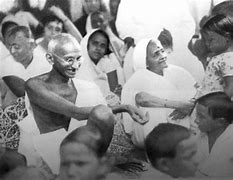
As we approach Gandhi Jayanti with the New Education Policy (NEP) now a reality, it is an appropriate time to re-visit Gandhiji’s philosophy of education as encapsulated in his Nai Talim (New Education)—Basic Education for All.
The fundamental premise of Nai Talim is that basic education is a holistic process, where all aspects of the individual—intellectual, physical, social, and spiritual—are given opportunity for development. The curriculum seeks to impart learning through hands-on skill-based work that prepares young people for the real world, rather than creating islands where education has nothing to do with the surrounding community. The centrality of skills aims to reinforce the dignity of labor, the value of self-sufficiency, and strengthen local culture. In this approach to education, craft-skill serves as the center of the holistic development of the student. Other skills such as literacy and mathematics are learned in the context of their craft, and subjects are taught in an interdisciplinary way and never separated from their practical application in the world.
Some other perspectives that under-pinned Gandhiji’s thinking on education were:
That education should include a “reverent study of all religions.”
Education meant lifelong learning
And a re-definition of the role of the teacher, which is summed up by him as : “A teacher who establishes rapport with the taught, becomes one with them, learns more from them than he teaches them. He who learns nothing from his disciples is, in my opinion, worthless. ..In this way, a true teacher regards himself as a student of his students.”
A national education conference held at Wardha on 22–23 October 1937 wherein Gandhiji shared his vision of education led to the setting up of two model schools at Wardha and nearby Segaon. A few years ago, I was in Wardha and sadly, it did not seem that the school was doing too well, or that it was at the forefront of educational innovation. It would seem that it is not easy to implement the philosophy of Nai Talim in a way that is relevant to today’s world.
They say the NEP has some influences from Nai Talim. How far these elements are implementable or how seriously they will be implemented is yet to be seen. My feeling is that it will take very creative re-interpretation of the philosophy of Nai Talim, if we want the spirit of it to infuse our education system. And as of now, I am not aware of any exciting experiments in this direction.
I often find myself returning to these two quotes from Gandhiji after discussions and debates on education. To me, they are the touchstone by which any educational initiative must be evaluated:
“By education I mean an all-round drawing out of the best in child and man–body, mind and spirit. Literacy is not the end of education nor even the beginning. It is only one of the means by which man and woman can be educated. Literacy in itself is no education.’
“The real difficulty is that people have no idea of what education truly is. We assess the value of education in the same manner as we assess the value of land or of shares in the stock-exchange market. We want to provide only such education as would enable the student to earn more. We hardly give any thought to the improvement of the character of the educated.’
My father-in-law will be 96 years old this month. He trained as an artist, but spent his career teaching machine drawing in a government polytechnic. He has now been retired for more years than he taught a subject that he was not passionate about. But what he was passionate about was reaching out to his students, not driven by any great philosophy or mission, but his innately sociable and open personality. Even today, he gets phone calls from his old (literally—some are 75 years and over!) students, just for them to say that they remember him fondly. Till a couple of years ago he clearly remembered names and attributes of so many of his students. It is that life force which continues to energize him even today.
The word Teacher itself is loaded with so much meaning. After all teachers were the key players in the long drama of one’s school (and college) life, with distinct characters, roles and parts. As a part of the student audience, and at times, minor characters in the crowd scenes, we spent a great deal of time and emotion on ‘adoring’, ‘hating’, ‘fearing’, ‘hero worshipping’, ‘imitating’, or ‘buttering up’ our teachers.
Teachers were a necessary evil that dominated every ‘period’ of our school days. It is when we were older (and perhaps a wee bit wiser) that we could look back with nostalgia and remember those teachers. This was also when we realized the lasting impressions and influences that different teachers had left on us. Not all of these were related to the subject they taught. More often, it was how they taught, or what they said and did, or even what they wore, and how they behaved. We could now see these as individuals with distinct personalities and persuasions. For some of us, the older we get, the more sentimental we get. And Teachers Day, celebrated in India on 5 September, revives many such memories.
In the good old school days, the run up to T-Day was exciting. This was the day that the tables were turned, as it were. It was the one day when students turned into teachers! This was how Teachers Day was celebrated in many schools.
This year for the first time perhaps in memory, the Covid wave has meant that educational institutions across the world are closed. In just a few months, our age-old understanding of educational spaces, classroom transactions, and players has been turned on its head. The e-learning revolution is sweeping across the globe.
Children of all ages (starting from nursery and kindergarten) passively face a small screen which reflects other small faces and a bigger face. It is in this virtual classroom that lessons are communicated (rather than taught). The day is divided into sterile time slots, rather than a time table in which the best parts were the time-outs for rowdy recesses and roistering assemblies. The Teacher is just a talking head who pops up at a designated time. As the young eyes and ears strain to keep alert and awake, the other senses lie dormant. Missing are the smells from the tiffin boxes, the touch of the dog-eared books and scarred desks, the jostling camaraderie of classmates, the fights and the making-up, the shared secrets, and playful antics…and with it the range of emotions that mark the gamut of relationships among the students, and between the teacher and the taught.
I must confess that I have no current and direct experience of e-learning, as a teacher, learner, or parent. But as Teacher’s Day approaches, I cannot help wondering and worrying about this new model of teachers and teaching. Yes, we have no alternative at this moment when safety and health is the priority. True that technology has enabled a safer and more widespread route to reaching out. Agreed that there are examples of inspiring innovations and models. But what will a child of the Age of Corona and Era of E-learning remember of her classroom, her classmates and above all, her teacher? What stories will he share with his children? Who will she remember with a smile or a grimace on another Teacher’s Day?
One looks back with appreciation to the brilliant teachers, but with gratitude to those who touched our human feelings. The curriculum is so much necessary raw material, but warmth is the vital element for the growing plant and for the soul of the child. Carl Jung
The year was 1911. A young man set up practice as a District Pleader in Vadhwan Camp, in the erstwhile princely state of Bhavnagar in Saurashtra. His practice was doing well, he was gaining a name and earning too, but his heart was not in the machinations of legal matters.
In 1913, he became a father to a son. The advent of the child Narendra triggered the life mission which would launch him into a new role. The man was Gijubhai Badheka and his mission was to bring about a revolution in the field of child development and education.
Indian education during that time was a curious mixture of the Macaulayism as practised by the English rulers and the traditional “spare the rod and spoil the child” tenet. Narendra’s parents saw the sorry state of the local schools and were apprehensive about the kind of education their son would get. Gijubhai yearned for something different for his child, but was not able to visualise what this could be. So he started reading whatever he could find about education and educators. He also started sharing his anxiety and dilemmas with his friends.
One of these was friends was Darbarshri Gopaldas Desai, who visited Vadhwan Camp often. He told Gijubhai “If you want to read literature about children’s education, and see a new kind of school, go to Vaso and meet Motibhai Amin”. This was when the door opened for him. Gijubhai went to Vaso, met Motibhai and saw his school. He came back with many books; among which was a book describing the Montessori Method of education. This was Gijubhai’s introduction to the thinking of Maria Montessori, and her writing.
The more he read, the more deeply he started thinking about children and child development, and about putting the theory to practice. He also started experimenting with young Narendra, and sharing his observations with his friends, as also the ideas of Montessori. As his desire to spend more time and energy into this new challenge grew, the further he drifted from his legal practice.
Dakshinamurti Balmandir
That is where serendipity stepped in. In 1915, Gijubhai helped to frame the constitution of an educational institution in Bhavnagar called Dakshinamurti. Its founders were kindred spirits, all grappling with dilemmas about education, as well as reading the works of Montessori. This was the turning point. In 1916, at the age of 32, Gijubhai quit his legal practice, and joined Dakshinamurti, initially as Assistant Warden of the student’s hostel, and teaching in the High School. His direct interactions with students reinforced his conviction that if real change had to happen it was critical to start from early childhood. He put forth a proposal to the Board to start an experimental pre-school (Balmandir). His wish was granted and in 1920 the Dakshinamurti Balmandir started. This became Gijubhai’s karmabhoomi (the land where one works). And this is where he applied the Montessori philosophy and method, drawing upon the core beliefs and tenets about child development, while adapting the methods and techniques to suit the local realities.
In 1925 Gijubhai took on three major initiatives that created a revolution in the thinking and practice of children’s education across Gujarat.
He set up a formal Adhyapan Mandir to train young people in the philosophy and practice of pre-school education.
To spread the thinking and to attract larger interest in children’s education, the first Montessori Sammelan (Conference) was held at Dakshinamurti. It was chaired by Saraladevi Sarabhai, who had personal experience in using the Montessori system in educating her own children, and who had tremendous belief in this philosophy. The Sammelan concluded with the setting up of the Nutan Bal Shikshan Sangh, headed by Saraladevi Sarabhai to take the work ahead.
Gijubhai invited all citizens interested in the new children’s education approach to join. The enthusiastic support of these members helped spread the new wave not only across Gujarat, but also other parts of the country. The Sangh became a platform to carry this forward. It was proposed to publish a monthly Shikshan Patrika to give voice to the movement.
In 1926, the second Montessori Sammelan was held at Ahmedabad, presided by Gijubhai. Educationists came from all parts of India and carried back the Montessori message.
In the short period from 1920 when he embarked on his mission, till his death in 1939 at the age of 54 years Gijubhai not only pursued his passion for, and practice of his vision of pre-school education, but wrote prolifically for children, teachers and parents.
He combined the scientific perspective of an experimenter, the desire to do something new, the insight to draw out some light from the doldrums that the educational system was in, and faith. This was supported by the revelations from the writing of Madame Montessori.
Sadly the two great like-minded people never met in person. Madam Montessori first came to India in 1939, the year that Gijubhai passed away, at the invitation of Theosophical Society of India. She was then 69 years old. She made Adayar, Chennai her home and lived there along with her son, Mario till 1946.
By then seeds that her writing had sown had already taken root and spread, and Gijubhai was the gardener that nurtured the early shoots, and encouraged the branches to spread far and wide.
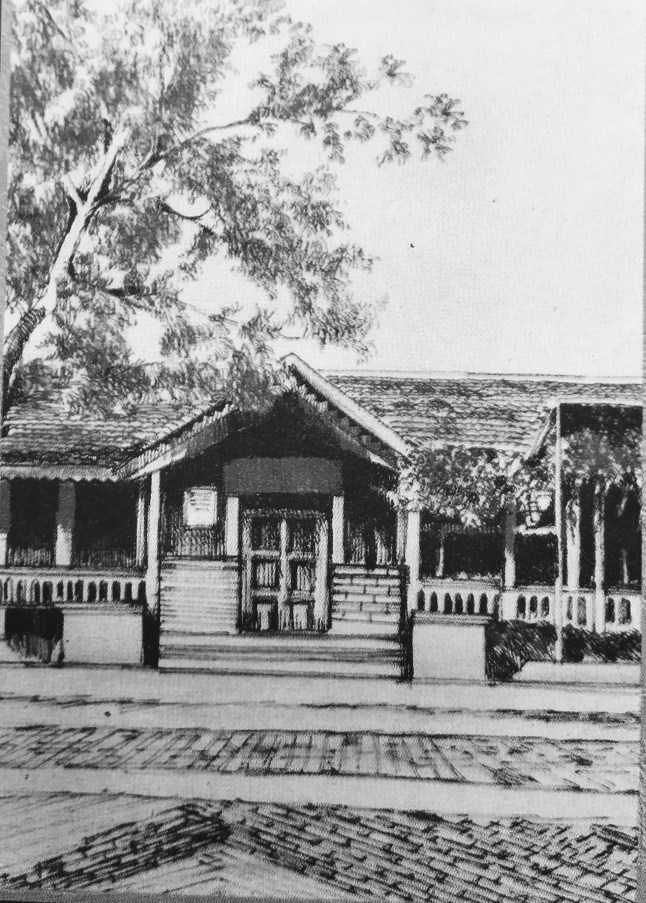
The Dakshinamurti Balmandir continues to function today, in its original building, one hundred years after it was first established.
It is necessary for the teacher to guide the child without letting him feel the pressure too much, so that she may be always ready to supply the desired help but may never be the obstacle between the child and his experience.
If we could say: “We are respectful and courteous in our dealings with children, we treat them as we would like to be treated ourselves” we should certainly have mastered a great educational principle and undoubtedly be setting an example for good education.
Dr. Montessori’s Own Handbook (1914)
A teacher’s work is like flowing water. …If we do not understand those who have to be educated; do not think about what they like and what they do not, then our work and theirs will go in vain. The fulfilment of the work of education is not in teaching one or two subjects nor preparing for a certain class, or passing matric or BA. Real education lies in making humans aware about their own unending strengths. It is to reveal the secret of how to animate these and how to use them. To do this requires that the strengths are respected. Their individual development needs to be given first place. Rather than being taught, they need to be guided onto the path of self-knowledge. This is the work of education today.
August 31 marks the birth anniversary of Maria Montessori, whose name of course is synonymous with the education system all of us wish our children to undergo. But even if she had not pioneered this revolutionary system of education, Ms. Montessori would still be in annals of history as a path-breaker. In 1883-84, at the age of 13, she enrolled in classes at an all-boys technical school. Not only did she choose technical subjects, but she did it with the hope of becoming an engineer, an almost unheard of choice for a girl. By the time she graduated in 1890, she had changed her mind and decided to become a doctor instead. This was not an easier choice though! She was strongly discouraged from taking up medicine in the University of Rome. So she enrolled for a degree in natural sciences, earning her diploma di licenza in 1892. This along with her studies in Italian and Latin, qualified her for entrance into the medical program at the University in 1893. This was only the first step though. She was met with hostility and harassment from students and professors. Her attending classes with men in the presence of a naked body was considered inappropriate, and she was required to perform her cadaver dissections alone, after college hours. Nothing deterred her, and she graduated from the University of Rome in 1896. The mores of the times also brought unhappiness in her personal life. She loved a colleague, Giuseppe Montesano, and even had a son with him. But she could not marry him because if she married, she would have to give up her professional work.
She specialized in pediatrics and was involved in the education of mentally challenged children. In 1906, she was invited to set up a childcare centre in San Lorenzo , a poor, inner-city district of Rome, working with the most disadvantaged children of the area, who had no previous exposure to school. She called the center the Casa dei Bambini—Italian for “Children’s House. It was a quality educational environment for youngsters whom many had thought were unable to learn. About 50-60 children were enrolled to being with, and the building porter’s daughter was the first teacher, under Dr. Montessori’s guidance.
The school showed amazing results. Soon the children exhibited great interest in working with puzzles, learning to prepare meals and clean their environment, were calm, orderly, self-regulating, and engaging in hands-on learning experiences—essentially teaching themselves.
Montessori’s experiments began to be widely studied and replicated, not only in Italy but across the world, till today it is a household name. India too has a long history of Montessori education, going back to the 1920s.
This system of education is undoubtedly what is needed for our young children today. Every Anganwadi and primary school should be a Montessori school. Considering that the whole experiment began with the aim of catering to under-privileged children who were first generation learners, and with a not very educated daughter of a building porter as the teacher, it is the most obvious model for adoption.
But alas somewhere, this system of education has become identified with exclusive schools for the children of the rich and famous. The fees are out of reach of even the middle class.
Is it that we have, in the pursuit of the letter of Montessori’s methods, completely missed the spirit, and have become inflexible and unable to adapt to make it workable at low cost?
At a time with the new National Education Policy has recognized the importance of education for ages below 5 for the first time, it is time for introspection, creativity and a re-think on how this pedagogy can be the basis of learning in every educational institution.
“Early childhood care and education (ECCE) is more than preparation for primary school. It aims at the holistic development of a child’s social, emotional, cognitive and physical needs in order to build a solid and broad foundation for lifelong learning and wellbeing. ECCE has the possibility to nurture caring, capable and responsible future citizens.” UNESCO
ECCE—particularly among disadvantaged children—improves not only cognitive abilities, but also critical behavioral traits like sociability, motivation and self-esteem.
The National Education Policy 2020 that India has just approved is, like all other policies, very broad, very noble. And also of course, parts of it are controversial. But however comprehensive and noble, obviously, a policy is only as good as its implementation, and how exactly this is going to happen, including the structural reforms needed, will be seen in the coming years.
Leaving aside the debates, the most significant thrust that could make a fundamental difference to our children, is the recognition of the importance of Early Childhood Education and the statement that ‘the responsibility for ECCE curriculum and pedagogy will lie with MHRD’. Hitherto, the Anganwadi system, under the Ministry of Women and Child Development, catered to children of this age, and there was no systemic coordination with the Ministry of Human Resource Development, and while education was on the charter, it was just one of the many responsibilities of the Anganwadies. There was no specific focus education, pedagogies or the continuity from Anganwadis to schools. The NEP takes children from age 3 upwards into the fold of education, and advocates coordination among various Ministries towards this.
But I think this puts a greater and different responsibility on the Ministry of Women and Child Development—viz, the responsibility of educational inputs in the home environment for children below the age of 3. Ages 0-3 is when a baby’s brain grows to 80% of its adult size and is twice as active as adults. Research in developed countries has shown that at age 2, toddlers from low-income families are already 6 months behind in their language processing skills. Without greater investment in the first 3 years, many children will miss the opportunity to reach their full potential. And inputs and influences at this age come mainly from the home environment.
The Ministry of Women and Child Development would do well to educate young parents on how to create a stimulating, nurturing and learning home environment for their infants and toddlers. Intensive training and sensitization of parents-to-be and parents of these children, along with ongoing hand-holding and support would probably be the way. This would pave the way for the entry of the children into the educational phase at age 3. An imaginative system involving NGOs, educationists and community-based organizations needs to be created.
So NEP, thank you for taking the responsibility for the education of for 3+ers. Now powers-that-be, please do something about ages 0-3!
There are many significant dates associated with radio in India. July 23 is one of them. Broadcasting in India started in June 1923, when the Bombay Presidency Radio Club of India transmitted the first-ever broadcast. But July 23 1927 is significant because it is the day on which the private Indian Broadcasting Company was authorized to operate two radio stations and started its Mumbai transmission. However, the company went into liquidation in three years and the government took over the facilities and the Indian State Broadcasting Service started operations on an experimental basis in April 1930 (strangely under the Department of Industries and Labour). In June 1936, this became All India Radio. In the meantime, in September 1935, Akashvani Mysore, a private broadcasting station had been set up. (This is significant as the term ‘Akashvani’—literally meaning ‘Voice from the Sky’–was first used by Mr. MV Gopalaswamy who set up this station. All India Radio, India’s public radio broadcaster, adopted Akashvani as its on-air name in 1956.).
Today, All India Radio is the largest radio network in the world, and one of the largest broadcasters i in terms of the number of languages broadcast (23 languages and 179 dialects!), and the range of audiences it serves. This is done through 420 stations located across the country, reaching nearly 92% of the country’s area and 99.19% of the population. AIR also operates close to 25 FM stations.
Though there is some amount of educational programming in India, the real power of radio to support formal education has probably never been fully tapped. In a country like Australia, for instance, radio has been used for direct teaching, whereby radio schools were used to connect children in secluded farmsteads in the outback together with a teacher sited many hundred miles away.
In the last few days, we have seen some data related to media access that is worrying. Reports based on latest National Sample Survey (NSS) data show that children in only 4% rural and 23% of urban households have access to computers. A survey in Karnataka has revealed that over 5.5 lakh school children in North Karnataka did not have access to TV.
In these COVID times—that is the foreseeable future—education has to depend heavily on such media. Yes, we must use the latest technology and leapfrog (as discussed in the previous blog). But it would be foolish indeed to ignore the good old medium of radio, which reaches 99+% of the population! It is time that AIR and educational authorities went into mission mode to ensure relevant, interesting educational radio programming, to support school children who will otherwise miss out on any educatoinal inputs. Education is not about exams, but about engaging the growing mind of the child, giving it food for thought, helping the imagination. We cannot leave lakhs of children without any educational inputs for months, maybe a whole year.
Radio surely has a part to play in this, especially in these times. May it truly be “Bahujana Sukhaya Bahujana Hitaya “( “For the happiness of many, for the welfare of many”),as the AIR motto goes!.
In the education space, stakeholders in India ( at least private
schools and ’learning solution providers’) have moved to E-learning. An estimate is that overall, technology adoption has been accelerated by upto two decades,
thanks to COVID.
Two things stand out. We would not have done it, if we did not have to
do it! While online tutoring had caught on in a big way, educational
institutions were definitely not leveraging technology to the extent
it should have happened—till COVID. The other, more heartbreaking, is
that this is adding to the already stark inequity in educational
access. The point is not to deny access to some because it cannot be
universal. The point is rather to go on a mission to make it
universal!
In contrast—SITE (Satellite Instructional Television Experiment)
undertaken by India in 1975, was a proactive effort to use technology
for education and development communication for the most-unreached.
Imagine 1975, when TVs were hardly seen even in urban households. Here
was an unimaginably bold initiative to take TV to 2400 of India’s most
backward villages in 6 states.
There were questions even apart from our technical ability to do this—was such an experiment necessary for a country at our level of poverty and problems? Surely, there were more pressing problems and more immediate use for the scarce resources? But the conviction of a team led by Dr. Vikram Sarabhai, that technology-leapfrogging was critical to solve India’s development challenges,
ensured that the topmost decision makers saw the advantages and they
could make it happen. (‘Technology-leapfrogging occurs when
decision-makers choose to adopt leading-edge technology, skipping one
or more technology generations’).
This was a NASA-ISRO partnership with the objective of using technology for the education of communities in the most deprived and unreached parts of the country . A NASA broadcasting satellite was used. In the first-ever Indo-US space collaboration, it was positioned over India for the
duration of the experiment (August 1, 1975 to July 1976). The
deeply-researched content on critical issues faced by the community,
from agriculture and health, to culture to short films promoting
scientific temper, the production was done mainly by All India Radio,
with social research and evaluation done by a special team from ISRO,
and with the involvement of experts from a range of the most
significant institutions of India-Tata Institute of Social Sciences, to NCERT. Apart from community programs, there was a rich variety of special educational programs for schools as also massive teacher training.
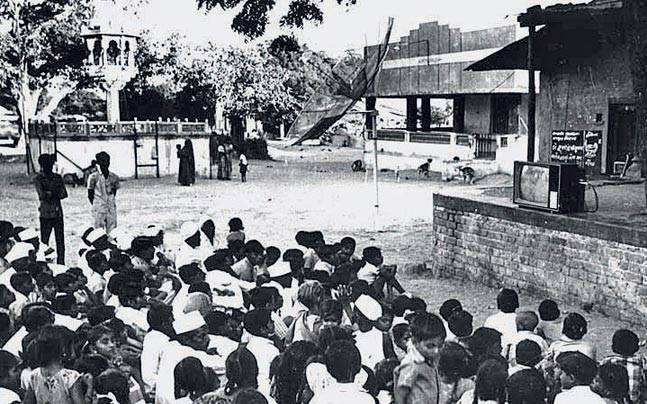
The programs were broadcast for a few hours a day, and hundreds of
people would gather in the village community hall or wherever the
village had installed the TV. In villages which did not have
electricity, truck or car batteries were used to power the viewing.
People in remote Bihar were watching television while many in Delhi
had never seen one!
SITE was a resounding success in proving that technology had a huge
role to play in solving the real development challenges of the
country. It helped ISRO develop its capabilities in operational
satellite systems and contributed to a sound platform for the Indian
National Satellite System (INSAT). It helped us develop an
understanding of educational software programming, from social
research to production to evaluation. And it helped develop managerial
capacities. It was probably also the first time in India that a very
young group (mainly in their 20s) formed the core of the team taking
responsibility for such a complex task of national importance.
Well-known science fiction writer Arthur C. Clarke called SITE ‘the
greatest communication experiment in history’.
So even as education (for some) moves online, here is a Hurrah for the vision of the
giants on whose shoulders we stand! Can that infuse us once again?
And a Hurrah from the Millennial Matriarchs for some of the amazing
people who were part of SITE, whom we have had a chance to interact
with—Prof. Yashpal, Kiran Karnik, BS Bhatia, Binod Agarwal,
Vishwanath, Mira Aghi—to name just a few. We are thankful to life for
giving us these opportunities.
The last three months of lockdowns across the world have, among other things, put the spotlight on parenting. With children and parents in continuous and close confinement, both have been tearing their hair out in frustration. The challenge of keeping children ‘occupied’; the careful negotiation of time and space that respects personal and physical boundaries; the sharing of responsibilities amidst the constantly looming uncertainty of when and where the virus could strike, has put everyone on tenterhooks.
This has led to a proliferation of Advice Columns. From counsellors to therapists, psychologists to agony aunts, there seems to be an overdose on ‘good parenting’ tips. In our zeal to do the best for our children we sometimes tend to forget the most basic and simple guidelines that are based on the fundamental premise of mutual respect.
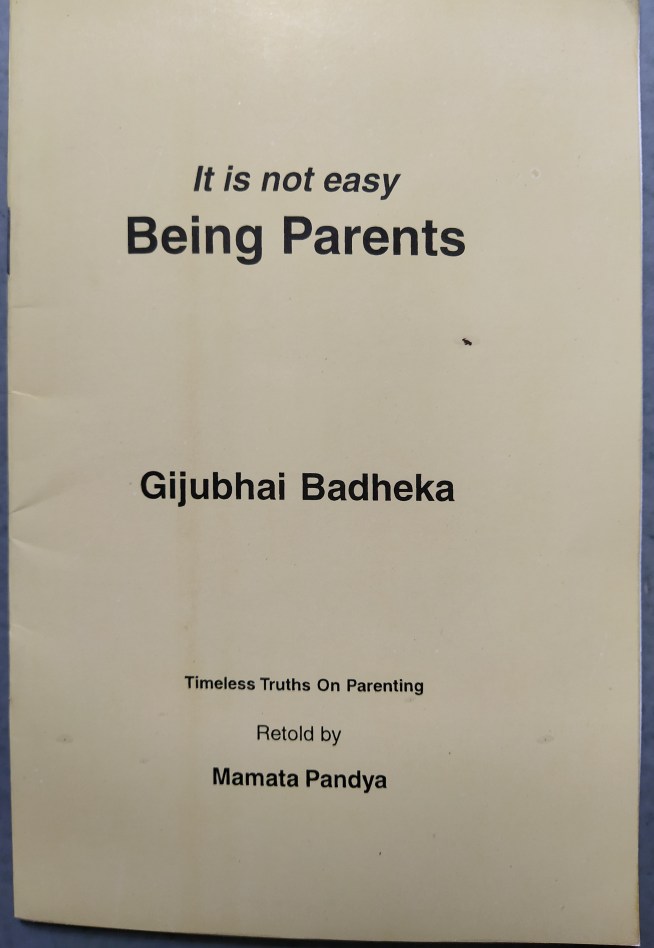
These were offered almost a hundred years ago by Gijubhai Badheka one of the pioneers of the Montessori system of education in India, lifelong advocate of children and their rights, and creator of some of the best loved and popular children’s literature in Gujarati. Gijubhai believed that every child has its own distinct personality. We as adults need to recognise and respect this. He urged parents to convert to the faith of trust, respect, freedom and love for children. Starting with these five fundamental tenets.
If You Really Want To
If you would like to do just one thing for children…
What could you do?
Do not hit children.
If you would like to do two things; what could you do?
Do not scold children
Do not insult them.
If you would like to do three things; what could you do?
Do not scare children
Do not bribe them to do something
Do not overindulge them.
If you would like to do four things for children; what would these be?
Do not preach to children
Do not blow hot and cold
Do not keep finding fault
Do not exercise authority all the time.
If you are keen to do five things; what will you do?
Do not do whatever the child demands; teach it to do for itself.
Let the child do what it desires to do.
Do not take a child’s work lightly.
Do not interfere into a child’s work.
Do not take away a child’s work.
In a world that has changed dramatically in the last 100 years, these timeless tenets remain as, if not more, true today.
Gijubhai Badheka passed away on 23 June in 1939, at the early age of 54 years leaving behind a prodigious legacy of writing for children, parents and teachers.
Gijubhai was my grandfather. In my small way, I try to carry forward his legacy by sharing and translating his works from the original Gujarati into English.
28 February marks National Science Day in India–it is the day in 1928 when Sir C. V. Raman discovered the Raman Effect. For his discovery, Sir C.V. Raman was awarded the Nobel Prize in Physics in 1930.
The discovery of the Raman Effect itself happened at Calcutta, but Bangalore was also Sir Raman’s ‘karma bhoomi’, in that he worked at the Indian Institute of Science from 1933 till his retirement in 1948, after which he founded the Raman Research Institute in the city, and continued working there till his death in 1970.
So on this Science Day, here is a little information on one of the exciting science education venues coming up in Bangalore. Science Gallery Bengaluru, under construction in Hebbal (not too far from IISc and the Raman Research Institute), ‘will be a dynamic new space for engaging young adults at the interface between science and the arts’. The under-construction centre anticipates a footfall of about 40,000 people a year, with a focus on 15-25 year olds. It is a multi-stakeholder collaboration, including Govt. of Karnataka, Trinity College UK, Indian Institute of Science, etc.
Scheduled to open in 2021, the Science Gallery is already active, having put up several events including ‘Submerge’ a major exhibition on Water.
And keeping with the theme of Science Day 2020 which is “Women in Science”, the Executive Director of the Science Gallery is Dr. Jahnavi Phalkey, a historian of science and technology. The Board is chaired by Dr. Kiran Mazumdar-Shaw, and includes Dr. Geetha Narayanan.
Bodes well for Science and Women Scientists!
Let us hope that the Science Gallery will help to infuse young people with the spirit of what Sir CV Raman said: ‘Ask the right questions and nature will open the doors to her secrets.’
When I saw the name Sathyanaryanan Mundayoor on this year’s Padma Shri list, a recognition for playing a ‘seminal role’ in spreading
Photo credit: Bapenlu Kri
education in Arunachal Pradesh, I was delighted. He epitomises for me a true passion for books and reading, and an inspiring story of a lifetime devoted to this mission. I first heard of him and his library mission, over a decade ago, from my old colleague and friend Ambika Aiyadurai. I sent him some of the books that we had developed in CEE, and over the years we corresponded sporadically. I have not yet been able to meet him in person, but truly hope to do so sometime. In the meanwhile I feel that his work needed to be shared. What could be better than a first-hand account from Ambika who has known him and seen his work over the years.
Thank you Ambika for sharing this!
–Mamata
I first heard about Sathyanaryanan Mundayoor, way back in 2006 when I started my research work in Arunachal Pradesh. School teachers, students, engineers, administrators, doctors and local villagers in Lohit district of Arunachal Pradesh suggested I meet him. In Lohit and later Anjaw district, where I started my field research, every one fondly spoke of ‘Uncle Moosa’, a name that people of Arunachal had given him. It was only after two years, in 2008, that I had a chance to meet him at Wakro (Lohit district). My accommodation was in the Circuit House, and he had come there to meet someone. With a pleasant smile, a gentle, fragile-looking man greeted me with a ‘namashkaram’. What struck me was his dress. That evening, in the chill of October, all Uncle Moosa had over him was a sweater and shawl, and a cotton veshti. In fact, I have only seen him in a veshti all these years.
Uncle Moosa invited me to visit Bamboosa library the next day. The days were short, so I decided to visit the library at 3 p.m. A group of children was in the library, sitting on a carpet on the floor, reading books. Few sat on chairs placed along the wall. Soon, another set of students arrived. With an assortment of books neatly arranged on the shelves, this single room is a wealth for local children. Students were free to choose any book, read on their own, or in groups. This library in Wakro is a result of Uncle Moose’s mission to inculcate reading skills and promote a reading culture among children in Arunachal Pradesh. And he has spent the last 30-odd years on this mission to connect rural children of Arunachal Pradesh with books. Starting with the Bamboosa library in Tezu, followed by Apne library in Wakro, and Hutong library in Yatong in Anjaw district, by now 13 libraries have been set up in the state, as part of the youth library network.
Uncle Moosa’s first visit to Arunachal Pradesh was in the year 1979 as part of a Vivekananda Kendra Vidyalaya mission. He took this up after quitting his government job in the income tax department in Mumbai. Till 1996, he worked with VKV, dedicating his entire time to the library movement, and never went back to Mumbai nor to his home state of Kerala. In addition to running libraries, Uncle Moosa would invite scholars and other visitors to give a talk in the library and interact with the students. Uncle mentored senior students to become reader activists and there are several events organized during Gandhi Jayanti, World Environment Day and Independence Day where students affiliated with the library movement would perform plays, skits, reading sessions and poem recitals. Those who have known him for several years tell me that Uncle Moosa would carry books in small trunks and suitcases to remote villages to set up reading camps. Hopping onto state transportation buses, and in places with little road connectivity, he would walk for several kilometers to reach a village.
Not many know about Uncle Moosa’s frugal living. A small single room with a bed and a shelf was his accommodation in Wakro. His day begins at four in the morning by doing yoga and meditation. His favourite breakfast is upma, and he prepares his own food himself every day. Full of energy, and with a kind, ever-smiling face, talking with him is a joy. His dedication to the library movement and helping students with their education has earned him love and respect, both from adults and children. He continues to live in Arunachal Pradesh, and is now based in Roing. Many years have passed, and I have completed my PhD, but every time I go back to Arunachal Pradesh, I look forward to meeting Uncle Moosa!
Uncle Moosa has dedicated his life to promoting education and fostering a culture of reading in the remote areas of the North-Eastern state. May his tribe increase!