Scientists in Israel say they will find the definitive cure to cancer within the year. Who would not like to believe this? Who is there today who has not lost someone to cancer– a family member, a friend, a colleague?
Even as these reports hit the news, there were others saying this was all bunkum.
Well, I do not know enough about the matter. Reason tells me that it is unlikely that a panacea is so close. But my heart would like to believe it.
I have lost my brother to cancer. And the MMs lost a dear, dear friend in her thirties to the Dreaded C. These losses have left indelible imprints, and maybe changed us as people.
But equally have the incredible stories of survivors: young nieces who survived and have made a full lives for themselves; a sister in law so gutsy, I even forget what she has gone through; friends like Anita (who did two guest pieces for the blog last year), who have overcome; an amazing and brave lady I knew in Italy, who not just survived cancer, but started an NGO (called Attive Come Prima) which has helped generations of breast cancer survivors to cope.
It is in this context that Feb 4, World Cancer Day is important. World Cancer Day is an initiative of the Union for International Cancer Control to bring focus on the disease and come together to fight it. The day is marked by events across many parts of the world.
It’s a day to take a pause and see what we can do. Know young people who may be vulnerable to taking up smoking? As a parent, teacher, mentor, friend, do what you can to stop them. Know a family battling the C? Be there for them—physically, emotionally, every which way. Know about a good organization working on the issue? Donate generously.
‘9.6 million people die from cancer every year – this number is predicted to almost double by 2030. At least one third of common cancers are preventable. Cancer is the second-leading cause of death worldwide. 70% of cancer deaths occur in low-to-middle income countries.’ Union for International Cancer Control.
2019 has been declared as The International Year of Indigenous Languages (IYIL2019) by UNESCO. The official launch of IYIL was held on 28 January 2019. The aim of IYIL is to “draw attention to the critical loss of indigenous languages and the urgent need to preserve, revitalize and promote indigenous languages around the world”.
Of the 6000-7000 languages in the world today, about 97% of the world’s population speaks only 4 % of these languages, while only 3% of the world speak 96% of all remaining languages. A great majority of those languages are spoken mainly by indigenous peoples.
India is one of four countries, along with Nigeria, Indonesia and Papua New Guinea, with the largest number of living languages. A mammoth project to conduct a comprehensive survey of Indian languages was launched in 2010. Initiated by Prof. G.N. Devy, founder of the Bhasha Research and Publication Centre in Vadodara, and undertaken by a large team of scholars, the project called the People’s Linguistic Survey Of India (PLSI) set out to document and preserve 780 languages which are being spoken in India today. These are being published in the multi-volume People’s Linguistic Survey of India, towards providing an overview of the extant and dying languages of India, as evolved till 2011, and as perceived by their speakers. The volumes chronicle the evolution of these languages in all their socio-political and linguistic dimensions, and encapsulate the worldview of their speakers. PLSI proposes to complete its task of publishing 92 volumes by 2020.
In the last couple of years, I have had the enriching opportunity to learn about some of the indigenous people of the north east of India and a glimpse of not just the incredibly rich traditions of textiles in the region, but equally the close ties between language of the people and the language of their textiles. Not only does every tribe have their own dialect, but each dialect has wonderfully nuanced words to describe every textile that they weave, and even every motif that is woven on these.
Names of textiles of the tribes have references to the history and geography of the tribe, as well as names that literally relate to colour, size, on which part of the body they are worn, as well as referring to age and status of the wearer. There are specific shawls for elder men or women, for those who have special social status (as in the Naga the Feast of Merit shawl), for a new bride to wear to her marital home, and for covering the deceased.
As Ganesh Devy puts it “in every manner without any exception, the language we learn or use is the absolute condition of our narrative of the world and the way we see the world.”
Of the numerous examples of this, is that of a textile of the Bodo Kachari tr
Aronai with Hawjagor pattern
ibe of Assam.The multi-use decorative textile called Aronai is characterised by a zig-zag motif called Hawjagor (hill pattern) in the Bodo dialect. This pattern is inspired by the hills which form an important part of the history as well as the geography of the Bodo people who settled by the foothills, on the north bank of the Brahmaputra in Assam.
It is in the names of motifs that women weave onto the textiles that the symbiosis between life, nature and culture is most evident. The names not just reflect how nature inspires form, but also reveal a keen eye for subtle detail and the richness of language to reflect this.
A common triangular motif on wrap skirts of the women of a small Naga tribe is called impeak bam. The word Impeak translates to ‘stretching out/extending/ spreading out’ and bam means ‘wings’; and the motif symbolises a flying Hornbill. While a similar but smaller triangular motif is named to mean the wings of the bird called a Swift.
Some of the motifs of the Liangmai Naga tribe in Manipur are named literally to represent elements such as fish bone (kakhara thua), cow’s teeth (kabuihu), and ripples in a lake (kazai kapai). There is even a woven line stitch line called matiang kang meaning ‘group of ants.’ These are only the tip of the iceberg of detail, as it were.
One of the traditional shawls of a small Naga tribe of the Manipur Naga Hills has a motif called inchitatpi that translates to ‘head of a long worm’ found in the woods. Another has a pattern representing cucumber seed called angi thei ru. Getting into even more minute detail, another tribe has a popular motif called aphinamik which literally means the ‘eye of a dove’.
There are patterns representing frog’s feet called sangkang nou ban and grasshoppers’ egg called changkow gum, and even a stitch called kabi n’dui where kabi translates to ‘good’ and ndui translates to ‘egg’, relating to the arrangement of eggs on a paddy plant!
What evocative words and how beautifully they capture richness of life lived in synergy with one’s environment. These are only a tiny sprinkling of the vocabulary of a tiny segment of indigenous people and languages.
Sadly with ‘modernisation’ comes homogenisation. A lot of the local weaving traditions are being replaced with mass-produced machine-made garments, and with it are lost not just the textiles and motifs but also the language that represented these.
According to UNESCO, approximately 600 languages have disappeared in the last century, and they continue to disappear at a rate of one language every two weeks. Up to 90 perccent of the world’s languages are likely to disappear before the end of this century if current trends are allowed to continue.
And Ganesh Devy expresses the Domino Effect that this has—“When a language dies, its speakers decide to migrate. First, they migrate to another language and then they physically start migrating to another region. The second thing that happens is that their traditional livelihood patterns go down. They may have some special skills and that disappears. Thirdly, a unique way of looking at the world disappears.”
A dramatic 6’x4’ acrylic on canvas by Mahadeva Shetty
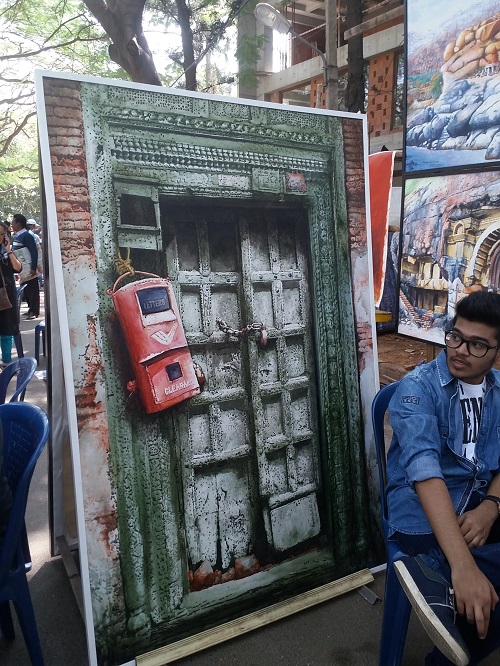
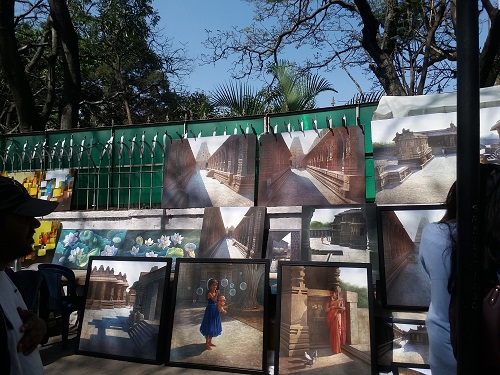
The first Sunday of January is marked down in every Bangalorean’s calendar as Chitra Santhe Day, the day when the busy Kumara Krupa Road is taken over by artists exhibiting and selling their works.
The Sunday just gone by was the 16th edition of the Chitra Santhe. About 1500 artists from 16 states of India were there, and 400,000 people visited!
As a regular visitor to the Santhe, it is something I look forward to. More than the art even, the festive atmosphere, people taking the time to look at paintings and talk about them, mothers and fathers discussing art with their children….
Grateful to the organizers and the city for this opportunity. And since it is about art, less words and some pics this time!
In school, one of the standard writing exercises in our language classes was to write a letter to the editor of a newspaper. We were encouraged to think about issues—from local to global—and express our considered opinion on the same in the letter. It was also an exercise in the proper form of address, the clear enunciation of views, and discipline of expressing what we had to say in limited words.
It was not only the writing, but also the reading of letters to editors in newspapers that was an integral part of the morning newspaper reading ritual. Over the years, it was comforting to know that the right hand column on the middle page of my newspaper would carry the day’s letters. Over time, one became familiar with some of the ‘regular’ writers, and were amused, appalled, or in silent agreement with the views expressed.
In recent times this part of the daily newspaper has been disappearing in many papers. In the age of social media, people express their views instantly, in the required number of characters. The almost knee-jerk reaction to happenings invokes an equally instant avalanche of responses. And, then, a new day begins with a fresh news-storm as it were.
Long before all this, it was a tradition of newspapers around the world to carry their readers’ opinions, thoughts, questions, and outrage on the news of the day. What is it that motivates people to write these letters? Letter writers do not receive material compensation for their efforts, but do enjoy rewards such as publicity, or satisfaction from directly or indirectly influencing public discourse. And most newspapers still honour and respect this sharing from their readers by giving them the space to be seen and heard.
Newspapers like the New York Times and the Washington Post receive thousands of letters to the editor every year. Letter writers respond to news articles and opinions, and often take the newspaper to task for how it operates. At the end of the year the Washington Post puts up on its website a selection of the novel, thoughtful and funny insights that readers submitted that year, sorted by the date they appeared in print and subject matter.
Other newspapers are also encouraging of the art of writing to newspapers. As the associate editor of an Irish newspaper puts it, “In a world where social commentary is now almost free of any kind of professional oversight — or curating, to use today’s vernacular — the letters columns of mature, honest newspapers are, as they ever were, a reliable weather vane of how a society feels on certain issues. They are a kind of a social pulse giving an insight into the health–in the broadest terms–of the nation. They are direct, from-the-heart commentary.”
The power of “Dear Sir”…is evident in the case of the letter to the Times from a seven-year old girl from the Isle of Man. It read ‘Sir, Yours faithfully, Caroline Sophia Kerenhappuch Parkes.’ The brief epistle was intended to inform readers of her unusual name Kerenhappuch which had been mentioned in a letter the previous week on the subject of uncommon 19th century names.
I for one do look forward to seeing the column back in all newspapers.
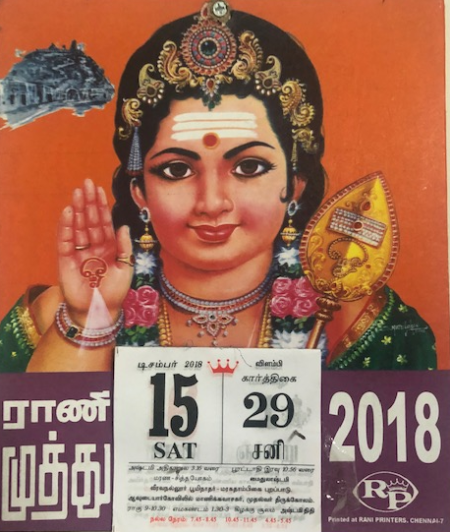
I am sure ‘Rani Muthu’ means nothing to anyone except Tamilians. But to them, it means a lot! Rani Muthu is a daily tear-away calendar, without which no Mami can operate!
It is amazing how much information a page of approx. 2.5 inches square can pack. Not only does it give the ‘English month, date’ and day, but equally boldly, the Tamil day, date and month. This is just the start. Other information includes:
Rahu kalam: This is the period of Rahu— a certain period of time every day that is considered inauspicious for any new venture.(Of course, self-respecting Tams don’t need to consult an almanac for this, they know it offhand. For the next tier of not-so-well informed, there are mnemonics like Mother Saw Father Wearing The Turban Suddenly. Too complex to explain to the uninitiated, but a breeze for the savvy ones)
Yama gandam: Yamagandam means death time. Only death ceremonies are performed during Yamagandam. Any activity commenced during this time invites the ‘death’ of the work or energies relating to that work. So activities during Yamagandam leads to a failure or destruction of the end-result.
But it is not all gloom and doom. The page will also give you:
Nalla nayram: Good time to start anything.
Festivals falling on the date (local, regional, national, pan-religious included).
Phases of the moon
Whether the day is auspicious for house-warmings, and other sundry celebrations.
Last but not the least. Quirky little illustrations enliven the pages. You have to look closely to figure them out, but it is worth it.
The size and the colour illustration on the main card board have remained unchanged for as long as I can remember (and that is pretty long!). A very benevolent pic of the God-child Subramanian is a pleasant sight to look at first thing in the morning.
Sadly, I could find no reference to the history of the Rani Muthu. And, as journalists say, e-mail to the concerned did not get any response till time of publication. A senior uncle says it goes back at least to the ‘50s.
Rani Muthu is a Tamil household essential. Many regions and states in India have their own calendar-almanacs, which are as basic to a home as a threshold.
What would life be without Rani Muthu!
–Meena
Scrambling to buy a Rani Muthu by Jan 1 was one of my year-end tasks. Alas, with the passing of my mother, this is one more ritual that I will no longer undertake.
As an “arts” student with two “science type” sisters I was always somewhat awed by the way they used to reel off the scientific names of plants, animals, and later in medicine. The names sounded like tongue twisters and I was most impressed at how they managed to remember these.
In a later avatar as environmental educator, I myself had to explore and discover the until-then mysterious realm of taxonomy and nomenclature. Over time I found that I was myself as easily saying Azadirachta indica and Phyllanthus emblica instead of neem and amla!
As an explorer of words I found it equally, if not more, fascinating to find out just how and why the flora and fauna got their scientific names. It appears that the first person to name, describe, and put an example of the species into a museum gets to name it. The name only gets changed if scientists learn something about the species evolutionary history to make them change the name.
How does this work? The International Commission on Zoological Nomenclature (ICZN) founded in 1895, provides the standard framework, and regulates a uniform system of zoological nomenclature ensuring that every animal has a unique and universally accepted scientific name. As long as it is within the guidelines of the International Code of Zoological Nomenclature and with no offensive wording, we can even have insects and butterflies named after our favourite teacher or parent! There are similar commissions for other areas like Botany and Entomology.
Since the scientist who discovers a species gets the right to name it, some scientists try to follow the traditional practice of incorporating an organism’s characteristics into its name, others give up and try something else. Scientists may be serious people, engaged in the pursuit of objective truth. But when it comes to naming species, they often let their hair down. There are species named for body parts and bodily functions, for celebrities, painters and writers, for cartoon characters and favourite sports. There are the literal as in Egretta egrettoides (literally, “egret that looks like an egret.”) There are creatures from Aa to Zyzzyx. There are the palindromic names Ababa and Xela alex.
Here are some really fun ones!
Aha ha:An Australian wasp named by entomologist Arnold Menke The story goes, Menke was in a debate with another research group over the validity of the species, and when he finally provided the definitive evidence, he exclaimed, “Aha ha!”
Ba humbugi: When scientists discovered this snail on the remote Pacific island, they opted to name him after the crankiest man in literature, Ebeneezer Scrooge whose trademark sneer was “Bah humbug”.
Ittibitium: Bittium is well-known genus of small sea snails and mollusks that are found all across the globe. So what name did scientists choose when they discovered a genus of mollusks even tinier than these? Ittibitium!
Ekrixinatosaurus calvo named “explosion-born lizard”because its bones were discovered during construction-related blasting.
Kamera lens: Although its discovery goes back to 1773, little was known about this single celled organism until 1991 when scientists must have thought, “Hey, we should use a camera lens to see this species better.”
It’s not scientists who have all the fun! Sometimes the naming rights for a new species are auctioned for a cause. Most recently the naming rights for a newly-discovered 10 cm amphibian were auctioned to raise money for the Rainforest Trust. The slippery little creature, found in the rainforests of Panama is blind, and likes to bury its head in the ground. Aidan Bell, co-founder of EnviroBuild, a sustainable building company, paid $25,000 for the right to name the creature after no other than President Donald Trump!
And what was his choice? Dermophis donaldtrumpi!
“Burrowing [his] head underground helps Trump when avoiding scientific consensus on anthropomorphic climate change […] Dermophis donaldtrumpi is particularly susceptible to the impacts of climate change and is therefore in danger of becoming extinct as a direct result of its namesake’s climate policies.”
The scientists who made the discovery have agreed to use the name Dermophis donaldtrumpi when they officially publish the discovery in scientific literature.
Winter is the season of Doctor’s conferences in my city, when super specialists of many branches of medicine meet to discuss professional research and new developments. Among these are many women who are working shoulder-to-shoulder with their male counterparts. It is difficult to imagine that just over 150 years ago, a woman doctor was unheard and undreamt of. This reminder was strongly communicated in a recent performance that traced the life of India’s first female doctor–Anandibai Joshi.
Anandibai Joshi is known to be the first woman of Indian origin to graduate with a degree in medicine in the US. Her story of grit and determination is an inspiration, and a trailblazer.
Born in 1865 as Yamuna, the third unwanted daughter, she was married off at the age of nine to a widower postal clerk 20 years her senior. Her husband Gopalrao took charge of her life by first changing her name to Anandi; but also encouraged her to study, which was unusual for that time. Anandi was a bright and curious girl-child, balancing between her innocence, her thirst for learning and her expected chores and role as ‘wife’. She became a mother at the age of 14, but lost her 10-day old child due to lack of medical care and facilities. Traumatised by this event, she began to dream the undreamable– to become a doctor so that she can help other women like herself. In a time when a girl going to school was spat at, and looked upon with intense disapproval, Anandi was supported to some extent by her husband.
Even more unusual is the story of how she reached America. A letter written by Gopalrao to an American missionary asking if Anandi could study medicine in America, was published in some American magazines, where a woman called Theodicia Carpenter read it and wrote to the young girl with an offer of a home and support if she were to go to New York. Against opposition from all quarters in India, Anandi embarked upon this journey into the unknown, reaching New York after an arduous two-month ship voyage. Once she reached, with support from her mentor Theodicia, Anandi Gopal Joshi applied to the Women’s Medical College of Pennsylvania and was granted admission at the age of 19. Medical school and life in an alien land was extremely difficult; but Anandi met the challenges head on—the extreme cold weather (she changed her attire from the traditional nine-yard sari to the six-yard one), the food (at one point she became so nutritionally deficient she had to start eating eggs), very poor health, loneliness, hostile classmates and neighbours, and nasty letters from her suspicious husband. Anandi persevered towards her goal and got through medical school, graduating in 1886. She returned to India the same year and was appointed as the physician-in-charge at the Albert Edward Hospital in the then princely state of Kohlapur (in present day Maharashtra).
Tragically, before she could finally make her childhood dream come true, by practising as a doctor, Dr Anandi Joshi died of TB in 1887, just over a month before her 22nd birthday. As per her wish, her ashes were sent to Theodicia Carpenter, who placed them in her family cemetery in Poughkeepsie, New York.
The true-grit story of Yamuna/Anandi was brought to life in a solo performance by Manasi Prabhakar Joshi. Titled Dr Anandibai this powerfully transposed the story of the path breaker in the context of the challenges that women face even today—reminding us that while on the one hand much has changed, on the other, much remains the same. Anandibai’s story continues to remain an inspiration and a beacon.
The disabled are often called the most ignored minority.
2011 Census reports indicate that there are about 2.68 crore disabled people in India–2.21% of the population. But NGOs and others who work in this field feel that this is too conservative an estimate. According to them, the figure is more like 5-8% of the population. World Bank data suggests the number is between 4 and 8 crore. And this is expected to increase steeply, as age-related disabilities grow and traffic accidents increase.
The most tragic part of this is that many of the disabilities in our country are preventable. A large number of mental and physical disabilities arise from lack of nutrition and proper health care for pregnant mothers and young children. Many irreversible disabilities are linked to poor nutrition of the mother—e.g., anemic conditions. Similarly deficiency of Vit. A in childhood may lead to blindness; deficiency of iodine may lead to mental retardation. Similarly, immunization coverage and disabilities are clearly correlated.
If infants and the very young are vulnerable, so are the old. Over 23% of visual impairment in India is due to cataract—a normal phenomenon associated with aging, and one which is correctable. But thousands in our country live without vision because they cannot access or afford the simple surgery required.
Other statistics which should disturb us: Close to 40% of school age children with disabilities are not in school. If the children do not go to school, they can never hope to be employable. This feeds the poverty-disability cycle.
In India, figures indicate that the number of disabled in employment actually fell between 1991 and 2002! Though there is legislation for 3% reservation in government sector, this is seldom fulfilled. And how can it ever be, if the disabled don’t get an education? If public transport and offices are not accessible to the disabled? If our own attitudes prevent us from employing the disabled?
On paper we have laws and policies for inclusivity in education, for reservation in jobs, for access to public spaces, etc., etc. But on the ground, there is little happening. The first barrier is in our minds—if we can truly accept that there are no ‘disabilities’, only ‘different abilities’, we may be able to see our way to building a more inclusive society. Just as I can’t sing, there are some who cannot speak! Just as I can’t dance, there are some who cannot walk! I don’t think of myself as any the less because of these lacks. Why then should I think of people who cannot speak or walk as different?
We need to translate attitude to action: Check if your child’s school has a policy for inclusive education, and if there are indeed differently-abled children. If not, gently bring it up in the next PTA meeting. Encourage your ward’s school or college to have traffic education sessions. Ensure that your own ward does not break traffic rules. Check your organization’s employment policy to see if there is anything about employing differently-abled people. If not, lobby for it! Spread the message for proper nutrition and immunization for pregnant women and young mothers. Support cataract operations through service organizations. Write to the managers of public spaces if they do not provide disability access.
Each of us may take a different route. But go on, make a resolve to make small difference on the 3rd of December!
The word of the year is Toxic! Crowned by the Oxford Dictionary this word was selected as the one “judged to reflect the ethos, mood, or preoccupations of the passing year, and have lasting potential as a term of cultural significance.”
The claim to fame was gained by the word not only on the basis of the number of times it was searched, but more for the sheer variety of contexts in which it is being used today. “Toxic” has been used to describe workplaces, schools, relationships, cultures, and most recently has become a keyword in the #MeToo movement.
My own association with the word dates back over 30 years when I started as an Environmental Educator. We used the word mainly in the context of something that poisoned the natural environment—air, water, flora and fauna. This was based on its dictionary definition as meaning ‘poisonous’, with its roots derived from the medieval Latin term toxicus, meaning poisoned or imbued with poison. Environmental Educators worldwide tried to create awareness about what makes things toxic and how this affects the environment—through ‘gloom and doom’ scenarios, through motivation and action, and even through humour!
An interesting example of the last one was a limerick competition run by the English newspaper The Observer in association with the Friends of the Earth inviting limericks that reflected the (then) toxic state of the environment. The competition was open to all, from ages 5 years and up!
Although this was almost 30 years ago, on revisiting these limericks, I felt that they are as relevant today (if not more, than ever before!) Here is a taste…
Said the seal to the salmon and otters,
Did God really design us as blotters,
To mop up the oil
From the sea and the soil
Spewed out by those corporate rotters?
When politicians say they are green
One wonders what they really mean,
For all their hot air
Only rises to share
In the Greenhouse Effect it would seem!
An ostrich from a tropical land
Once buried his head in the sand.
The move was a riot,
They all had to try it—
Evading the issue was grand!
Fast forward to 2018. Has anything changed? At least not for the better, alas! The word has simply exploded in scope and toxicity. As Oxford University Press’s president of dictionaries, said: “Reviewing this year in language, we repeatedly encountered the word ‘toxic’ being used to describe an increasing set of conditions that we’re all facing. Qualifying everything from the entrenched patriarchy to the constant blare of polarising political rhetoric, ‘toxic’ seems to reflect a growing sense of how extreme, and at times radioactive, we feel aspects of modern life have become.”

 Scientists in Israel say they will find the definitive cure to cancer within the year. Who would not like to believe this? Who is there today who has not lost someone to cancer– a family member, a friend, a colleague?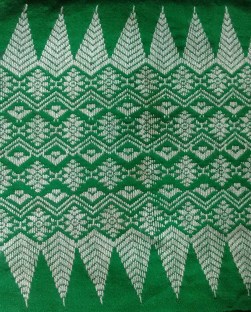
 The Sunday just gone by was the 16th edition of the Chitra Santhe. About 1500 artists from 16 states of India were there, and 400,000 people visited!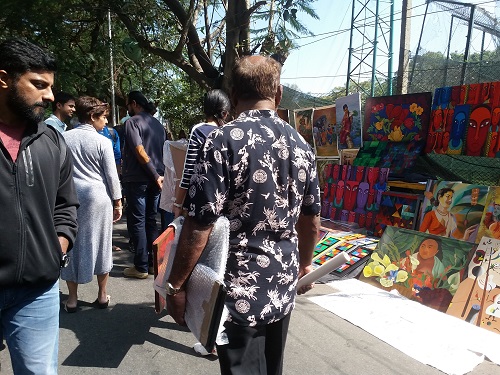
 It is amazing how much information a page of approx. 2.5 inches square can pack. Not only does it give the ‘English month, date’ and day, but equally boldly, the Tamil day, date and month. This is just the start. Other information includes:
 Millennial Matriarchs