
22 April 1970 saw what, at the time, was perhaps the planet’s largest civic event. Millions of American citizens took to the streets, college campuses and hundreds of cities to protest environmental ignorance and demand a new way forward for our planet.
“Earth Day” as this event was dubbed, was a unified response to the numerous environmental crises that engulfed the world in the 1960s—oil spills, smog, polluted rivers, and newly exposed dangers of pesticides.
2020 marks 50 years since what was considered to be the trigger that launched the modern environmental movement. In the five decades since, much has transpired and much has changed for, and on, planet earth. Despite all the noble intentions, movements and efforts (which I have also been a part of for three decades), the planet seems to have been damaged beyond limits, plummeting in recent times into an uncontrollable downward spiral. Poisoned waters, toxic air, melting ice, disappearing forests and vanishing wildlife have become so much a part of the daily news that we have become inured. Worst still, we continue to pretend that all will be well—after all man is the master of technology, and we will find the answers.
It has taken 50 years for Earth to have gotten a respite from human interference. Ironically, this has been given by an invisible, seemingly indestructible microbe.
Almost a hundred years ago, pioneering environmental philosopher John Muir wrote “The universe would be incomplete without man; but it would also be incomplete without the smallest transmicroscopic creature that dwells beyond our conceitful eyes and knowledge…”
In the three months since this ‘creature’ has sent us scurrying for shelter, and changed the world as we know it, the earth is changing too. It is coming back to life.
The theme for this year’s Earth Day was Climate Action and events were planned to draw attention to the critical need to take action to combat climate change. Ironically, what a hundred conferences did not do for climate change, is happening today simply without human activity.
When I read about the revised suggested activities for a house-bound Earth Day it made me wonder though! All the activities were digital– webinars, online learning, nature videos, teach-ins and make-ins, and more. Everything that called for virtual interaction through digital media. What a paradox! What a missed opportunity to open windows and minds to the world outside. Some thoughts on this.
A lot is being written and shared about windows and balconies. W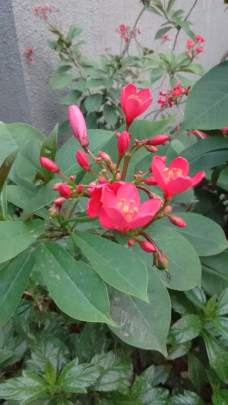 hile these are great to reach out to other humans, they are also a wonderful opportunity to be inside looking out, at nature. One does not have to be in the countryside to see Nature. Even in the midst of the urban jungle, look from the same balcony or window, and you will discover—a bird, a butterfly a bumblebee, a spider. A patch of sky and a puff of cloud. The branches of a tree with fresh green leaves, a bird call, a shaft of sunlight on a wall, or the stars on a clear night.
One doesn’t have to be outdoors to do one’s bit for Earth day. Just making time to stop and stare is as much a contribution as a ‘run for earth marathon’.
And why make Earth Day just a one-day celebration? Even in 1970, the entire month was marked by events and it came to be called Earth Spring.
In these unusual times, let us be grateful for Nature which is never in ‘shutdown’! Come let us celebrate every moment, every day of our Earth Spring.
–Mamata
 But that is not the subject of the blog today. April 25th is marked as World Penguin Day, and that is the occasion of the blog. This day coincides with the annual northern migration of Adelie penguins.
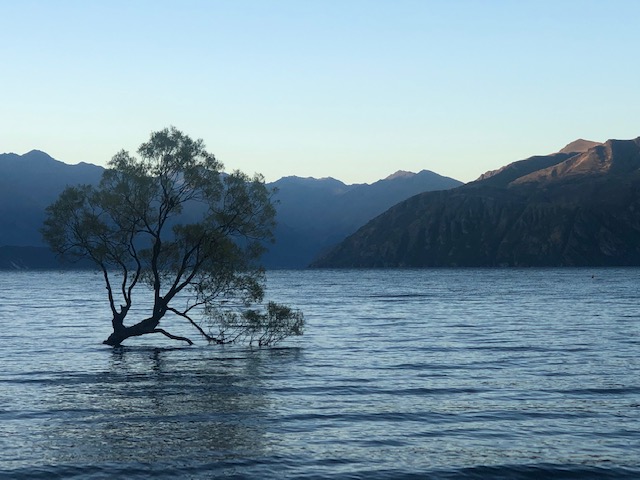 The connection is a tree that is reputed to be the most instagrammed tree in New Zealand, almost a symbol of NZ tourism. On a recent trip there, we were urged to set aside time to see the tree, specifically around sunset. So we worked around our program to ensure we got to the spot—a stretch of a beach—well ahead. We drove past a few times, keenly looking at the beach. We could see some people, but nothing special in the way of trees. We asked natives and tourists alike, and they all pointed us to the same area which our GPS had shown us, and which we had passed, looking in vain for a landmark. We decided to make our way down to the beach anyway. Lo and behold, there were many, many people there, jostling for some spot (we could not figure out what the spot was for), all setting up professional looking camera equipment. It came to a pass when we had to ask a friendly-looking lady what everyone was waiting to photograph, where the famous tree was, and what it was about. She kindly pointed to this spindly willow tree, standing a few feet into the waters of the beautiful Wanaka Lake, against a beautiful background of majestic mountains. But the tree itself? In my mind, this will forever define and exemplify ‘under-whelming’. ‘Why is the tree famous’, we asked many around us in bewilderment. While there was some story of how it was part of a fence and had survived in the water for several years, the general consensus was that it was famous because it was famous! So famous , it even has its own insta handle #ThatWanakaTree.
 d midwife spent in the poor slums of the East End of London. 23 years old and newly qualified she lived and trained as a midwife with a dedicated group of nuns St Raymond Nonnatus.
 ay of Hans Christian Anderson one of the best known children’s writer who was born on 2 April 1805 in Denmark.
 Pencil sketch, V. Raghunathan, using 3B and 4B pencils. 1980.
 to Eureka moments, ideas keep our little grey cells ticking away. Sometimes we let these slip away because we are preoccupied with what we feel are more serious or important matters, and sometimes because we feel that the ideas is too inane to pursue.
 Millennial Matriarchs