No, let me hasten to clarify that there is no such Day. But there is indeed a World Toilet Day which is observed on 19th November every year, and ‘celebrates toilets and raises awareness of the 4.2 billion people living without access to safely managed sanitation’. The Day is about taking action to tackle the global sanitation crisis and achieve Sustainable Development Goal 6: Water and Sanitation for all by 2030.
Well, if we were to ‘celebrate toilets’ as urged in the mission, I would advocate for a lovely little book called ‘Toilets of the World’ by Morna Gregory and Sian James, and published by Merrell Publishers.
The book begins with a very brief History of Toilets which is followed by a continent-wise round-up of interesting toilets. The beautiful colour plates are themselves an education of how creative photographers can make art out of not conventionally photogenic items!
Here are some interesting nuggets of information from the book.
- The oldest known flush toilet is that of the palace of Knossos on the island of Crete, dating back to 1700 BC.
- Solid waste generated by astronauts in space is compressed into round, flat discs and brought back to earth. NASA’s toilet engineers refer to them as ‘people patties’.
- Toilets on board ships are referred to as ‘heads’.
And here are some toilets mentioned in the book which caught my attention for their ‘extreme’ qualities:
Keith Siding Road, Crandon Wisconcin: Someone as part of their garden decorations has put up an outhouse with the sign ‘Up North Rest Stop’. The door of the facility is open, and on the toilet sits a life-like lady in full view of the road, using the facilities!
Incahuasi Island, Bolivia: In the middle of 12000 sq. km. salt desert is a toilet carved from the trunk of dried cactus, with the needles removed to allow for comfortable seating.
30-Gold Store, Kowloon: This gold washroom put up in his shop by a Hong Kong jeweler is down in the Guinness Book of Records as the most expensive washroom. Fixtures, sinks, toilet brushes, toilet paper holders, all are made of gold.
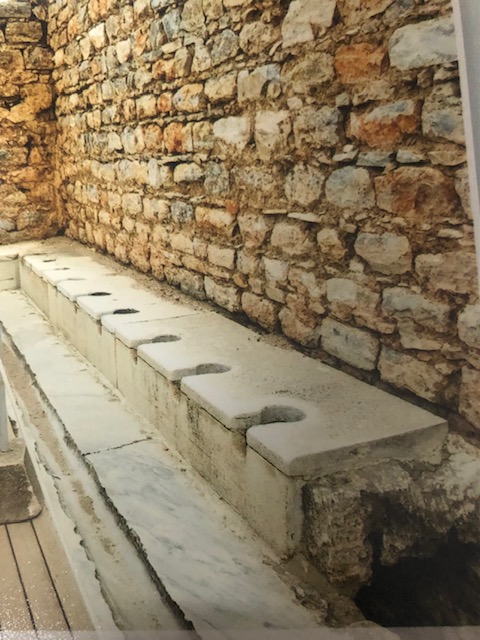
Ancient Roman City, Ephesus, Turkey: Built around 200 AD, these communal pay-and-use marble latrines were for men only, and were a place for social gatherings and where many business deals were struck. Slaves used to come in early to literally warm the seats so that their masters did not feel the chill of the marble on their bottoms. There are many other yucky details, which I will refrain from sharing. (The picture is from an unforgettable family trip there.)
For more interesting information on toilets, the place to visit would of course be the unique Sulabh International Museum of Toilets at New Delhi, which, to quote the museum website ‘has a rare collection of facts, pictures and objects detailing the historic evolution of toilets from 2500 BC to date. It provides a chronological account of developments relating to technology, toilet related social customs, toilet etiquettes, prevailing sanitary conditions and legislative efforts of different times. It has an extensive display of privies, chamber pots, toilet furniture, bidets and water closets in use from 1145 AD to the modern times. It also has a rare collection of beautiful poems related to toilet, their usage.’
In India, where close to half the population does not have a toilet at home, and where no ‘nudge’ or carrot or stick or government slogan seems to work towards reducing open defecation, every day has to be Toilet Day, and every person a Toilet Warrior!
Let’s get Vocal for Local Toilets!
–Meena
PS: I had borrowed this book from a dear friend David Foster and hope to meet him soon to return it.
PPS: Photo credit: Ashok Seshan