
Continuing our celebration of path-breaking women this month. Through history, women have often been denied rightful recognition for their contribution in different fields. In STEM, their significant work has been eclipsed by the attention and glory garnered by men. While many of these female scientists and researchers are equally present in labs, they tend to lose visibility as their achievements advance. These achievements have been ignored, minimized, or credited to men.
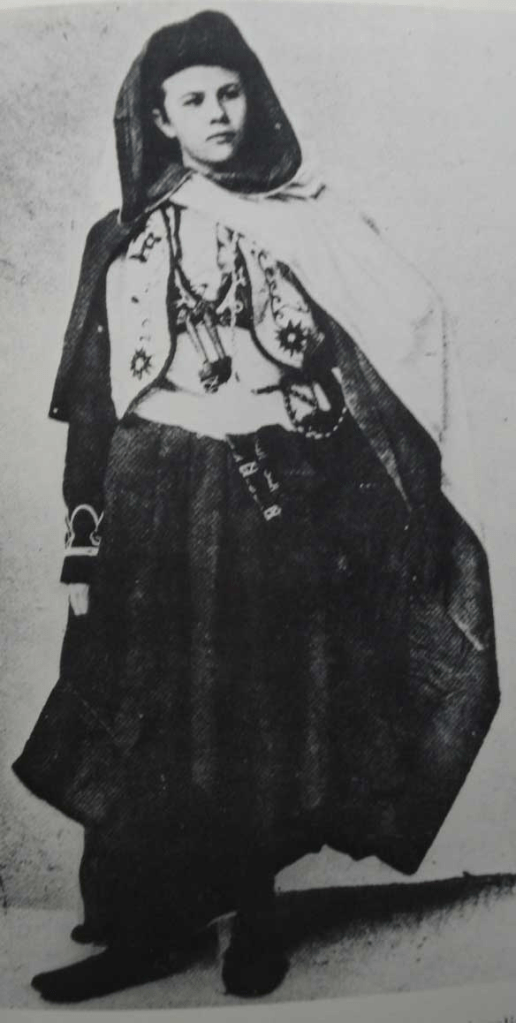
There is another band of women, who have had to make efforts to disguise their real persona in order to pursue their passions. This has been the story of several women who have stepped into what is traditionally considered a ‘male domain’. Among these are women explorers who have boldly ventured into dangerous terrains on perilous missions; women who broke conventional barriers in more ways than one.
One such story is that of Isabelle Eberhardt—journalist, writer, explorer-adventurer, and rebel. Today she would also be identified as ‘feminist’.
Isabelle was born in February 1877 in Geneva, Switzerland. Her mother Nathalie was the daughter of a German and a Russian Jew. There is some uncertainty about Isabelle’s real father, but she always considered her mother’s husband Alexandre Trophimowsky as her father. Isabelle was taught by Alexandre, who was a tutor. She studied philosophy history and geography, and also learned many languages including French, Russian, German, Italian, Latin, Greek, and classical Arabic. She loved literature and read a great deal. Alexandre had liberal views and gave her a lot of freedom to explore, and develop, her own personality.
When she was 17 Isabelle started correspondence with a French officer in the Sahara desert wanting to know, in detail, all about life there. This triggered in her the yen to explore for herself. In the meanwhile, based on her correspondence, she began to write short stories about the region under a male pseudonym Nicolas Podolinsky. These were published in a magazine. By now Isabelle was eager to see and experience for herself.
She met a photographer from Algiers who offered to help her move to Algiers. In May 1897 Isabelle and her mother moved to Bone in Algeria. Isabelle was 20 years old. Both mother and daughter were distressed by how the colonial Europeans treated the local Arab population. They rented a house in the non-European part of town. This was an area where women were not expected to go out alone or without a veil. So Isabelle started wearing a burnous and a turban (the dress worn by the local men). She quickly became fluent in Arabic. She and her mother also converted to Islam. Isabelle found it easy to accept Islam because she believed in fate, and Islam gave meaning to this belief. Isabelle’s unusual lifestyle caused the French colonial settlers and officials to suspect her of being a spy.
Isabel converted her observations and experiences into fictional stories, some of which were published. Her mother’s death in the same year that they had moved to Algiers, was a great blow. She returned for a while to Geneva to look after her sick father. After he died, she mortgaged the family property and returned to Africa in 1900, and began to lead a nomadic life. She wandered restlessly in North Africa, usually alone, writing her diaries, stories and travelogues. To freely experience everything as a native would, she wore only male clothing, joined a local Sufi group, and even changed her name to Si Mahmoud Saadi. During her travels she met and fell in love with an Algerian soldier Slimane Ehnni. This heightened the suspicion of the French authorities. Isabelle continued to court danger; she was attacked and severely wounded by a man with a sword. She was ordered by the French to leave North Africa, and went back to France where she could barely make ends meet by working as a dock worker, disguised as a man. Meanwhile she continued with her writing.
A friend introduced her to Eugene Brieux, a writer who supported Arab freedom. He tried to publish her stories, but there was no market nor support for pro-Arab stories. The only ray of light was when Slimane Ehnni was transferred to a military unit near Marseilles. They did not need permission to marry in France, and the two married in 1901. The next year, her husband left the army and the couple returned to Algeria.
Back in Algeria she started working for the Al-Akhbar newspaper. Her novel Trimardeur also began to appear in parts in the paper. She worked hard, but only when she felt like it; and spent all her money on tobacco, books, and gifts for friends. She travelled for long periods on assignments.
Isabelle continued to lead an erratic life, travelling in perilous conditions; she indulged excessively in drink and drugs. But amid all this, her writing still occupied a central part of her life. Her articles and short stories appeared in the local press, and for a while she also wrote a regular column on the customs of Bedouin tribes. In 1903 when reporting on a battle she met the French general Hubert Lyautey, and helped him communicate with the local Arabs because of her fluency in Arabic.
Isabelle’s nomadic and often promiscuous lifestyle took a severe toll on her mental and physical health. By 1904 she was so spent and weak that she was admitted to a military hospital in Ain Sefra. Some weeks later she discharged herself, against medical advice, to meet with her husband who she hadn’t seen for almost a year. The very next day the town where they had rented a mud house was struck by a flash flood. Isabelle was missing. General Lyautey ordered a search; Isabelle’s body was found later, pinned under a beam of the house, and surrounded by the soggy pages of her latest manuscript. Isabelle was buried in Aïn Sefra with a marble tombstone with her adopted Arabic name and her birth name in French. Isabelle was only 27 years old; an untimely end to a short and tumultuous life.
The General tried to collect as many of Isabelle’s unpublished writings as he could manage to find. These were later published. Her first published story after her death, Dans l’Ombre Chaude de l’Islam (In the Warm Shadow of Islam), was highly praised in 1906. This book made Isabelle famous as one of the best writers about Africa. Streets were named after her in Béchar and Algiers.
Today Isabelle is perceived as an early feminist and anti-colonialist. In her own time, she was simply a woman ahead of her times—adventurer, chronicler, gender bender, and one who lived on her own terms.
–Mamata

 Millennial Matriarchs