
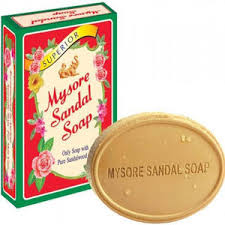
A recent advertisement for an old soap in a new packing brought back many memories. Any visit to South India, or to the erstwhile Mysore Emporium in Delhi always included picking up several cakes of Mysore Sandal Soap. These were good gifts for friends, and a special treat for us to use. The rich fragrance of sandalwood was very different from the light flowery fragrances like rose and jasmine that Lux, Cinthol and Rexona, the other popular soap brands of those days had, nor the medicinal smell and feel of ‘healthy’ soaps like Margo, Hamam and Lifebuoy. While Pears soap was a high-end soap that had a very English look and feel, Sandal Soap was regally Indian; sandalwood signalled luxury, and bathing with such soap made one feel like a princess!
It is only recently that I also learned about the fascinating history of this soap.
The saga goes back to the First World War.
But going back further, the kingdom of Mysore was the largest producer of sandalwood in the world. In the 1700s the largest buyer of sandalwood from Mysore was China, where the wood was used to make furniture for the affluent and also used in traditional medicine. In the early 1800s Germany became one of the main buyers of sandalwood for its oil. The Germans already had the know-how for distilling the oil from the wood. At that time Mysore was under British administration; sandalwood was a state monopoly. By the end of the 1800s the demand for sandalwood had risen considerably and it became an important source of public revenue. The demand continued to grow when the British restored the state of Mysore to the ruling Wadiyar dynasty. Sandalwood auctions were held which were attended by representatives of leading international perfumery houses. The process of sandalwood distillation to manufacture oil had, by then, been mastered by German chemists.
The outbreak of World War I in 1914 caused huge disruptions in international trade. Sandalwood exports to Germany were suspended, local auctions of the wood were stopped. With large stocks of sandalwood piling up, and no buyers, the revenue of Mysore State was adversely impacted. The Maharaja of Mysore realized that if the oil from the wood could be distilled to meet international standards, the extract could be exported. This it would be easier than transporting wood, and more lucrative. This was smart thinking!
For the execution of the idea the Maharaja selected Alfred Chatterton who had been principal of the college of engineering in Madras, and appointed him as the Director of Industries in Mysore state. Chatterton teamed up with two English chemistry professors from the Indian Institute of Science in Bangalore to experiment with distilling sandal oil in a lab. After extensive experiments and trials, the team finally discovered the right process to extract sandal oil. They continued to refine the process until they created a product that would meet international standards. Now it was time to move from the lab to a larger scale of production.
A factory, headed by Chatterton, was opened in Mysore. It was called the Mysore Sandalwood Oil Factory. Production began, and by 1916, high-quality sandalwood oil was being produced and exported to London. A second factory was opened in Bangalore, adding new equipment and machinery, and soon a third larger factory opened, also in Mysore. Chatterton remained Director for six years during which time he established what was then the largest sandal oil distillery in the world.
Mysore retained a near monopoly in the sandal oil market until about 1930, when it was challenged by Australian sandalwood oil.
Until then the oil was used primarily in perfume making. But a foreign guest presented the Maharaja of Mysore Krishnaraja Wadiyar IV with a pack of soaps made by using sandalwood oil. Ironically the oil used for the soap had been produced in Mysore! The Maharaja saw an opportunity and discussed this with his trusted and foresighted Dewan Sir M. Visvesvaraya. Both of them were keen to encourage industrial development in the state. They agreed that manufacturing sandalwood soaps would provide such an opportunity. Visvesvaraya was a perfectionist; he wanted that the soap should be of the best quality, but also not so expensive that its market would be limited. He invited technical experts from Mumbai to start experiments on the premises of the Indian Institute of Science (IISc) in Bangalore. He also identified a researcher working in IISc. This was SG Shastry who had obtained a degree in Industrial Chemistry from England. Now he was sent to London to get advanced training in soap and perfume technology. Upon his return with the knowhow to incorporate pure sandalwood oil in soaps, the Maharaja set up The Government Soap Factory near Cubbon Park in Bangalore, and here began production of India’s first sandal soap. The first batch of soaps was produced in 1918. It was simply called Mysore Sandal Soap. The same year, another oil extraction factory was set up at Mysore to ensure a steady supply of sandalwood oil to the soap making unit.
But how was this new soap to stand out among the many soaps already in the market? SG Shastry proved to be as astute a marketer as he was a chemist! All the other soaps then were traditionally rectangular in shape and usually wrapped in colourful paper. Shastry felt that this soap should reflect its cultural heritage. To start with, this soap was oval in shape. In its centre was embossed the logo of the factory which depicted Sharaba, a mythological creature which had a lion’s body with an elephant’s head. This creature stood for wisdom strength and courage, which also represented the philosophy of Mysore state. It was felt that the soap needed to be dignified with a unique packing. The aromatic soap was first wrapped in white tissue paper, as a piece of jewellery would be, and then placed in a rectangular box printed with floral designs in tasteful colours. Every box also carried the printed message Srigandhada Tavarininda (from the maternal home of sandalwood).
The next step was marketing this soap as a unique product. The soap was advertised through different channels—neon signboards, half page ads in major newspapers, and even match boxes and tram tickets with pictures of the soap carton. The promotion extended overseas. An exhibition was arranged in England; the soap was ceremoniously presented to Queen Victoria who liked the fragrance and ordered more for her family. A mark of its popularity was that its competitors used to mock it as My-sore soap! Meanwhile the soap was becoming a household name in Mysore.
The Mysore Sandal Soap has retained its popularity, and its niche as the first indigenous sandal soap with Sandal Note as its fragrance, along with other essential oils. Today the soap is manufactured by the company called Karnataka Soaps and Detergent Ltd (KSDL). In 2006 the brand received a GI (Geographical Indication) tag. It remains an iconic symbol of majesty and luxury that can be enjoyed by all.
–Mamata

 Millennial Matriarchs