
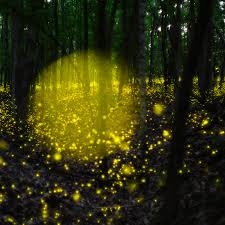
Poets have celebrated them, children have been awe-struck by their magic, scientists have not yet unravelled all their mysteries …These are fireflies that glow and twinkle in the dark of the night, like the stars come down to earth.
What makes a firefly? The ‘fly’ part of the name is misleading as these insects are not flies but soft-bodies beetles.
The ‘fire’ in the name is more self-explanatory. It comes from the flashes of light that these insects naturally produce. This phenomenon is called bioluminescence. It is caused through a chemical reaction by two enzymes in a firefly’s tail: Luciferin which is heat resistant and glows under the right conditions (in Latin the word Lucifer means ‘light-bearing’), and luciferase, an enzyme the triggers light emission. The two enzymes combine in the presence of magnesium, oxygen and ATP (Adenosine Triphosphate), to emit light.
This bioluminescence in fireflies is nearly 100 per cent efficient, in that very little energy is wasted to produce their light. By contrast, in an incandescent light bulb 90 per cent of the energy is lost as heat. Because it produces no heat, scientists refer to firefly lights as “cold lights.
Like most insects, fireflies have four life stages — egg, larvae, pupa, and adult. Their average lifespan is around two years, most spent of this is spent as larvae. But fireflies emit light at all stages of their life. Their tiny eggs glow in the darkness underneath leaf litter; the worm-like larvae glow as they crawl around the forest undergrowth, and the adults shine as they fly around among the forest foliage.
Scientists believe that fireflies evolved the ability to emit light to avoid predation, warn predators (like bats, birds, and toads), and signal that they are distasteful. Fireflies release drops of toxic, foul-tasting blood, and their light is an early warning that keeps predators away.
Over time, adult fireflies began using this ability to emit light as a mating signal. Every firefly species has a unique flash pattern, much like Morse code. When a male firefly wants to communicate with a female firefly, he flies near the ground while he flashes his light every six seconds. Once he’s near the ground, a female can more easily tell if he’s from the same species as she is. (Most female fireflies can’t fly.) She answers his flashes by turning on her lights. Then the male finds her. That’s how males and females of a species identify each other and mate.
After the twinkling courtship, an adult firefly lives only long enough to mate and lay eggs in the soil or on aquatic plants. The larvae hatch in around 25 days. The larval form lasts two months to over a year (depending on the species), before becoming adults and giving birth to the next generation. The larvae eat snails, worms, and slugs, which they inject with a numbing chemical to disable. An adult firefly’s life span is just one to three weeks. Not much is known about what the adults eat; they may feed on plant pollen and nectar, or they may eat nothing.
Presently there are about 2,000 firefly species globally, although there may exist many more which are not yet known to science. They are found on all continents except Antarctica, and inhabit a wide range of habitats: forests, grasslands, marshes, coastal mangroves, and even vacant plots and city parks which meet their two important requirements: adequate food for their larval form (slugs, snails and small insect larvae), and darkness so that adult fireflies can use their light signals to find mates. At least 50 species have been reported in India, distributed across the country.
Fireflies have been on earth for at least 100 million years. Sadly in this anthropocene epoch firefly populations are in decline. This is because the natural habitats where the adults fly and mate are destroyed or degraded, the pesticides in agriculture fields kills firefly larvae and the insects that they depend on for food. Artificial lighting from streetlights, buildings and vehicles creates light pollution and wipes the darkness that is necessary for the firefly’s signalling during mating season.
A recent year-long study carried out by Tamil Nadu Forest Department’s Advanced Institute for Wildlife Conservation (Research, Training and Education) about the insect’s genetic diversity, distribution, habitat and their ecology, and seasonal changes in population, as well as the environmental conditions at ten different locations within the Annamalai Tiger Reserve identified at least eight distinct species within different micro habitats. The studies aimed to understand the health of the ecosystem and develop strategies to conserve firefly habitats.
The study reinforced the concern that human activities, especially those that create a lot of artificial light (headlights, floodlights from religious festivals, and even the glow of mobile phones) in buffer areas around protected areas are adversely affecting fireflies. This affects synchrony, the phenomenon where thousands of fireflies flash in unison and which is an ecological marker, an indicator of habitat health.
At the same time there are also opportunities for non-scientists to enjoy the pure magic of firefly illumination at some places in Maharashtra which hold Firefly Festivals in May-June every year. Two of these are in Bhandardara (Kajwa Mahotsav) and Purushwadi.
But one can always be on the lookout for even a little spark of the magic in a dark park or garden (even your own) between May to July when adult fireflies emerge. And if you are lucky enough to spot fireflies you can become a citizen scientist by becoming a part of FireflyWatch (https://citsci-india.org/projects/project/fireflywatch/)
–Mamata

 Millennial Matriarchs