
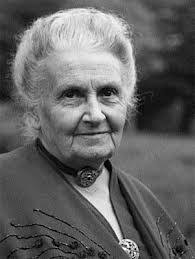
Montessori is a word much-used today in early education and there is an explosion of what are self-described ‘Montessori’ schools. These are often housed in modern buildings, equipped with a surfeit of the latest ‘equipment’, and accordingly charging high fees. Perhaps not many of the parents who rush to book admission for their child in such a school, almost as soon as it is born, may know much more about Montessori than the name.
The original story behind the schools, and the name that distinguishes these schools is very different. It is the story of Maria Montessori an educator, scientist, physician, innovator, philosopher, feminist and humanitarian.
Maria Montessori was born on 31 August 1870 in Chiaravalle, Italy, the only child of Alessandro and Renilde Montessori. Her parents moved to Rome when she was five years old. A curious, strong-willed girl, Maria, from a young age took paths that defied the norms of her times. After completing high school, instead of going in for teaching, a conventional occupation for girls at the time, she applied to medical school but was refused admission. So she enrolled in the university where she studied physics, mathematics and natural sciences; and reapplied to medical school. She was eventually admitted in 1890, one of the first women in medical school in Italy. In the face of many obstacles because of her gender, Maria qualified as a doctor in 1896. She was also beginning to get involved in the movement for women’s rights.
As a practising doctor Maria became known not only for her skills in treating patients but equally for working with the poorest, and the respect she showed to patients of all social classes. She also joined as a volunteer for a research programme at the psychiatry clinic of the University of Rome, where she became deeply interested in the needs of children with learning disabilities. She went on to become co-director of a new institution called the Orthophrenic School which focussed on such children. During her work here she became convinced that instead of writing off such children as ‘retarded’, they needed the right support. This theory was radical for that time. She also travelled to London and Rome to learn more, and when she came back she spent hours in developing and experimenting with materials and methods, using ideas from the founders of kindergarten, Froebel and educators Itard and Seguin. Her experiments began to show positive results.
Maria continued her academic pursuits with studies of educational philosophy and anthropology, and from 1904-1908 she was a lecturer at the Pedagogic School of the University of Rome. During this period Rome was in economic decline, leading to widespread poverty and the growth of many ghettos. One such was an area called the “Quartiere di San Lorenzo” which was known as the shame of Italy. Here children of desperately poor parents who were out all day trying to earn a living, were left to their own devices in unsanitary and chaotic conditions. These children ran wild, destroying property, and indulging in anti-social behaviour. The authorities were looking for a solution to this huge problem. Maria was offered the opportunity to work with these children, using the materials that she had been developing when she was working with children with special needs. Maria took up the challenge.
As Dr Montessori recalled later: “One room was set aside for this purpose, resembling in every way a children’s prison. It was hoped that a person would be found with enough social courage to tackle the problem. I in my capacity of medical officer of hygiene was approached to take an interest in the work. Having considered the situation I demanded that at least the commonest aids in hygiene, food and sanitation be made available. On the 6th of January 1907 this room was inaugurated to collect the 50 children
But while everyone had had the idea that by giving houses and sanitation, the people would be purified, no one had taken in consideration the children; no one had thought to bring toys or food for them. When the children, ranging between the ages of 2 to 6 entered, they were dressed all alike in some thick, heavy, blue drill. They were frightened and being hindered by the stiff material, could move neither arms nor legs freely. Apart of their own community they had never seen any people. To get them to move together, they were made to hold hands. The first unwilling child was pulled, thus dragging along the whole line of the rest. All of them were crying miserably.”
Thus opened the first Casa de Bambini (Children’s House). A pioneering experiment in working with 50 poorest of poor and illiterate two to six-year-old children. Maria began with using the activities and materials that she had developed at the Orthophrenic School. She closely observed the children with a scientist’s approach, noting which ones engaged them and discarding the ones that did not. Her observations led her to realize that children who were placed in an environment where activities were designed to support their natural development had the power to educate themselves. As she said when recalling the opening of the first Casa di Bambini: “I don’t know what came over me but I had a vision and inspired by it, I was enflamed and said that this work we were undertaking would prove to be very important and that someday people would come from all parts to see it.”
The results that followed were so surprising that working for children soon became her life’s work. As she later wrote: “In order to follow them, I changed my whole life. I was nearly 40. I had in front of me a doctor’s career and a professorship at the university. But I left all because I felt compelled to follow them and to find others who could follow them, for I saw that in them lay the secret of the soul.”
By 1909 Maria gave her first training course in her new approach to around 100 students. Her notes from this period provided the material for her first book published that same year in Italy, appearing in translation in the United States in 1912 as The Montessori Method, and later translated into 20 languages. The rest, as they say is history. The experiment at Casa di Bambini grew into a movement. Montessori societies, training programmes and schools sprang up all over the world. Dr Montessori herself travelled across the world, giving talks. But through her life she emphasized: “It has nothing to do with any educational method of the past, nor with any educational method of the future. It stands alone as the contribution of the child himself. Perhaps it is the first of its kind, which has been built by him step by step. It cannot have come from an adult person; the thought, the very principle that the adult should stand aside to make room for the child, could never have come from the adult.”
Today as young parents are faced with choices of educational institutions, and inundated with invitations from expensive Montessori schools, and toys and equipment, it is a good time to recall that the roots go back to very opposite circumstances. And remember Maria Montessori’s words: “Anyone who wants to follow my method must understand that he should not honour me but follow the child as his leader.”
–Mamata

 Millennial Matriarchs