
A few years ago an exhibition at a Research Centre at the University of Chicago was titled But is it a Book? The exhibition broke down the classic elements of ‘bookness’ like format, shape and binding.
The walk-through exhibition had a number of objects that through history were considered as ‘books’, ranging from a clay tablet made in the 3rd century BCE to a modern audiobook. But are either of these books? It was up to the visitor to decide. The exhibition posed a series of questions: “Does a book need to have pages? Does a book need text?” It was up to the visitors to decide. And each decision led the decider down a different path.
If some adults find the journey of exploring and discovering what makes a book, and furthermore, what makes a good book interesting, this exploration is even more adventurous when we enter the realm of children’s books. It is generally accepted that good children’s books are a blend of engaging storytelling, relatable characters, age-appropriate language, vibrant illustrations, cultural diversity, emotional depth, interactive elements, and timelessness. Each of these elements is deep and has numerous facets. And there is no magic formula; even if all these elements are present, it does not guarantee that the outcome is a ‘great’ children’s book.
Perhaps one element that is not explicitly listed, and which may be the key, is the ability of the author to think like a child; to recall how the world seemed as a child—the sense of mystery and discovery, the sense of wonder and anticipation, the sense of being insignificant and powerless in a world of adults…And to translate these complexities into a story that feels true to its young readers, wherein the spark of their imagination is ignited, to explore their imagination, and develop their creativity.
These are the guiding tenets of the International Board on Books for Young People (IBBY), an organization which represents an international network of people from all over the world who are committed to bringing books and children together. The mission of the IBBY includes the promotion of international understanding through children’s books, giving children everywhere the opportunity to have access to books with high literary and artistic standards, and encouraging the publication and distribution of quality children’s books, especially in developing countries.
The IBBY also promotes the celebration of International Children’s Book Day. This is celebrated every year on 2 April, to mark the birthday of Hans Christian Andersen, whose fairy tales have been an integral part of the childhood of many generations.
International Children’s Book Day (ICBD) emphasizes the significance of high-quality literature for children and the creativity it fosters. It highlights the love of reading that unites children worldwide. In high-quality children’s books, the reader’s imagination is kindled and developed. These books help children to explore their imagination, to develop their creativity and to see the world in a new way.
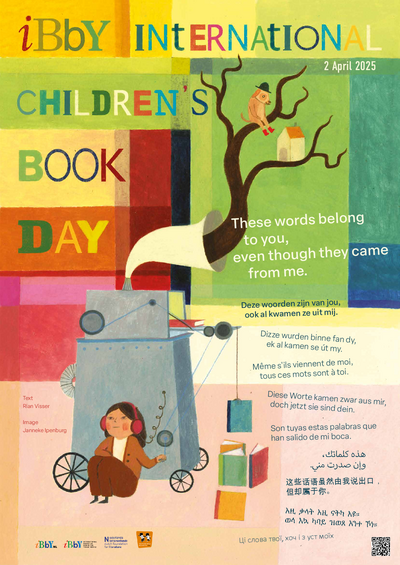
Each year a different National Section of IBBY has the opportunity to be the international sponsor of ICBD. It decides upon a theme and invites a prominent author from the host country to write a message to the children of the world and a well-known illustrator to design a poster. The host country for this year’s ICBD is the Netherlands. The theme for 2025 is The Freedom of Imagination. This derives from the belief that good books invite readers to interpret the words for themselves, making the story their own.
The poster for the theme is designed by two Dutch creators of children’s books, and the message of the theme is highlighted with the last sentence of the poem The Language of Pictures: Make pictures for my poem, and please feel free: these words belong to you even though they came from me.
Reading about this brought back memories of a wonderful project that I was involved in, many years ago, and which was sparked by the same message.
As environmental educators at the Centre for Environment Education, my team and I had diverse opportunities to develop creative teaching-learning resources for teachers and children. Perhaps the most exciting of these was a project to develop children’s books on four different themes: Pollution, Forests, Waste, and Conservation of Natural Resources. The form, format and presentation was left for us to decide. This presented an exciting blank canvas, as well as the challenge to be creative while still retaining the educational objectives for each theme. The outcome was the decision to develop books in four very different formats: a magazine format for Pollution; a collection of folk tales from the region for Forests; a quirky mystery story for Waste. But when it came to Natural Resources we were stumped! What was a manageable way of covering the wide range and scope of the theme?
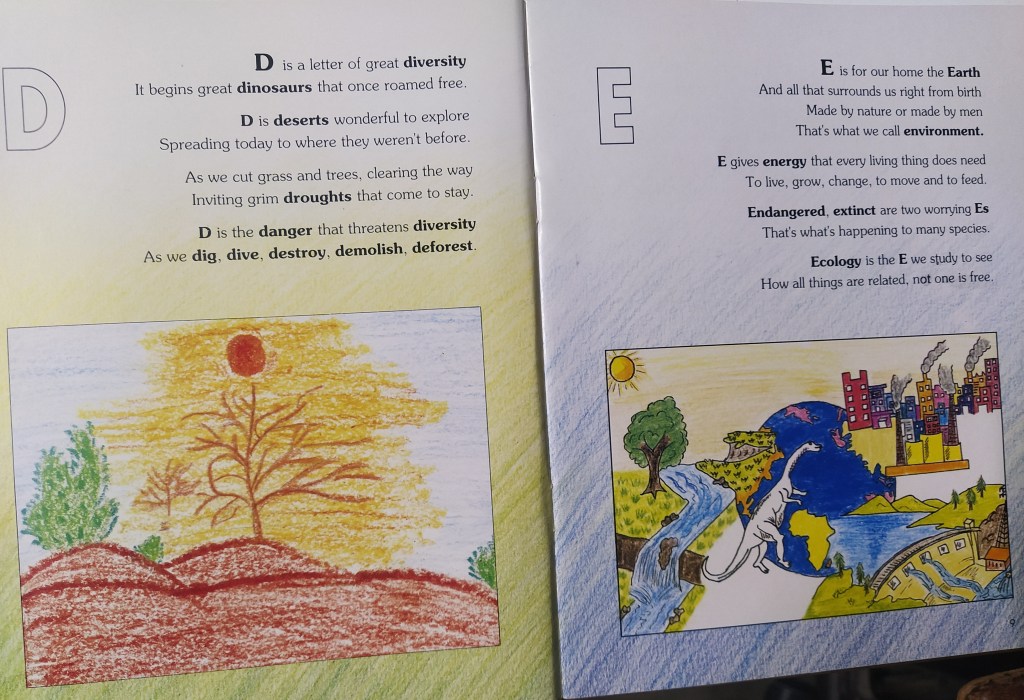
Much brainstorming later this took the form of verses through which we could take “poetic liberties” by bringing together different natural resources. To make it more fun, we decided to do this alphabetically. Hence the title ABC…Naturally. And so the R page could have a verse with the words: rivers, rainbows, reptiles, roots, rainforests, resources, recycle, reuse and reduce.
With such a motley assortment of words in place, there arose the next challenge. How would an artist illustrate these verses? As adults we are so conditioned to ‘labels’ and fixing of labels in ‘appropriate places’; this would need a huge leap of imagination. But Eureka! Children could make these leaps effortlessly. And so, we walked into a school and handed it over to more creative minds! We simply gave different children the verses, and gave them the Freedom of Imagination to interpret the words through their pictures, as they saw fit. The result was an incredibly rich and many-layered tapestry where disparate elements seamlessly fell into place. ABC…Naturally became a shared work, with every child feeling a sense of ownership and pride at being a ‘creator’. It was a true reflection of the freedom of imagination! It was also a validation of the belief that good books invite readers to interpret the words for themselves, making the story their own.
As someone who was deeply engaged in every part of this process, I am excited that the IBBY is celebrating International Children’s Book Day this year by providing a similar opportunity to
children across the world. IBBY Netherlands has launched an International Illustration Competition to encourage children worldwide to use and express their imagination and creativity by creating works of art inspired by the theme The Freedom of Imagination and the associated motto: “Make pictures for my poem, and please feel free: these words belong to you, even though they came from me.”
Details are available on https://www.ibby.org/fileadmin/user_upload/icbd/icbd_2025/ICBD_2025_international_illustration_competition_-_regulations.pdf
–Mamata

 Millennial Matriarchs