
It has dominated the news for the last month or more. It has broken records. The numbers are counted not in thousands, but in crores. It is the headline-making event of a century and a half…It is the Mahakumbh Mela.
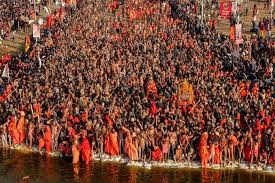
The many records being broken may also include the media coverage which breathlessly recounts every VIP visit and holy dip that has become a “must do must show” part of every itinerary.
Over a hundred years ago, another newsmaker also visited the Kumbh. And as was his wont, wrote about the experience in his own words. This was Mohandas Karamchand Gandhi.
Gandhi had returned to India in January 1915 after spending almost a quarter century in South Africa. After spending a few days in Mumbai, he proceeded to Pune to meet Gopal Krishna Gokhale who he considered as his mentor. Gokhale advised that if Gandhi were to plan to remain in India and work for the people of this country, he first needed to acquaint himself better, first hand, with the country and its people. It was decided that this orientation would be through a journey across India by train, travelling by third class, as the common people did. Gandhi did indeed embark upon such a journey after a short visit to Calcutta, Shantiniketan and Burma.
In his own words: I, having been out of India for so long, have no business to form any definite conclusions on matters essentially Indian, and that I should pass some time here as an observer and a student. This I have promised to do, and I hope to carry out my promise.
Early in these travels Gandhi visited the Kumbh Mela at Haridwar. He recounts his experiences and impressions in his autobiography. Some excerpts:
This year – 1915 – was the year of the Kumbha fair, which is held at Hardvar once every 12 years. I was by no means eager to attend the fair, but I was anxious to meet Mahatma Munshiramji who was in his Gurukul. Gokhale’s Society had sent a big volunteer corps for service at the Kumbha. Pandit Hridayanath Kunzru was at the head, and the late Dr. Dev was the medical officer. I was invited to send the Phoenix party to assist them, and so Maganlal Gandhi had already preceded me. On my return from Rangoon, I joined the band.
Our stay in Shantiniketan had taught us that the scavenger’s work would be our special function in India. Now for the volunteers in Hardvar tents had been pitched in a dharmashala, and Dr. Dev had dug some pits to be used as latrines. He had to depend on paid scavengers for looking after these. Here was work for the Phoenix party. We offered to cover up the excreta with earth and to see to their disposal, and Dr. Dev gladly accepted our offer. The offer was naturally made by me, but it was Maganlal Gandhi who had to execute it. My business was mostly to keep sitting in the tent giving darshan and holding religious and other discussions with numerous pilgrims who called on me. This left me not a minute which I could call my own. I was followed even to the bathing ghat by these darshan-seekers, nor did they leave me alone whilst I was having my meals. Thus it was in Hardvar that I realized what a deep impression my humble services in South Africa had made throughout the whole of India.
But this was no enviable position to be in. I felt as though I was between the devil and the deep sea. Where no one recognized me, I had to put up with the hardships that fall to the lot of the millions in this land, e.g., in railway travelling. Where I was surrounded by people who had heard of me I was the victim of their craze for darshan. Which of the two conditions was more pitiable, I have often been at a loss to determine. This at least I know that the darshanvalas’ blind love has often made me angry, and more often sore at heart. Whereas travelling, though often trying, has been uplifting and has hardly ever roused me to anger.
I was in those days strong enough to roam about a lot, and was fortunately not so known as not to be able to go in the streets without creating much fuss. During these roamings I came to observe more of the pilgrims’ absent mindedness, hypocrisy and slovenliness, than of their piety. The swarm of sadhus, who had descended there, seemed to have been born to enjoy the good things of life.
The day of the fair was now upon us. It proved a red letter day for me. I had not gone to Hardvar with the sentiments of a pilgrim. I have never thought of frequenting places of pilgrimage in search of piety. But the seventeen lakhs of men that were reported to be there could not all be hypocrites or mere sight-seers. I had no doubt that countless people amongst them had gone there to earn merit and for self-purification. It is difficult, if not impossible, to say to what extent this kind of faith uplifts the soul.
I therefore passed the whole night immersed in deep thought. There were those pious souls in the midst of the hypocrisy that surrounded them. They would be free of guilt before their Maker. If the visit to Hardvar was in itself a sin, I must publicly protest against it, and leave Hardvar on the day of Kumbha. If the pilgrimage to Hardvar and to the Kumbha fair was not sinful, I must impose some act of self-denial on myself in atonement for the iniquity prevailing there and purify myself. This was quite natural for me. My life is based on disciplinary resolutions.
So I pledged myself never whilst in India to take more than five articles in twenty-four hours, and never to eat after dark. I gave the fullest thought to the difficulties I might have to face. But I wanted to leave no loophole. I rehearsed to myself what would happen during an illness, if I counted medicine among the five articles, and made no exception in favour of special articles of diet. I finally decided that there should be no exception on any account whatsoever.
But the Hardvar experiences proved for me to be of inestimable value. They helped me in no small way to decide where I was to live and what I was to do.
Just over a century later, how much has changed, and yet, how much remains the same? Food for thought!
–Mamata

 Millennial Matriarchs