
This week the Indian nation will stand proudly as we salute our national flag and celebrate the 76th Republic Day, and the air reverberates with the chorus of Jana Gana Mana. This is the refrain of the national anthem that unites every citizen of the country.
From the time children are in school, the anthem, played and sung on important national days, becomes deeply engrained, often learned by sheer repetition, without really going into what the words mean, and how they came to be conferred the status of a national anthem.
While Jana Gana Mana was declared as the National Anthem of free India on 24 January 1950, its history goes way back. The hymn was originally composed in Bengali, by Rabindranath Tagore, India’s first Nobel laureate, on 11 December 1911. Titled Bharoto Bhagyo Bidhata, it consisted of five stanzas. It was first published in a journal called Tatwabodhini Patrika in 1912 under the title Bharat Bidhata. However, it was first sung on Day 2 of the annual session of the Indian National Congress on 27 December 1911, by Saraladevi Chowdhrani along with a group of school students.
The fact that the date of the composition of the hymn coincided with the eve of the coronation of King George V led to rumours that the song was written to honour the British king. This was mainly due to misreporting in the press that confused this song with another song in Hindi Badshah Hamara, which was sung on the same occasion and, in fact, was in praise of the monarch.
Years later, Tagore himself clarified in a letter dated 10 November 1937, that this was never the case; the song was a tribute to the greatness of India. In his own words (originally in Bengali): A certain high official in His Majesty’s service, who was also my friend, had requested that I write a song of felicitation towards the Emperor. The request simply amazed me. It caused a great stir in my heart.
In response to that great mental turmoil, I pronounced the victory in Jana Gana Mana of that Bhagyo Bidhata [ed. God of Destiny] of India who has from age after age held steadfast the reins of India’s chariot through rise and fall, through the straight path and the curved. That Lord of Destiny, that Reader of the Collective Mind of India, that Perennial Guide, could never be George V, George VI, or any other George.
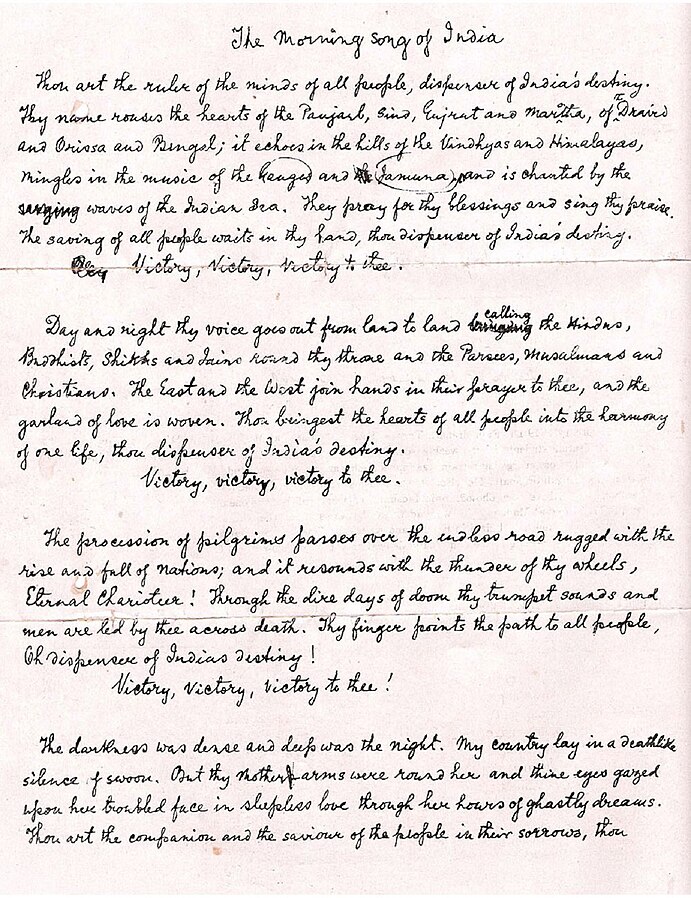
For the next few years the song continued to be sung on different occasions, but with many regional variations. It still did not have a uniform tune. In February 1919, while on a tour of South India, Tagore took a break to rest at the Theosophical College in Madanapalle, in Andhra Pradesh. Started by Dr Annie Besant, the college was headed by educationist and poet James Cousins. James and his wife, Margaret Cousins who was Vice Principal, used to have informal singing sessions with the college community, every Wednesday night. Tagore also joined the session and asked if he could sing one of his poems in Bengali. This was the first time Tagore himself sang his poem. Margaret Cousins was enthralled, especially with the refrain, Jaya hai, Jaya hai, Jaya hai, Jaya Jaya Jaya Jaya hai. She requested Tagore for an English translation, which Tagore did, on the same day, 2 February 1919, while still at the college. He titled it The Morning Song of India. The translated version of the first stanza read: “Thou art the ruler of the minds of all people, dispenser of India’s destiny. Thy name rouses the hearts of the Punjab, Sindh, Gujarat and Maratha, of the Dravida, Orissa and Bengal. It echoes in the hills of the Vindhyas and Himalayas, mingles in the music of the Yamuna and Ganges and is chanted by the waves of the Indian Ocean. They pray for thy blessings and sing thy praise. The saving of all people waits in thy hand, thou dispenser of India’s destiny. Victory, Victory, Victory to thee.’
Margaret Cousins was very taken by the words. Herself a trained musician, she set down the musical notations, and rendered the song with musical instruments, sung by the students. Tagore appreciated the melody, and the efforts in composing it. The college adopted the English version as their prayer song which is sung even today. And from then on, the musical form of the Bengali song also became the tune that we are familiar with today.
While India was still in the struggle for Independence from British rule, Netaji Subhashchandra Bose, who was in Germany, at the founding meeting of the German-Indian Society selected Jana Gana Mana to be played as the national anthem of independent India. It was performed (not sung) by the Hamburg Radio Symphony Orchestra on 11 September 1942.
On the midnight of August 14, 1947, India the Indian Constituent Assembly assembled for the first time as a sovereign body. The session ended with a performance of Jana Gana Mana. The members of the Indian Delegation to the General Assembly of the United Nations held at New York in 1947 gave a recording of Jana Gana Mana as the country’s national anthem. The song was played by the house orchestra in front of a gathering consisting of representatives from all over the world.
The first stanza of Jana Gana Mana was officially adopted as India’s National Anthem by the Constituent Assembly of India on January 24, 1950. The formal rendition of the anthem takes approximately 52 seconds to complete.
There is a protocol to be followed in the performance of the anthem as laid down by the Government of India which includes instructions on the correct versions of the anthem; the occasions on which it can be sung or played; the need for paying respect to the anthem by observing proper decorum on such occasion. It is mandated by the Supreme Court of India that all must stand up with properrespect when the National Anthem is being rendered.
This Republic Day, as we stand and honour the anthem, let us also bow in respect to the rich history that has enabled us to stand as proud citizens of a proud nation today.
–Mamata

 Millennial Matriarchs