
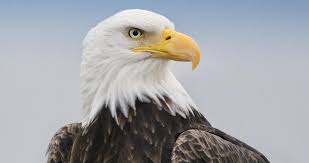
A news item that President Joe Biden had signed a bill on Christmas Eve 2024 that designated the bald eagle as the national bird of the USA was confusing, to say the least. One had always assumed that this had always been so, given that it was seen on all official US documents, and indeed even the US passport. It turns out that while the bald eagle has been the national symbol since it appeared on a copper cent in 1776, and has been appearing on the Great Seal of the US since 1782, the bird had never been legally recognized as the national bird till 24 December 2024.
Behind this lies an old story. On 4 July 1776, the Declaration of Independence was signed whereby the 13 American colonies severed their political connections to Great Britain. Following this it was decided that the new nation should have an official seal. It took three committees and six years before the seal was finalized on20 June 1782. The seal denoted a bald eagle grasping an olive branch and arrows in its talons. The significance of this is explained thus: ”The olive branch and the arrows held in the eagle’s talons denote the power of peace and war. The eagle always casts its gaze toward the olive branch signifying that our nation desires to pursue peace, but stands ready to defend itself”.
The bald eagle lives only in North America and to the people of the newly-born republic this bird was a symbol of courage, strength and freedom. It soon became a cultural and political symbol appearing on official documents, US currency, military insignia, and popular merchandise. Thus the bird remained a national emblem in the US for nearly 250 years, but it had not been officially designated to be the national bird until Congress passed the bill.
Many countries have a national bird. These are usually representative, in one way or another, of the country that they are the designated symbol of. The designation is done in different ways. The approaches range from the official, semi-official or unofficial, ranging from government decrees to popular vote. The choice is usually from among birds that have a high recognition factor.
Some countries in Central and South America have selected flamboyant birds as their national symbols, while some have selected bird species that are unique to their country. Among these are Gautemala’s Resplendent Quetzal and Papua New Guinea’s Raggiana Bird-of-paradise, which are spectacularly colourful. A beautifully matched choice is that of the Cuban Trogon or Tocororo whose colours exactly match the colours of Cuba’s flag. These birds cannot survive in captivity, and thus symbolizes the people’s love of freedom.
Some countries have selected threatened species in the hope to promote their conservation measures, like Bermuda’s Cahow or Bermuda Petrel (endangered) and Cambodia’s Giant Ibis (critically endangered). While Dodo is the unofficial mascot of Mauritius, seen as a symbol everywhere, it is sadly extinct. Thus the country has officially adopted the Mauritius Kestrel as its national bird. This is a rare bird of prey, endemic to the island and its recovery from near extinction (only four known individuals in the wild in 1974) to over 350 kestrels today, is a successful conservation story.
Some Arab states have also designated other species of falcons as national birds. These birds represent grace, elegance, ability and alertness, and are considered a symbol of bravery. A variety of eagles have been a favoured choice of several countries for these very attributes. These include golden eagle (national bird of Albania, Mexico, Kazakhstan, Scotland, Serbia, and Germany), African fish eagle (Namibia, Zambia, Zimbabwe), harpy eagle (Panama), Javan hawk-eagle (Indonesia), Philippine eagle (Philippines), and the white-tailed eagle (Poland).
The raptor with the largest wing span in the world, the Andean condor of South America has been designated the national bird by several countries in that continent for its different qualities–Bolivia (for boundary-less pursuit), Chile (for strength), Colombia (for liberty and order), and Ecuador (for power, grandeur, and valour).
Whereas Japan could have adopted the Red-crowned crane as its national bird because of its scientific name Grus japonensis, it has chosen the kiji or Green pheasant. This bird is said to be particularly sensitive to earthquakes, to which Japan is prone. It is also features in many literary works.
Curiously, Grus japonensis was selected to be the national bird of China through an internet survey which was launched by the Chinese Wildlife Animals Protection Association and about 20 news organizations in 2004. The Red-crowned crane was the choice of about 1.3 million Chinese netizens to be the national bird.
Britain was pretty late in the naming of its national bird. In 2015 there was an online poll of over 200,000 people in Britain to vote for a national bird in response to a campaign started by ornithologist David Lindo. From an original list of 60 birds, online voters arrived at a shortlist of 10 birds. The Robin won first place with 34% of the vote, followed by the barn owl and blackbird.
Another popular vote led to the change in Denmark’s national bird. Till 1984, the Skylark was the national bird, but a poll held by a TV show indicated that the more popular choice was the mute swan. The mute swan’s Danish name (Knopsvanen, literally meaning ‘the knob swan’) refers to the black knob it has over its orange beak. This selection was not based on natural history criteria but rather the association of the bird with Hans Christian Anderson’s famous fairy tale about the ugly duckling that grew into a swan.
Thus there are many reasons and many avenues that make a national bird. Closer to home, there is an interesting tale. In the 1960s the Government of India was encouraged by international bird conservation organisations to select a national bird. It was suggested that this could be a bird species that was in immediate need of protection, and thus attention. The most obvious choice at the time was the Great Indian Bustard that was already endangered then, with less than 1300 individuals in the wild. The famous ornithologist Salim Ali emphasised that this spectacular bird required “an urgent, nation-wide effort” to save it from its impending doom. As the story goes, in this respect, the Bustard was a logical choice. But there was a concern that its name could easily be misspelt or mispronounced, leading to much embarrassment! Whether this is just jest or a fact, it was the peacock which made the title in 1963, not because of its conservation status, but because of its cultural significance, religious and legendary associations, beauty, and widespread distribution in the country.
–Mamata

 Millennial Matriarchs