
This week the focus revolves around the numerous facets of Christmas–from festive decorations, to feasts and family gatherings. An appropriate week to share something that does not really share much in common with these facets except for its name. That is Christmas Island; so named because it was first discovered on Christmas day.
The island however may have been there millennia before its formal discovery and christening. A small speck in the Indian Ocean, Christmas Island is the peak of a steep basalt volcanic seamount that rose 5000 metres from the ocean floor about 60 million years ago. Located in the Indian Ocean 2600 km northwest of Perth in Australia and 350 km off Indonesia, this island is today a part of Australian territory. However it has a chequered history of human settlement.
For centuries the small island’s isolated location and its rugged coasts provided a natural barrier to human intrusion. Its sighting was recorded in the charts of British and Dutch navigators in the early seventeenth century. But it was named by Captain William Mynors of the Royal Mary a vessel of the East India Ship Company when his ship approached the island on 25 December 1643; but he was unable to land on the island. The first recorded landing on the island is believed to be by the English ship Cygnet under Captain Swan in 1688.
It was in the 19th century that several explorers visited Christmas Island. Some of these were naturalists who collected plant and animal species from the island which was rich in biodiversity. It was in 1887 during one of these collecting expeditions that the crew of a ship called HMS Egeria also discovered that the island had rich resources of phosphate which was a valuable fertilizer. This led the British to annex the island in 1888. Human settlement of Christmas Island began in 1888, when George Clunies-Ross, the owner of the Cocos Islands, sent his brother Andrew and a small party of Cocos Malay workers to form a settlement at Flying Fish Cove. He did this to pre-empt any other claim to the island’s phosphate resources.
The British leased the island to John Murray, a naturalist who had first predicted the presence of phosphates and George Clunies-Ross who initiated the first settlement on the island. Together the two set up the Christmas Island Phosphate Company which started mining and exporting phosphate from the island from 1900. The operation needed a large labour force for which they brought in Chinese, Malays and Sikhs as indentured migrant labourers. These were the early settlers who, over time, grew into a multicultural community. However at that time these workers lived in appalling conditions, and in the early years, hundreds of them died from beri-beri caused by malnutrition. But conditions gradually improved and the island’s phosphate industry continued to flourish in the period till the First World War, with Japan as the biggest customer.
During the Second World War, the island was targeted by the Japanese who wanted to capture the phosphate deposits. In 1942 Japanese troops took over the island and the phosphate mining provided rich fertilizer for the Japanese Empire. The island was an arena for several acts of war between the Allied and the Japanese forces until 1945 when Japan surrendered. The island was re-occupied by the British in October 1945.
The Australian and New Zealand governments purchased the Christmas Island Phosphate Company in 1949, and administrative responsibility for the island shifted from the UK to the British colony of Singapore. When Britain was giving up many of its colonies after World War II Australia expressed an interest in acquiring Christmas Island. In 1958, sovereignty of the island was transferred to Australia. As part of the transfer, Australia paid Singapore £2,800,000 as compensation for lost phosphate revenue. Christmas Island became an Australian Territory on 1 October 1958. This day is celebrated on the island as Territory Day.
The centuries of mining and exploitation for phosphate had left huge scars on this island which with its unique geology supported rare species of endemic plants and animals not found anywhere else. Many of the flora and fauna unique to this ecosystem had reached the point of being endangered. In the 1970s it was realized that this exploitation could have a serious impact on the Abbot’s booby a bird that nests only on Christmas Island. In 1974 a committee recommended that conservation of such endangered species was critical. This resulted, in 1980, in the creation of a national park on the south-western part of the island. This was further expanded in 1986 and 1989 to create the Christmas Island National Park. Today the park extends over 64% of the island’s land area as well as extending 50 metres offshore. The area protects rainforests, wetlands, freshwater mangroves, sea cliffs and coral reefs, each harbouring a rich diversity of life.
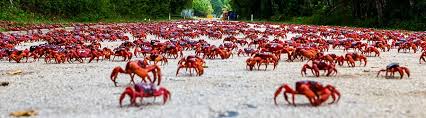
Perhaps the most significant of this is the great variety of crabs that have earned it the sobriquet as the kingdom of crabs. Among these crustaceans is the enormous robber crab, and the red crabs whose annual migration from the rainforest to the ocean in an unforgettable spectacle. Every year, millions of red crabs move from Christmas Island’s interior rainforests to the ocean to breed and lay eggs. A single female can lay up to 100,000 eggs. Red crabs must keep their bodies moist, so they wait for the rainy season to provide conditions that are ideal for the difficult journey. During migration, red crabs climb over and around obstacles in their way, following the same migration paths every year.
The island’s 80 km coastline is an almost continuous sea cliff rising up to 20 metres in height. In a few places the cliff descends to shallow bays with sand and coral shingle beaches. The island is surrounded by a narrow circling reef teeming with swarms of tropical fish species. Dolphin, whale sharks, turtles and manta rays are easy to spot. Today Christmas Island has become a naturalist’s paradise. Often described as the Galapagos of the Indian Ocean, Christmas Island has replaced phosphate mining with ecotourism. A heartening case of exploitation transformed into caring conservation.
–Mamata

 Millennial Matriarchs