
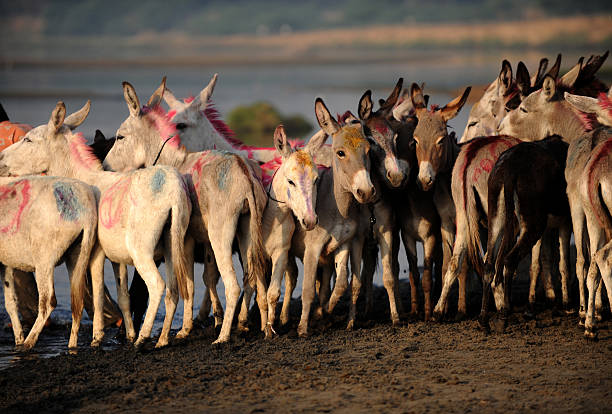
For an animal that is usually the brunt of jokes, or the joker on the animal pack, this is the one occasion when the donkey is in the limelight. The Donkey Fair revolves around donkeys, and marks an important event in the local calendar of Gujarat. Held annually at Vautha, the fair goes back hundreds of years, and even today attracts large crowds.
The event occurs on the full-moon night of the lunar month of Kartik (October-November), which begins after Diwali. Kartik Purnima is considered as an auspicious day and is celebrated by different communities in India in different ways. A common ritual is taking a holy bath in a river. As per Hindu mythology, it is believed that this is the day on which Hindu Gods came down to earth to take a dip in a river, and even today, those who take holy dips in rivers receive the blessings of all gods, and their sins are washed away.
One such site is at Vautha in Gujarat, located near Dholka, about 50 km from Ahmedabad. Vautha is located at the confluence of the rivers Sabarmati and Vatrak. The confluence is also called sapta sangam, which means the meeting of seven rivers. It is at Vautha that the Vatrak river merges with the smaller rivers Meshwo, Hathmati, Shedhi, Majum and Khari with the Vautha, which in turn merges with the Sabarmati.
The history of the fair goes back almost five hundred years. There are many local legends associated with it. One legend attributes the fair’s origins to the time when the sage Vashishta is believed to have performed a yagna at the confluence of the rivers. Another one claims that Vautha is one of the sites that the Pandavas stopped by at during their exile.
Legend also has it that Kartikeya or Kartik, the son of Lord Shiva and the Goddess Parvati visited this site on this full moon night. To mark this, an annual fair dedicated to Kartikeya is held on Kartik Purnima. Thousands of pilgrims from all castes and communities and professions throng here for a holy dip, and the festive atmosphere is highlighted by a fair.
The fair is a vibrant event with numerous stalls selling local food, handicrafts, and lots of other attractive ware. It is enlivened by music and local theatre performances and folk dances. There are rides and varied exciting activities. This is a major social and cultural event that villagers from far and near look forward to all year.
What makes this fair unique is that this is the major animal trading fair in Gujarat where the main animals traded are donkeys, although there is also some trade in camels, horses and goats. It is believed that this is an auspicious time for buying and selling animals.
Farmers and traders from all over India bring donkeys to the fair. The animals are painted with coloured patterns and make for an attractive sight. However the buying and selling is serious business. Donkeys are closely examined to verify breed, build, fitness and health. Scrutiny of the teeth is an important part of the process. There is usually an auction to boost to competition and the prices which can range from 7,000 to 17,000 rupees or more.
Several different breeds of donkeys make their way to this auction. Each has its own characteristics and uses. Halari donkeys from Saurashtra are white in colour and of docile temperament. They are used as pack animal during pastoralist migration, being able to walk 30-40 km a day; and also to pull carts. Kuchchhi donkeys from Kuchchh are grey, white, brown or black in colour. They are sturdy and can carry 80-100 kg and pull 200-300 kg on carts. They are used as pack animals during migration, and also for weed removal on farms. Sindhi donkeys from Barmer and Jaisalmer districts of Rajasthan are brown in colour can carry 1000-1500 kg and are used as pack animals to transport water, soil, earthenware, construction material, and fodder; as well as for pulling carts and for ploughing by small and marginal farmers. There are also donkeys from Marwad as well as other local breeds from other parts of India.
While thousands of donkeys continue to be brought and traded at this largest donkey fair, studies indicate that there is a steady decline in the donkey population in India. Increasing mechanization has replaced the need for donkeys for transporting material and as pack animals. This is also a factor for replacing donkeys in farm work. Traditional donkey-raising and herding families are moving to new occupations as demand for donkeys is going down, and the cost of maintaining the animals rises. There are also no specific government schemes or policies that promote the animal or its welfare. Donkeys are being abandoned when they are too old or feeble for hard labour. Even in Ladakh which has a tradition of donkey rearing, there is a decreasing role for donkeys in local occupations and uses. A donkey conservation park has been opened here in collaboration with communities where stray or abandoned donkeys are kept with dignity.
In the meanwhile the donkeys still have their day at Vautha. And this year it falls on 15 November.
–Mamata

 Millennial Matriarchs