
It is arguably the least-known cat-species of India. Its popular vernacular name based on the Persian words is syah (black)and gosh (ear). This is the caracal—the black-eared one. Caracals inhabit dry, arid regions and moist woodlands, living in small herds. They mark territory by clawing trees and releasing scent from glands on their faces and between their toes. They communicate with meows, hisses and spits.
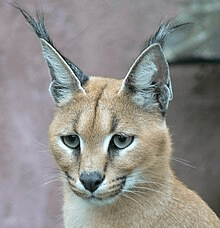
A medium-sized cat (about the size of a jackal) with fur in varying shades from reddish-fawn to dull sandy, the caracal is distinguished by its ears. The ears are longer than in most felines and are pointed at the tips that end in an erect tuft of hair. The ears have almost 20 different muscles that control independently the motion of each ear and aid in their wide range of movements, which they use for a variety of communication. The ear tufts act as sensitive antennae, with the ability to detect even minute vibrations.
Strongly muscled with tall rear limbs the caracal is the athlete of the cat world. It can run at a top speed of 80 km an hour and can change direction in mid-air. It can launch its whole body as high as 10 feet above the ground in one jump, and can even catch birds in flight. This litheness enables it to be an effective predator; its diet includes rodents, rabbits and birds, it is known to subdue prey much larger than itself.
It is this ability that that made the caracal a favoured hunting or coursing animal in medieval India. The caracal was a favourite pet among royalty, dating back to the time of the Mughal emperors and on to the Maharajas in the British times. Caracals were tamed and trained to hunt game, especially birds. They used to be transported to hunting grounds hooded and leashed on a bullock cart, from where they were set after prey. Using its speed and agility, the cat would swiftly bring down large game birds like cranes, hares, antelopes and even foxes. However once it had successfully hunted the caracal would ferociously hang on to it, making it difficult to retrieve the kill.
Caracals feature commonly in literature from the Mughal through to the British rule period, indicating that they were fairly common, and considered significant. In later years these cats began to disappear from the landscape and literature. As a result the caracal remains one of the least studied species of Indian felines. Their shy and elusive nature makes them difficult to spot in the wild; they are rarer to spot than a tiger.
Conservation biologist Dharmendra Khandal who has spent many years looking for studying this elusive creature has spotted the cat only five times in twenty years compared to the hundreds of times he has seen tigers. Today he is one of the few caracal experts in India. Research on this elusive nocturnal cat is incredibly difficult because there are no captive caracals in the country.
Once found all across Central Asia and the Indo-Gangetic plains, today these cats are rarely, if ever, sighted in these parts. While the cheetah got hunted to extinction, the reasons for the vanishing of the caracal in India are not clear. While they may face a variety of threats. Increasing area under irrigated agriculture in the arid and semi –arid region that the caracal inhabits has led to habitat modification and loss. This has also affected its diet which earlier consisted largely of birds, but now includes rodents. Human intrusion due to increasing population, and increased activity such as large scale mining and setting up wind factories in the already fragile landscape has driven these cats to near extinction.
And indeed they have vanished. A 2015 study threw up the grave concern that only two populations of the cat remain in India. It estimated that only some 28 caracal individuals were believed to be in the Ranthambhore Tiger Reserve in Rajasthan, and around 20 in Kutch in Gujarat. Scientists fear that after the Asiatic cheetah, that was declared extinct in 1952, the caracal will be the second cat species to be wiped out from the country.
While the species is listed under “least concern” under the IUCN Red List globally, it has been listed as “near threatened” by the Conservation Assessment and Management Plan and IUCN Red List assessment in India. The species is included in the Schedule-I category of the Indian Wildlife (Protection) Act, 1972, offering it the highest possible protection.
Currently, three Protected Areas, namely, Ranthambore National Park and Kailadevi Wildlife Sanctuary in Rajasthan and Narayan Sarovar Wildlife Sanctuary in Kachchh, Gujarat are the only known strongholds of Caracals in India. Viable populations outside these protected areas remain either unknown or poorly monitored.
In 2021, the National Board for Wildlife and the Ministry of Environment, Forest and Climate Change announced a Species Recovery Plan for the conservation and population revival of 22 species in India, including the caracal.
A ray of hope comes in the form of the recent news that the royal family of erstwhile princely state of Kachchh has transferred the ownership of Chadva Rakhal, part of their ancestral property to the state government of Gujarat for conservation of biodiversity. The Government has transferred the 4,900-hectare woodlot to the Forest Department to support conservation efforts. The area will also include a caracal conservation breeding centre which will focus on the protection and breeding of the rare and critically endangered Caracal.
A heartening gesture indeed.
–Mamata

 Millennial Matriarchs