
Last week was devoted to calligraphy, which we are assured by practitioners, is not handwriting at all. Rather, they aver, it is an art form.
Calligraphers are few and far between. But each and every one of us is a hand-writer. Children start doodling and scribbling by the age of two, and most write the alphabet before they are four. It might be one of the most universal of skills! And an essential one too, because research suggests that writing by hand enhances learning and memory. Brain patterns established during handwriting are important for memory formation and learning new information. And of course it improves fine motor skills. So hand writing practice is pretty important even for children who are digital natives and may not use the skill very much as grown-ups.
There are 12 characteristics on which quality of handwriting is evaluated: line quality, spacing, size consistency, pen lifts, connecting strokes, complete letters, cursive vs. print, pen pressure, slant, baselines, embellishments, and placements.
But it is a fact that the quality of penmanship has gone down with time. As we use the skill less, we get worse at it. In fact, there are times when I can’t decipher my own scribbled notes. Reports and records based on these notes are my only forays into fiction!
Which is why it is probably important to highlight and celebrate this skill.
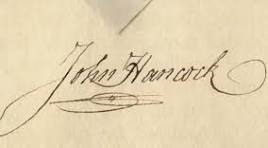
In the US, they observe National Handwriting Day on January 23rd. Why this date? Well, it is the birthday of John Hancock, the first signatory of the Declaration of Independence. Among the 56 signatures on the document, his large, flamboyant signature stood out. In fact, so prominent was it that “John Hancock” is an informal synonym for signature in the US!
The Day started to be observed in 1977, when educators were already beginning to feel that the art of handwriting was getting lost. The Writing Instrument Manufacturers Association came forward to do something about this (and of course at the same time, increase sales of pens, pencils, paper and writing instruments). They initiated National Handwriting Day.
(Incidentally, though we use handwriting and penmanship interchangeably, they are not quite the same. Handwriting is the act of writing out full words or sentences by hand on paper. Words may be written either legibly or illegibly. Penmanship is the art or skill of having excellent writing, and good penmanship makes the process of reading written work much easier.)
Lately, something called the World Handwriting Contest has been initiated. Each year, the World Handwriting Contest opens for entries between January 1 and June 30. There are eight age categories, starting from Children below age 7, right through –Teens, Teens, Adults and Seniors (age 65 up). And it is open to anyone, anywhere.
There are two styles for which prizes are given:
Functional Handwriting which strives for legibility, speed, and fluency without aiming at artistic effect. For this category, the judges will further separate entries as cursive, which joins 50% or more of its letters or manuscript printing, which joins fewer than half of its letters; and
Artistic handwriting which uses a monoline or calligraphy marker, pen, or brush along with decorative strokes, flourishes, and/or combinations of shading, hairlines and/or thick and thin strokes to create an artistic effect.
NRI domination over the Spelling Bee contests is well accepted. People of Asian origin now seem to dominate among winners of the Handwriting competition too, with Indians and Indian-origin names finding frequent mention (with stiff competition from Bangladesh!). Among Indians, Salil Jha of Bhopal has won a prize (above 65 category). Roslin Richard of Bangalore is first place winner in the Adult Category; Feba Sara Saji of Kerala is a winner in the Teens category. Keep it up people! May the moving finger keep writing beautifully!
–Meena

 Millennial Matriarchs